Patent numbers such as US2025/0112325A1, US11378527B2 and WO2026045268A1 appear in battery news articles, press releases and this site’s own patent analyses. If you can read the kind code at the end of the number (A1, B2 and so on; the letters and digits that indicate the publication stage a document comes from), you can tell for yourself whether the document is a published application or a patent that has already become a right, and gain a starting point for checking how long a right remains in force. This guide explains how to read patent numbers, the difference between published applications and granted patents, and how patent terms are calculated, using official sources, and shows with real numbers why closing a freedom-to-operate (FTO; the judgment of whether a product can be made and sold without infringing someone else’s patent) analysis on published claims alone is risky.
① What’s the Topic
The kind code at the end of a patent number is the marker that tells you whether the document is a “published application” or a “granted patent.” The claims of a published document ending in an A-series code are not yet a right and may change during examination, so “secured a patent” and “filed or published a patent application” must be read as two different statements.
Start with the situation in the industry: even among the patents this site has analyzed, the types are mixed. Samsung SDI’s battery housing cover document is a US published application (A1), Vieworks’ cell inspection apparatus is a US granted patent (B2), and CATL’s positive electrode document for solid-state cells is a PCT international application (WO) [19][21][22]. This is where the tension arises. All three are commonly called “patents,” yet their legal effect, the stability of their claims and the meaning of their expiry dates differ, and the legal status shown by the portal carries the caveat that it is “an assumption and is not a legal conclusion” [19]. So the question this article answers is this: when you are handed a single number, how do you determine whether it is a right, an application, or still alive, and how far can you trust published claims?
② Basic Principle — Blueprints on Public Display (A) vs. a Registered Building (B)
Break down US11378527B2 and you get US (country/office code) + 11378527 (document number) + B2 (kind code). The framework for kind codes comes from WIPO (World Intellectual Property Organization) Recommended Standard ST.16. The letter A denotes the first publication level, B the second and C the third, while utility models (a separate system protecting comparatively minor inventions) use U, Y and Z [2]. Because each patent office defines the meaning of digits 1 to 7 after the letter according to its needs, ST.16 states that the numerical code must be interpreted together with the country code and the letter code [2].
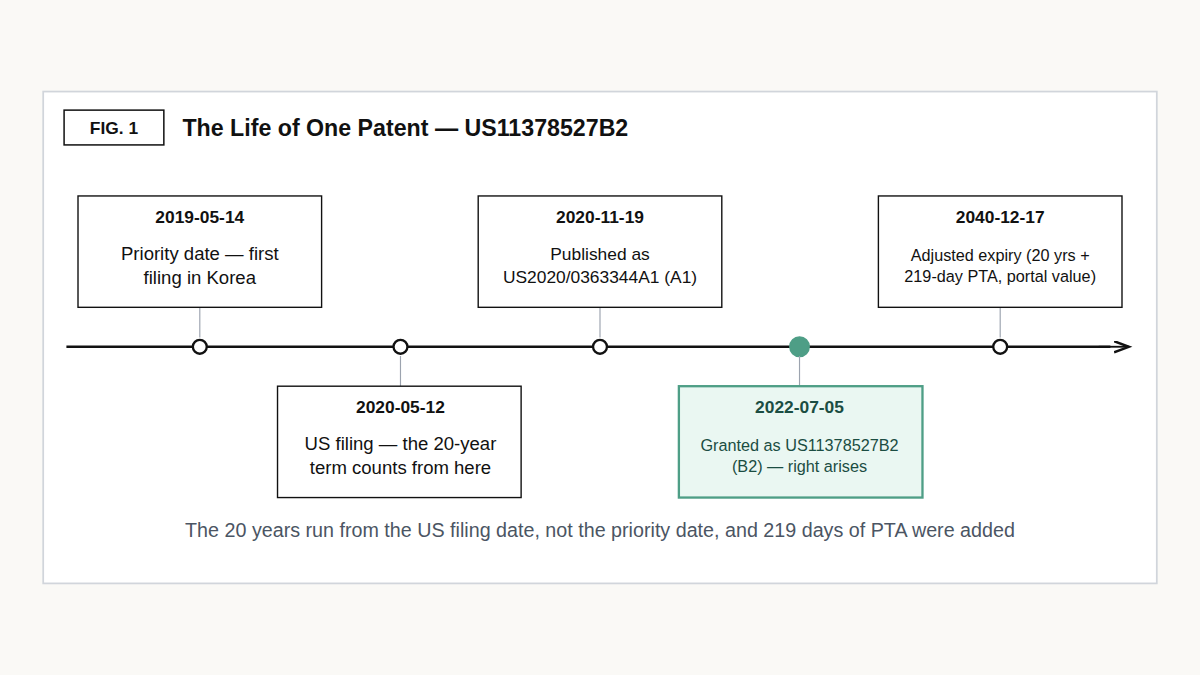
Source: reconstructed by the editorial team from Google Patents bibliographic data for US11378527B2 (accessed 2026-09-25) and the USPTO patent front page (219-day PTA)
The life of an invention is easiest to grasp through a building analogy. Publication of an application is like putting the blueprints of a building under construction on public display, and grant is like entering the finished building in the land register. Blueprints on display can still be revised during the permit process, and ownership can be asserted only after registration is complete. The actual procedure runs in the following order.
- Priority date: the date of the first filing. Under the Paris Convention, a person who has filed a patent application in one country of the Union can claim a right of priority based on that first filing when filing in other countries of the Union within 12 months [8].
- Publication: Korea publishes the application in the patent gazette after 1 year and 6 months from the priority date (or the filing date if no priority is claimed) (Korean Patent Act Article 64(1)) [9]. The United States, as a rule, publishes promptly after 18 months from the earliest filing date, but an applicant who certifies that the invention has not been and will not be the subject of a foreign application requiring 18-month publication can request non-publication (35 U.S.C. §122(b)) [10]. The European Patent Office also publishes at 18 months as a rule (European Patent Convention (EPC) Article 93) [16].
- Grant: in Korea, a patent right arises upon registration of its establishment (Article 87(1)) [9]. From this point it is a “right.”
- Expiry: in Korea, the term runs from the date of registration until the date 20 years after the filing date of the patent application (Article 88(1)) [9]. In the United States, it runs from the date of issue until 20 years after the US filing date, and foreign priority and the like are not taken into account in determining the term (§154(a)(2) and (3)) [11].
Apply this to Vieworks’ US11378527B2 and the structure becomes clear. The sequence is: first filing in Korea (priority date) 2019-05-14, US filing 2020-05-12, publication (US2020/0363344A1) 2020-11-19, and grant 2022-07-05 [14][19]. The front page of the patent states that its term is adjusted by 219 days under 35 U.S.C. §154(b) [14], and Google Patents displays an adjusted expiration of 2040-12-17 [19]. Adding 20 years and 219 days to the US filing date of 2020-05-12 gives exactly this date. Beginners easily miss that the 20-year clock starts not from the priority date but from the US filing date. What an expiry actually opens up is covered separately in our analysis of the expiry of the foundational pre-lithiation patent.
In this analogy, a PCT international application (Patent Cooperation Treaty; a treaty procedure that prepares entry into many countries through a single filing) is not a building but closer to “reserving construction permits for several countries at a single counter.” The International Bureau of WIPO publishes the international application after 18 months from the priority date (PCT Article 21(2)(a)) [4], and the applicant must, as a rule, furnish any required translation and pay fees to each country within 30 months from the priority date to enter the national phase (the separate examination procedure before each national office) (Article 22(1)) [5]. WIPO likewise explains that the granting of patents remains under the control of the national or regional patent offices in the national phase [7].
③ Comparison — Same Letter, Different Meaning
The table below organizes the publication codes and grant codes of six major offices according to the official listings, and adds as real examples the document numbers, by country, that stem from the same Korean application (10-2019-0056389) [3][23]. The United States uses an annual numbering series for published applications and a separate numbering series for granted patents, while China’s B documents keep the number of the corresponding A document [3].
| Country/office code | Publication (application-stage) code | Grant (right) code | Real number example (publication → grant) |
|---|---|---|---|
| US (United States) | A1: patent application publication [1] | B1: granted with no prior publication / B2: granted after prior publication [1] | US2020/0363344A1 [20] → US11378527B2 [19] |
| KR (Korea) | A: unexamined patent gazette (published before examination) [3] | B1, B2: patent specification (published after examination) [3] | KR20200131589A [24] → KR102190447B1 [23] |
| JP (Japan) | A: published unexamined patent application (before examination; includes PCT-based publications) [3] | B1: issued without prior A publication / B2: issued after A publication [3] | JP2020188004A [26] → JP7000496B2 [25] |
| CN (China) | A: invention patent application publication (before examination) [3] | B: invention patent (keeps the A number) / U: utility model patent (first publication level) [3] | CN111948233A [28] → CN111948233B [27] |
| EP (European Patent Office) | A1: published with search report / A2: published without search report [3] | B1: European patent specification / B2: new specification maintained as amended after opposition [3][17] | EP4531180A1 (Samsung SDI) [29] |
| WO (PCT international application) | A1: published with international search report / A2: published without it / A3: search report published later [3] | None — all WO codes in the WIPO listing are A-series [3] | WO2026045268A1 (CATL) [22] |
Source: reconstructed by the editorial team from the USPTO kind code guide, WIPO Handbook Part 7.3.2 (November 2022 edition), EPC Article 103, and Google Patents bibliographic data (accessed 2026-09-25)
What this table shows: at all six offices the application-stage publication is A-series, but B2 means “granted after publication” in the US and Japan and “a new specification amended after opposition” in Europe, so the same letter points to different facts. Among the four national documents from the same family, the US, Korea and Japan changed the number itself at grant, while only China kept the number and changed just the final letter from A to B.
④ Patent Perspective — Don’t Close an FTO on Published Claims
The basics of reading claims (the part of a patent that states in sentences the scope of protection sought) are covered in how to read claim structure. What matters here is “claims as of when.” Claims in a published document are the scope the applicant is asking for; granted claims are the scope that passed examination. The Korean Patent Act allows the specification to be amended (amendment; the procedure for revising claims and other parts) until a certified copy of the decision to grant is served, but not beyond what was stated in the original specification, and from a certain stage after a notice of grounds for rejection it limits claim amendments to, among others, reducing the scope by restricting or deleting claims (Article 47(1)-(3)) [9]. In other words, published claims may narrow, or may be revised in another direction within the scope of the specification.
Placing three documents side by side shows that the kind code is the first clue to status. Only the granted patent in the middle is a right; Samsung SDI’s published venting-cover application on the left and the WO document on the right are still at the application stage.
| Item | US2025/0112325A1 | US11378527B2 | WO2026045268A1 |
|---|---|---|---|
| Applicant (as displayed by portal) | Samsung SDI [21] | Vieworks [19] | CATL [22] |
| What the kind code says | US application publication [1] | US granted patent with prior publication [1] | International application published with international search report [3] |
| Priority date (basic application) | 2023-09-28 (EP23200304.6) [21] | 2019-05-14 (KR 10-2019-0056389) [14] | 2024-08-30 (CN202411214822.X) [22] |
| Filing date | 2024-05-14 [21] | 2020-05-12 [14] | 2025-03-31 [22] |
| Publication/grant date | Published 2025-04-03 [21] | Published 2020-11-19, granted 2022-07-05 [19] | Published 2026-03-05 [22] |
| Number of claims | 9 [21] | 20 [14] | 17 [22] |
| Status shown by portal | Pending [21] | Active [19] | Pending [22] |
| Expiry-related display | None shown [21] | Adjusted expiration 2040-12-17 (219-day PTA) [14][19] | Anticipated expiration 2027-02-28 — matches priority date + 30 months [22] |
Source: reconstructed by the editorial team from Google Patents bibliographic data (accessed 2026-09-25) and the front page of USPTO patent US 11,378,527 B2
How the target moved within a single application becomes clear when the patent examined in our analysis of Vieworks’ US11378527B2 is compared with its published version. The published and granted versions of the same US application (US15/930,365) both had 20 claims [13][14], but the wording of claim 1 changed.
| Element | Published claim 1 (US2020/0363344A1, 2020-11-19) [13] | Granted claim 1 (US11378527B2, 2022-07-05) [14] | What changed |
|---|---|---|---|
| (a) Preamble | Apparatus for total inspection of battery cells by radiography | Same | None |
| (b) Main stage | Rotatable | Same | None |
| (c) Sub-stages | Sub-stages placed on the main stage | A plurality of sub-stages rotatably disposed on an upper portion of the main stage | “A plurality of” made explicit (the published text already used the plural “sub-stages”) and “rotatably” added |
| (d) Mounting stage | Composed of the main and sub-stages | Same | None |
| (e) Test object casing | Placed on each sub-stage so that test objects are stacked | Rotatably disposed on an upper portion of each sub-stage so that test objects are sequentially stacked | Two limitations added: “rotatably” and “sequentially” |
| (f) Inspection unit | Acquires radiographic images at the position to which the casing is moved | Same | None |
Source: reconstructed by the editorial team from claim 1 of USPTO publication US 2020/0363344 A1 and USPTO patent US 11,378,527 B2. This is a comparison of wording only, not a judgment of infringement or non-infringement
The number of claims stayed the same, but claim 1 narrowed. If a design had been changed to eliminate the “stacking casing” itself based only on the published version (A1), it may have avoided more than necessary as measured against granted claim 1. An A1 is a “moving target,” and the moment the final letter of the number changes to B, the very sentence you must compare against is replaced.
That does not mean the publication stage is a legal void. In Korea, after publication the applicant may warn in writing anyone who commercially practices the claimed invention, and may claim compensation equivalent to the amount reasonably obtainable for practice from the time of the warning, or of knowledge that the invention was published, until registration. However, this claim can be exercised only after registration, and it is deemed never to have arisen if, among other cases, the application is abandoned or withdrawn or a decision to reject becomes final (Article 65) [9].
US provisional rights cover a reasonable royalty from the date of publication to the date of issue, but require that the other party had actual notice of the published application, that the invention as claimed in the patent be “substantially identical” to the invention as claimed in the published application, and that the action be brought within 6 years after issue (§154(d)) [11]. Because claim changes interlock with these requirements, they may also affect compensation for the publication period.
Whether a patent is “alive” also cannot be read from the number alone. The United States has a patent term adjustment (PTA) system that compensates for, among other things, delays by the patent office (§154(b)) [11], and Korea can likewise extend the term by the period of delay if registration occurs later than the later of 4 years from the filing date or 3 years from the request for examination (Article 92-2) [9].
Conversely, if maintenance costs are not paid after grant, the right ends before 20 years. In the United States, maintenance fees are due at 3 years 6 months, 7 years 6 months and 11 years 6 months after grant, and the patent expires if they remain unpaid through the 6-month grace period (§41(b)) [12]; in Korea, patent fees must be paid every year, and if they are not paid even within the 6-month additional payment period, the patent right is deemed to have lapsed retroactively (Articles 79 and 81) [9]. Google Patents itself states that its status display is an assumption, not a legal conclusion [19].
This caveat matters most for WO documents. WO2026045268A1, discussed in our comparison of CATL and Rivian interface-coating patents, is displayed on Google Patents with status Pending and an “Anticipated expiration” of 2027-02-28 [22]. This date coincides with the date 30 months after the priority date of 2024-08-30. Because February 2027 has no 30th day, PCT Rule 80.2 makes the last day of that month the deadline [6]. A WO number has no term of rights, because it is a procedure, not a right. The “anticipated expiration” attached to a WO document should be read not as the end of a 20-year right but as a date identical to the basic 30-month national phase entry deadline under PCT Article 22(1) (national laws may set later deadlines under Article 22(3)).
Design-around scenario (with counterarguments). Looking at granted claim 1 alone, a design that keeps the casing non-rotating or reduces the sub-stages to one may fall outside the literal wording of claim 1. The counterarguments run in three directions.
- Other claims and the doctrine of equivalents: the other independent claim among the 20 (claim 18, a method claim) and the doctrine of equivalents (the theory that a configuration may infringe if it is substantially the same, even where the wording differs) must be reviewed separately. The US Supreme Court held that a narrowing amendment may give rise to an estoppel limiting equivalents for the amended element, but treated this as a presumption the patentee can rebut rather than a complete bar (Festo, 2002) [18]. How this applies to this patent depends on the history of the amendment.
- A target that moves even after grant: in the United States, a later application that meets the requirements and is filed before the patenting or abandonment of an earlier application, for an invention disclosed in that earlier application, has the same effect as though filed on the earlier filing date (§120) [15], and in Korea a divisional application can be filed even after receipt of a certified copy of the decision to grant, within 3 months (or until the registration date, if earlier) (Article 52(1)) [9]. Such continuation or divisional applications can produce claims different from the published and granted versions. For the Vieworks case, Google Patents displayed only one US family application [19].
- Later changes to granted claims: the USPTO kind code list has separate codes for reexamination certificates (C1-C3), reissue patents (E) and inter partes review (IPR) certificates (K1-K3) [1]. The kind of aftermath an invalidity dispute leaves after grant can be seen in the case of the invalidated foundational LFP patent.
⑤ Limits and Outlook
On the optimistic side, kind codes follow the framework of an international standard (ST.16) and each country has official lookup services, so once readers build the habit of reading the code, the status and the expiry date, even beginners can verify the numbers for themselves [2][30][31][32].
Counter-scenario: looking at a single number may cause you to miss the full picture of rights. According to Google Patents, the family documents stemming from Vieworks’ Korean application span five countries (the US, Japan, Korea, China and Germany) [19], and the publication dates of their granted (B) documents varied: Korea 2020-12-14, Japan 2022-01-19, the US 2022-07-05 and China 2024-03-08 (the Korean registration itself took place on 2020-12-07 and the Japanese registration on 2021-12-27, ahead of their gazettes) [23][25][19][27].
Anyone who looked only at the US A1 (2020-11-19) and concluded “not yet a right” may have missed that a registered patent gazette (B1) came out in Korea 25 days later [20][23]. The portal’s expiry-related displays also diverge by about one year and seven months: Korea 2039-05-14 and the US 2040-12-17 [23][19]. Claim wording can differ by country as well: claim 1 of the European publication of Samsung SDI’s application (EP4531180A1) contains a limitation, absent from the US publication, that the venting channel guides the gas stream exhausted through the venting exit away from that exit [21][29].
Strategic alternative: track by family (patent family; the bundle of national applications linked by the same priority), not by number. Use the priority number as the axis, manage each country’s document kind code, status, expiry-related date and claim 1 in a single table, and add to the watch list the routes through which new claims can emerge even after grant, such as continuation and divisional applications. How one foundational technology multiplies into many patents can be seen in our analysis of LG Chem’s SRS separator portfolio.
Action to check (planning/IP teams): when you receive a patent number, record three things on one line. ① Read the kind code together with the country code to separate published documents from granted ones. ② Check legal status and prosecution history not on a portal but on the official lookup services, namely KIPRIS (Korea’s intellectual property information search service), the USPTO’s Patent Center and the EPO’s European Patent Register, and for a granted document also check whether maintenance or annual fees have been paid [32][30][31]. ③ Confirm the family countries linked by the same priority and the stage in each country.
Items Requiring Verification
- The specific history of how claim 1 of US11378527B2 changed from the published to the granted version (grounds for rejection and amendments) was not checked in the USPTO prosecution history (file wrapper). How the amendment relates to limits on equivalents (Festo) also depends on this history.
- The ‘Active’ status of US11378527B2, its adjusted expiration of 2040-12-17, maintenance fee payment and the existence of any continuation were not checked directly in official USPTO records (such as Patent Center). The status and expiry-related values in the text rely on Google Patents display values (estimates) and the PTA days on the patent’s front page.
- How Google Patents calculates the ‘Anticipated expiration’ for WO documents could not be confirmed from public materials. The text records only that the value displayed for WO2026045268A1 coincides with the date 30 months after the priority date.
- The status and expiry-related dates of KR102190447B1, JP7000496B2 and CN111948233B are Google Patents display values, not official national register entries. The owner of the Chinese documents is displayed on Google Patents under a translated English name and is not discussed in the text.
- The kind code table relies on WIPO Handbook Part 7.3.2 (November 2022 edition) and USPTO guidance. The criteria distinguishing Korean B1 from B2 and the current use of codes not included in the table, such as European B3, could not be confirmed from official sources and were excluded.
- A footnote to PCT Article 22(1) notes that the 30-month time limit may apply differently for some designated offices, and national phase entry deadlines by country were not checked in this article.
- Case law on how Korea’s compensation claim under Patent Act Article 65 and the US ‘substantially identical’ requirement under §154(d) are applied where published and granted claims differ was not reviewed.
Sources
- USPTO, “‘Kind Codes’ Included on the USPTO Patent Documents,” United States Patent and Trademark Office, updated 2021-07-07 (accessed 2026-09-25). Link
- WIPO, “Standard ST.16 — Recommended Standard Code for the Identification of Different Kinds of Patent Documents,” Handbook on IP Information and Documentation, October 2016 (accessed 2026-09-25). Link
- WIPO, “Examples and Kinds of Patent Documents — Inventory Listed According to the Issuing Industrial Property Office (Part 7.3.2),” November 2022 (accessed 2026-09-25). Link
- WIPO, “Patent Cooperation Treaty (PCT), Article 21 — International Publication” (accessed 2026-09-25). Link
- WIPO, “Patent Cooperation Treaty (PCT), Article 22 — Copy, Translation, and Fee, to Designated Offices” (accessed 2026-09-25). Link
- WIPO, “PCT Regulations, Rule 80 — Computation of Time Limits (80.2 Periods Expressed in Months)” (accessed 2026-09-25). Link
- WIPO, “Protecting your Inventions Abroad: Frequently Asked Questions About the Patent Cooperation Treaty (PCT),” August 2026 (accessed 2026-09-25). Link
- USPTO, “MPEP Appendix P — Paris Convention for the Protection of Industrial Property,” Article 4C (accessed 2026-09-25). Link
- Korea Ministry of Government Legislation, National Law Information Center, “Patent Act” (Act No. 21134, in force 2025-11-11), Articles 47, 52, 64, 65, 79, 81, 87, 88 and 92-2 (accessed 2026-09-25). Link
- Cornell LII, “35 U.S. Code § 122 — Confidential status of applications; publication of patent applications” (accessed 2026-09-25). Link
- Cornell LII, “35 U.S. Code § 154 — Contents and term of patent; provisional rights” (accessed 2026-09-25). Link
- Cornell LII, “35 U.S. Code § 41 — Patent fees; patent and trademark search systems” (accessed 2026-09-25). Link
- USPTO, U.S. Patent Application Publication US 2020/0363344 A1 (published 2020-11-19), PDF, claims 1-20 (accessed 2026-09-25). Link
- USPTO, U.S. Patent No. 11,378,527 B2 (issued 2022-07-05), PDF, front-page term-adjustment notice and claims (accessed 2026-09-25). Link
- Cornell LII, “35 U.S. Code § 120 — Benefit of earlier filing date in the United States” (accessed 2026-09-25). Link
- EPO, “European Patent Convention (EPC), Article 93 — Publication of the European patent application” (accessed 2026-09-25). Link
- EPO, “European Patent Convention (EPC), Article 103 — Publication of a new specification of the European patent” (accessed 2026-09-25). Link
- U.S. Supreme Court, Festo Corp. v. Shoketsu Kinzoku Kogyo Kabushiki Co., 535 U.S. 722 (May 28, 2002), Cornell LII (accessed 2026-09-25). Link
- Google Patents, US11378527B2, “Apparatus and method for inspecting battery cells for automation of total inspection,” bibliographic data, legal status and family (accessed 2026-09-25). Link
- Google Patents, US20200363344A1 (pre-grant publication of the same application), bibliographic data (accessed 2026-09-25). Link
- Google Patents, US20250112325A1, “Battery system with improved thermal runaway handling,” bibliographic data, claims and family (accessed 2026-09-25). Link
- Google Patents, WO2026045268A1 (CATL), bibliographic data, legal status and claims (accessed 2026-09-25). Link
- Google Patents, KR102190447B1 (Vieworks), bibliographic data and legal status (accessed 2026-09-25). Link
- Google Patents, KR20200131589A, bibliographic data (accessed 2026-09-25). Link
- Google Patents, JP7000496B2, bibliographic data and legal status (accessed 2026-09-25). Link
- Google Patents, JP2020188004A, bibliographic data (accessed 2026-09-25). Link
- Google Patents, CN111948233B, bibliographic data and legal status (accessed 2026-09-25). Link
- Google Patents, CN111948233A, bibliographic data (accessed 2026-09-25). Link
- Google Patents, EP4531180A1 (Samsung SDI), bibliographic data and claims (accessed 2026-09-25). Link
- USPTO, “Check the filing status of your patent application,” updated 2026-02-20 (accessed 2026-09-25). Link
- EPO, “European Patent Register” information page (accessed 2026-09-25). Link
- Korea Institute of Patent Information, “KIPRIS” intellectual property information search service website (accessed 2026-09-25). Link
This article is a technology and patent trend commentary, not legal advice. Specific FTO judgments require professional review.
Related Reading
- How to Read a Battery Patent — Understanding Claim Structure
- [Patent Analysis] Two Layers in the Lid When the Cell Lets Go — The Boundary Drawn by Samsung SDI’s Venting Cover Application (US2025/0112325A1)
- [Patent Analysis] They Spun the Cell Instead of Speeding Up the Scanner — The Boundary of Vieworks’ US11378527B2
FRONTIERCELL PRIMER · 2026.09
More from this primer series
- How a Battery Cell Is Made — Electrode, Assembly, and Formation, and the Patents Attached to Each Step
- How to Read a Battery Spec Sheet — What Wh, Ah, Wh/kg, C-rate, and SOH Tell You, and What They Don’t
- ITC Complaints, Invalidation Trials, Settlements — The Terms You Need to Read Battery Patent Dispute News