Battery news articles and spec sheets pile up numbers such as V, Ah, Wh, Wh/kg, C-rate, SOC/SOH and cycle life. For readers learning how to read battery specs for the first time, this article lays out what each number means, how it is calculated, and how to read the test conditions attached to it. Finally, it looks at what changes when the same numbers become “numerical limitations” in patent claims.
① What’s the Topic
A number on a spec sheet is not a stand-alone adjective; it is a sentence with conditions attached, such as temperature, charge/discharge rate, cut-off voltage, and whether it refers to the cell or the pack. Comparing numbers stripped of their conditions easily leads to wrong conclusions, and in patents the same principle can decide the boundary of the scope of rights.
Start with the industry context. Battery news is usually summarized in a single number. For example, in a statement dated August 9, 2026, CATL introduced an aviation battery system as one “using prismatic cells with an energy density of 350 Wh/kg”[1]. Grammatically, 350 Wh/kg reads as a modifier attached to the cells. If the word “cell” drops out of a headline, the same number can read as the performance of the whole system (the announcement is covered in our aviation cell roundup).
The tension is that conditions change the numbers. The MIT Electric Vehicle Team’s guide to battery specifications defines capacity (Ah) and energy (Wh) as values “for a specific C-rate” and states that both decrease with increasing C-rate[2]. The United States Advanced Battery Consortium (USABC) likewise writes energy density in its EV cell targets (October 2025 version) as “useable” energy at end of life at 30°C, and leaves the definition to a separate test manual[3]. So the question this article answers is this: What does each number on a spec sheet mean, which conditions must be read with it, and what changes when that number enters a patent claim?
② Basic Principle — Reading Voltage, Capacity and Energy as a Water Tank
Battery specs are easy to read if you think of a water tank. Voltage (V) is the height of the tank, i.e., the pressure pushing water out; capacity (Ah) is the amount of water held; and energy (Wh) is the product of the two, the “total amount of work that can be done.” According to the MIT guide, the nominal voltage is the reference voltage of the battery, and capacity is the amp-hours (Ah) delivered when the battery is discharged at a set current from 100% state of charge to the cut-off voltage (the minimum allowable voltage that defines the “empty” state)[2]. As assumed values, take a cell with a nominal 3.6 V and a capacity of 5 Ah: its energy is roughly 3.6 × 5 = 18 Wh. Because voltage keeps changing during discharge, this multiplication is only an approximation.
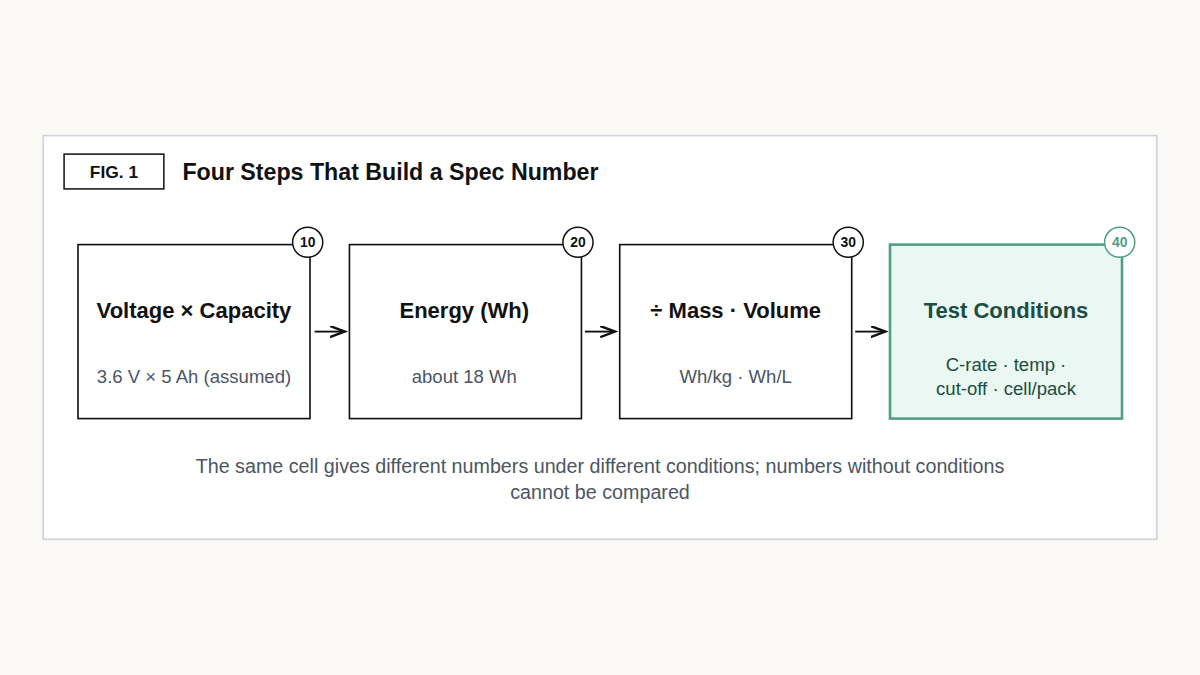
Source: editorial concept diagram based on the definitions in MIT Electric Vehicle Team (2008)
C-rate corresponds to how far you open the tap. A 1C rate is the current that discharges the entire capacity in one hour; for a 100 Ah battery, 1C is 100 A, 5C is 500 A, and C/2 is 50 A[2]. For the 5 Ah cell above (assumed values), 1C is 5 A, 0.5C is 2.5 A, and 2C is 10 A. Much as a wide-open tap makes the outlet pressure sag sooner, so that a “minimum pressure” rule calls the tank empty earlier, capacity and energy decrease as the C-rate increases[2]. One way to understand this is that the terminal voltage varies with current[2], and the moment the cut-off voltage is reached first is treated as the “empty” state.
SOC (state of charge) is the share of water left in the tank: it expresses the present capacity as a percentage of maximum capacity and is generally calculated by integrating current over time[2]. How remaining charge is calculated is covered in our explainer on BMS SOC estimation patents. DOD (depth of discharge) conversely means how much has been drawn, and a discharge to at least 80% DOD is called a deep discharge[2]. SOH (state of health) corresponds to how much smaller the tank itself has become compared with new, but it has no single definition. A 2024 paper notes that SOH can be defined differently depending on the viewpoint, e.g., of a manufacturer or a battery user, sets out capacity-based (present capacity ÷ nominal capacity), energy-based and internal-resistance-based definitions side by side, and explains that SOH very often refers to the capacity-based one[4].
Cycle life is the number of charge-discharge cycles a battery can undergo before it fails to meet specified performance criteria. It is estimated for specific charge and discharge conditions, and the deeper the DOD, the shorter it becomes[2]. The key is the “performance criteria”: one study explains that EV batteries are currently considered to have reached end of life (EOL) once their SOH falls to 70–80%[5]. Depending on whether the end line is set at 80% or 70%, the same cell’s cycle-life number changes. For an example of a design that gives up some energy density to gain life, see our article on LTO anodes.
The unit beginners most often confuse is specific capacity (mAh/g). It is the charge held not by a cell but by 1 g of active material (the material that actually stores lithium); for example, the theoretical specific capacity of graphite is 372 mAh/g[6]. How a material number turns into electrode capacity (Ah) is shown clearly by a calculation formula in one patent specification. That specification calculates the positive electrode charging capacity as “charging capacity per gram of active material × width × length of the active material layer × mass per unit area × content of active material in the layer”[7]. As assumed values, using 25 g of a 200 mAh/g cathode material gives 5,000 mAh, i.e., 5 Ah.
The cell’s weight, however, adds the anode, current collectors, separator, electrolyte and case on top of the cathode material. That is why the MIT guide calls Wh/kg a characteristic of both the chemistry and the “packaging”[2]. The same guide defines a cell as the smallest packaged form of a battery, a module as a group of several cells, and a pack as modules connected together[2]. As the unit grows, non-cell weight and volume are added, so even with the same cells the pack-level Wh/kg is structurally lower than the cell-level figure. How cell shape affects this packaging efficiency is covered in our pouch, prismatic and cylindrical comparison.
③ Comparison — Ten Metrics, Their Units and the “Conditions to Read With Them”
| Metric | Unit | Meaning | Calculation / example (assumed values) | Conditions to read with it |
|---|---|---|---|---|
| Nominal voltage | V | Reference (representative) voltage of the battery[2] | Assume 3.6 V | Charge voltage and cut-off voltage[2] |
| Capacity | Ah | Charge delivered from 100% charge to the cut-off voltage[2] | Assume 5 Ah | Discharge C-rate (decreases as it rises)[2] |
| Energy | Wh | Energy delivered in the same discharge (power × time)[2] | 3.6 V × 5 Ah ≈ 18 Wh | Discharge C-rate (decreases as it rises)[2] |
| Gravimetric energy density | Wh/kg | Energy per mass; a characteristic of chemistry and packaging[2] | 18 Wh ÷ 0.07 kg ≈ 257 Wh/kg (70 g assumed) | Whether cell, module or pack basis[1][2] |
| Volumetric energy density | Wh/L | Energy per volume[2] | 18 Wh ÷ 0.025 L = 720 Wh/L (25 mL assumed) | Reference unit, temperature, whether useable energy[3] |
| C-rate | C | Current relative to capacity; 1C discharges everything in one hour[2] | 1C = 5 A, 0.5C = 2.5 A, 2C = 10 A | Charge and discharge C-rates may differ[8] |
| SOC | % | Present capacity ÷ maximum capacity[2] | 4 Ah left gives 80% (DOD 20%) | Estimation method such as current integration[2] |
| SOH | % | Condition relative to new; often present capacity ÷ nominal capacity[4] | 84% if capacity falls to 4.2 Ah | Which definition: capacity, energy or resistance[4] |
| Cycle life | cycles | Charge-discharge cycles until performance criteria are no longer met[2] | Value shifts with the end line (80% or 70%) | DOD, C-rate, temperature and end criterion (SOH 70–80%)[2][5] |
| Specific capacity (material) | mAh/g | Charge per gram of active material; graphite theoretical 372 mAh/g[6] | 200 mAh/g × 25 g = 5 Ah | Test C-rate and temperature; whether the denominator is active material only or the whole electrode[8][9] |
Source: reconstructed by the editorial team from MIT Electric Vehicle Team (2008), CATL (2026), USABC targets (2025), von Bülow et al. (2024), Etxandi-Santolaya et al. (2024), Asenbauer et al. (2020) and the US9793538B2 specification
What this table shows: Of the ten metrics, not a single row has an empty “conditions to read with it” cell. Even the same 5 Ah (assumed) cell is discharged at 10 A at 2C, twice the 1C current, and because capacity and energy decrease as the C-rate rises[2], two numbers stripped of their conditions cannot be put on the same scale.
④ Patent Perspective — When Spec Numbers Become “Numerical Limitations” in Claims
Spec-sheet numbers reappear in patents as numerical limitations. This is a way of defining the scope of rights in which a claim (the part of a patent that states in words the scope of protection sought) sets a numerical range, such as “1.60 or more and 2.55 or less.” Under U.S. patent law, 35 U.S.C. § 112(b) requires claims particularly pointing out and distinctly claiming the subject matter of the invention[10].
In Dow v. NOVA (2015), the U.S. Court of Appeals for the Federal Circuit (CAFC) examined the numerical limitation “a slope of strain hardening coefficient greater than or equal to 1.3” and found that there were at least four methods for calculating the slope (three known methods and one devised by the patentee’s expert for this litigation), that they may produce different results, and that the patent gave no guidance as to which method to use, so the choice of method could decide whether a product infringes. The court held the claims invalid as indefinite[11]. The standards of other jurisdictions, including Korea, require separate review.
| Patent (owner, priority year, status) | Numerical limitations in claim 1 (restated) | Where the test conditions are written | Issue for the scope of rights |
|---|---|---|---|
| US11769904B2 (Prime Planet Energy & Solutions, 2020, Active)[7] | In a battery with a graphite anode: 1.60 ≤ NPR/AAR ≤ 2.55, 1.45 ≤ NPR ≤ 1.90, 0.75 ≤ AAR ≤ 0.90[7] | Specification: 25°C (±1°C), 1/20 It, etc.; charge upper-limit and discharge lower-limit voltages are “for reference”[7] | The boundary may shift if the capacity ratios change with the test voltage window |
| US9793538B2 (Dow → Jiangsu Hengtron Nanotech, 2012, Active)[8] | Li 1.025–1.10, Mn 0.70–0.85, Fe 0.1–0.3, dopant 0.01–0.075, cation charge sum 2.85–2.99[8] | Specification: in certain embodiments the formula is “based on the raw materials provided into the process”[8] | Which basis governs if product analysis and raw-material values diverge |
| US12055593B2 (BMW, 2019, Active)[12] | First measurement frequency above 300 Hz (series resistance from the real part of impedance)[12] | The wording of claim 1 itself[12] | Boundary is relatively clear; a changed measurement design may fall outside the literal scope |
Source: reconstructed by the editorial team from the Google Patents bibliographic data, claims and specifications of US11769904B2, US9793538B2 and US12055593B2
The first example, US11769904B2 (applicant Prime Planet Energy & Solutions, priority date 2020-08-11, granted 2023-09-26), is a product claim[7]. NPR is the negative electrode charging capacity divided by the positive electrode charging capacity (corresponding to the N/P ratio), and AAR is the share of the negative electrode’s effective discharging capacity in the sum of the irreversible capacity (the capacity corresponding to lithium that is inactivated and adheres to the negative electrode surface during the first charge) and that effective discharging capacity[7].
Granted claim 1 places ranges on three values at once: NPR/AAR, NPR and AAR[7]. The specification performs measurements at 25°C (±1°C) and defines 1 It as “the current at which a capacity corresponding to an SOC of 100% is discharged in one hour” (read as the same meaning as 1C in the MIT definition), yet it also states that the charging upper-limit and discharging lower-limit voltages are merely for reference and may be changed according to the battery specification[7].
Because measured capacity is set by the voltages to which the cell is charged and discharged[2], NPR may change if the voltage window changes. The passage that leaves the test voltages “for reference” gives the patent owner room for interpretation, but for third parties it becomes uncertainty in the FTO (freedom to operate, the judgment of whether a product can be made and sold without infringing others’ patents) analysis. The design background is summarized in our article on the N/P ratio and US11769904B2.
Second, US9793538B2 (original assignee Dow Global Technologies, current owner Jiangsu Hengtron Nanotech, priority date 2012-12-21, granted 2017-10-17) is a product claim to a composition window for an LMFP cathode material[8]. The specification expresses the formula in certain embodiments as “based on the raw materials provided into the process,” and states that specific capacity is measured in half-cells (test cells that evaluate one electrode only) at 25°C at C/10, 1C, 5C, 10C and finally C/10 again[8].
It indeed states specific capacity at C/10 (e.g., at least 140–160 mAh/g) separately from the ratio at 5C (e.g., at least 80% of the theoretical value of approximately 170 mAh/g)[8]. In other words, even the mAh/g of the same material comes with a C-rate condition. The full composition window is analyzed in our LMFP composition window analysis. Third, BMW’s US12055593B2 (priority date 2019-10-10, granted 2024-08-06) is a method claim that writes directly into claim 1 the step of measuring the real part of the impedance at a first frequency above 300 Hz to obtain the series resistance[12]. The context of internal-resistance decomposition is in our explainer on BMW’s impedance decomposition patent.
A cross-check of similar patents also reveals a unit problem. US11183683B2 (priority date 2017-08-10, granted 2021-11-23), filed by LG Chem and now held by LG Energy Solution, claims pressing times (0.5–3 hours and 2–6 hours) and a “pressure” of 20–50 kgf in an electrode pre-lithiation method (a process that loads lithium into an electrode before cell assembly)[13]. kgf is a unit of force, not pressure per area, and the example likewise states that a jig was tightened with a force of 30 kgf[13]. If the electrode area differs, the same kgf gives a different pressure per unit area, so the unit and reference area of a number can also become variables in interpreting the scope of rights.
Design-around scenario (with counterarguments). (a) Designing outside the literal scope: for US11769904B2, directions worth reviewing include setting NPR/AAR below 1.60 or above 2.55, or placing either NPR or AAR outside its range. Note, however, that independent claim 2 separately claims the combination of NPR 1.05–1.40 and AAR 0.55–0.65[7], so it must be checked that a design escapes both independent claims. Also, the specification reports a tendency for the high-rate cycle output retention ratio to be significantly improved at NPR/AAR of 1.60–2.55[7], so leaving the range may conflict with performance targets.
(b) Arguing test conditions: one can argue that the product falls outside the range when measured under one’s own conditions, but that argument may not be accepted if the deciding body adopts the test conditions written in the specification. (c) Whether the doctrine of equivalents (the doctrine that finds infringement where a product differs slightly from the claim wording but is substantially the same) applies just outside a numerical boundary may be decided differently by jurisdiction and case.
Conversely, a claim with an ambiguous measurement method may be exposed to an indefiniteness invalidity challenge as in Dow v. NOVA[11], so writing down test conditions can also serve as a defensive tool for the patent owner.
⑤ Limits and Outlook
On the optimistic side, standard test methods can reduce this confusion. IEC 62660-1:2018 specifies performance and life testing of lithium-ion cells for the propulsion of electric vehicles and provides standard test procedures and conditions to obtain capacity, power density, energy density, storage life and cycle life[14]. USABC likewise states the test method, “C/3 CC-CV (constant current-constant voltage) charge, C/3 CC (constant current) discharge,” next to its material specific-capacity targets, and notes that the values represent the complete electrode including inactive materials[9]. CC-CV charging charges at a constant current until the charge voltage is reached and then holds the voltage while the current tapers[2].
Counter-scenario: Even with standards, the comparison problem remains if a spec sheet does not say which procedure and conditions it chose. IEC 62660-1 is a cell test standard[14], so mixing its results with pack-level numbers blurs the basis again, and for a metric such as SOH, whose definition varies with the viewpoint[4], the same “90%” may point to different things.
Strategic alternative: When a comparison is needed, ask not for numbers but for “a comparison table converted to the same conditions.” If cell/module/pack basis, temperature, charge and discharge C-rates, voltage window and end-of-life criterion are aligned on one line, even different chemistries such as NCM and LFP, which trade energy density against cost, can be placed side by side fairly. On the IP side, a “test-protocol comparison table” that re-measures the metrics caught by a competitor’s numerical limitations under exactly the test conditions of that specification plays the same role. The conclusion of this article fits in one sentence: a number on a spec sheet is not an adjective but a conditional statement; for the same reason, in a claim’s numerical limitation, “how it is measured” rather than “how much” is likely to become the real boundary of the scope of rights.
Action to check (planning/IP teams): When you receive a spec sheet, mark for each number whether it states (1) cell, module or pack basis, (2) test temperature, (3) charge and discharge C-rates, (4) charge voltage and cut-off voltage, and (5) the end-of-life criterion and DOD for cycle life, and request any blanks from the supplier in writing. If a metric overlaps a numerical limitation in a competitor’s patent, plan a re-measurement under that specification’s test conditions at the same time.
Items Requiring Verification
- The 350 Wh/kg in CATL’s statement (2026-08-09) was read as a cell-level figure from its sentence structure, but it was not re-confirmed against company technical material that explicitly states the cell basis.
- The full text of IEC 62660-1:2018 (paid) was not accessed, so specific test temperatures, discharge currents and end-of-life criteria are not cited (only the IEC Webstore abstract was checked).
- How clarity is assessed under Korean law for numerical or parameter claims whose measurement method is not specified (Korean Patent Act Article 42(4)(ii), examination guidelines of the Ministry of Intellectual Property (MOIP, formerly KIPO), Korean case law) was not checked against original texts in this article.
- Whether the test conditions in the US11769904B2 specification were discussed as a basis for claim interpretation during prosecution, and whether the Korean and European family claims of the four patents carry the same numerical ranges as the U.S. patents, were not checked.
- How much the ‘raw-materials-based’ composition of US9793538B2 actually differs from analyzed finished-product composition was not verified against numbers in the specification.
Sources
- CATL, “CATL Aviation Battery Passes Thermal Runaway Test for Adjacent Cells,” CATL official news, 2026-08-09 (accessed 2026-09-25). Link
- MIT Electric Vehicle Team, “A Guide to Understanding Battery Specifications,” MIT, December 2008 (accessed 2026-09-25). Link
- USABC (USCAR), “USABC Goals for Advanced Batteries for Light Duty Electric Vehicles (EVs)” (USABC EV Performance Targets), version of 2025-10-06 (accessed 2026-09-25). Link
- Friedrich von Bülow, Felix Heinrich, William Arthur Paxton, “The future of battery data and the state of health of lithium-ion batteries in automotive applications,” Communications Engineering 3, 173, 2024-11-19, DOI 10.1038/s44172-024-00299-w (accessed 2026-09-25). Link
- Maite Etxandi-Santolaya, Lluc Canals Casals, Cristina Corchero, “Extending the electric vehicle battery first life: Performance beyond the current end of life threshold,” Heliyon 10(4), e26066, 2024, DOI 10.1016/j.heliyon.2024.e26066 (accessed 2026-09-25). Link
- J. Asenbauer, T. Eisenmann, M. Kuenzel, A. Kazzazi, Z. Chen, D. Bresser, “The success story of graphite as a lithium-ion anode material – fundamentals, remaining challenges, and recent developments including silicon (oxide) composites,” Sustainable Energy & Fuels 4, 5387–5416, 2020, DOI 10.1039/D0SE00175A (accessed 2026-09-25). Link
- Google Patents, US11769904B2, “Nonaqueous electrolyte secondary battery” (Prime Planet Energy & Solutions), bibliographic data, claims 1–2 and description (claims checked against the granted-patent PDF; accessed 2026-09-25). Link
- Google Patents, US9793538B2, “LMFP cathode materials with improved electrochemical performance,” bibliographic data, claims 1–3 and description (accessed 2026-09-25). Link
- USABC (USCAR), “USABC Goals for Active Materials for Cells to be Used in Automotive Traction Applications” (USABC Active Material Performance Targets), version of 2025-10-21 (accessed 2026-09-25). Link
- Cornell Law School LII, “35 U.S. Code § 112 – Specification,” subsection (b) Conclusion (accessed 2026-09-25). Link
- U.S. Court of Appeals for the Federal Circuit, “The Dow Chemical Company v. NOVA Chemicals Corporation (Canada),” Nos. 2014-1431, 2014-1462, decided 2015-08-28, opinion PDF on U.S. government govinfo (accessed 2026-09-25). Link
- Google Patents, US12055593B2, “Method for parameter estimation in an impedance model of a lithium ion cell” (BMW), bibliographic data and claims 1–9 (claims checked against the granted-patent PDF; accessed 2026-09-25). Link
- Google Patents, US11183683B2, “Pre-lithiation method of negative electrode for secondary battery” (LG Chem → LG Energy Solution), bibliographic data, claim 1 and examples (accessed 2026-09-25). Link
- IEC, “IEC 62660-1:2018 Secondary lithium-ion cells for the propulsion of electric road vehicles – Part 1: Performance testing,” Edition 2.0, 2018-12-12, IEC Webstore abstract (accessed 2026-09-25). Link
This article is a technology and patent trend commentary, not legal advice. Specific FTO judgments require professional review.
Related Reading
FRONTIERCELL PRIMER · 2026.09
More from this primer series
- How a Battery Cell Is Made — Electrode, Assembly, and Formation, and the Patents Attached to Each Step
- What’s the Difference Between A1 and B2 After a Patent Number? — A Primer on Reading Battery Patents Through Publication, Grant, and Expiry
- ITC Complaints, Invalidation Trials, Settlements — The Terms You Need to Read Battery Patent Dispute News