“ITC complaint,” “investigation launched,” “invalidation trial filed,” “KRW 2 trillion settlement.” Battery patent dispute news mixes procedures whose names sound alike but that fight over entirely different things. This article explains, at a beginner’s level, the U.S. ITC Section 337 investigation, court infringement suits, IPR, and Korea’s invalidation trials, scope confirmation trials and infringement suits, and uses actual official notices to show why patent and claim numbers deserve your attention before any dollar amount.
① What’s the Topic
A single procedural term in a dispute article tells you who is asking which body for what, and how many steps remain before a conclusion. A complaint or the institution of an investigation is not a conclusion.
Start with the industry context. On July 21, 2026, LG Energy Solution and its U.S. unit LG Energy Solution Arizona asked the U.S. International Trade Commission (USITC, “the ITC”) to open an investigation over alleged infringement of patents related to secondary cylindrical batteries (a complaint), and on August 20 the ITC voted to institute an investigation (institution) and assigned it the number 337-TA-1518[1][2]. The respondents (the companies under investigation) number ten in total: three EVE Energy group entities and seven entities of the Bosch, Koki and Chervon groups[1]. According to press reports, LG Energy Solution also sued in a federal district court in Texas, and four of the five patents concern cylindrical battery technology including tabless designs while one concerns separator technology[3][4]. The technical background of this dispute is covered in our analysis of the 46mm cylindrical cell ITC investigation.
The tension is that a headline alone rarely reveals the stage or the issues. In its institution news release, the ITC stated that instituting the investigation is not a decision on the merits[2]. “Investigation launched” is only a starting line. Conversely, the most widely reported figure from the earlier LG–SK battery dispute, KRW 2 trillion, came not from an ITC ruling but from a settlement between the parties[5][6].
So the question this article answers is this: what does each procedural term in dispute news actually fight over, and what should a reader check instead of the dollar amount?
② Basic Principle — A Border Checkpoint, a Courtroom, Disarmament, and a Blueprint Comparison
Sorting the procedures into four metaphors makes the news far easier to read. An ITC Section 337 investigation is a border checkpoint. It blocks the importation of goods that infringe patents and other rights, and its core remedy is an exclusion order directing U.S. Customs and Border Protection (CBP) to keep infringing goods out[7]. A court infringement suit is a courtroom fight seeking damages and a halt to sales[8][9][10]. Invalidity proceedings (IPR in the U.S., invalidation trials in Korea) try to disarm the opponent by destroying the weapon itself, the patent, while a scope confirmation trial compares blueprints to confirm whether my product falls within a patent’s scope.
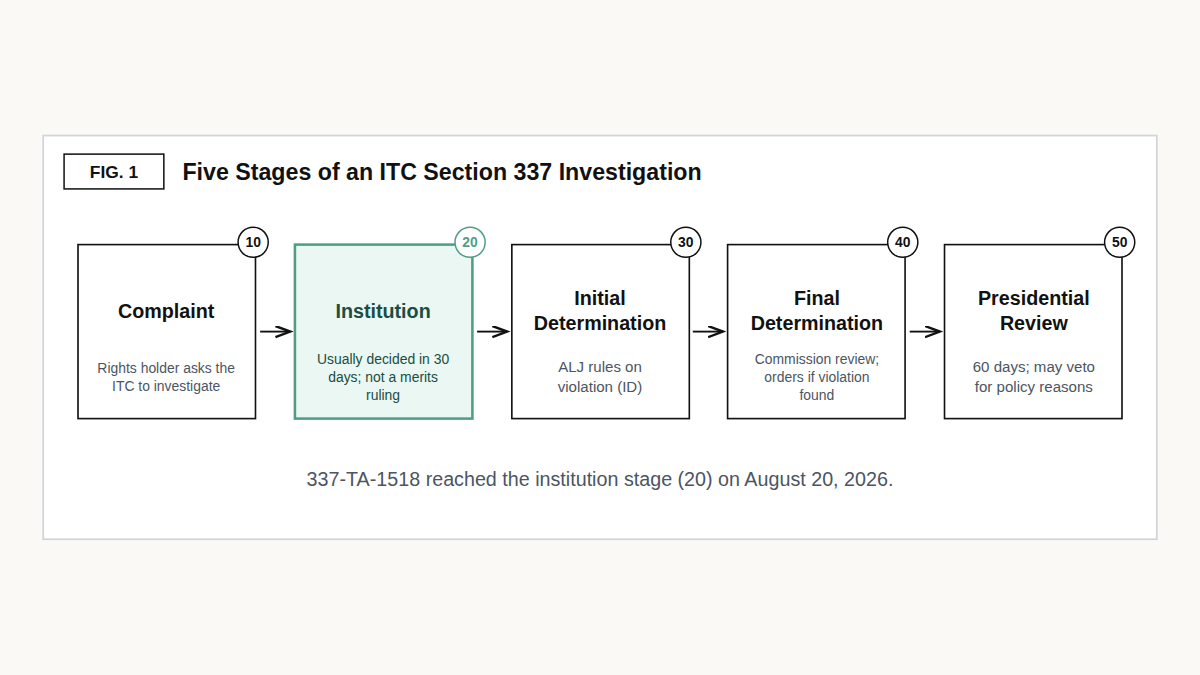
Source: reconstructed by the editorial team from the USITC “Section 337 Investigations: Answers to Frequently Asked Questions,” 19 U.S.C. §1337 and the 337-TA-1518 institution notice (91 FR 54764).
Take the ITC procedure first. The ITC normally decides whether to institute within 30 days after a complaint is filed, and a target date for completion is set within 45 days after institution[7][11]. In the 1518 case, too, institution was voted on the 30th day after the complaint[1]. After the hearing, an administrative law judge (ALJ) issues an initial determination (ID) on whether there is a violation, and the Commission may review it and adopt, modify or reverse it, or decide not to review it, a process that leads to the final determination[7]. Historically, the Commission has strived to complete most investigations in less than 15 months[7]. Once orders issue, the President may disapprove them for policy reasons within 60 days, and during that period importers may bring goods in by posting a bond[7][11].
The ITC has two more features. First, money damages are not a remedy at the ITC[7]. The core remedies are the general exclusion order, which excludes infringing goods regardless of source; the limited exclusion order, which excludes only a named respondent’s goods; and the cease and desist order, which can stop sales even out of U.S. inventory[7]. Second, in a patent case, a related industry must exist in the United States or be in the process of being established (the domestic industry requirement)[11]. The 1518 notice also records the complainants’ allegation that a U.S. industry is “in the process of being established”[1].
Invalidity proceedings work differently. In the U.S., an IPR (inter partes review) is a proceeding petitioned at the USPTO by a person who is not the patent owner, only on novelty and obviousness grounds (§102 and §103), and only on the basis of prior-art patents and printed publications[12]. The decision is issued by the USPTO’s Patent Trial and Appeal Board (PTAB)[13], and it must come within one year after the institution notice, extendable by up to six months for good cause[14]. In Korea, an invalidation trial is requested by an interested party or an examiner before the Intellectual Property Trial and Appeal Board (IPTAB), and once an invalidation decision becomes final, the patent right is in principle deemed never to have existed[10][15]. For a case in which a patent stays in industry conversation long after being invalidated, see the story of an invalidated foundational LFP patent.
A scope confirmation trial comes in two forms: an active trial, in which the patent owner (or exclusive licensee) seeks a decision that a third party’s practiced invention “falls within” its patent, and a passive trial, in which a third party seeks a decision that its own invention “does not fall within” it[15]. A passive trial can also cover an invention the requester intends to practice in the future[15]. A party dissatisfied with a trial decision must sue in the Patent Court within 30 days of receiving a certified copy of the decision, and the Patent Court’s judgment may be appealed to the Supreme Court[10]. Because infringement suits and trials can run separately, a court must notify the IPTAB President when an infringement suit is filed and may, if needed, stay its proceedings until a trial decision becomes final[10].
③ Comparison — Six Procedures: Who Decides and What You Can Get
| Procedure | Deciding body | What the requester can obtain | Timeline (statutory or official target) | Common phrases in the news |
|---|---|---|---|---|
| U.S. ITC Section 337 investigation | USITC (ALJ, then the Commission) | General or limited exclusion orders, cease and desist orders. No money damages[7] | Target date set within 45 days after institution[11]; historically aimed at finishing most within 15 months[7] | Complaint, institution, initial determination, final determination, import ban |
| U.S. federal district court infringement suit | Federal district court | Damages (no less than a reasonable royalty, may be increased up to three times)[9], injunction (principles of equity)[8] | — | Patent infringement suit filed, damages verdict |
| U.S. PTAB IPR | USPTO Patent Trial and Appeal Board (PTAB) | Claim-by-claim patentability decision on challenged claims, cancellation of unpatentable claims[13] | Final determination within 1 year after institution notice (extendable up to 6 months)[14] | IPR petition, institution decision, final written decision |
| Korean invalidation trial (Patent Act Article 133) | IPTAB | Invalidation of the patent (may be requested claim by claim), deemed never to have existed once final[10] | — | Invalidation trial filed, invalidation decision |
| Korean scope confirmation trial (Article 135) | IPTAB | Decision on whether the challenged invention falls within the scope (active) or does not (passive)[15] | — | Active or passive scope confirmation trial |
| Korean court infringement suit (Articles 126 and 128) | Courts | Claims to stop or prevent infringement, damages (up to five times the loss for willful infringement)[10] | — | Injunction claim, damages suit |
Source: reconstructed by the editorial team from 19 U.S.C. §1337, the USITC FAQ, 35 U.S.C. §§283, 284, 316 and 318, Korean Patent Act Articles 126, 128, 133 and 135, and IPTAB guidance.
What this table shows: Of the six procedures, only two, U.S. federal district courts and Korean courts, can directly award damages. The statutory deadlines this article confirmed are likewise only two, the ITC (target date set within 45 days after institution) and IPR (decision within 1 year after institution), so the schedules of the other procedures must be followed through case-by-case notices.
Applying this to a past case makes the difference clear. On April 29, 2019, LG Chem filed an ITC complaint against SK Innovation over trade secret misappropriation (337-TA-1159)[16]. On February 14, 2020, the ALJ issued an initial determination finding SK in default because of spoliation of evidence[5]. In other words, the outcome was a sanction for destroying evidence, not a technical comparison of the trade secrets. On February 10, 2021, the Commission affirmed it and issued a limited exclusion order and cease and desist orders effective for ten years[5].
The orders, however, permitted imports of components for U.S. production for Ford’s EV F-150 program for four years and for Volkswagen’s MEB line for two years[5]. On April 11, 2021, ahead of the presidential review deadline (midnight April 11, local time), the two companies announced that SK would pay a total of KRW 2 trillion in present-value terms (KRW 1 trillion in cash plus KRW 1 trillion in royalties), withdraw all disputes in Korea and the U.S., and refrain from further litigation for ten years[6][17]. The Commission later granted SK’s settlement-based petition and permanently rescinded the exclusion order and the cease and desist orders by a vote on June 21, 2021[30].
The ITC deals with borders, not money. So the weight of ITC news comes not from a damages figure but from the products, duration and carve-outs an exclusion order covers, and the KRW 2 trillion in the 1159 case likewise came not from an ITC ruling but from a settlement reached under that pressure.
④ Patent Perspective — Read the Patent and Claim Numbers, Not the Dollar Amount
The most important numbers in dispute news are not dollar amounts but patent numbers and claim numbers, because decisions are made claim by claim (a claim is the part of a patent that states, in sentences, the scope of protection sought). An IPR petitioner asks to cancel “1 or more claims”[12]. The PTAB decides patentability for each challenged claim, and claims finally held unpatentable are removed by a cancellation certificate[13]. The Korean Patent Act likewise lets invalidation trials and scope confirmation trials be requested claim by claim[10]. The basics of reading claims are laid out in our guide to reading claim structure.
The 337-TA-1518 institution notice lists the claims under investigation separately for each of the five patents[1]. Adding bibliographic data from Google Patents gives the following.
- US 8,420,257 (‘257): a gasket structure that keeps a cap assembly’s gasket from sagging; originally filed by LG Chem, currently held by LG Energy Solution; granted in 2013 — claims 1–6[18]
- US 11,749,866 (‘866): rupture and bending notch structure of a top cap safety vent; granted September 5, 2023 — claims 1, 4–6, 9[19]
- US 12,412,924 (‘924): multilayer nanoporous separator; granted September 9, 2025 — claims 1–9, 12, 14, 16–19, 21–25, 27–30[20]
- US 12,412,965 (‘965): cylindrical battery, battery pack and vehicle; granted September 9, 2025 — claims 1, 4, 7–11, 14, 15, 19, 20, 22–24, 26–33[21]
- US 12,646,735 (‘735): notching tabs of a jelly-roll electrode assembly bent radially inward to overlap axially as welding portions; LG Energy Solution; granted June 2, 2026 — claims 1, 6, 10, 12, 13, 15[1][31]
Count them and the investigation covers 5 patents and 63 claims, and the notice contains no dollar amount anywhere. The notice also never uses the words “tabless” or “46mm,” so a news reference to “tabless patents” should be read as the reporter’s description, not the notice’s wording. Numbers must be matched to the last digit. Tesla’s tabless patent US11749842B2 and this case’s ‘866 patent (US11749866B2) share their first six digits and were both granted on September 5, 2023, yet they have different owners and cover different inventions[22][19]. The scope of rights of Tesla’s patent is covered in our deep dive into Tesla’s foundational tabless patent.
| Common news sentence (example) | Information to check | Answer from 337-TA-1518 official documents |
|---|---|---|
| “Complaint filed with the U.S. ITC” | Forum, docket number, filing date | Filed 2026-07-21; docket number (DN) 3926 per the receipt notice[23] |
| “ITC formally launches investigation” | Institution date, investigation number, whether it is a merits ruling | Institution voted 2026-08-20, 337-TA-1518, not a merits ruling[1][2] |
| “Five patents infringed” | Patent numbers, claims | 5 patents, 63 claims in total[1] |
| “Import ban sought” | Remedies requested, product scope | Limited exclusion order and cease and desist orders, plus a bond during presidential review; covers secondary cylindrical batteries and components (top cap assemblies, electrode windings, separators, etc.) and products containing them[23][1] |
| “Even customers sued” | List of respondents | EVE 3, Bosch 2, Koki 2, Chervon 3 entities[1] |
Source: reconstructed by the editorial team from the USITC 337-TA-1518 institution notice (91 FR 54764), complaint receipt notice (91 FR 46942) and news release.
Numbers also define how far a settlement or license reaches. In October 2014, LG Chem and SK Innovation agreed to end disputes related to Korean registered patent No. 775310 on ceramic-coated separators; on August 27, 2020, the Seoul Central District Court, ruling at first instance, reportedly held that the covenant not to sue covered only the Korean patent written in the agreement, and that a U.S. patent could not be read into it contrary to the wording even if it was effectively the same patent[24]. Google Patents’ reassignment record lists LG Energy Solution as that patent’s last assignee (2022) and shows it as expired (2025-12-21)[25]. How a single technology exists as separate patents in each country is illustrated in why one foundational technology becomes 800 patents.
Design-around scenario (including counterarguments). Once an exclusion order issues, a respondent may try to redesign its product to move outside the order’s scope of rights, because lacking even one element of a claim may reduce the risk of literal infringement. For example, claim 1 of the ‘965 patent limits, in the cross-section of the electrode winding, the circumferential angle of the “stress vulnerable region” to 30–180° and that of the “stress amplification region” to 1–90°[26], so a winding design outside these numerical windows could be examined as a design-around option.
Whether a redesigned product is caught by an existing order can also be put to the Commission through a request for an advisory opinion (the Commission decides whether to issue one)[27]. The counterarguments are clear. Even outside the literal wording, a design could be contested under the doctrine of equivalents (the principle that a substantially identical invention may be held infringing), and with 63 claims spread across 5 patents, avoiding one claim may still leave a risk of infringing another.
Moreover, in a trade secret case like 1159, the orders covered the trade secrets LG identified, not claims, and were issued with a ten-year term[5], so patent-style design-around logic of moving outside the claims may not work. The starting point for such analysis is a freedom-to-operate (FTO) assessment, i.e., a judgment on whether a product can be made and sold without infringing others’ patents.
⑤ Limits and Outlook
On the optimistic side, most of a dispute’s skeleton is published in official documents. The 1518 case’s investigation number, patent numbers, claims and respondents appeared in the Federal Register, and even the next official step, setting the target date, has a statutory frame of 45 days after institution[1][11]. With that frame, even a beginner can interpret the news independently.
There is also a contrary scenario. The ending may not be verifiable through the news. An ITC investigation can end through a license or settlement or a consent order[7][11], and unlike the 1159 case, if the amount and terms are not announced, it is hard to confirm from public sources who gained what. The IPR environment is another variable. In October 2025, the USPTO published proposed rules that include not instituting an IPR when the petitioner intends to keep pursuing §102 or §103 invalidity challenges in other venues such as district court or the ITC[28], and a final rule was not found in the Federal Register at the time of writing. If finalized, the familiar formula of running IPR in parallel with the ITC and the courts could change.
The strategic alternative is a dispute tracker updated only from official documents. Give each case five columns (forum, patent numbers, claims, current stage, next date) and change them only when the Federal Register, the USITC or the IPTAB publishes a notice. If a district court case runs alongside, the date the complaint was served is worth recording too, because an IPR petition filed more than one year after service of an infringement complaint cannot be instituted[29]. Articles titled “patent war” can be re-read through the same five columns, for instance by first asking whether the dry electrode process patent war is a story about litigation or about filing competition.
Action to check (planning/IP teams): When you see dispute news, fill in the five columns first (forum, patent numbers, claims, current stage, next date), and match each patent number on Google Patents down to the last digit, the owner and the legal status.
Items Requiring Verification
- US 12,646,735 (‘735), asserted in 337-TA-1518, was not yet indexed on Google Patents at the time of writing (2026-09-25); only its bibliographic data and the gist of claim 1 were checked in the USPTO full-text PDF, and the individual asserted claims were not compared.
- The presiding administrative law judge and the target date for 337-TA-1518 could not be confirmed from official sources at the time of writing.
- The case number and filing date of the Texas federal district court suit were confirmed only through press reports; court records were not reviewed. A Korean report gives the filing date as July 22 (local time), which differs from the ITC filing date (July 21) in the USITC notice.
- Which of the five patents the reported ‘four tabless-related patents’ refer to was not pinned down from the notice or the patent texts.
- The claims of Korean registered patent No. 775310, the full text of the 2020 Seoul Central District Court first-instance judgment, and the subsequent appeal were not reviewed (bibliographic data confirmed on Google Patents; the holding confirmed through press reports).
- Case law on whether a scope confirmation trial decision binds the court hearing an infringement suit was not reviewed in the original for this article.
- Whether the USPTO’s October 2025 proposed IPR rules (90 FR 48335) have been finalized, and when they would take effect, could not be confirmed in a Federal Register search at the time of writing.
Sources
- U.S. International Trade Commission (USITC), “Certain Secondary Cylindrical Batteries, Components Thereof, and Products Containing the Same; Notice of Institution of Investigation” (Inv. No. 337-TA-1518), Federal Register 91 FR 54764–54765, August 24, 2026 (accessed 2026-09-25). Link
- USITC news release, “USITC Institutes Section 337 Investigation of Certain Secondary Cylindrical Batteries, Components Thereof, and Products Containing the Same,” August 20, 2026 (accessed 2026-09-25). Link
- Vincent Shaw, “LG takes EVE Energy patent fight to U.S. court, trade commission,” pv magazine USA, July 27, 2026 (accessed 2026-09-25). Link
- Kim Yun-hee, “LG Energy Solution files patent infringement suits against China’s EVE Energy in the U.S.” (in Korean), ZDNet Korea, July 23, 2026 (accessed 2026-09-25). Link
- USITC, “Certain Lithium Ion Batteries, Battery Cells, Battery Modules, Battery Packs, Components Thereof, and Processes Therefor; Commission Decision Finding a Violation of Section 337; Issuance of a Limited Exclusion Order and Cease and Desist Orders; Termination of the Investigation” (Inv. No. 337-TA-1159), Federal Register 86 FR 9952–9953, February 17, 2021 (accessed 2026-09-25). Link
- LG Energy Solution and SK Innovation joint release, “LG Energy Solution and SK Innovation Reach Agreement to End USITC Trade Secret Dispute and End Litigation,” Business Wire, April 11, 2021 (accessed 2026-09-25). Link
- USITC, “Section 337 Investigations: Answers to Frequently Asked Questions” (2009 ed.), pp. 1, 2, 15, 17, 19, 23–25 (accessed 2026-09-25). Link
- Cornell LII, 35 U.S.C. §283 (Injunction) (accessed 2026-09-25). Link
- Cornell LII, 35 U.S.C. §284 (Damages) (accessed 2026-09-25). Link
- Ministry of Government Legislation, Korea Law Information Center, “Patent Act” (Act No. 21134, effective November 11, 2025), Articles 126, 128, 133, 135, 164 and 186 (in Korean) (accessed 2026-09-25). Link
- Cornell LII, 19 U.S.C. §1337 (Unfair practices in import trade), (a)(2), (a)(3), (b)(1), (c), (d), (f), (j) (accessed 2026-09-25). Link
- Cornell LII, 35 U.S.C. §311 (Inter partes review) (accessed 2026-09-25). Link
- Cornell LII, 35 U.S.C. §318 (Decision of the Board), (a) and (b) (accessed 2026-09-25). Link
- Cornell LII, 35 U.S.C. §316 (Conduct of inter partes review), (a)(11) (accessed 2026-09-25). Link
- Intellectual Property Trial and Appeal Board (IPTAB), “Inter Partes Trials” guidance page (types of trials), in Korean (accessed 2026-09-25). Link
- USITC news release, “USITC Institutes Section 337 Investigation of Certain Lithium Ion Battery Cells, Battery Modules, Battery Packs, Components Thereof, and Processes Therefor,” May 29, 2019 (accessed 2026-09-25). Link
- Park Hyo-jae, “LG and SK battery dispute ends in dramatic settlement with KRW 2 trillion in compensation” (in Korean), Kyunghyang Shinmun, April 11, 2021 (accessed 2026-09-25). Link
- Google Patents, US8420257B2 “Cap assembly comprising gasket prevented from sagging,” bibliographic data and claim 1 (accessed 2026-09-25). Link
- Google Patents, US11749866B2 “Secondary battery,” bibliographic data and claim 1 (accessed 2026-09-25). Link
- Google Patents, US12412924B2 “Multilayer nanoporous separator,” bibliographic data (accessed 2026-09-25). Link
- Google Patents, US12412965B2 “Cylindrical battery, battery pack and vehicle,” bibliographic data (accessed 2026-09-25). Link
- Google Patents, US11749842B2 “Cell with a tabless electrode,” bibliographic data and claim 1 (accessed 2026-09-25). Link
- USITC, “Notice of Receipt of Complaint; Solicitation of Comments Relating to the Public Interest” (Certain Secondary Cylindrical Batteries, DN 3926), Federal Register 91 FR 46942–46943, July 27, 2026 (accessed 2026-09-25). Link
- Namgung Min-kwan, “SK Innovation says LG Chem broke a six-year-old agreement: why the court did not accept it (comprehensive)” (in Korean), Edaily, August 27, 2020 (accessed 2026-09-25). Link
- Google Patents, KR100775310B1 “Organic/inorganic composite microporous membrane and electrochemical device prepared thereby,” bibliographic data (accessed 2026-09-25). Link
- U.S. Patent and Trademark Office (USPTO), full text of U.S. Patent No. 12,412,965 (PDF), claim 1 (accessed 2026-09-25). Link
- Cornell LII, 19 CFR §210.79 (Advisory opinions), (a) (accessed 2026-09-25). Link
- USPTO, “Revision to Rules of Practice Before the Patent Trial and Appeal Board” (notice of proposed rulemaking), Federal Register 90 FR 48335, October 17, 2025 (accessed 2026-09-25). Link
- Cornell LII, 35 U.S.C. §315 (Relation to other proceedings or actions), (b) and (e)(2) (accessed 2026-09-25). Link
- U.S. International Trade Commission (USITC), “Commission Decision To Institute a Rescission Proceeding; Permanent Rescission of a Limited Exclusion Order and Cease and Desist Orders; Termination of the Rescission Proceeding; Certain Lithium Ion Batteries, Battery Cells, Battery Modules, Battery Packs, Components Thereof, and Processes Therefor” (Inv. No. 337-TA-1159 (Rescission)), Federal Register 86 FR 33737–33738, June 25, 2021 (accessed 2026-09-25). Link
- USPTO, U.S. Patent No. 12,646,735 B2, “Secondary battery and method for manufacturing the same,” full text (PDF), granted June 2, 2026 (accessed 2026-09-25). Link
This article is a technology and patent trend commentary, not legal advice. Specific FTO judgments require professional review.
Related Reading
- 46mm Cylindrical Cells, From a Mass-Production Race to a Patent War — LG Energy Solution vs. EVE Energy’s ITC Investigation Opens a Fork in the Tabless Standard
- [Patent Analysis] A Deep Dive Into Tesla’s Foundational Tabless Patent (US11749842B2) — The Scope of Rights and Design-Around Options Underpinning the 46mm Cylindrical Cell Standard
- How to Read a Battery Patent — Understanding Claim Structure
FRONTIERCELL PRIMER · 2026.09
More from this primer series
- How a Battery Cell Is Made — Electrode, Assembly, and Formation, and the Patents Attached to Each Step
- How to Read a Battery Spec Sheet — What Wh, Ah, Wh/kg, C-rate, and SOH Tell You, and What They Don’t
- What’s the Difference Between A1 and B2 After a Patent Number? — A Primer on Reading Battery Patents Through Publication, Grant, and Expiry