1. What’s the news
The deciding factor in total CT inspection turned out to be the number of rotation axes, not the detector. US11378527B2, held by Vieworks Co., Ltd., covers an apparatus for automating total inspection of battery cells — and claim 1 limits neither detector specification nor decision algorithm. It stacks rotating stages three deep instead.
Set the context first. Attempts to run radiographic inspection on every cell in a battery line are not new, and the technical barrier always sat in the same place. Multi-angle capture requires time to rotate the specimen, and once that time exceeds line tact time, “total” stops being possible. Here is the tension: making the detector faster collapses into a components-procurement race, offers little differentiation, and is not a domain an equipment maker can defend on its own.
So this article asks: what exactly did this patent tie up, and where is the passage left for a competitor to reach the same objective?
2. The underlying principle — a carousel on top of a carousel
The structure reads like small carousels mounted on a large one. A big turntable (the main stage) carries small turntables (sub-stages) into the imaging position, and each small turntable rotates independently so that its specimen is captured from multiple angles. Then one more layer: on each small turntable sits a casing in which specimens are stacked vertically, itself rotatable.
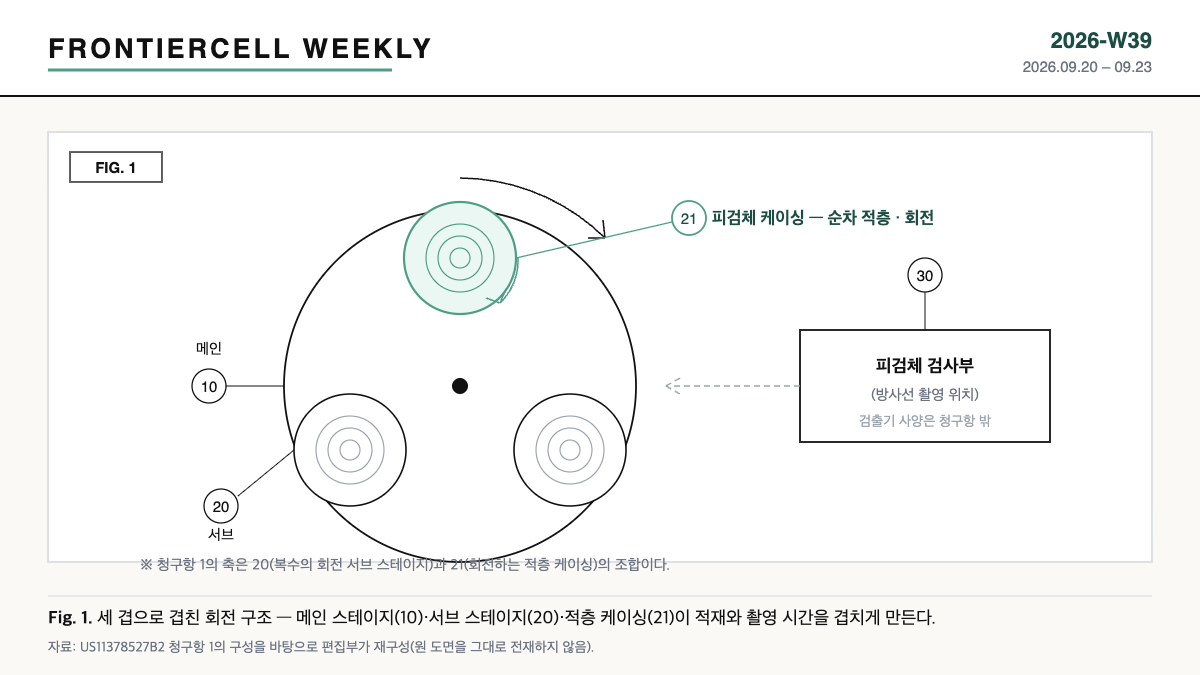
Source: Reconstructed by the editorial desk from the claim structure of US11378527B2 (original drawings are not reproduced).
Why stack them this way? There are only two ways to cut inspection time: image one unit faster, or handle several at once. The detector side is already bounded by component specification, so what remains is the latter. While the main stage turns, one sub-stage sits in the imaging position while another is being loaded and unloaded. Once loading, imaging and ejection overlap on the same time axis, the tool’s throughput rises independently of detector speed. What this patent actually claims is not “fast imaging” but “overlapping time.”
3. Comparison — the bibliographic record
| Item | US11378527B2 |
|---|---|
| Title | Apparatus and method for inspecting battery cells for automation of total inspection |
| Applicant / current assignee | Vieworks Co., Ltd. (same) |
| Priority date | 2019-05-14 |
| Filing date | 2020-05-12 |
| Grant / publication date | 2022-07-05 |
| Legal status | Active (adjusted expiration 2040-12-17) |
| Number of claims | 20 |
| What claim 1 limits | The rotational arrangement of stages and casing, and the imaging position |
| What claim 1 does not limit | X-ray tube and detector specifications, defect decision algorithms, cell form factor |
Source: Reconstructed by the editorial desk from Google Patents bibliographic data and claim 1 (verified 2026-09-20).
What this table says: the absence of detector and algorithm from claim 1 defines the character of this patent. The scope looks narrow, yet it also means that whatever detector and whatever AI you use, adopting this mechanical arrangement puts you inside it. The 20 claims, including apparatus claim 1 and independent method claim 18, read as an attempt to cover that arrangement from both the apparatus and the method side.
4. The patent view — elements of claim 1 and design-around points
Restating the claim by element rather than quoting it verbatim:
| Element of claim 1 (restated) | Design-around point to review |
|---|---|
| (a) An apparatus configured to inspect battery cells by radiography for automation of total inspection | Preamble — ultrasonic or eddy-current methods fall outside this premise |
| (b) A rotatable main stage | Substituting linear conveyor transfer may fall outside the “rotatable” limitation |
| (c) A plurality of sub-stages rotatably disposed on the main stage | Using a single sub-stage or a fixed one — though the throughput advantage disappears |
| (d) A mounting stage comprising the main stage and the sub-stages | A generalisation of (b) and (c) — little independent room |
| (e) A specimen casing rotatably disposed on each sub-stage, in which specimens are sequentially stacked | The core limitation. A horizontal tray rather than stacking, or a non-rotating casing, is the first candidate |
| (f) An inspection unit acquiring images by radiography at the position to which the casing is moved by the mounting stage | Rotating the detector rather than fixing it — of little use while (b), (c) and (e) remain |
Source: Reconstructed by the editorial desk from the claim structure of US11378527B2. The right-hand column states review directions and does not warrant non-infringement.
Laid side by side, the axis of the right is the combination of (c) and (e): “a plurality of rotating sub-stages” plus “a rotating casing in which specimens are sequentially stacked.” Elements (b) and (d) are the superstructure that makes the combination possible, and (f) defines the imaging position.
From a freedom-to-operate standpoint, the substantive fight is likely over whether (e)’s “sequentially stacked” and “rotatable” are satisfied together. A tray arrangement laying specimens out horizontally arguably does not read on stacking — but it expands the tool’s footprint, which can cancel the tact-time advantage that motivated the design. That a design-around is technically possible and that it is commercially viable are different propositions. And with 20 claims, including a separate independent method claim (claim 18), clearing independent claim 1 is not sufficient; the dependent claims and claim 18 have to be mapped as well.
5. Limits and outlook
Optimistically, demand for total CT spreads past 46-series cells into prismatic and pouch formats, and the rights around this structure grow more valuable.
The counter-scenario deserves equal weight. This patent attaches to a “spin several at once” solution — and if detectors and sources become fast enough, the solution itself becomes unnecessary. Should photon-counting detectors, or any component that fundamentally cuts exposure time, fall to battery-inspection price points, there is no reason to stack stages three deep. Rights attached to a mechanical arrangement hold only while that arrangement is needed. And an Active status does not establish that any competitor’s tool practises the construction; this article makes no such determination.
A strategic alternative: for a cell maker buying the tool, the practical defence is to specify the scope of the patent indemnity clause in the purchase agreement. Rights attached to mechanical structure are the equipment vendor’s responsibility, not something a cell maker can adjudicate on the line. For a tool developer, the reverse: the arrangement that avoids (e) has to be settled early in design. Changing stage architecture after production design is finished amounts to a redesign.
Action to take (for planning and IP teams): obtain the stage layout drawing for any total-inspection tool under consideration and check only whether (c) a plurality of rotating sub-stages and (e) a rotating stacked casing are both present. If they are, put US11378527B2 and its family on the freedom-to-operate review list immediately.
Items requiring confirmation
- Whether Korean, European or Chinese counterparts of this patent exist, and their grant status, were not examined for this article.
- Of the 20 claims, claim 1 (apparatus) and claim 18 (method) are independent; this article analysed only claim 1.
- No determination is made that any company’s actual equipment practises this patent, and no infringement is implied.
Sources
- Google Patents, US11378527B2 “Apparatus and method for inspecting battery cells for automation of total inspection,” bibliographic data and claim 1 (verified against the original on 2026-09-20). Applicant and current assignee Vieworks Co., Ltd.; priority 2019-05-14; filed 2020-05-12; granted 2022-07-05; status Active; 20 claims.
RELATED READING
- [Patent Analysis] Filling Electrolyte ‘Atmospheric-Pressure First,’ Not ‘Vacuum First’ — The Claim Boundary of the Reduced-Pressure Cycle Drawn by US10476097B2
- A Patent That Calculates Even the ‘Inertia’ of a Single Winding Roller — The Claim Boundary of Tension Control Drawn by KR101899991B1
- The Year Equipment Shows Got an ‘EV Fire Special Zone’ — What K-Battery Show 2026 Revealed About the Center of Gravity in Equipment Orders
FRONTIERCELL WEEKLY · 2026-W39 (20–23 Sep 2026)
Also in this issue
- The Powder That Holds Eight-Tenths of Solid-Electrolyte Cost — What a 100-Tonne Lithium Sulfide Pilot Changes (published 20 Sep)
- [Patent Analysis] Two Layers in the Lid When the Cell Lets Go — Samsung SDI’s Venting Cover Application (US2025/0112325A1) (21 Sep)
- Inspection That Watched the Surface Has Started Looking Inside — Where Battery Total Inspection Turns Radiographic (22 Sep)