As contracts to run ESS (energy storage systems) for 15 or 25 years multiply, “when to add more modules” has become a matter of operation rather than design. US12632024B2 from Fluence, a US ESS integrator, ties exactly this judgment into its claims. It claims, as a single closed loop, estimating capacity from field data and then taking a corrective action that adjusts temperature, configuration, number of components or material according to the result. This article follows the structure of the claims and the three forms of independent claim to read the boundary of the rights and the room to design around them.
① What Is the Story
To put the point first: the weight of this patent lies less in “how capacity is calculated” than in “what is changed as a result of the calculation.” All three independent claims of US12632024B2 (applicant and assignee Fluence Energy LLC, filed 2022-11-14, granted 2026-05-19) require, as an essential element, a corrective action based on the estimated capacity — that is, an adjustment of physical parameters [3]. The key point is that “number of components” appears in that list of parameters, because it means the operating decision of module augmentation may have entered the wording of the scope of rights.
The industry setting makes the patent timely. According to a report on September 18, 2026, a subsidiary of EVE Energy signed a framework with Fluence for up to 206 GWh of ESS cell supply over 2027–2031. The 16 GWh for 2027 is committed and the 190 GWh for 2028–2031 is reserved, with detailed specifications and prices to be set by later purchase orders [1]. In the same week in Korea, a 25-year contract with a condition of “two charge-discharge cycles a day for 25 years” was opened in Jeju for the first time [2].
The tension is the length of the contracts. The longer the term, the more often the work of tracking capacity loss and filling the shortfall repeats, and if that “estimate → act” flow is tied up in a patent, integrators, operators and software suppliers alike face an FTO (freedom-to-operate) question. So the question this article answers is this: what exactly do the claims tie up, and where does the boundary lie?
② Basic Principles — ESS Capacity Estimation and the Rainflow Calculation
The remaining capacity of an ESS is counted by adding and subtracting the charge that flows in and out, but small errors in the current sensor and errors in the estimated state of charge (SOC) pile up day after day. So a recursive estimate is used that gradually forgets past estimates and gives more weight to new data. It is similar to a batting average that weights recent games more heavily, and the value that sets how fast the past is forgotten is called the forgetting factor.
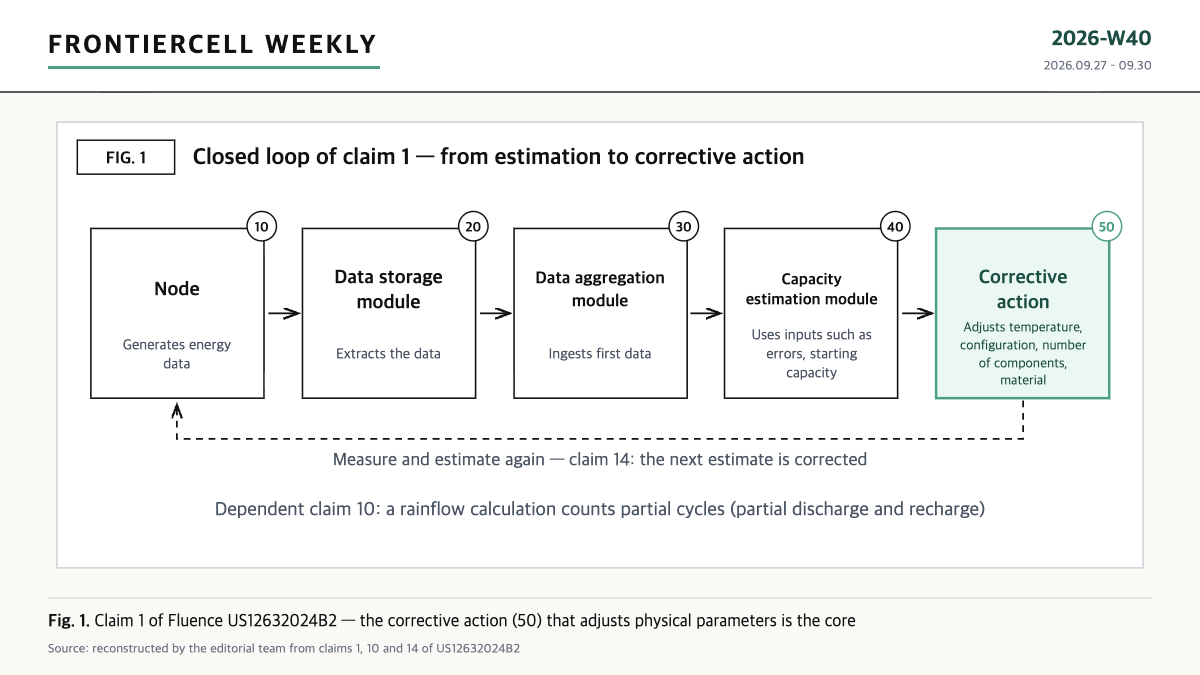
Source: reconstructed by the editorial team from claims 1, 10 and 14 of US12632024B2
The other ingredient is the rainflow calculation. It was originally a method from fatigue analysis of machine parts for splitting an irregular load history into cycles by size, and it is set out in the standard practices for cycle counting (ASTM E1049). The name comes from pairing the peaks and valleys of a signal the way rain runs down a sloping roof. Applied to an ESS, it turns a day’s ragged charge-discharge record into “so many full cycles and so many shallow partial cycles.” Dependent claim 10 of US12632024B2 limits the capacity estimate to one that counts partial cycles (partial discharge and recharge) using exactly this calculation [3].
Following the flow of claim 1, the node (10) generates energy data, the data storage module (20) extracts it, the data aggregation module (30) ingests the first data, the capacity estimation module (40) calculates capacity using its inputs, and the corrective action (50) is carried out based on the result. Dependent claim 14 limits the adjusted physical parameters to correcting the next estimated capacity upward or downward, completing a structure in which measurement and action go round in one loop [3].
③ Comparison — Claim 1 Elements Mapped
| Claim 1 element (paraphrased) | Construction point | Room to design around (possibility) |
|---|---|---|
| (a) A node generating energy data, a processor and a memory | Does not limit the unit of the node (cell, module, rack, system) | Hard to avoid through the configuration itself |
| (b) Extract data with a storage module; ingest first data with an aggregation module | Modules are functional units, so different software structures may still fall within | Not dividing the modules is a weak basis on its own |
| (c) Determine an input that modulates the capacity determination and estimate capacity | Example inputs: sensor error, SOC error, starting capacity and variance, forgetting factor (claims 5–9) | Plain accumulation without such inputs leaves room to dispute construction |
| (d) Implement a corrective action based on the estimated capacity | Written as the processor implementing the action | An operation in which a person decides through a separate procedure leaves room to argue a difference |
| (e) Corrective action = adjusting one or more of temperature, configuration, number of components, material | Number of components may read on augmentation or reduction; configuration on rearrangement | Correcting only the displayed value without physical change is a different path |
Source: reconstructed by the editorial team from claims 1, 5–9 and 14 of US12632024B2
What this table shows: the front part of claim 1 — the data flow and the capacity estimate — is close to configurations in common industry use, and the weight of the rights rests on (d) and (e), that is, “physical action based on the estimate.” Any discussion of design-around also starts from those two elements.
④ Patent Perspective — Who Meets Which Form of Claim
Bibliography and filing flow. US12632024B2 was filed on November 14, 2022 (US17/986,348) and granted on May 19, 2026, and Google Patents shows an adjusted expiration date of October 21, 2044. A PCT application based on the same filing (PCT/US2023/071315, 2023-07-31) was published as WO2024107464A1. There are 22 claims; the independent claims are claim 1 (system), claim 15 (method) and claim 16 (non-transitory recording medium) [3]. No Korean counterpart appears in the Google Patents family list.
Gist of the claims. All three independent claims require a capacity estimate that passes through storage, aggregation and estimation modules, and a corrective action based on the result. The corrective action is defined as adjusting one or more of a node’s temperature, configuration, number of components or material. The dependent claims add the types of input (current-sensor error, SOC error, starting capacity and its variance, forgetting factor, scaling factor; claims 5–9), rainflow partial cycles (claims 10 and 20), simultaneous estimation across several nodes or several ESSs (claims 11 and 12) and a troubleshooting module (claim 13) [3].
Source: reconstructed by the editorial team from claims 1, 10, 14, 15 and 16 of US12632024B2
Scope of rights and risk of infringement. Because one concept is claimed in three forms, the candidate infringers can also split. Equipment and EMS (energy management system) suppliers that supply the system, operators that perform the method, and suppliers of software carrying the instructions may each meet a different claim. It should also be borne in mind, however, that when several parties divide the steps of a method claim among them, whether direct infringement is made out can be contested (US Court of Appeals for the Federal Circuit, Akamai v. Limelight, 2015 en banc decision) [4].
Design-around scenarios (counterarguments). First, an operation in which the system only reports the estimate and a person decides augmentation or rearrangement through a separate procedure leaves room to argue a difference from the element “the processor implements a corrective action.” Second, a software action that corrects only the displayed capacity without changing any physical parameter may fall outside element (e). Third, because effect is country by country, as long as no Korean counterpart is confirmed, this patent is unlikely to bear directly on domestic business. Fourth, the same search turned up modular ESS patents such as The AES Corporation’s US9929594B2 (priority 2015-05-26, “Modular energy storage method and system”), which could be a candidate for comparison when examining the possibility of invalidity (this article did not compare the claims).
⑤ Limits and Outlook
Counter-scenario: because the front part of the claims is close to generic data processing, in the United States it may be exposed to invalidity challenges based on patent eligibility (Alice Corp. v. CLS Bank, 2014) or prior art [5]. What role the element of adjusting physical parameters would play in such challenges can only be judged after checking the prosecution history. And if operators manage augmentation decisions through contracts and manual procedures, the practical impact of this patent may be limited.
Strategic alternative: companies that operate ESS or supply EMS in the United States would be safer documenting the decision boundary between “estimation” and “physical action,” and, if they have automatic augmentation or automatic rearrangement functions, comparing those functions against claim elements (d) and (e). Writing clear patent warranty and indemnity clauses into supply contracts is also worth considering.
Practical action: review the prosecution history (amendment record) of US17/986,348 in USPTO Patent Center to see when and why the limitation to “adjusting physical parameters” was added. It is the starting point for claim construction and any prosecution history estoppel analysis.
This article is a technology and patent commentary based on public sources and is not legal advice on any specific matter.
Items Requiring Verification
- The prosecution history (amendment record) of US17/986,348 was not checked — when and why the corrective-action limitation was added is not confirmed.
- Whether WO2024107464A1 entered national phases was checked only against the Google Patents family list (no Korean counterpart shown).
- Whether this patent is actually applied in Fluence products (EMS) was not found in public sources.
- The claims were not compared with prior patents such as US9929594B2.
Sources
- pv magazine, “EVE Energy signs 206 GWh battery framework with storage supplier Fluence,” 2026-09-18. Article link
- ZDNet Korea, “Government ESS round 3 begins with orders doubled; K-battery competition expected to intensify” (Korean-language article), 2026-09-22. Article link
- Google Patents, US12632024B2 “Systems and methods for managing capacity of an energy storage system,” bibliographic data, claims 1–22 and family list (original checked 2026-09-27).
- Akamai Technologies, Inc. v. Limelight Networks, Inc., 797 F.3d 1020 (Fed. Cir. 2015) (en banc).
- Alice Corp. v. CLS Bank International, 573 U.S. 208 (2014).
- ASTM E1049, Standard Practices for Cycle Counting in Fatigue Analysis (defines the rainflow counting method).
Related Reading
- The ESS War AI Data Centers Ignited — What the LFP Three-Way Order Race and the Third Central Contract Market Auction Reveal
- How to Read a Battery Spec Sheet — What Wh, Ah, Wh/kg, C-rate, and SOH Tell You, and What They Don’t
- What’s the Difference Between A1 and B2 After a Patent Number? — A Primer on Reading Battery Patents Through Publication, Grant, and Expiry
FRONTIERCELL WEEKLY · 2026-W40 (2026.09.27–09.30)
More from this week’s Frontiercell Weekly
- Twice a Day for 25 Years — The 18,250 Cycles a Jeju ESS Contract Asks of a Cell (published Sept 27)
- The Equipment Arrived in Spring, the Cells in Autumn — What CATL’s Debrecen Trial Production Shows About a European Plant’s Critical Path (published Sept 29)
- [Patent Analysis] Screening Out Defective Cells From the First Charging Curve — The Boundary of the Formation-Data Method Claimed in CATL US12540983B2 (published Sept 30)