Korea’s 2026 central contract market for ESS (energy storage systems) has, for the first time, opened a 25-year contract in Jeju. The condition is a facility “capable of two charge-discharge cycles a day for 25 years.” Multiply the days and you get 18,250 cycles; the highest cycle life announced for a cell or system this year is 15,000. This article looks in turn at whether cells must close that gap, whether the contract’s definitions and operating design close it, and who already holds the rights in Korea to technology that “revives” capacity.
① What Is the Story
To put the point first: the real issue in this tender is not the cell specification but the definition of “one charge-discharge cycle.” On September 22, 2026, the Ministry of Climate, Energy and Environment announced that it had opened the 2026 ESS central contract market and would select generators for a total of 1,180 MW. According to reports, the program builds 1,100 MW on the mainland and 80 MW in Jeju by February 2029; bids are accepted until November 11 and winners will be chosen in November [1][2]. The first and second markets awarded 563 MW and 565 MW respectively, so the scale has roughly doubled [2].
The industry setting is familiar. Selected operators sign 15-year long-term contracts with the Korea Power Exchange. What is new is the Jeju exception. For facilities with long life that can charge and discharge repeatedly, the contract term can be chosen up to 25 years, and the government cited the character of Jeju’s grid, where a high share of wind power means storage must also charge at night [1][2].
The tension lies in the numbers. Assuming two full charge-discharge cycles every day of the year, 25 years is 18,250 cycles. By contrast, Pylontech’s 601Ah LFP (lithium iron phosphate) cell, which entered mass production on September 21, 2026, is rated at more than 12,000 cycles [4]; Envision’s 790Ah cell announced in April at more than 15,000 [5]; and CATL’s sodium-ion ESS unveiled in June at 15,000 [6]. So the question this article answers is this: who closes the gap between 18,250 and 15,000, by what means, and which of those means are tied up in patents?
② Basic Principles — What Percentage Is “One Charge-Discharge Cycle”?
Cycle life resembles the recommended mileage of a running shoe. Even a shoe said to last 800 km does not wear out by the same “count” for someone who runs 10 km a day and someone who runs 1 km several times a day. A battery’s cycle life likewise only means something when it is stated together with the depth of discharge (DoD, the share of capacity used in one go), the temperature, the charge-discharge rate, and the criterion for declaring end of life (80% or 70% of initial capacity).
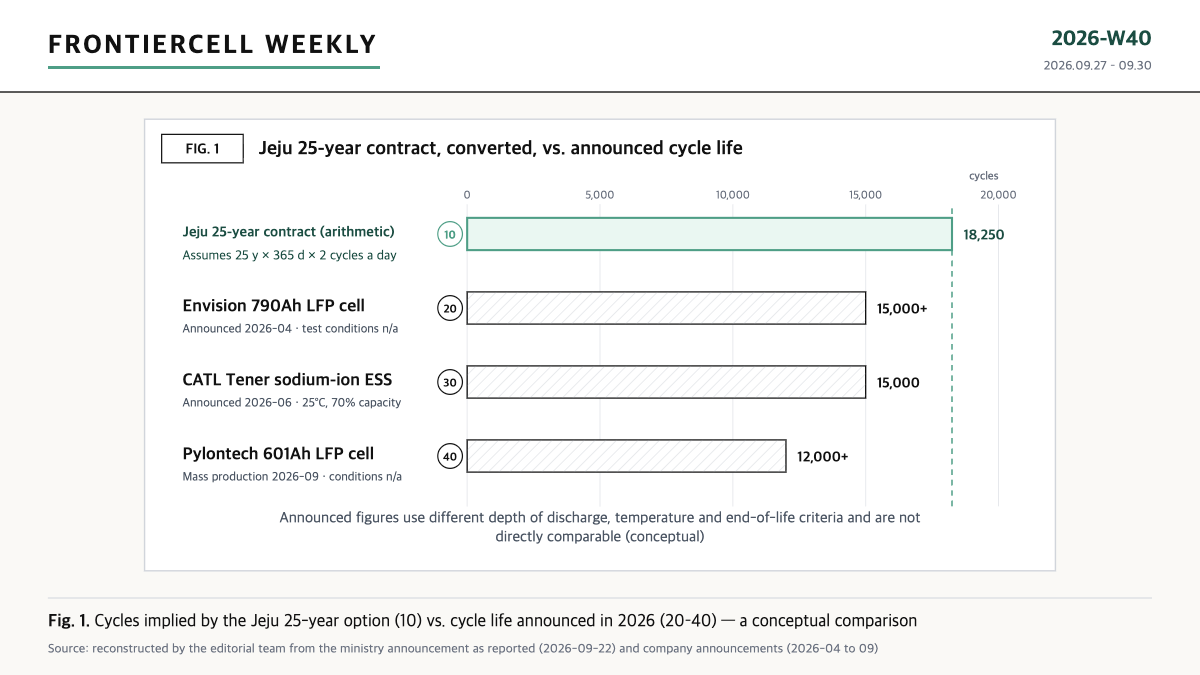
Source: reconstructed by the editorial team from the ministry announcement as reported (2026-09-22) and company announcements (2026-04 to 09)
In fact, the 15,000 cycles claimed for CATL’s sodium-ion ESS are a figure at about 25°C against a 70% capacity criterion, converted into 25 to 30 years of operation [6]. Pylontech’s and Envision’s announcements do not show their test conditions [4][5]. Meanwhile, the wording of the Jeju exception, as reported, says only “two charge-discharge cycles a day” and does not state a depth of discharge or an end-of-life criterion [1]. There is as yet no guarantee that the cycles on a cell specification sheet and the cycles in the contract are the same unit.
It is also worth noting how life is lost. The patent examined in section ④ defines its target as “a battery in which active lithium has degraded” [7]. Each time the cell cycles, the protective film on the negative electrode (the SEI) grows slightly and locks up lithium that could otherwise shuttle back and forth, much as a fee is deducted from a bank balance with every transaction. So there are three broad routes toward 18,250 cycles.
- Use less — reduce the depth of discharge to lower the “fee” taken each time.
- Add more — install ample capacity from the start, or add modules during operation (augmentation).
- Revive — resupply the lost active lithium inside the cell.
③ Comparison — Contract Requirement vs. Announced Figures
| Item | Cycles (announced / converted) | Conditions / end-of-life criterion | Date / source |
|---|---|---|---|
| Jeju 25-year contract (requirement) | 18,250 (arithmetic conversion, assumption) | Depth of discharge and criterion not stated (as reported) | Announced 2026-09-22 [1][2] |
| Pylontech 601Ah LFP cell | More than 12,000 | Conditions not disclosed · 425.8 Wh/L · 96.5% energy efficiency | Mass production 2026-09-21 (reported 09-24) [4] |
| Envision 790Ah LFP cell | More than 15,000 | Conditions not disclosed · calendar life up to 30 years · 96% cell efficiency | Reported 2026-04-09 [5] |
| CATL Tener sodium-ion ESS | 15,000 | About 25°C · 70% capacity criterion · converted to 25–30 years | Reported 2026-06-22 [6] |
| BYD MC Cube / HiNa sodium-ion ESS | 10,000 | Conditions not disclosed (mentioned for comparison) | Reported 2026-06-22 [6] |
Source: reconstructed by the editorial team from reports of the ministry announcement [1][2] and reports citing company announcements [4][5][6]
What this table shows: even the highest announced figure, 15,000 cycles, is about 82% of the arithmetic 18,250. And because some figures disclose a 70% end-of-life criterion while others disclose none, any comparison at the bidding stage only holds once the conditions are aligned, before the numbers.
Because this gap is hard to close with a cell alone, operating design is likely to play the decisive role. If the two daily cycles are split into shallow ones, the load on the cell can be smaller than 18,250 full cycles; if they are used deeply, augmentation or replacement has to fall within the contract term. In the end, “25 years” is a number in the operating plan, not in the cell data sheet.
④ Patent Perspective — The Rights to “Revive” Are Already Registered in Korea
Of the three routes, “revive” is the most patent-dense. CATL’s US11984563B1 (priority 2021-11-01, filed 2024-01-16, granted 2024-05-14; original applicant CATL, current assignee Contemporary Amperex Technology Hong Kong) claims a method for recovering the capacity of a capacity-degraded lithium-ion secondary battery [7]. Claim 1 has five steps: (1) provide the capacity-degraded battery; (2) provide a recovery agent made of a p-phenylenediamine compound, a lithium salt and an organic solvent; (3) inject it into the battery; (4) let it react inside; and (5) pour out the reacted liquid and inject electrolyte again. Dependent claims add conditions such as an active-lithium loss rate of 5% or more (claim 3), 0.5–15 wt% each of the compound and the lithium salt (claim 8), and standing at 20–60°C (claim 12), while claim 15 claims the battery obtained by the method itself and names, in its list of cathode materials, olivine-structured phosphates including lithium iron phosphate [7]. In other words, the leading ESS chemistry sits inside the wording of the scope of rights.
Source: reconstructed by the editorial team from the claims of US11984563B1, US12100817B2 and KR102941179B1
According to the specification, the capacity recovery rate in some embodiments is 0.5–25%; a comparative example that left the reacted liquid in place instead of pouring it out showed lower capacity retention than all the examples, and with agents lacking the lithium salt or the amine compound the capacity barely changed [7]. The filing pattern is also worth noting. US12100817B2 (granted 2024-09-24), from the same priority, separately claims a recovery agent changed to lithium iodide (LiI) and an organic solvent [8]. One concept (inject, react, drain) has been split into patents by agent composition.
The right that bears directly on Jeju projects is not the US patent. Patents take effect country by country, so what matters in Korea is KR102941179B1 (granted 2026-03-19) in the same family, whose claim 1 consists of the same five steps as the US claim [9]. The party that practises a method claim is the one that actually performs the injection and reaction, so it is possible that the operator running and maintaining the facility for 25 years, rather than the cell maker, becomes the party facing a risk of infringement. The “add more” side, meanwhile — a system patent that adjusts physical parameters such as the number of components according to estimated capacity — is covered separately in this week’s patent analysis.
There are also design-around scenarios. First, recovery agents of compositions other than p-phenylenediamine compounds or lithium iodide may fall outside the wording of both patents. Second, omitting the drain in step (5) creates room to avoid the literal wording, though the effect may drop, as the comparative example in the specification shows. Third, a design that loads ample lithium at the manufacturing stage without any injection follows a different technical path altogether. In every case, however, the doctrine of equivalents and the other claims in the family must be considered together, so the conclusion is a matter for an individual FTO (freedom-to-operate) review.
⑤ Limits and Outlook
Counter-scenario: few operators may choose the 25-year contract. The longer the term, the more of the degradation and maintenance cost 25 years out must be priced into the bid, and if that uncertainty is large, the familiar 15-year contract becomes the rational choice. And if operators manage life through cell replacement and augmentation, injection-type capacity recovery may remain at the experimental stage, facing the hurdle of field safety verification.
Strategic alternative: cell and system suppliers would do better not to present cycle life as a single number but as a condition table — depth of discharge, temperature, end-of-life criterion and daily cycles — in the same format as the contract wording. If recovery-type maintenance is considered as a long-term option, injection paths and sealing structures should be considered at the cell design stage, but it is safer to start by checking FTO against KR102941179B1.
Practical action: bid teams should first confirm, in the Korea Power Exchange notice, how “two charge-discharge cycles a day” will be judged (depth of discharge, capacity retention criterion), and build a one-to-one comparison table against their own cell warranty conditions.
This article is a technology and patent commentary based on public sources and is not legal advice on any specific matter.
Items Requiring Verification
- Regional volumes: Newspim and ZDNet Korea reported 1,100 MW on the mainland and 80 MW in Jeju, while The Financial News reported 1,048 MW and 148 MW (the latter does not add up to 1,180 MW). The original Korea Power Exchange notice needs to be checked.
- The depth of discharge and capacity criterion behind “two charge-discharge cycles a day” were not found in the reports.
- The test conditions behind the cycle life of the Pylontech 601Ah and Envision 790Ah cells were not found in public sources.
- Whether CATL’s capacity recovery patent is used in actual commercial maintenance was not found in public sources.
- Whether a Korean counterpart of US12100817B2 (lithium iodide agent) exists was not checked.
Sources
- Newspim, “Climate ministry issues 1,180 MW energy storage tender; applications close Nov. 11” (Korean-language article), 2026-09-22. Article link
- ZDNet Korea, “Government ESS round 3 begins with orders doubled; K-battery competition expected to intensify” (Korean-language article), 2026-09-22. Article link
- The Financial News, “Government opens third ESS central contract market to select 1,180 MW of operators” (Korean-language article), 2026-09-22. Article link
- pv magazine, “Pylontech starts mass production of 588 Ah, 601 Ah storage cells,” 2026-09-24. Article link
- ESS News, “Envision launches 12.5 MWh AI storage system, starts production of 790 Ah LFP cell,” 2026-04-09. Article link
- Notebookcheck, “First sodium-ion battery ESS with 25-year service life comes in 30 MWh modules,” 2026-06-22 (citing CATL’s announcement). Article link
- Google Patents, US11984563B1 “Method for capacity recovery of lithium-ion secondary battery,” bibliographic data, claims and specification (original checked 2026-09-27).
- Google Patents, US12100817B2 “Method for capacity recovery of lithium-ion secondary battery,” bibliographic data and claim 1 (original checked 2026-09-27).
- Google Patents, KR102941179B1, bibliographic data and claim 1 (original checked 2026-09-27).
Related Reading
- The ESS War AI Data Centers Ignited — What the LFP Three-Way Order Race and the Third Central Contract Market Auction Reveal
- From 314 Ah to 587 Ah — The Design Challenges That Change When Scaling Up LFP Prismatic Cells for ESS
- How to Read a Battery Spec Sheet — What Wh, Ah, Wh/kg, C-rate, and SOH Tell You, and What They Don’t
FRONTIERCELL WEEKLY · 2026-W40 (2026.09.27–09.30)
More from this week’s Frontiercell Weekly
- [Patent Analysis] When an Augmentation Decision Becomes a Claim — The Boundary of ESS Capacity Management in Fluence US12632024B2 (published Sept 28)
- The Equipment Arrived in Spring, the Cells in Autumn — What CATL’s Debrecen Trial Production Shows About a European Plant’s Critical Path (published Sept 29)
- [Patent Analysis] Screening Out Defective Cells From the First Charging Curve — The Boundary of the Formation-Data Method Claimed in CATL US12540983B2 (published Sept 30)