On September 22, 2026, CATL began trial production of battery cells at its plant in Debrecen, Hungary. Installation of the production equipment was finished in the spring, but the door to trial production opened in the autumn, after the occupancy permit and environmental permits. This article looks at what trial production validates, and at how the process know-how that hardens at that stage, and the patents around it, are protected and enforced in Hungary, which sits outside the Unified Patent Court (UPC).
① What Is the Story
To put the point first: the critical path in bringing a European plant online was not equipment delivery but permitting and process validation, and the patent jurisdiction map around Debrecen differs from that of its neighbors. According to a report citing CATL’s announcement, the Debrecen cell plant secured all permits required for trial operation and began trial production on its first two lines on September 22. Phase 1 is 34 GWh, and once all facilities are ready it will reach 100 GWh, becoming CATL’s largest production base outside China [1].
In the industry context, the plant is CATL’s second European plant, announced in August 2022. Construction of the first cell building began in summer 2023, and modules have been produced since autumn 2024, with 537,000 made to date. Installation of production equipment was completed by spring 2026, and the company said it uses flexible production lines to meet customer needs [1].
The tension lies in the time in between. The plant obtained its occupancy permit in August and then met the remaining permits and the requirements of its Integrated Pollution Prevention and Control (IPPC) permit, while the authorities carried out repeated on-site inspections to follow up on issues that had raised serious concerns among residents. The target reported by Reuters in September 2025 was “production starting in late 2025 or early 2026” [1]. So the question this article answers is this: what does trial production settle, and how is the know-how settled at that point protected and contested in the jurisdiction of Hungary?
② Basic Principles — Trial Production Is a Restaurant’s “Soft Opening”
A new restaurant does not open its doors the moment the kitchen equipment is in. During a soft opening with a limited number of guests, it tunes the heat and timing of the recipes, the staff’s movements and the supply of ingredients. A battery plant’s trial production is the same. According to the report, the purpose of trial production is to set up, optimize and validate production equipment and manufacturing processes before full-scale mass production [1].
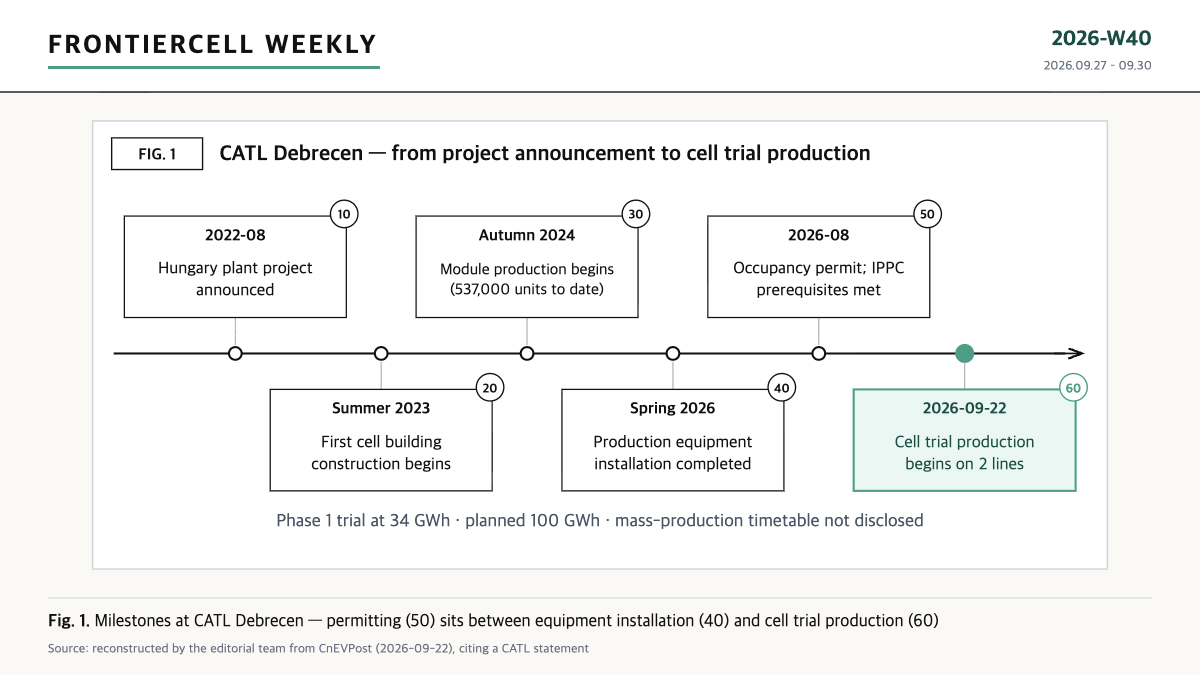
Source: reconstructed by the editorial team from CnEVPost (2026-09-22), citing a CATL statement
Validation has two layers. One is equipment commissioning — checking that each coater, winder, filling machine and charge-discharge unit runs to specification. The other is process validation — checking that the whole line of connected equipment turns out cells of the same quality again and again. Electrode thickness and uniformity, assembly alignment, electrolyte fill volume, and the data from the formation (activation) process, in which the first charge builds the protective film (SEI) on the negative electrode, must each come within their criteria in turn.
The formation process in particular is the stage where a cell “speaks” for the first time. A cell short of electrolyte or contaminated with moisture shows a different shape in its voltage and capacity curves during the first charge, and the method of screening out defective cells with that signal can itself be the subject of a patent. What remains when trial production ends is, in the end, a fixed process window (the recipe), and that is intellectual property.
③ Comparison — Milestones at the Debrecen Plant
| Stage | Date | Details | Source |
|---|---|---|---|
| Project announced | 2022-08 | CATL’s second European plant after Germany, planned capacity 100 GWh | [1] |
| First cell building construction begins | Summer 2023 | Construction of the cell production building starts | [1] |
| Module production | Autumn 2024 onward | 537,000 modules produced to date | [1] |
| Production equipment installation completed | Spring 2026 | Flexible production lines to meet customer needs (company statement) | [1] |
| Occupancy permit and permit requirements met | From 2026-08 | Occupancy permit after repeated on-site inspections of residents’ concerns; IPPC requirements met | [1] |
| Cell trial production begins | 2026-09-22 | First two lines, Phase 1 at 34 GWh | [1] |
| (Reference) earlier target | Late 2025 to early 2026 | Production start target as reported by Reuters in 2025-09 | [1] |
Source: reconstructed by the editorial team from CnEVPost (2026-09-22) [1], citing a CATL statement
What this table shows: the milestones between the completion of equipment installation (spring 2026) and cell trial production (September 22) were not equipment but the occupancy permit and environmental permits. The start also came later than the target reported in September 2025 (late 2025 to early 2026).
For equipment makers seeking to enter the European supply chain, this table shows the reality of revenue recognition. Even after the equipment is delivered, site acceptance tests and process validation are tied to the customer’s permitting schedule, and the technical support staff and data-handling capability needed during that period become a hidden cost of the contract.
④ Patent Perspective — Where to Keep the Recipe: Trade Secrets, Patents and Hungary
Trade secret or patent. Process conditions that harden during trial production usually remain trade secrets. The EU Trade Secrets Directive ((EU) 2016/943) protects know-how on the premise of reasonable steps to keep it secret, so managing people as they come and go at a new plant is managing the right itself [5]. Conversely, there is also the choice of accepting disclosure and tying a method up in a patent. CATL’s US12540983B2 (priority 2022-04-19, granted 2026-02-03) claims a method that puts two feature values obtained from first-stage formation data into a two-dimensional Gaussian model to screen out cells with electrolyte or moisture anomalies and remove them from subsequent production [6]. The same family was published as WO2023201531A1 and has been granted in Korea (KR102877176B1) and Japan (JP7697141B2), but the European counterpart (EP4382937A1) remains at the published stage [6]. The details and boundary of the claims are covered separately in this week’s patent analysis.
Hungary sits outside the UPC. The UPC Agreement has been signed by 24 EU member states and is currently in force in 18, and Hungary is classed as a state that has signed but not ratified it [2]. The Hungarian Constitutional Court held on June 29, 2018, that proclaiming the agreement was not compatible with the Fundamental Law [3]. A European patent therefore needs national validation to take effect in Hungary, and UPC unified actions and injunctions do not reach Hungarian territory. It would be a mistake, however, to read this as “outside the jurisdiction means safe.” In its judgment of February 25, 2025, in BSH Hausgeräte v Electrolux (C-339/22), the Court of Justice of the European Union held that the courts of the defendant’s domicile can rule on infringement of patents validated in other countries as well [4]. Moreover, the moment cells made in Hungary enter a carmaker’s plant in a UPC state, that product may again fall within the UPC’s reach.
Source: reconstructed by the editorial team from the UPC website [2], Bird & Bird [3], CJEU C-339/22 [4], Directive (EU) 2016/943 [5] and the family list of US12540983B2 [6]
Design-around scenarios (counterarguments). For a third party supplying formation equipment and analysis software to European plants, a design that provides only a raw-data interface and lets the customer choose the decision model, instead of shipping by default an analysis function configured like a method the customer has patented, could be one way to reduce the FTO (freedom-to-operate) burden. For CATL, conversely, keeping recipes other than the screening method it disclosed through a patent as trade secrets is likely to make the management of people and documents during trial production as important as filing patents.
⑤ Limits and Outlook
Counter-scenario: the optimistic view holds that, with the permitting issues resolved, the transition to mass production will be quick. Conversely, if new yield or skilled-labor problems surface during trial production, mass production could slip further. CATL has not disclosed a mass-production timetable [1].
Strategic alternative: Korean companies supplying equipment to European plants would be safer proposing a package that bundles “commissioning data plus process validation support” rather than a stand-alone machine, while writing into the contract first who owns the intellectual property in the data and analysis algorithms generated during validation.
Practical action: IP staff should check the examination status and designated states of EP4382937A1 in the European Patent Register, and review the clauses on ownership of data and algorithms in supply contracts for European plants.
This article is a technology and patent commentary based on public sources and is not legal advice on any specific matter.
Items Requiring Verification
- What the Phase 1 lines at Debrecen produce (cell format and chemistry) was not found in public sources.
- The timing of the switch to mass production has not been disclosed.
- Whether EP4382937A1 has been granted, and in which states it would be validated, needs to be checked.
- Whether the formation and screening method actually used at the Debrecen plant is the same as US12540983B2 cannot be confirmed.
- The number of UPC states in force (18) is as of the UPC website on 2026-09-27; later changes need to be checked.
Sources
- CnEVPost, “CATL begins trial cell production at planned 100 GWh Hungary plant,” 2026-09-22 (citing CATL’s announcement). Article link
- Unified Patent Court, “UPC Member States” (accessed 2026-09-27). Link
- Bird & Bird, “The Hungarian Constitutional Court has decided that the proclamation of the Agreement on a Unified Patent Court is not compatible with the Fundamental Law,” 2018. Link
- Court of Justice of the European Union, BSH Hausgeräte GmbH v Electrolux AB, C-339/22, judgment of 2025-02-25 (EUR-Lex). Link
- Directive (EU) 2016/943 of the European Parliament and of the Council of 8 June 2016 on the protection of undisclosed know-how and business information (trade secrets) (EUR-Lex). Link
- Google Patents, US12540983B2 “Method and apparatus for identifying abnormal battery cell, electronic device, and storage medium,” bibliographic data, claims and family list (original checked 2026-09-27).
Related Reading
- Europe’s Battery Market, Lost to China, Reopens Its Door to Korea’s Big Three — A Reshuffling of the Secondary-Battery Equipment Supply Chain
- How a Battery Cell Is Made — Electrode, Assembly, and Formation, and the Patents Attached to Each Step
- ITC Complaints, Invalidation Trials, Settlements — The Terms You Need to Read Battery Patent Dispute News
FRONTIERCELL WEEKLY · 2026-W40 (2026.09.27–09.30)
More from this week’s Frontiercell Weekly
- Twice a Day for 25 Years — The 18,250 Cycles a Jeju ESS Contract Asks of a Cell (published Sept 27)
- [Patent Analysis] When an Augmentation Decision Becomes a Claim — The Boundary of ESS Capacity Management in Fluence US12632024B2 (published Sept 28)
- [Patent Analysis] Screening Out Defective Cells From the First Charging Curve — The Boundary of the Formation-Data Method Claimed in CATL US12540983B2 (published Sept 30)