This article was written on 2026-09-23 and backdated to the date of the event (2026-05-18). Patent bibliographic data and claims were verified against the original on Google Patents on the writing date.
1. What’s the news
On 18 May 2026, secondary-battery assembly equipment maker MOT announced that it had signed supply contracts for next-generation secondary-battery assembly equipment worth KRW 40 billion in total. That is about 53% of its 2025 consolidated revenue of KRW 75.5 billion. The order was added to an existing backlog of KRW 42.9 billion[1].
Here is the industry context. MOT presents tab-welding equipment, which joins tabs to the cathode and anode so current can flow, and packaging equipment, which forms and seals the battery shape, as its main lines, and said it is responding as global cell makers broaden next-generation product families such as LFP, 46-series cylindrical, and all-solid-state[1]. The tension lies in the assembly process. The more electrodes are stacked or wound, the more layers of metal foil gather at the tab, and joining these multilayer foils firmly in one go has a narrow process window.
The question this article answers is this: why does multilayer metal-foil tab joining show a trend toward being split into “two steps,” and where are the rights to that approach tied up?
2. The underlying principle — the problem of stapling dozens of sheets of paper in one go
The tab of an electrode assembly is made by gathering the protruding portions of each electrode current collector (thin copper or aluminium foil) and joining them to a thick lead (tab lead). Ultrasonic welding bonds metal to metal as a horn vibrates at high frequency and rubs between the foils. By analogy, it is like trying to staple dozens of sheets of paper in one go. Press once, and the top tends to tear while the bottom tends to bond less. So a two-step configuration is discussed: first lightly bind the foils together into one block (pre-joining), then join the lead onto that block (main joining).
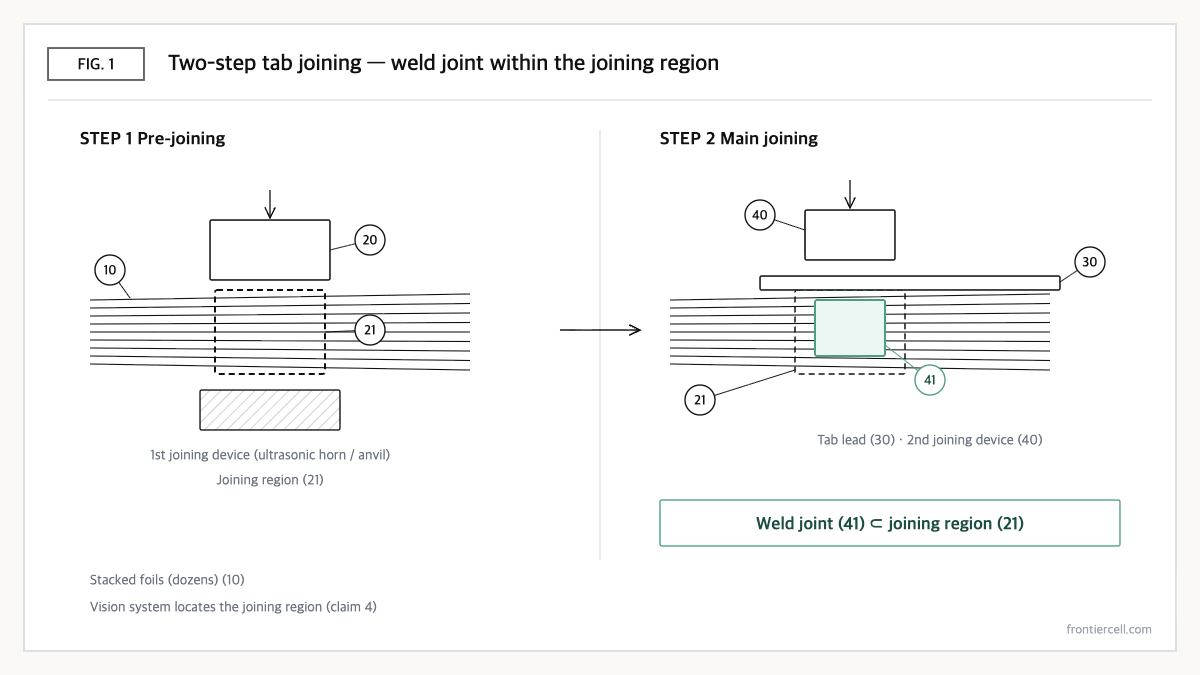
Source: reconstructed by the editorial team from the structure of claims 1–4 of US11710879B2 on Google Patents[2] (original drawings not reproduced). Unrelated to the process configuration of MOT’s equipment.
Splitting into two steps lets the conditions of each step be set separately. The step that binds the foils is tuned to the number of layers and foil thickness; the step that joins the lead is tuned to lead material and thickness. In exchange, aligning the second weld so that it does not stray outside the region bound in the first becomes a new task. This is where vision (camera) alignment enters the assembly equipment.
3. Comparison — what MOT’s order disclosure shows
| Item | Disclosure | Note |
|---|---|---|
| Contract size | KRW 40 billion (next-generation secondary-battery assembly equipment) | Announced 2026-05-18[1] |
| Relative to revenue | About 53% of 2025 consolidated revenue of KRW 75.5 billion | Per company announcement |
| Backlog | Existing KRW 42.9 billion + this KRW 40 billion | Exceeds KRW 80 billion per the report’s subheading |
| Main equipment | Tab-welding equipment; packaging (shape forming and sealing) equipment | Company description |
| Product families addressed | LFP, 46-series cylindrical, all-solid-state | Company description (target product of this contract not disclosed) |
| Preceding orders | April 2026: about KRW 7.99 billion secondary-battery component manufacturing equipment contract with a Korean automotive precision-parts maker; about KRW 2 billion ERCV automation line | Per report[1] |
| Customer | Not disclosed | — |
Source: reconstructed by the editorial team from a Newspim report[1]. The counterparty and target cell format were not confirmed in the report.
What this table shows: more notable than the order size is that the company defined itself as “tab welding + packaging.” Because next-generation cells change the number of stacked electrodes and the cell size, the value of assembly equipment is more likely to be decided not by speed but by the process window for joining multilayer foils uniformly.
4. The patent view — the rights to “joining twice” attach to a positional relationship
A case showing how joining multilayer foils in two steps was claimed is GM Global Technology Operations LLC’s US11710879B2, “Method and apparatus for welding foils.” Priority and filing date 2021-04-13; grant date 2023-07-25; status Active; adjusted expiration 2042-01-25; 17 claims; with counterpart filing records in Germany (DE) and China (CN)[2].
| Claim element (gist of original) | Generic one-step tab ultrasonic welding | Correspondence |
|---|---|---|
| [Claim 1] (a) Arranging a plurality of foils in a stack | Foil stacking | Yes |
| (b) Joining the foils via a first joining device, the first joining device defining a joining region | No pre-joining step | No |
| (c) Arranging a portion of the cell tab on the foils | Placing the lead on the foils | Yes |
| (d) Joining the tab to the foils via a second joining device, generating a weld joint | Lead and foils joined in a single weld | Partial |
| (e) The weld joint generated by the second joining device is encompassed within the joining region defined by the first joining device | No such concept | No |
| [Claims 2–3] The first joining is ultrasonic welding; foils stacked and clamped on an anvil, ultrasonic force applied by a horn | Ultrasonic welding | (dependent) |
| [Claim 4] A vision system identifies the joining region and determines its spatial location; the weld joint is encompassed within that location | No vision alignment | (dependent) |
Source: reconstructed by the editorial team from claims 1–4 of US11710879B2 on Google Patents[2]. The reference is a generic process; no determination is made as to whether the equipment of MOT or any other company practises the patent or infringes it.
The insight to take from this patent is that the core of the rights is not “weld twice” but the positional relationship that “the second weld joint falls within the first joining region.” Claim 1 does not limit the method of the second joining device, so other joining methods such as laser may be literally included. And claim 4 claims a configuration that uses a vision system to find the location of the joining region and align the weld, showing that designs integrating vision alignment into assembly equipment can come under review.
As design-around scenarios, candidates for review are (1) optimising conditions to finish in a single process without pre-joining, and (2) a configuration that deliberately places the main joint partly overlapping the pre-joining region. However, (2) runs counter to the purpose of the claims (reducing porosity and cracks), so a loss of quality may have to be accepted, and results may vary with how “encompassed” is construed. Korean counterpart filings were not checked this time.
5. Limits and outlook
On the optimistic view, as next-generation cell formats multiply, cell makers must lay down new assembly processes for each format, and orders for assembly equipment such as tab welding and packaging continue.
There is also a counter-scenario. Dependence on a single contract cuts both ways. With a contract worth more than half of revenue, if the customer’s investment schedule slips once, the timing of revenue recognition slips with it. As long as the customer and target format are undisclosed, reading this order as a mass-production signal for a particular next-generation cell may be premature.
As a strategic alternative, state “joining sequence and positional relationship” as a separate item in assembly-equipment specifications. A specification listing only process parameters (amplitude, pressure, time) makes an FTO review impossible, and whether vision alignment is used should also be visible at the specification stage.
Action to check (planning and IP staff): Ask the supplier whether the tab-welding equipment you plan to adopt uses a two-step configuration that pre-joins the foils and then main-joins the lead, and whether it uses vision to find the pre-joining region and align the main-joining position. If both apply, put claims 1 and 4 of US11710879B2 on the FTO review list.
Items requiring verification
- The counterparty, target cell format, and delivery schedule of MOT’s contract were not confirmed in the report.
- The joining process configuration of MOT’s equipment (number of steps, use of vision alignment) was not checked, and the patent comparison in the text does not suggest infringement by that equipment.
- Korean counterpart filings for US11710879B2 were not checked.
Sources
- Newspim, “MOT wins KRW 40 billion order for next-generation secondary-battery assembly equipment” (in Korean), 2026-05-18. Article link
- Google Patents, US11710879B2, “Method and apparatus for welding foils,” bibliographic data and claims 1–4 (verified against the original on 2026-09-23). Original
RELATED READING