1. What’s at Stake
The clearest signal confirmed in Korea’s secondary-battery equipment industry this week is not that orders have declined, but that the items being ordered are themselves changing.
As the slowdown in EV demand drags on, the pace of new line expansion has clearly slowed. So what are equipment makers actually selling right now — this is the real question left for equipment-planning staff. Overlaying the exhibition layout of the 5th Secondary Battery Materials, Components & Equipment Show (K-BATTERY SHOW 2026), held September 9–11 in Hall 7 of KINTEX’s second exhibition center in Goyang, Gyeonggi Province, with the order/procurement announcements disclosed around the same period begins to sketch the outline of that answer.
This year’s show, themed “More Than Battery: The Future of Energy,” was co-hosted by Korea E&Ex and the Korea Battery Industry Association, with 185 companies participating from Korea and abroad. What stands out is not the scale of participation but the exhibition category structure. Core materials — cathode, anode, separator, electrolyte, current collector, additives — were placed alongside manufacturing/automation equipment, inspection/measurement equipment, charging systems, ESS, EV charging infrastructure, and battery reuse/recycling technology. On top of that, a dedicated EV Fire Safety & Battery Protection zone was set up as its own section, gathering fire prevention, detection, and suppression technologies for EVs and ESS, along with battery safety solutions.
2. The Basic Mechanism — Expansion Orders and Reinforcement Orders Come from Different Budgets
An analogy to home construction makes this easier to grasp. Line expansion is building a new house. A production capacity (CAPA) target is set first, and coaters, presses, slitters, and winders are ordered as a set to meet it. The order trigger is order backlog, and the decision-maker is generally the cell maker’s investment organization.
Reinforcing safety, inspection, and back-end processes, by contrast, is closer to redoing the wiring and fire-suppression systems of a house that’s already built. Orders happen even when production capacity isn’t growing, because the trigger is externally imposed — standards, certification, incident response. The decision-maker also shifts from the investment organization toward the quality/safety organization. Because the two kinds of orders come from entirely different budget line items, reinforcement spending doesn’t stop just because expansion does.
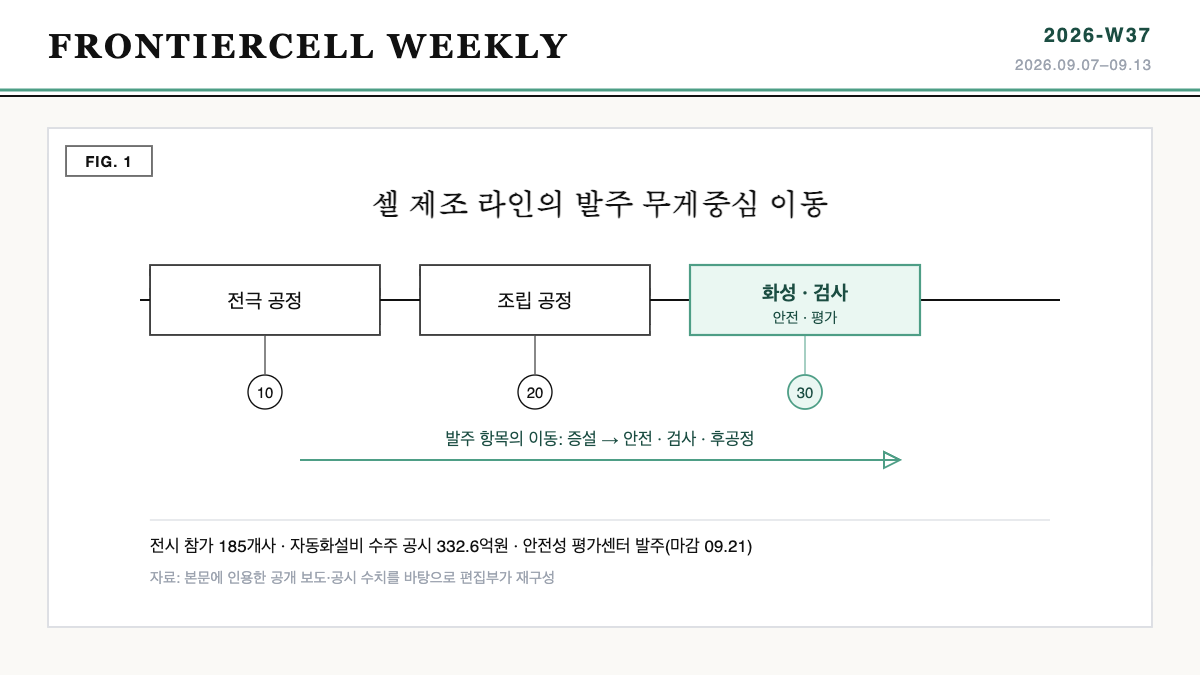
Source: editorial reconstruction based on the exhibition structure and disclosures cited in the text.
This is why this week’s signal matters. Inspection/measurement and reuse/recycling occupied sections on par with materials in the exhibition’s category structure, and fire response was broken out into its own dedicated zone — meaning that, as read by the organizers, attendees’ purchasing interest has shifted in that direction.
3. Comparison — Three Order Signals Confirmed This Week
| Category | Case confirmed this week | Verifiable figures | Order trigger |
|---|---|---|---|
| Exhibition/demand confirmation | 5th Secondary Battery Materials, Components & Equipment Show (K-BATTERY SHOW 2026), KINTEX Exhibition Center 2, Hall 7, 2026.09.09–09.11 | 185 participating companies; 1 new EV Fire Safety zone established | Attendee purchasing interest (organizer’s planning judgment) |
| Automation equipment order | J’s Robotics, robotics automation equipment supply contract for secondary battery manufacturing processes (disclosed 2026.09.02) | KRW 33.26 billion / 108.48% of recent annual revenue / contract period 2026.09.01–2027.08.31 | Customer order (counterparty and region undisclosed; sales/supply region overseas) |
| Safety infrastructure order | Korea Automotive Technology Institute, electrical construction of a new xEV energy storage system safety evaluation center | Bid deadline 2026.09.21 | Building safety-evaluation infrastructure (public sector) |
What this table shows: none of the three cases takes the form of “expanding the line by X GWh” — all are framed as process-quality items: automation, safety, and evaluation. The J’s Robotics case in particular was disclosed as ‘robotics automation equipment,’ not an expansion project, even though the contract value exceeds the company’s most recent annual revenue (108.48%) — a single case, but one that illustrates the character of the order category.
4. Patent Perspective — The Barrier to Entry in This Space Is Not Hardware but the ‘Method of Operation’
There is a point here that IP staff can easily overlook. Expansion-type equipment generally competes on mechanical structure — roll layout, die geometry, frame stiffness, and the like. Claim scope in the inspection/safety/process-quality space, by contrast, is more often built as a ‘method claim’ rather than a device claim — and within that, frequently as the temporal sequence of process parameters.
US10476097B2 (Envision AESC Energy Devices Ltd, granted November 12, 2019, priority April 16, 2015), covered in a separate article in this issue, is a typical example. Claim 1 of this patent takes the common process of electrolyte injection and stakes its claim on the pressure profile itself — beginning injection under atmospheric-pressure conditions and then performing injection and pressure reduction intermittently and alternately.
Source: editorial conceptual diagram reconstructed from the gist of US10476097B2 claim 1 (not a reproduction of the original patent drawings or text).
In a structure like this, even a completely newly designed piece of equipment can carry infringement risk if its recipe sequence overlaps. Put the other way around, the lever for a design-around also sits in the recipe rather than the hardware. Moving the start of pressure reduction to before injection begins, or using a monotonic pressure-reduction profile instead of alternation, become design-around candidates.
Rebuttal — this doesn’t mean design-around is easy. What makes process-parameter claims tricky is that a design-around can translate directly into degraded process performance. If the claimed profile is in fact the optimum, the design-around recipe pays the price in longer impregnation time or a higher defect rate. This is why FTO (freedom-to-operate) review should not be legal work alone, but something conducted together with process engineers.
5. Limits and Outlook
This observation has clear limits. First, a new exhibition category may reflect market demand, but it could equally be the organizer’s own planning and marketing judgment. Second, in the J’s Robotics order, the contracting counterparty is undisclosed at its request to protect trade secrets, and the sales/supply region is disclosed as overseas, so this is difficult to use as evidence of domestic equipment demand.
Counter-scenario to the optimistic outlook: the growth in safety and inspection orders may not be a “new growth axis” at all, but temporary substitute demand that appears during the lull between expansion cycles. Standards-compliance investment tends to require fewer repeat orders once completed, so its share could fall back once expansion resumes.
Strategic alternative: the safer reading, then, is not to treat safety/inspection items as a ‘new revenue stream,’ but as a shift in bid-qualification requirements. When the next expansion cycle comes around, equipment makers without a track record of safety-evaluation-standard compliance are more likely to be filtered out at the quotation stage. Today’s reinforcement-type orders function more as a window for building that track record.
Action item (for planning/IP staff): Check whether ‘safety-evaluation and inspection-standard compliance’ appears in your company’s equipment proposals as an independent chapter, not just a supplementary note. If it doesn’t, compiling a list of applicable standards and a testing track record within this quarter will reduce your cost in the next bid.
Also in This Week’s Frontiercell Weekly
FRONTIERCELL WEEKLY 2026-W37 · 2026.09.07–09.13
- [Patent Analysis] Filling Electrolyte ‘Atmospheric-Pressure First,’ Not ‘Vacuum First’ — The Claim Boundary of the Reduced-Pressure Cycle Drawn by US10476097B2
- Every Time a Satellite Enters Shadow — Where Space-Grade Batteries Diverge from Ground Cells
- [Patent Analysis] The Sun That Warms Also Locks the Heat Path — The Claim Boundary of Lockheed Martin’s Satellite Battery Thermal Management Patent (US7967256B2)
Pingback: Every Time a Satellite Enters Shadow — Where Space-Grade Batteries Diverge from Ground Cells - Frontiercell