This article was written on 2026-09-23 and backdated to the date of the event (2026-05-15). Patent bibliographic data and claims were verified against the original on Google Patents on the writing date.
1. What’s the news
On 15 May 2026, Teledyne DALSA announced “Kaleido,” a short-wave infrared (SWIR) hyperspectral camera for industrial sorting. The disclosed specifications are a spatial resolution of up to 1,280 pixels, line rates exceeding 2.3 kHz, and a 10 GigE interface. The company named recycling, food safety, pharmaceuticals, and waste management as its main applications[1].
Here is the industry context. The mainstream of machine vision has been visible-light cameras similar to the human eye, with judgements made on shape and colour. The tension shows up in processes such as battery recycling. Copper foil, aluminium foil, and cathode powder in shredded cell fragments are hard to tell apart by colour alone. On the research side, attempts have been reported to distinguish copper and aluminium foils in shredded lithium-ion batteries with hyperspectral imaging[2]. The barrier that hyperspectral is expensive and slow remained, and Kaleido was described as targeting exactly that cost-to-performance ratio[1].
The question this article answers is this: whose rights covered the basic configuration of hyperspectral sorting, and after those rights lapsed, where does the remaining wall stand?
2. The underlying principle — a camera that takes a “fingerprint” at every pixel
An ordinary colour camera obtains only three values — red, green, and blue — at each pixel. A hyperspectral camera obtains reflectance intensities in tens to hundreds of wavelength bands at each pixel. By analogy, if a colour camera tells people apart by the colour of their clothes, a hyperspectral camera tells them apart by fingerprint. Because each substance has a different pattern of absorbing particular wavelengths, even powders of the same black colour can be separated by the shape of their spectrum. In line-scan operation, objects passing on a conveyor are captured one line at a time, and a spectrograph spreads the light of that line by wavelength onto the sensor.
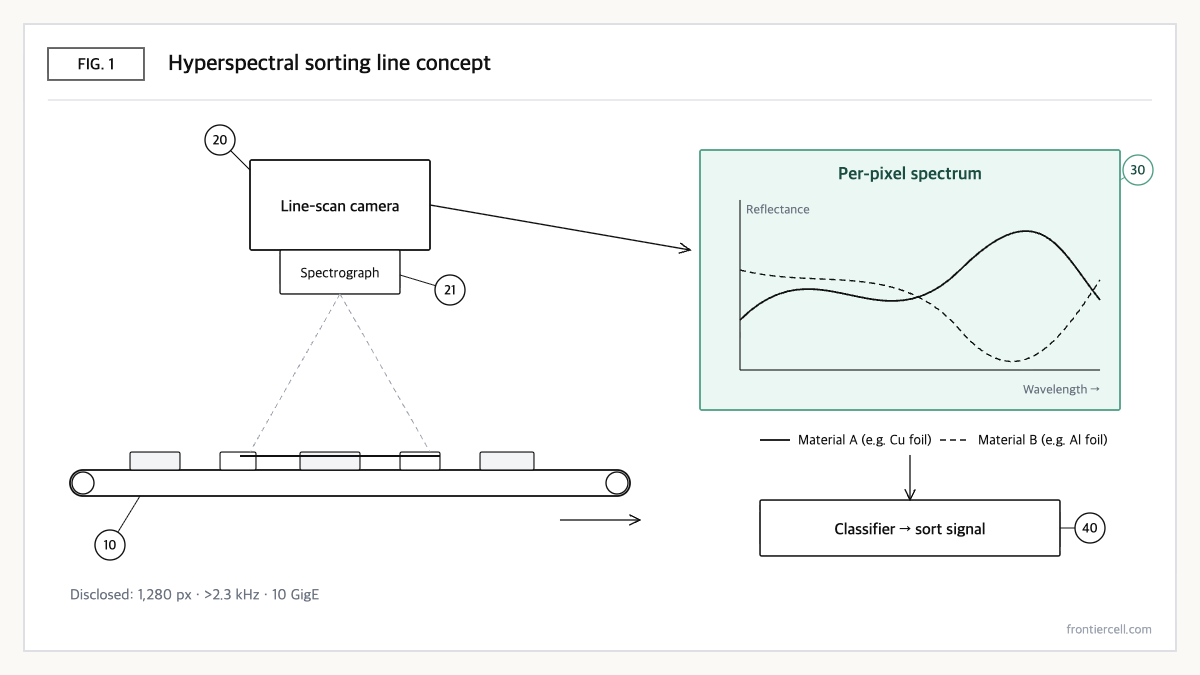
Source: reconstructed by the editorial team from the disclosed specifications in Teledyne’s announcement[1] and the structure of claim 1 of US7449655B2[3]. The battery recycling application is an editorial example, not an application named by Teledyne.
The problem is data volume. With one more axis for wavelength, the data to be processed at the same line rate explodes. That is why Kaleido emphasised built-in spectral band selection, multiple regions of interest (ROI), and metadata tagging[1]. Sending only the wavelengths that are needed is itself speed. In this respect, hyperspectral converges on the same direction as edge AI vision: “reduce first, on the camera side.”
3. Comparison — Kaleido’s disclosed specifications and what a sorting line requires
| Item | Kaleido disclosure | Meaning for a sorting line |
|---|---|---|
| Spatial resolution | Up to 1,280 pixels | Sets resolution across the conveyor width |
| Line rate | Exceeding 2.3 kHz | Sets the ceiling on conveyor speed and throughput |
| Band selection | Built-in spectral band selection | Reduces transmission and computation |
| Correction | Spectrograph-based aberration correction; consistent calibration across units throughout the full operating temperature range | Less recalibration burden when running the same model on many lines |
| Data management | Metadata tagging, multiple ROI | Only regions of interest are sent to the processing engine |
| Interface | 10 GigE, compliant with GigE Vision and GenICam | Connectivity with existing machine-vision software |
| Lighting | Maintains signal in low light; allows SWIR LED lighting | Lower lighting power and heat |
| Named applications | Recycling, food safety, pharmaceuticals, waste management | Batteries not named |
Source: reconstructed by the editorial team from Teledyne’s announcement[1]. Wavelength range and price were not disclosed in the announcement; all items are company-announced values.
What this table shows: more than half of the disclosed specifications are devoted not to sensor performance but to calibration, data reduction, and connectivity. This reads as a sign that competition in hyperspectral sorting is moving from “a sensor that sees better” to “a system that is cheaper to install on site.”
4. The patent view — the sensor configuration is free, and the wall has moved to “what you sort toward”
A prior patent that shows the basic configuration of hyperspectral sorting is Qinetiq Ltd’s US7449655B2, “Apparatus for, and method of, classifying objects in a waste stream.” Priority date 2003-09-20; filing date 2004-09-20; grant date 2008-11-11; 16 claims; and on Google Patents its status is Expired – Lifetime (adjusted expiration 2025-03-12)[3]. The same page shows a family litigation flag, but the litigation details were not checked this time.
| US7449655B2 claim 1 element (gist of original) | Generic hyperspectral sorting line | Correspondence |
|---|---|---|
| (a) A hyperspectral sensor responsive in at least ten spectral bands | Hyperspectral line-scan camera | Yes |
| (b) A conveyor moving objects through the sensing region of the sensor | Conveyor | Yes |
| (c) A processor classifying objects of multiple material types in the waste stream from the sensor signals | Classification computer | Yes |
| (d) A broadband camera generating pixellated image data | Separate colour or monochrome camera | Depends on configuration |
| (e) Classify material per pixel → associate contiguous pixels of the same material with an object → associate a material with the object | Blob-level judgement after pixel classification | Yes |
| (f) Spectral signature analysis by a Support Vector Machine (SVM) algorithm | Other classifiers such as deep learning | Depends on algorithm |
Source: reconstructed by the editorial team from claims 1 and 5 of US7449655B2 on Google Patents[3]. As the patent has expired, the comparison serves to explain the technology trajectory and is not an infringement determination.
That this patent has expired means the skeleton of “hyperspectral sensor + conveyor + pixel classification + object-level judgement” is no longer blocked by this patent in the United States. That does not mean the sorting field has become free. An example of active rights is Sortera Technologies Inc’s US12017255B2, “Sorting based on chemical composition” (earliest claimed priority 2015-07-16; filing date 2022-03-16; status Active; adjusted expiration 2037-06-01; 15 claims)[4]. Claim 1 does not limit the type of sensor and claims a method of determining the mass of each piece and classifying it, then sorting so that the collected pieces possess a predetermined specific “aggregate chemical composition.”
The insight to take from this is as follows. The wall of rights has moved from “how you see” (sensor configuration) to “what you sort toward” (the composition target of the output). In processes such as recycled black mass, where the composition specification of the output is itself the selling price, the decision to write sorting logic as “composition-target” logic is more likely to become an FTO review item than the decision to buy a new camera. As design-around scenarios, sorting by count or area without mass measurement, and sorting only by purity grade without a composition target, are candidates for review, but actual non-infringement may vary with claim construction and each specific embodiment. Korean counterpart filings for the two patents were not checked.
5. Limits and outlook
On the optimistic view, as the cost of adopting hyperspectral cameras falls, judgements that colour could not see — separating metal foils in shredded cell fragments, or checking composition variation in electrode coatings — move inline.
There is also a counter-scenario. Hyperspectral sees the spectrum of the “surface.” If shredded material is covered with electrolyte residue or dust, the spectrum blurs, and when fragments overlap, pixel classification gets mixed. Without pre-treatment (washing, drying, dispersion), camera performance may not translate into sorting purity. That price and wavelength range were not disclosed is another reason to reserve judgement.
As a strategic alternative, evaluate hyperspectral adoption not by camera specification but as a bundle of “pre-treatment + judgement target.” If the judgement target is a composition specification, the FTO of that logic itself must be settled first; if it is a purity grade, the pre-treatment conditions must be settled first.
Action to check (planning and IP staff): Confirm in writing whether the judgement logic of your recycling or sorting line is “pass/fail per piece” or “matching the aggregate composition of a shipping lot.” If the latter, put claim 1 of US12017255B2 on the FTO review list.
Items requiring verification
- Kaleido’s wavelength range, number of bands, and price were not disclosed in the announcement.
- Teledyne did not name batteries as an application; the battery-recycling application in the text is the editorial team’s analysis.
- The litigation history of the US7449655B2 family and Korean counterpart filings for the two patents were not checked.
- Whether the products of companies mentioned in the text practise any specific patent was not checked, and no infringement is suggested.
Sources
- Teledyne Vision Solutions, “Teledyne Introduces Kaleido SWIR Hyperspectral Camera for High‑Speed Industrial Inspection,” 2026-05-15. Original
- IEEE Xplore, “Hyperspectral Unmixing Using Convolutional Autoencoder For Metal Detection In Lithium-Ion Battery Recycling Applications.” Original
- Google Patents, US7449655B2, bibliographic data and claims 1 and 5 (verified against the original on 2026-09-23). Original
- Google Patents, US12017255B2, bibliographic data and claim 1 (verified against the original on 2026-09-23). Original
RELATED READING