This article was written on 2026-09-23 and backdated to the date of the event (2026-06-24). Patent bibliographic data and claims were verified against the original on Google Patents on the writing date.
1. What’s the news
On 24 June 2026, Korea’s Ministry of Climate, Energy and Environment announced that it had prepared performance requirements for grid-forming, a grid-stabilisation technology, and would apply them first to “long-duration energy storage systems (ESS)” in the central contract market that begin commercial operation from December 2027.[1]
Here is the industry context. As renewables grow, more plants connect to the grid through inverters, and the inertia that rotating generators naturally provided declines. The tension comes from this. Conventional grid-following inverters passively “follow” the grid’s voltage and frequency[1], so when the reference itself wavers, they cannot hold a reference of their own. The government said it prepared performance criteria for transmission-level ESS in cooperation with KEPCO, the Korea Power Exchange, academia, and domestic inverter manufacturers[1].
The question this article answers is this: what do grid-forming requirements demand of ESS inverters, whose rights covered the basic control structure, and where do rights remain now?
2. The underlying principle — a singer following the accompaniment versus the accompanist who sets the pitch
A grid-following inverter measures the phase of the grid voltage and injects current to match it. It is like a singer who sings along to the accompaniment. A grid-forming inverter creates the magnitude and frequency of the voltage itself, and holds that reference when the grid wavers. It is the accompanist. As the government explained, grid-forming is a technology that controls inverter-based plants such as ESS and solar to form voltage and frequency on their own, and it can provide grid-stabilisation functions such as inertia and robustness[1].
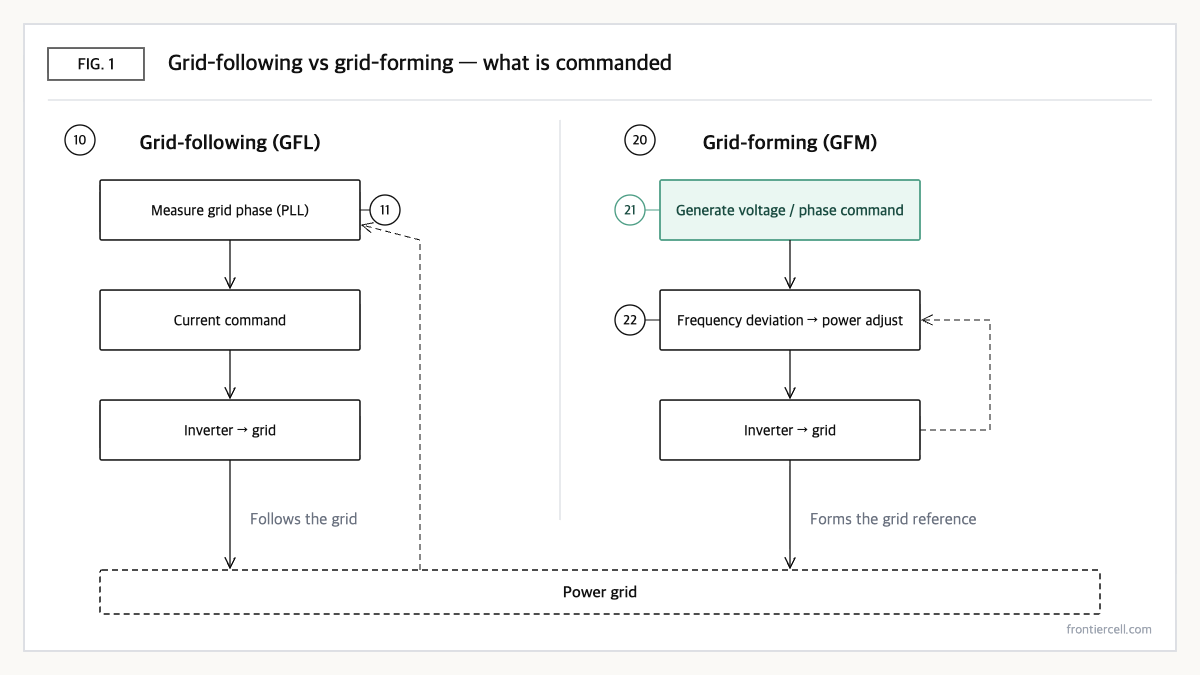
Source: reconstructed by the editorial team from reports of the Ministry of Climate, Energy and Environment’s announcement[1] and the structure of claim 1 of US5798633A[2].
The key is “what is commanded.” Grid-following commands current; grid-forming commands voltage and phase. So grid-forming requirements fall not on battery cells but on inverter control algorithms and on the power headroom those algorithms demand instantaneously (the power the battery can deliver at once).
3. Comparison — the two approaches and the application schedule
| Item | Grid-following (GFL) | Grid-forming (GFM) |
|---|---|---|
| Voltage and frequency | Passively tracks grid values | Formed on its own |
| Contribution to the grid | Centred on power supply | Provides grid-stabilisation functions such as inertia and robustness |
| Government application | — | Applied first to central-contract-market long-duration ESS due to begin commercial operation in December 2027 |
Source: reconstructed by the editorial team from an Industry News report citing the ministry’s announcement[1]. Detailed figures of the performance requirements were not disclosed in the report.
| Year | Long-duration ESS to be introduced | Region |
|---|---|---|
| 2027 | 540 MW | Mainland and Jeju |
| 2028 | 540 MW | (no regional breakdown in the report) |
| 2029 | 600 MW | Mainland |
Source: reconstructed by the editorial team from an Industry News report[1].
What this table shows: a window has opened for a combined 1,680 MW of long-duration ESS over three years to come in carrying grid-forming requirements. Because the requirements apply not to cells but to inverters, part of the value added in this volume may shift not to cell makers but to power conversion system (PCS) manufacturers.
4. The patent view — the skeleton was filed in 1996 and has already expired
Grid-forming is presented as a “new technology,” but the basic structure in which a battery ESS inverter prioritises frequency control was disclosed in a patent long ago. General Electric Co.’s US5798633A, “Battery energy storage power conditioning system,” has a filing date of 1996-07-26, a grant date of 1998-08-25, and 15 claims, and on Google Patents its status is Expired – Lifetime (anticipated expiration 2016-07-26)[2]. Its abstract explains that the system favours frequency control over power control and adjusts power in response to frequency shifts in the inverter output.
| US5798633A claim 1 element (gist of original) | Generic grid-forming inverter control | Correspondence |
|---|---|---|
| (a) A control system for a solid-state inverter coupling a DC source in parallel with a utility power system | PCS for battery ESS | Yes |
| (b) A gating logic circuit generating switching signals in response to a voltage command signal and a phase command signal (the phase command establishing output frequency and phase) | Voltage-source control | Yes |
| (c) A voltage regulator generating the voltage command from the difference between the selected load voltage and measured voltage | Voltage control loop | Yes |
| (d) A power regulator comparing inverter output frequency with a reference frequency to generate a power offset signal | Frequency-active power droop, etc. | Depends on implementation |
| (e) Generating a phase shift signal from the power offset and power error, summed with the measured phase, to regulate real power | Real-power control through phase-angle adjustment | Depends on implementation |
Source: reconstructed by the editorial team from claim 1 of US5798633A on Google Patents[2]. As the patent has expired, the comparison serves to explain the technology lineage and is not an infringement determination.
That this patent has expired means the skeleton of “running a battery inverter as a voltage source and prioritising frequency control” is not blocked by this patent. Active rights have moved into the details of implementation. For example, General Electric Renovables Espana SLGE Renovables España S.L.’s#8217;s US11671039B2 (priority and filing date 2020-12-10; grant date 2023-06-06; status Active; adjusted expiration 2041-01-27; 16 claims) claims closed-loop control that receives frequency and voltage reference commands from an external controller, determines a power reference, turns it into a current vector, and then rotates the d-q reference frame into the a-b-c reference frame using a phasor angle to obtain voltage commands; claim 2 limits this to emulating a virtual synchronous machine (VSM)[3]. Counterpart filings were confirmed in Canada, Europe, Spain, Denmark, Brazil, and China; a Korean counterpart was not confirmed this time.
The insight to take from this is as follows. Performance requirements set “what must be achieved,” and patents attach to “how it is achieved.” With the skeleton structure already expired, the FTO burden for Korean PCS manufacturers is more likely to arise not from meeting the requirements themselves but from the specific configuration of the control algorithm they choose. As design-around scenarios, a structure that generates voltage commands directly without passing through a current vector, and choosing a droop-based structure instead of virtual-synchronous-machine equations, are candidates for review, but actual non-infringement may vary with claim construction and each individual algorithm.
5. Limits and outlook
On the optimistic view, as the government said, Korean inverter manufacturers build on grid-forming capability to gain competitiveness in overseas markets as well[1].
There is also a counter-scenario. Grid-forming demands a “margin always kept free” in the battery. To emulate inertia, it must be able to deliver instantaneous power, so the capacity available for buying and selling energy in the power market shrinks accordingly. With detailed figures of the performance requirements undisclosed, it is hard to gauge how this margin affects business viability.
As a strategic alternative, settle grid-forming readiness before bidding not as “an inverter swap” but as a set of “power headroom + control algorithm + FTO.” If the algorithm comes from an overseas source, first check whether patents covering that algorithm are registered in Korea.
Action to check (planning and IP staff): If you are reviewing a bid for central-contract-market long-duration ESS, ask the supplier whether the grid-forming control of the PCS you will adopt is a current-vector-based virtual-synchronous-machine structure, and if so, search KIPRIS for a Korean counterpart of US11671039B2.
Items requiring verification
- Detailed figures of the grid-forming performance requirements (inertia constant, response time, etc.) were not disclosed in the report.
- The regional breakdown of the 540 MW of long-duration ESS for 2028 was not confirmed in the report.
- Korean counterpart filings for US11671039B2 were not checked, and the comparison in the text does not suggest infringement by any company’s product.
Sources
- Industry News, “Grid-forming, key to grid stabilisation, fully introduced… applied from long-duration ESS in 2027” (in Korean), 2026-06-24. Article link
- Google Patents, US5798633A, “Battery energy storage power conditioning system,” bibliographic data, abstract, and claim 1 (verified against the original on 2026-09-23). Original
- Google Patents, US11671039B2, bibliographic data and claims 1–2 (verified against the original on 2026-09-23). Original
RELATED READING