Cell Design & Structure
On October 1, 2026, BMW announced the formal opening of a Gen6 high-voltage battery[1] plant in Irlbach-Straßkirchen, Bavaria, a site that cost about 1 billion euros. The packs for the new i3 come off its two lines at several hundred a day. Counted in the order BMW describes the process, there are seven steps, and the one that caught my eye is the fourth, where foam sets between the cells. BMW wrote only that this foam secures safety, stability and durability. It did not say what the material is, whether it also blocks heat, or whether a hardened pack can be opened later. Yet filling the space between cells is ground that BMW itself and Rivian have already written into claim 1 of US patents.
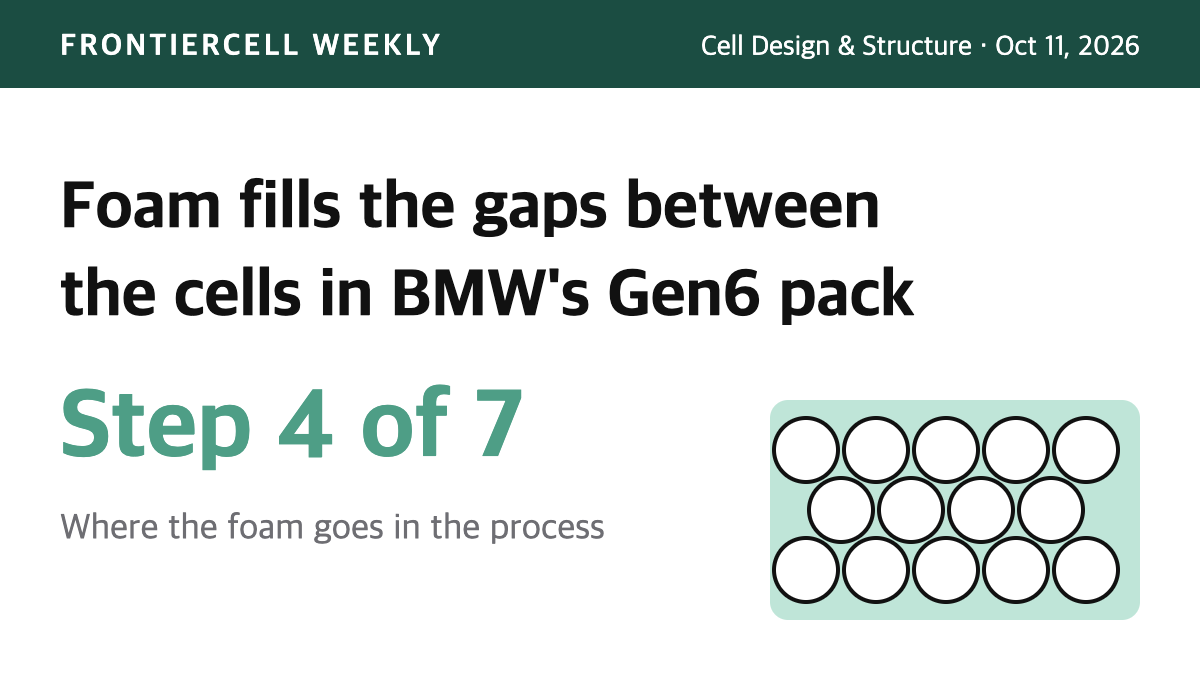
Source: Author’s reconstruction from the BMW Group press release (2026-10-01)
The mint-colored area is the foam (Figure 1). Stand cylindrical cells upright and the round bodies leave gaps between them whatever you do, and the plant fills those gaps with a material that hardens.
Seven steps off two lines in Irlbach-Straßkirchen
According to the BMW press release of October 1, 2026, construction began in April 2024, the first pre-series battery came out in March 2026, and two lines on two shifts build several hundred batteries a day. The site covers 60 hectares with 50,000 square meters of production area, about 500 robots, and about 1,600 staff at full operation. More than 3,500 data points are recorded for each battery. Output is given only as “several hundred” a day, so there is no figure that can be converted to GWh.
Gen6 assembly plants of the same kind also exist in Debrecen in Hungary, Shenyang in China, Woodruff in the United States and San Luis Potosí in Mexico. The first output of this plant goes to the new i3 built in Munich. The release names the cell maker only as a “leading cell manufacturer”, with no company name.
The release says the process starts by checking the voltage of incoming cells, and that BMW’s own AI assistants and agents analyze data gathered during assembly to raise overall equipment effectiveness (OEE). That incoming check is step one. The release does not number the steps; seven is a count that follows the order of its description, and some outside outlets count six by leaving out the incoming check.
Laid out in that order (Figure 2), cells that pass the check are attached to a cooler to form a cluster[2], a step the release says ensures optimal insulation and cooling. The clusters and the cell contact system are then laser-cleaned and welded, and after that comes the foam. The housing is closed, sealed and riveted, the central control unit called the Energy Master[3] is installed, and at the end of the line every single battery is inspected. A permanently elastic sealing adhesive is mentioned after the Energy Master is fitted; the flow chart leaves it out.
Source: Author’s reconstruction from the process description in the BMW Group press release (2026-10-01)
The order of welding and foam stands out. Welding comes first and foam second, so the check of the welds has to be finished before the foam goes in, by inference. Whether the foam covers the weld points, or whether they can be reached after it hardens, is not stated in the release. The reason foam gets a step of its own starts with how the cells stand.
The triangular gaps in a row of cylinders, and what the foam is for
Look down on cylindrical cells[4] standing on the floor of a pack and you see round circles in rows. However tightly they are packed, something close to a triangular gap remains between circles. Prismatic cells meet face to face and leave almost no gap, but cylinders cannot be shaped that way. The cell BMW chose for Gen6 is cylindrical, in a cell-to-pack[5] arrangement that puts cells straight into the housing with no modules (BMW press release, 2025-02-21).
How big the gaps are can be worked out simply. The assumptions are two: all cylinders have the same diameter, and the cells touch each other when set out. BMWBlog reports the Gen6 cell diameter as 46 mm, but the ratio below is the same for any diameter. One circle has an area of π/4 × d², and in a triangular lattice the cell that one circle occupies has an area of (√3/2) × d², so the share taken up by cells is π/(2√3), about 90.7 percent. In a square lattice it is π/4, about 78.5 percent. Either way, 9.3 to 21.5 percent of the cross-section is not cell, and in a real pack the cooler and housing walls add more gap.
A padded jacket is a handy picture. Quilting stitches divide the padding into compartments so the fill stays in its cell, whereas a jacket with the fill stuffed in without dividers tends to shift to one side. Modules are the dividers, and cell-to-pack drops the dividers and presses the fill to hold it instead. The picture fails on the cost of shifting. A shifted jacket is only uncomfortable, but in a pack, abnormal heat in one cell spreading to its neighbors, called thermal propagation[6], becomes a safety problem.
On top of this comes the structure BMW calls pack-to-open-body[7]. BMW says the battery takes a structural role in the body (2025-02-21 press release), and BMWBlog explains that mounting the pack on a body left open at the top makes the pack the floor. Once the pack is part of the body, cells carry loads and vibration alongside the body as well as storing electricity. Our July article on cell-to-body approached the same problem from the bonded surfaces. With Gen6, the answer comes from filling the space between cells.
Source: Author’s reconstruction from BMW Group press releases (2025-02-21, 2026-10-01)
In Figure 3 the mint area is the foam. BMW wrote that the hardened foam secures the safety, stability and durability of the high-voltage battery, and that it protects all components as one mechanical unit (2026-10-01). Blocking heat is not in that description. The same release does attach insulation and cooling to the earlier clustering step. Whether the foam slows thermal propagation cannot be judged from BMW’s material alone.
The mechanical side of the foam is like packing rolls of kimbap upright in a lunchbox. If you fill the gaps between them with a material that sets, the whole block moves as one when you shake the box. The price is that taking out a single roll becomes hard. The picture fails in two places. One spoiled roll does not spread to the next, but a cell can spread its trouble, and kimbap has no welded joints or cooler linking it together.
Is the Gen5-to-Gen6 number a cell-level number or a vehicle-level one?
BMW’s Gen6 figures are split between the announcement of February 21, 2025 and the one of October 1, 2026. The same percentage means different things depending on what it is measured against, so Figure 4 gives the baseline its own column.
| Item | Compared with | Value | Level | Released |
|---|---|---|---|---|
| Energy density | Gen5 prismatic cell | +20 % | Cell | 2025-02-21 |
| CO2e per Wh | Gen5 cell | about −33 % | Cell | 2026-10-01 |
| Energy loss | Gen5 (powertrain context, exact target not settled) | −40 % | Vehicle | 2025-02-21 |
| Cost | Gen5 (exact target not settled) | −20 % | Vehicle | 2025-02-21 |
| Weight | Gen5 (exact target not settled) | −10 % | Vehicle | 2025-02-21 |
| Charging speed | No baseline in the press release (BMWBlog says vs. Gen5) | +30 % | Not given | 2025-02-21 |
| i3 50 xDrive First Edition battery capacity | Vehicle specification | 108.7 kWh | Vehicle | 2026-10-01 |
| Range of the same car | Test method WLTP[8] | up to 906 km | Vehicle | 2026-10-01 |
| DC charging of the same car | ISO 12906, WLTP-based conversion | up to 400 kW · 423 km in 10 min | Vehicle | 2026-10-01 |
Source: BMW Group press releases (2025-02-21, 2026-10-01)
In the table only two numbers sit at the cell level: the 20 percent rise in energy density and the roughly 33 percent fall in CO2e per Wh. The 40 percent cut in energy loss, the 20 percent cut in cost and the 10 percent cut in weight read as statements about the vehicle or its powertrain, and the exact wording of what they are measured against is unsettled. The 30 percent faster charging has neither a baseline nor a level in the release.
The i3’s 108.7 kWh, 906 km and 400 kW are finished-car values that come with a test method, so they cannot be attached directly to the cell or the foam. The fall in CO2e per Wh is presented together with cells that use some recycled cobalt, lithium and nickel, but the share of the reduction by item is not given.
Size of the Gen6 changes BMW cites (%, baseline differs by item)
Source: Author’s tabulation of figures in BMW Group press releases (2025-02-21, 2026-10-01)
In Figure 5 the longest bar, 40 percent, is not a cell value. A pack-level number for the foam step, such as thermal-propagation test results before and after foaming or the foam’s share of pack weight, is something I did not find in the BMW releases or the BMWBlog article I read.
Two documents that claim the space between cells: BMW US12555843B2 and Rivian US12542330B2
Searching Google Patents for combinations of BMW, cylindrical, foam or potting, and cooling, two granted US patents turned up that address the space between cells directly in claim 1. One is BMW’s own US12555843B2 and the other is Rivian’s US12542330B2. Nothing establishes that either matches the Gen6 pack; they serve only as points of comparison.
US12555843B2 was filed by BMW (Bayerische Motoren Werke AG) on March 2, 2021 and granted in the United States on February 17, 2026. Claim 1 is a product claim[9] that requires several cells with cooling plates between them. At least one of the cooling plates has a cooling side and an insulation side, and the cooling side must conduct heat better than the insulation side. When the cells sit in a single layer, the spaces between cells must be filled with a thermally insulating material so that adjacent cells are thermally insulated from each other.
US12542330B2 was filed by Rivian IP Holdings LLC on April 19, 2024 and granted on February 3, 2026. Claim 1 requires a cell carrier with openings to receive cells, a first adhesive on the inner sidewall of each opening attaching to the side of the cell, and potting[10] material extending from the top height of the cells to a portion of the carrier between adjacent cells. The first adhesive must be different from the potting material but compatible with it. A cold plate[11] is added, along with a second adhesive, different from the first, attaching the cell bottoms to the cold plate.
| Element | BMW Gen6 public material (2026-10-01) | US12555843B2 claim 1 | US12542330B2 claim 1 |
|---|---|---|---|
| Type of claim | Not applicable (press release) | Product claim | Product claim |
| How cells are held | Cells connected to a cooler to form a cluster | Cooling plates placed between cells | Cells inserted in a cell carrier with openings |
| Space between cells | A foaming step exists, material not stated | Filled with a thermally insulating material (single-layer arrangement) | Potting material extends between adjacent cells |
| Job of the filling material | Safety, stability, durability; protects as one mechanical unit | Thermal insulation between adjacent cells | In the text I read, no function is stated; position and contact are specified |
| Adhesive | A permanently elastic sealing adhesive is mentioned; relation to the foam not described | Not in claim 1 | Two different adhesives, compatible with the potting material |
| Cooling part | Connected to cooler in the clustering step, said to ensure insulation and cooling; structure not stated | Cooling plate with cooling side and insulation side (at least one) | Cell bottoms bonded to a cold plate |
Source: BMW Group press release (2026-10-01); Google Patents US12555843B2 and US12542330B2 claim 1, restated by the author
The “BMW Gen6 public material” column is what BMW has said about Gen6. Put the three columns together and one difference stands out. Claim 1 of US12555843B2 asks the material filling the space between cells to provide thermal insulation. The foam in the Gen6 release is described only by mechanical protection and stability. On its wording, Rivian’s claim 1 does not ask what the filling material does and requires a position and a combination of adhesives.
A requirement to “thermally insulate” defines a function rather than a material name. A foam with low thermal conductivity that really blocks heat flow between adjacent cells may satisfy this element, while a foam densified purely for structural fixing may not. The foam’s thermal conductivity and test conditions in a specification sheet are therefore the first document needed to examine BMW’s claim.
Claim 1 is a list of elements, so a product that lacks even one listed element is outside that claim on its wording. The presence of foam alone does not bring a product under either claim, which is why the table gives each element its own row.
Going through the elements one by one also shows ways around. In US12555843B2, at least one cooling plate must have a cooling side and an insulation side, and the space between cells must be filled with a heat-blocking material. Using only plates without an insulation side, confining the fill to structural fixing rather than thermal insulation, or leaving the gaps empty in a single-layer arrangement would depart from the wording of claim 1. In US12542330B2 the cell carrier with openings, two different adhesives and potting material reaching from the cell top height to the carrier must all be present. Cutting the adhesives to one type or pouring foam without a carrier may avoid literal infringement.
In the United States, though, the doctrine of equivalents[12] can reach a configuration outside the wording, so removing one element does not by itself make a design safe. A real FTO (freedom-to-operate) review needs the finished product drawings and the foam material specification, and neither is available here.
I checked the grant records of both on the Google Patents screen on October 10, 2026. Extensions, invalidation trials and litigation were not looked up. Other applicants or other BMW family patents on foam between cells may exist, and the two above are all that was checked.
Where reuse and recycling meet hardened foam
The point that worries me most is that a pack with hardened foam may be hard to open. BMW wrote that the housing is closed, sealed and riveted, and said nothing on whether it can be reopened or a single cell swapped. The grounds for optimism are clear. BMW puts cells directly into the pack without modules (2025-02-21), and BMWBlog ties that to higher energy density and lower weight. Plants of the same assembly type number five. The concern sits on the other side: the more foam packs there are, the more packs there may be that cannot be opened.
In that case the approach in our September 29 article on reuse, stacking whole packs without opening them, may become the only road rather than one option. Recycling looks much the same. The cell recycling center in Salching, built and run by Encory, has operated since December 2025 and BMW holds the intellectual property in the method, but how a foam pack is dismantled there does not appear in the BMW press release.
For people designing packs, writing the foam’s role in the specification as thermal insulation and mechanical fixing, kept separate, makes it possible to say at element level where a design overlaps the two claims above and where it passes by. Keeping a service-access zone in the drawing is useful for the same reason. Fixing a region where foam is left out, or where it can be removed, keeps both the reuse road and the recycling road from being closed completely.
I read BMW’s description of the foam purely as “mechanical integration” as a different layer from the “thermal insulation” that claim 1 of BMW’s own US12555843B2 requires. One ground is that the release attaches insulation and cooling to the clustering step while giving the foam only safety, stability and durability; the other is the claim 1 wording I confirmed on Google Patents. If a technical document appears giving the foam material and its thermal conductivity, or a later application claims thermal insulation for the foam, that judgment changes. At that point the question becomes whether BMW’s claim and the Gen6 pack aim at the same spot.
If you work on pack design or IP, start by laying the items in the “Element” column of Figure 6 over the “space between cells” entry in your own pack drawing. Write down which material goes where and what its documented job is, then compare claim 1 of US12555843B2 and US12542330B2 line by line. If you cannot find the foam’s thermal conductivity in the specification, that blank is the first question of the review.
Glossary
- High-voltage battery — The large battery that drives the motor of an electric car. The name separates it from the 12V auxiliary battery used for instruments and lighting. ↩
- Cell clustering — The step in which several cells are attached to a cooler to form one group. BMW does not say how many cells make up a group. ↩
- Energy Master — The name of the central control unit BMW places on top of the Gen6 battery. ↩
- Cylindrical cell — A cell with the electrodes rolled up inside a round metal can, like a large battery cell for a flashlight. The Gen6 cell size of 46 mm diameter and 95 mm or 120 mm height comes from a BMWBlog article, not from the BMW press releases. ↩
- Cell-to-Pack (CTP) — A structure that puts cells straight into the pack housing without an intermediate module. It cuts part count and lets more cells fit in the same space, which is the usual reason for choosing it. ↩
- Thermal propagation — The spread of heat from one cell that starts to overheat to its neighbors. Pack safety design is largely about how much this spread can be slowed. ↩
- Pack-to-open-body — BMW’s term. BMW describes the battery as taking a structural role in the body. The explanation that the pack is mounted onto a body that is still open at the top and so becomes part of the floor is BMWBlog’s. ↩
- WLTP — The standard European test procedure for passenger-car consumption and range. The same car gets different range figures under different test procedures. ↩
- Product claim and method claim — A claim is the sentence that sets a patent’s scope. A claim that lists the parts of a device is a product claim; one that lists the steps of making it is a method claim, and infringement is judged differently for each. The difference between A1 and B2 is covered in our primer on patent numbers. ↩
- Potting — Pouring a liquid material into the empty space between parts and letting it harden. BMW’s release calls its step foaming; Rivian’s claim says potting material. ↩
- Cold plate — A thin metal plate with channels inside for coolant. It is attached to the bottom or side of cells to carry heat away. ↩
- Doctrine of equivalents — A legal doctrine under which a product that does not match the claim wording exactly can still fall within the claim if it does substantially the same thing in the same way for the same result. It applies in the United States among other places, and its application differs from case to case. ↩
References
- BMW Group, “Series production gets underway: BMW Group officially opens Plant Irlbach-Straßkirchen for high-voltage batteries”, 2026-10-01 (accessed 2026-10-10). Link
- BMW Group, “Charge faster, drive further: BMW Group reveals revolutionary electric drive concept with 800V technology for the Neue Klasse”, 2025-02-21 (accessed 2026-10-10). Link
- Electric & Hybrid Vehicle Technology International, “BMW starts Gen6 battery series production in Bavaria to supply new i3”, 2026-10-01 (accessed 2026-10-10; secondary outlet, counts six process steps). Link
- BMWBlog, “Inside BMW’s Gen6 Battery Revolution: A Deep Dive from Landshut”, 2025-02-20 (accessed 2026-10-10; secondary outlet, source of the cell size figures). Link
- Google Patents, US12555843B2 “Energy storage device, motor vehicle and cooling plate assembly”, BMW (accessed 2026-10-10). Link
- Google Patents, US12542330B2 “Battery subassembly with potting material”, Rivian IP Holdings LLC (accessed 2026-10-10). Link
This article explains technical and patent information. It is not investment advice or legal counsel, and whether a specific product infringes needs expert review. Patent scope and dispute outcomes are described only as possibilities.