News & Trends
“…to extend the value of our batteries beyond their original applications.” That is how Seung Tak Joo, head of LG Energy Solution’s EaaS[1] business, described the strategy behind a partnership with US-based B2U Storage Solutions (B2U), announced from Seoul on September 22, 2026. B2U runs used electric vehicle batteries, pack by pack, in cabinets as grid energy storage systems (ESS)[2], and it has patented that structure in the US. In Korea that patent does not appear, but a law taking effect on May 27, 2027 sets a different threshold. With the law almost eight months away, two documents decide where and how batteries coming out of cars can be used again: claim 1 of US11289921B1, and Articles 14 and 15 of Korea’s Used Battery Act.
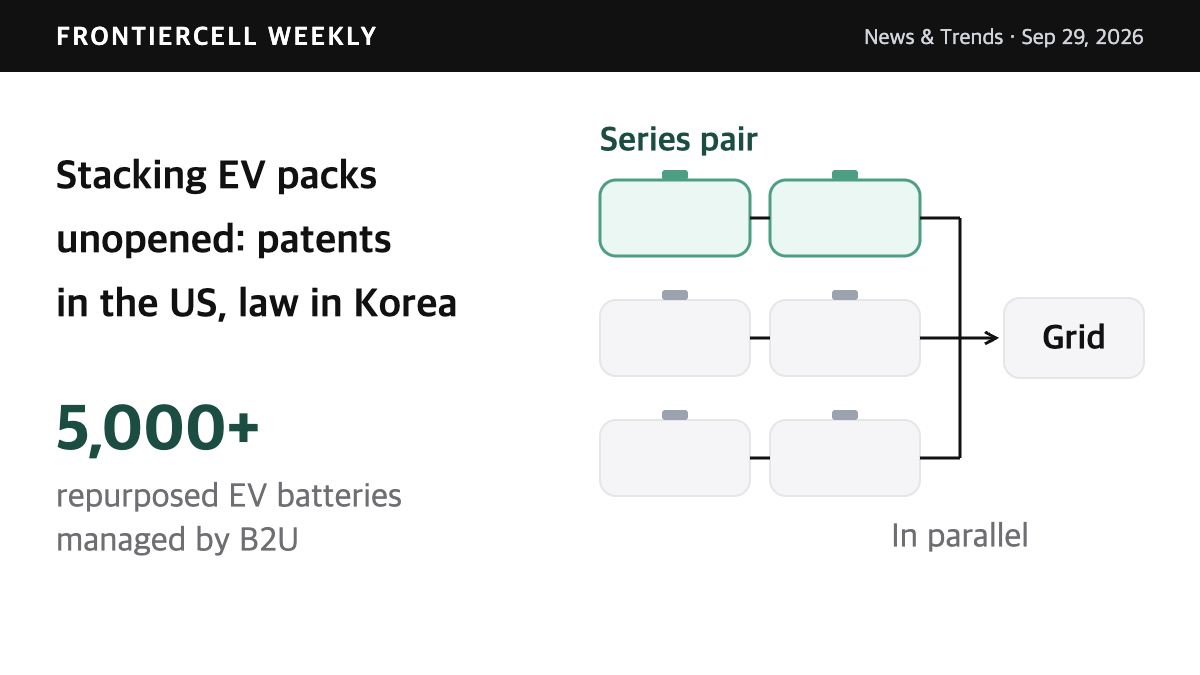
Source: redrawn by the author from the B2U press release (2026-09-09) and the claim structure of US11289921B1
Two packs taken out of cars are joined in a single row, and several such rows are gathered side by side to act as one large battery (Figure 1). The structure is simple. Claim 1 of the patent B2U obtained in the US in 2022 is written in almost exactly those terms.
28 MWh in Texas and 200 kWh in Dongtan
The Bexar Martinez storage facility near San Antonio, Texas, is built entirely from repurposed EV batteries. On September 9, B2U announced that it had entered commercial operation and provides 28 MWh of grid services to ERCOT, the operator of the Texas grid. In the same release, B2U said its Texas portfolio had passed 50 MWh, and that across Texas and California it manages more than 5,000 repurposed EV batteries and operates roughly 100 MWh of storage. It also said it expects to add another 50 MWh or more in ERCOT within six months.
The terms of the partnership, announced by LG Energy Solution on September 22, are brief. B2U gets priority access to LG Energy Solution’s battery capacity, and the two companies will explore business opportunities in the US that reuse LG Energy Solution batteries in grid-scale ESS with B2U’s patented technologies. Utilities, ESS developers and large power users such as data centers are named as customers, and the goal is storage on the order of gigawatt-hours (GWh). The release keeps returning to the idea of using batteries longer before recycling, but it does not say whether the batteries will be packs taken out of cars or newly made cells or modules, how many there will be, or which patents will be used.
The Korean scene came 12 days earlier. On September 10, Hyundai Motor, Kia, LG Energy Solution, Hyundai Engineering and Wonik PNE held a ceremony at Wonik PNE’s Dongtan site in Hwaseong, Gyeonggi Province, for a pilot of UBESS, a storage system built from used batteries. Used battery packs from vehicles on E-GMP, the dedicated EV platform of Hyundai Motor and Kia, form 200 kWh of storage that charges when electricity is cheap and powers an EV fast charger when it is expensive. Hyundai Motor and Kia supply the packs, and LG Energy Solution builds the system from them while supporting performance and safety verification. The announcement does not say how many packs make up the 200 kWh or whether they were opened.
Hyundai Motor Group’s announcement lists Seung Tak Joo of LG Energy Solution among those who attended. It is the same name quoted in the US partnership release 12 days later. The same organization opened a pilot in Korea with an automaker’s packs and, in the US, partnered with a company that holds patents.
Korea’s own rules were also set this year. The Act on the Management of Used Batteries and Promotion of Related Industries (Act No. 21683, unofficial translation; hereafter the Used Battery Act), was enacted and promulgated on May 26, 2026. It treats used batteries as an industrial resource rather than only as waste, and it defines remanufacturing, reuse and recycling[3] separately.
Source: redrawn by the author from Articles 2 and 14 of the Used Battery Act
Sorted into the Act’s three boxes, both B2U’s cabinets and the Dongtan pilot fall into the middle one, reuse (Figure 2). The bottom box, extracting raw materials, is recycling and lies outside the scope here. Even within the middle box, the road splits in two again: one path opens the pack and rebuilds it, and the other keeps it closed.
Samsar Opens the Pack, B2U Keeps It Closed
An EV battery is made of small cells bundled into modules, and the modules are gathered with a housing, cooling structure and control hardware into a pack[4]. The battery management system (BMS)[5] inside the pack measures each cell’s voltage and temperature and talks to the vehicle’s controllers over a fixed communication protocol. Reusing a pack without opening it means bringing this brain along. Connecting to the grid takes a higher voltage, so packs are joined in series, and adding capacity means joining them in parallel[6]. B2U’s patent specification notes that EV packs may not have been designed for series connection in the first place.
Source: redrawn by the author from the embodiment in the US11289921B1 specification
Two packs tied into one string are in the position of two runners whose ankles are tied together for a race (Figure 3). If one runner is even a little slower, both have to match that pace, and if they force a faster one they fall together. With batteries it is worse. A person merely slows down, but a weak pack fills first and empties first while carrying the same current, so it is cycled more deeply, wears out faster and becomes more dangerous. The weakest pack in a string sets what the whole string can do. The problem is sharpest when used packs with different states of health, or SOH[7], are mixed.
Samsar Resources (Samsar), a battery remanufacturing start-up in Texas, deals with this by opening the pack. At its plant in Sugar Land, it breaks Nissan Leaf packs down to modules, checks quality at the cell level and reassembles them. The company calls this remanufacturing, but if the batteries go into energy storage at work sites, the wording of Korea’s Act would put them closer to reuse, because they become batteries other than EV-type batteries. The same English word can land in a different box under Korean law, a point worth checking separately in contracts and export paperwork.
The approach in B2U’s patent does the opposite: it keeps the pack closed and keeps using the original BMS. It is the difference between loading moving boxes onto the truck as they are and unpacking every box to look at each item before packing it again. Moving boxes as they are is fast and cheap. You cannot tell what broke inside, though, just by shaking the box. A company building storage from closed packs therefore has to rely on the records a pack leaves behind and on inspections that see inside without opening it.
One such inspection is the AIR system that Fraunhofer IIS in Germany announced on September 21. It passes X-rays through a closed pack or an entire vehicle and automatically detects cell displacement, deformation and swelling; in the test environment, evaluating one pack took about five minutes. The researchers examined the battery of a Volkswagen ID.3 after a crash test in which it hit a stationary car at 79 km/h, and in an overall assessment that added BMS data and electrical tests, they placed it at level 0, the lowest hazard level defined by EUCAR, the European Council for Automotive R&D. They also wrote that the X-ray results do not replace electrical testing. If SOH is electrical fitness, the X-ray looks at the bones.
The figures from B2U, Samsar and Dongtan are all units of energy, but they count different things. B2U’s figure is storage capacity in operation, Samsar’s is the cumulative battery capacity put back into service after remanufacturing, and Dongtan’s is the size of a single pilot facility. Figure 4 gathers the three cases.
| Case | How packs are handled | Scale (MWh) | Batteries (units) | Date |
|---|---|---|---|---|
| B2U facilities overall (Texas and California) | Used as whole packs | about 100 (operating) | more than 5,000 | 2026-09-09 |
| B2U Bexar Martinez (Texas) | Used as whole packs | 28 (operating) | not in release | 2026-09-09 |
| Samsar (Texas) | Broken down to modules, cell-level checks | more than 25 (cumulative) | 1,000 (Nissan Leaf packs) | 2026-09-15 |
| Hyundai Motor, Kia and LG Energy Solution UBESS (Dongtan, Hwaseong) | Used E-GMP packs | 0.2 (pilot) | not in announcement | 2026-09-10 |
Source: B2U press release (2026-09-09) and website, US11289921B1 specification, Samsar Resources press release (2026-09-15), Hyundai Motor Group newsroom (2026-09-10)
The roughly 100 MWh that B2U says it operates is about 500 times the 0.2 MWh (200 kWh) of the Dongtan pilot (100 ÷ 0.2). Both are storage capacities, so they can be compared. Samsar’s more than 25 MWh, by contrast, is not one facility but the total battery capacity returned to service since its first remanufacturing in 2022, so it does not belong on the same line as the 28 MWh at B2U’s one Texas site. In the US, the closed-pack approach is already in commercial operation, while Korea’s first E-GMP pack pilot starts from verifying the technology and the business model. Drawn as bars, the Dongtan bar is barely visible (Figure 5).
Scale of repurposed-battery storage (MWh)
Source: B2U press release (2026-09-09), Samsar Resources press release (2026-09-15), Hyundai Motor Group newsroom (2026-09-10)
Samsar says it remanufactured 20 packs in 2022 and was disassembling, testing and rebuilding more than 300 packs a year by 2025. The pace is picking up quickly. None of the cases, however, discloses the lifetime cost per kWh of stored electricity, known as the levelized cost of storage (LCOS)[8], or any record of failures and safety incidents in operation. B2U’s patent specification says reused batteries can cut LCOS sharply compared with new ones, but that is the applicant’s claim, and I have seen no figures that confirm it.
Three Words Missing From Claim 1 of US11289921B1
US11289921B1, which B2U obtained in March 2022, is a continuation[9] of a first application filed in December 2020 and later abandoned. The B1 at the end of the number means it was granted without a prior published application[10]. Claim 1[11] fits in one sentence of plain language: an integrated storage system in which several EV battery packs are arranged in series and parallel, with several strings of two or more packs connected in series, and those strings connected to one another in parallel. Claim 16, a method claim, has the same skeleton.
The first thing I noticed in this claim was the words it leaves out. The condition “second-life” sits in dependent claim 8, “without modifying the manufacturer’s pack casing” in dependent claim 2, and “with the original BMS” in dependent claim 3; independent claim 1 contains none of the three. Independent claim 9, which requires an outdoor enclosure, balancing converters and the original BMS all together, is much narrower. Read on its words alone, any storage system that forms series strings from two or more EV battery packs and joins the strings in parallel could be measured against claim 1, regardless of whether the packs are used, whether the casing was modified or whether the BMS was replaced.
A broad claim is easy to read onto products, and for the same reason it is more exposed to invalidity challenges if a similar facility was made public earlier. I did not investigate this time whether any facility tying whole packs in series and parallel was disclosed before December 2020. The Google Patents event list shows no invalidation proceeding or lawsuit over this patent, although the records of the US Patent Trial and Appeal Board (PTAB) were not checked directly. The Japanese application in the same family received a decision of refusal in April 2025 and was registered as JP7855245B2 on April 30, 2026 (gazette published May 8).
The Google Patents citation list includes documents from BMW, Toyota and Australia’s Relectrify, among others. Among them, US10752128B1, granted to BMW in 2020, approaches the same problem from the other direction. Its claim 1 covers a system of EVs that can exchange power with the grid and a stationary second-life unit, in which each battery’s SOH is controlled individually during its first life in the vehicle so that the batteries have substantially similar SOH when their second life begins.
In terms of the ankle-tied race, BMW trains the runners to the same pace from the start, while B2U takes runners who have already grown apart and pairs those with similar paces. That pairing is what the family’s second granted patent, US12401207B2 (granted in 2025), claims. As a continuation-in-part, its claim 1 adds connection rules to the series-parallel structure of the first patent: a processor joins packs with lower voltages in series, packs with higher voltages in series, or packs in the most common voltage range in series, or joins packs within a set voltage window in parallel.
Dependent claim 8 of US12401207B2 goes as far as counting the packs’ voltage distribution in bins to decide the groupings. The continuation US20250350128A1, filed in 2025, heads in a somewhat different direction. Its published claim 1 gives each pack connected in parallel its own BMS interface board, reads pack identification data and real-time status, and issues a warning when a threshold is exceeded. Its dependent claims spell out that information as make, model and serial number, plus voltage, temperature and SOH. The three claims come from the same specification, but each aims at a different part (Figure 6).
Source: redrawn by the author from the claims of each patent (Google Patents, checked 2026-09-29)
A design that does not tie packs into series strings, but gives each pack its own power converter and joins them only in parallel, moves away from claim 1 of the first two patents. Yet claim 1 of the pending US20250350128A1 is written for packs connected in parallel. While a continuation remains open, the applicant keeps room to rewrite its claims after seeing a competitor’s design. A Samsar-style design that opens packs and rebuilds them into modules raises a question of interpretation, whether the rebuilt assembly is still an EV battery pack, and outside the literal wording, room for a dispute under the doctrine of equivalents[12] remains. Since the claims may change before grant, a US FTO[13] review does not end after one pass.
The first family is registered in Japan and pending in Europe (EP4320009) and China (CN116888010A), and the second family has separate applications in Europe, Japan and China (EP4480062, JP2025508433A, CN119032485A). In the Google Patents family lists I checked on September 29, no Korean application appears anywhere. A patent takes effect only in the country where it is registered, so if these lists are right, the Dongtan pilot is running outside the scope of B2U’s patent family. I did not separately investigate whether another rights holder in Korea has similar rights.
Evaluation Before Removal Under Article 14 of Korea’s Used Battery Act
The Used Battery Act takes effect on May 27, 2027, one year after promulgation, with some provisions applying from July 1, 2027. Article 14 requires the owner of an EV or another product designated by presidential decree to have a used battery evaluated for performance and safety before removing it, and lets the decree define cases, such as when advance evaluation is impractical, in which the evaluation may follow removal. Evaluation of EV-type batteries follows Article 35-13 of the Motor Vehicle Management Act, a part that applies from July 1, 2027. Article 15 requires a pre-distribution safety inspection before selling products designated by decree that carry remanufactured or reused batteries, and Article 16 requires periodic safety inspections[14].
As of September 29, I could not find a legislative notice for the decree that will designate the covered products. Even so, if the Dongtan packs move beyond the pilot into business, they are likely to go through this evaluation and inspection. The Act also provides, in Article 20, a legal basis for a used-battery history management system. What evaluation and history management will handle is likely to overlap in kind with what the claims of US20250350128A1 say they read from a pack: make, model and serial number, plus voltage, temperature and SOH.
The gigawatt-hour scale that both companies’ releases hold out rests on the assumption that as more packs come out of cars, cheap storage will pour in. If prices of new cells made for storage keep falling while the costs of evaluating each pack, inspecting it periodically and operating mismatched packs pile up, the price advantage of used packs shrinks. A single accident at a reuse facility could slow the whole market. I did not find material comparing the costs of the two paths on the same basis, so this stays a possibility.
How much of this cost can be cut depends on the pack’s history data. If automakers hand over the BMS records from the car together with the pack, the pre-removal evaluation may become faster, and a battery maker that uses those records to group packs by voltage and condition is working on the problem that the pairing in US12401207B2 claims to solve. Checking in advance which elements of B2U’s claims these functions overlap with gives a basis for choosing, before entering the US, among a partnership, a license and a design that keeps its distance from the claims.
I read LG Energy Solution’s choice to partner with the US rights holder as a calculation driven by the breadth of claim 1. Claim 1 of US11289921B1 requires only series strings of two or more packs and a parallel connection between them, so anyone building pack-level reuse storage in the US would need a substantially different design to escape its wording. Going with the rights holder cuts that cost and the risk of a dispute, so it was likely a rational route. The judgment weakens, however, if the batteries turn out to be new cells rather than used packs, which would put the partnership more on supply than on patents, or if claim 1 falls to an earlier disclosure, which would undercut the reason to partner.
Stacking packs without opening them already works: roughly 100 MWh runs that way in Texas and California. Where it happens decides what has to be cleared, and the answer depends on documents still being written. In the US, the form in which the claims of US20250350128A1 are granted, and in Europe, how far EP4320009 is narrowed, will set the next boundary of B2U’s rights. In Korea, I plan to watch how the decree designates the products subject to safety inspection, and whether Dongtan’s 200 kWh moves from pilot to business after May 27, 2027.
The one document worth opening now is claim 1 of US12401207B2. For someone preparing for a job in the battery industry, it makes a good exercise: explain in your own words why a rule for grouping packs of similar voltage is needed, and the roles of BMS data diagnostics and power conversion in reused-battery storage follow from that. For those in planning or IP, keep it open alongside claim 1 of US11289921B1 when comparing any storage design bound for the US, and check each quarter how the claims of US20250350128A1 change before grant.
Glossary
- EaaS (Energy as a Service) — A business model that goes beyond selling batteries or storage systems and bundles installation, operation and energy management into a service. LG Energy Solution has a unit under this name within its ESS division. ↩
- Energy storage system (ESS) — Equipment that stores electricity and releases it when needed, ranging from large grid-connected plants to units for charging stations and factories. ↩
- Remanufacturing, reuse, recycling — The distinction in Article 2 of Korea’s Used Battery Act. A battery repaired and made into an EV-type battery again (the traction battery of an EV, hybrid, fuel-cell vehicle, or electric construction or farm machine) is remanufactured; one made into any other battery is reused; one from which recycled raw materials are extracted is recycled. The definition of remanufacturing (Article 2, item 4) applies from July 1, 2027. ↩
- Cell, module, pack — A single battery is a cell, a bundle of cells is a module, and the finished unit that gathers modules with a housing, cooling and control hardware is a pack. Some designs place cells directly in the pack without modules. ↩
- BMS (battery management system) — The electronics and software that measure cell voltage, temperature and current and keep charging and discharging within limits. A record of how the pack was used also stays here. ↩
- Series and parallel — A series connection lines batteries up in a row to add voltage; a parallel connection sets them side by side to add capacity, the amount of electricity they can hold. ↩
- SOH (state of health) — An indicator of how much capacity and similar performance remains compared with when the battery was new. The calculation may differ between manufacturers. See How to Read a Battery Spec Sheet for how it relates to other figures. ↩
- Levelized cost of storage (LCOS) — The lifetime cost of a storage system, construction plus operation, divided by the total electricity it stores and delivers over its life. It amounts to the cost of one kWh of stored electricity. ↩
- Continuation and continuation-in-part (CIP) — In the US, an application filed while an earlier one is still pending to obtain new claims on the same specification is a continuation; one that adds new matter is a continuation-in-part. Content shared with the earlier application keeps its date. ↩
- B1 and B2 (US kind codes) — B1 marks a patent granted without a prior published application; B2 marks one granted after a published application (A1). See What’s the Difference Between A1 and B2 After a Patent Number?. ↩
- Claim, independent claim, dependent claim — The sentences that set out what a patent protects. An independent claim, which cites no other claim, is the broadest; a dependent claim adds conditions to an earlier claim and is narrower. ↩
- Doctrine of equivalents — The principle that a product can infringe even if it does not match the claim word for word, when it works in substantially the same way to achieve the same result. Whether it applies depends on the case. ↩
- FTO (freedom to operate) — A review of whether making or selling a product would infringe someone else’s valid patents. Because patents are national, the review is done country by country. ↩
- Evaluation and inspection (Articles 14 to 16 of the Used Battery Act) — The performance and safety evaluation before removing a battery, and the pre-sale and periodic safety inspections for products carrying remanufactured or reused batteries. The covered products are set by presidential decree. ↩
References
- LG Energy Solution, “LG Energy Solution and B2U Storage Solutions Collaborate on BESS Business Opportunities by Repurposing Batteries,” Seoul, 2026-09-22 (posted to the newsroom 2026-09-24) (checked 2026-09-29). Link
- B2U Storage Solutions, “B2U Storage Solutions and LG Energy Solution Collaborate on BESS Business Opportunities by Repurposing Batteries,” GlobeNewswire, 2026-09-24 (checked 2026-09-29). Link
- B2U Storage Solutions, “B2U Begins Commercial Operations of Its Second Repurposed Battery Storage Project in Texas,” GlobeNewswire, 2026-09-09 (checked 2026-09-29). Link
- B2U Storage Solutions website, EV Pack Storage system overview (checked 2026-09-29). Link
- Hyundai Motor Group Newsroom, announcement of the UBESS pilot based on used batteries with LG Energy Solution and Wonik PNE (in Korean), 2026-09-10 (checked 2026-09-29). Link
- Korea Ministry of Government Legislation, National Law Information Center: Act No. 21683 on used batteries (enacted 2026-05-26, effective 2027-05-27; in Korean) (checked 2026-09-29). Link
- Samsar Resources, “Samsar Upcycles Electric Vehicle Battery From 1,000th Nissan Leaf,” EIN Presswire, 2026-09-15 (checked 2026-09-29). Link
- Fraunhofer IIS, “Fraunhofer IIS Develops Automated X-Ray Analysis for Electric Vehicle Batteries,” 2026-09-21 (checked 2026-09-29). Link
- Google Patents, US11289921B1 (checked 2026-09-29). Link
- Google Patents, US12401207B2 (checked 2026-09-29). Link
- Google Patents, US20250350128A1 (checked 2026-09-29). Link
- Google Patents, US10752128B1 (checked 2026-09-29). Link
- Google Patents, JP7855245B2 (checked 2026-09-29). Link
This piece explains technology and patent information; it is not investment or legal advice, and whether a specific product infringes needs professional review. I describe the scope of patent rights and dispute outcomes only as possibilities.