Cell Chemistry & Materials
0.5 percent. According to a Chinese testing center, that is the weight a punctured cell failed to lose after six hours in a 120°C vacuum oven, and it is the number Guangzhou-based battery maker 巨湾技研 (Greater Bay Technology, GBT) put forward when it started producing all-solid-state batteries[1] in Nansha on October 13, 2026. The company and local media called it the first mass-produced cell to pass China’s new national standard. The announcement itself describes something other than a hard ceramic sheet: an existing liquid-cell line was modified, and a liquid feedstock is filled into the cell and then solidified. I wanted to check two things. Where does the new standard draw the line for “solid-state,” and what does crossing that line tell us, and not tell us, about patent boundaries?
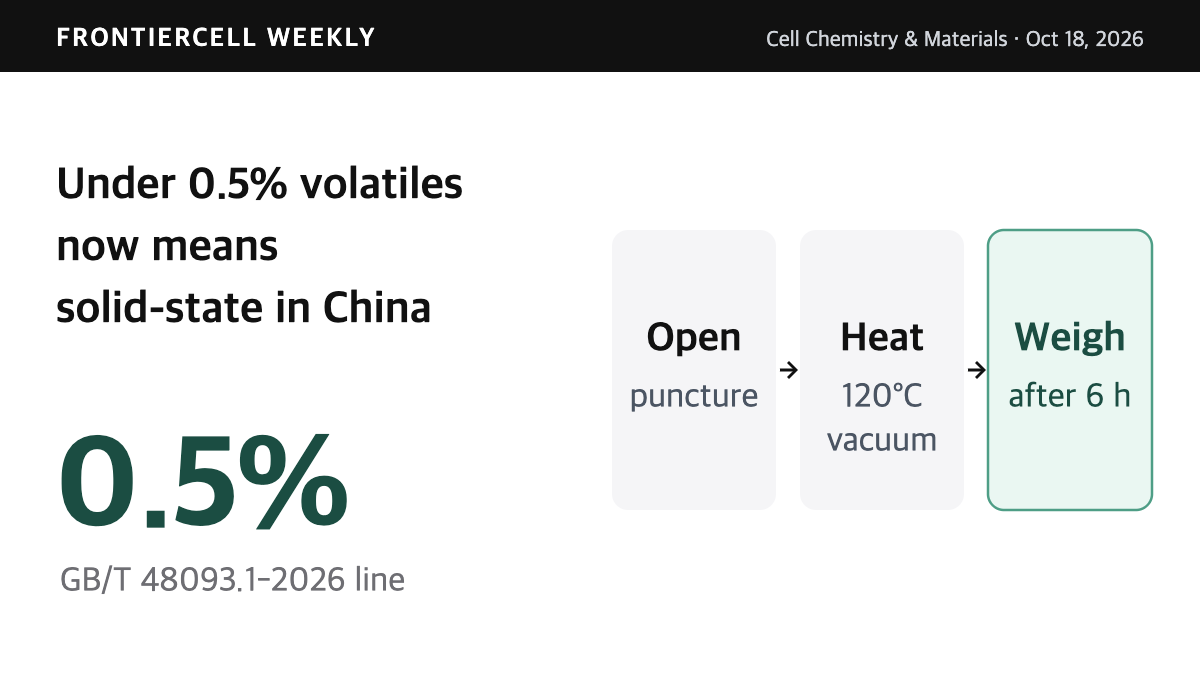
Source: redrawn by the author from 21jingji (2026-10-14) and CCTV (2026-09-19) reports
Tear the cell open on purpose, bake it for hours in a hot box with no air, then weigh what has escaped (Fig. 1). Those three steps are the skeleton of the announcement. Why that test became the dividing line only makes sense if you start with a standards document published about six weeks before the ceremony.
The 0.5% Line in GB/T 48093.1-2026
China’s State Administration for Market Regulation (SAMR) lists GB/T 48093.1-2026, “Solid-state battery for electric vehicle, Part 1: Terms and classification,” as published on August 28, 2026, with an implementation date of January 1, 2028. The “/T” after GB marks it as a recommended[2] standard, so ignoring it does not by itself block sales.
The document sets a numerical method, based on volatile content, for judging whether a vehicle battery counts as solid-state, and local media have described it as the qualification standard for all-solid-state cells. Liu Shiqiang (刘仕强), chief expert at the China Automotive Technology and Research Center (CATARC), explained at a forum in Tianjin on September 18, 2026 that the volatile components inside a cell are measured under high temperature and vacuum, and that the share must be below 0.5% for the cell to count as a solid-state battery. He added that the same figure for conventional liquid cells generally exceeds 10 to 12%.
The test conditions GBT disclosed fit that description. According to the company and local media, the testing center of China’s National Power Battery Innovation Center heated a punctured cell continuously for six hours at 120°C in a vacuum, and the weight loss was under 0.5%. The same cell reportedly passed all cell-level items of GB 38031-2025, the mandatory safety standard in force since July 1, 2026, and did not catch fire or explode when a nail was driven through it at full charge. I could not confirm whether the temperature and duration written in the standard itself match GBT’s conditions. SAMR’s listing points to a full-text viewer, but I was unable to open the text this time.
In an article on August 14, 2026, this site introduced GBT as a company targeting “GWh-scale mass production by the end of 2026.” Production actually began on October 13, six months after its A-sample cells came off the line in April. Back then I wrote that the three companies’ versions of “mass production” were heading toward different finish lines; this announcement puts the first measurable mark on one of them. Because this test may become the reference for anyone who wants to use the term “all-solid-state” in China, the test method will probably outlast the date as news.
Source: redrawn by the author from electrive (2026-10-14) and Gasgoo (2026-10-15) reports
What changed inside the plant follows the flow in Fig. 2. In an October 14, 2026 article, the EV outlet electrive reported that electrode manufacturing, stacking, formation[3], and testing all use conventional lithium-ion equipment, and that the main modification is the electrolyte-filling step, carried out in a dry, oxygen-free environment. Huang Xiangdong (黄向东), introduced there as GBT’s founder and CTO, called it an existing line with a new core. Part of a 4 GWh liquid-cell line was retrofitted, and the company says production can switch between liquid and all-solid-state cells as needed. What remains is how a feedstock that goes in as a liquid becomes a solid, and how that solid gets past the standard’s scale.
Gelatin, an Oily Towel, and a Deep-Eutectic Electrolyte
Pour warm gelatin into a mold and the liquid runs into every corner, then sets in exactly that shape over time. There are far fewer gaps than if you tried to press hard pieces into the mold from the start. That difference is what in-situ solidification[4] is after.
The electrodes inside a cell are sponge-like structures built from tiny particles, and making solid pieces touch one another has long required heavy pressure in conventional solid-state processes. If the electrolyte enters as a liquid and sets inside, it fills those gaps from the outset. The analogy is only half right, because gelatin sets as it cools while the electrolyte in a cell sets through heat or a chemical reaction. If the material shrinks or traps bubbles while it sets, gaps reappear, and the analogy cannot show those conditions.
Why solids need pressure to touch is worth pausing on. A liquid finds its own way into gaps, but two solid particles exchange ions only through the points where they meet. That is why many solid-state cells have had to be clamped tightly even while charging and discharging, and this site has covered a Toyota and Panasonic patent aimed at lowering that pressure from 20 MPa to 0.5 MPa or less. In-situ solidification tries to solve the same problem through the order of setting rather than through pressing force.
Source: redrawn by the author from the process description in electrive (2026-10-14)
GBT calls its electrolyte a “deep-eutectic-based composite solid electrolyte” (Fig. 3 shows the principle, with the moment of filling and the set state side by side). Deep eutectic[5] refers to a combination of two or more solids that becomes liquid at a temperature far lower than either component’s melting point. As reported by 21jingji, Dong Yang (董扬), chairman of the China Automotive Battery Industry Innovation Alliance, described it as another route alongside sulfides, polymers, oxides, and chlorides. Yet GBT has not disclosed which substances it mixes in what ratio, or what it uses to set them. None of the five reports reviewed for this piece contained a composition table.
Going back to the standard’s scale reveals what kind of test this is. Weigh laundry after drying and you can tell how much water has left it. If the weight barely changes, you would guess it was dry to begin with, yet a towel soaked in oil also loses little weight in a dryer, because oil hardly evaporates. The volatile-content test measures what escapes under heat and vacuum more than what is inside the cell. This analogy has limits too. The standard may include judgment criteria other than volatile content, and since I have not read the text I cannot say whether it does. Even so, the fact that a scale sits at the center of the boundary makes the axis of comparison clear.
10–12%, 0.5%, and 260–480 Wh/kg
Put the numbers from the announcement and the standard into one table and you can see what can and cannot be compared. Fig. 4 places liquid cells, the standard’s threshold, and GBT’s production cells in the same rows. Where measurement conditions were not disclosed, the table says so.
| Item | Liquid cells | Standard threshold | GBT production cell |
|---|---|---|---|
| Volatile content (%) | 10–12 or more | below 0.5 | below 0.5 |
| Test conditions | Not in public remarks | High temperature, vacuum | 120°C vacuum, punctured, 6 h |
| Cell specific energy (Wh/kg) | Not in public remarks | Not applicable | 260–480 |
| Effective / announced | — | Effective 2028-01-01 | Production from 2026-10-13 |
Source: CCTV (2026-09-19), 21jingji (2026-10-14), SAMR national standard listing (checked 2026-10-17)
If liquid cells lose 10% or more as volatiles, the 0.5% threshold is one-twentieth of that. In the same remarks, however, Liu also said that solid-state batteries at both the mass-production and research stages are stably kept below 0.5%. On that reading, GBT’s “first to pass” is less about technical difficulty than about order: it was first to obtain third-party testing and first to ship from a production line. Dong Yang’s remark that GBT may not have run fastest but was certainly the first out reads the same way. The specific energy[6] of 260 to 480 Wh/kg is likewise presented as a range that depends on cell generation and material configuration.
Set one more number from the same week beside it and the comparison trap becomes visible. On October 14, CarNewsChina reported that Changan Automobile said on the Shenzhen Stock Exchange’s investor platform that it would expand its joint venture with CATL to 75 GWh, and the article also covered Changan’s plan to commercially produce a solid-state cell targeting 400 Wh/kg in 2027. On the numbers alone, the top of GBT’s range is higher, but one is a range for cells already off a line and the other is a target, so they cannot go on the same scale.
Share of volatile components escaping a cell (%)
Source: CCTV (2026-09-19), 21jingji (2026-10-14)
Drawn as bars, the gap between liquid cells and the threshold looks large (Fig. 5). That gap, however, is about how little escapes as vapor; cycle life, charging speed, and cost are not in it. On cycle life GBT said only that it is comparable to conventional lithium-ion cells and gave no cycle figures. Electrive put the initial solid-state capacity at 1 GWh, while Chinese reports used only the phrase “GWh-scale.” What a standard-compliant cell will compete with in the market cannot be judged until these blanks are filled, and the only documents in hand right now are the patents GBT has already published.
What GBT’s Own Filings Actually Claim
Electrive reported that GBT holds more than 50 patents on the technology. The article did not list them. A Google Patents search for the applicant 广州巨湾技研有限公司 with the term “solid electrolyte” returned 32 results as of October 17, 2026. Among the applications examined, the one that claims setting a liquid precursor is CN120809954A[7], filed by GBT on July 23, 2025 and published on October 17, 2025. It is still a published application under examination, so whether it will be granted and its final scope of rights[8] remain open. The term “deep eutectic” does not appear anywhere in its text, so there is no basis for treating it as the same technology as the production cell.
Claim 1 has three parts. There is a porous base film made of an inorganic ceramic solid electrolyte and a binder, and a polymer composite fills its pores and covers its surface. The polymer composite is fixed at 3 to 10% lithium salt, 85 to 95% imidazolium-based ionic liquid[9], 1 to 5% crosslinker with a molecular weight of 150 to 2000, and 0.1 to 0.5% initiator. Claim 5 is the manufacturing method of placing a precursor liquid with this formulation into the base film and curing it in situ, and claim 8 narrows that curing to 70 to 90°C for 2 to 4 hours under vacuum. The specification describes the film as free of organic solvent and low in volatility.
Source: redrawn by the author from each patent’s claims (Google Patents, checked 2026-10-17)
The 85 to 95% figure needs careful reading (item 10 in Fig. 6). It is a share within the polymer composite that fills the pores, not within the whole film. Claim 2 sets the mass ratio of ceramic material to polymer composite at 85 to 95 to 3 to 14. Across the whole film the ceramic is the host and the ionic-liquid polymer is the guest, and the specification itself uses the phrase “ceramic as host, polymer as guest.”
Placing one granted solid-electrolyte patent from the same search results beside it shows how a fence can change between publication and grant. Item 20 in Fig. 6, CN119153768B, was filed on November 19, 2024 and granted on April 8, 2025. Claim 1 in the published application gave only the compound’s formula, but the granted claim 1 adds a condition narrowing the trivalent element other than aluminum to gallium, indium, or the lanthanides, along with the raw materials (lithium halide, trivalent-element halide, and antimony or tin oxide) and a high-energy ball-milling and heating process. Claim 2 adds a melting point below 200°C, claims 5 and 7 cover a composite cathode made by milling and heating, and bonding with the cathode by low-temperature melting appears only in the specification.
Claims 6 and 7 of CN120809954A hold more clues about the shop floor. The base film is made by mixing the ceramic material and binder in a jet mill between −20°C and −10°C, extruding the mixture through a screw extruder so that it knits into fibers, and then pressing it. PTFE is listed as a candidate binder, which places the technique in the same family as solvent-free dry electrode processes. The precursor liquid is placed on the base film and drawn in under negative pressure for 2 to 6 hours. No step says the material is set inside the cell after assembly; “in situ” here means curing on the film.
The two patents fence off different things. CN120809954A is a published application with a narrowly stated formulation, so switching to a different class of ionic liquid or moving the ratio outside 85% may take a product outside the literal wording of claim 1. Figures can shift during examination, but, as with CN119153768, where raw materials and process steps were added between publication and grant, they usually narrow. How far the doctrine of equivalents[10] reaches for numerically limited elements needs case-by-case judgment.
CN119153768B carries raw materials and process into claim 1, so even with a similar elemental makeup, a product made from different raw materials or by a different milling and heating process may fall outside its literal scope. How a product claim limited by its manufacturing method is interpreted differs by jurisdiction and needs separate review. Which of the two, if either, overlaps with the production cell cannot be told from GBT’s announcement alone.
Where a Standard’s Label Stops Helping
Electrive reported that GBT is in advanced discussions with several major automakers about series applications. If a standard-compliant cell came out of a retrofitted line, the expectation quickly follows that other companies could also move to solid-state by modifying their liquid lines slightly. That expectation can go wrong in two places.
If in-situ solidification passes the scale because of liquid-type components that barely evaporate, weaknesses different from ceramic routes may surface in mechanical strength or low-temperature performance. And a process that fills in a precursor and cures it in situ sits in an area that could overlap with method claims such as claim 5 of CN120809954A, though I did not examine other applicants’ method claims this time. A cell maker would be safer treating standard compliance and FTO[11] review as separate tasks, and comparing its own precursor chemistry and curing conditions against the numerical ranges in GBT’s published application first.
With no composition table for GBT’s cell yet, I see the biggest change in how the basis for the name “all-solid-state” has moved from what a material looks like to a reading on a scale. If the composition or other judgment criteria in the standard’s text are published, I may need to revise this view. Even so, the name a standard confers and the composition a patent claim looks at have already become separate questions. GBT’s own application CN120809954A describes low volatility in its specification but stakes its rights on the type and ratio of ionic liquid. Passing the scale does not decide whether a product falls inside such a claim.
There are three documents to watch next: whether a list of the 50-plus patents GBT mentioned, or corresponding foreign filings, appears; how CN120809954A’s formulation ranges change in examination; and whether the test conditions in the standard’s text match the 120°C and six hours GBT disclosed. Once those three are confirmed, it will be possible to say far more precisely where the name that passed the scale and the composition in the claims actually meet.
The most useful step this week is concrete: open claims 1, 2, and 8 of CN120809954A and claim 1 of CN119153768B on Google Patents, and check, element by element, whether your own solidification recipe’s ionic-liquid class, ratios, raw materials, and curing temperature fall inside the stated ranges. Planning and IP teams can file that check separately from any standard test report. For students preparing for battery-industry interviews, one point is worth carrying away: in China the label “solid-state” now rests on a volatile-content test under heat and vacuum, and that label says nothing about patent scope.
Glossary
- All-solid-state battery — A battery whose electrolyte, the medium that carries lithium ions between cathode and anode, is solid rather than liquid. Reducing flammable organic solvents is expected to help both safety and energy density. ↩
- Recommended national standard (GB/T) — A Chinese national standard with T in its code, which sets a recommended benchmark. GB standards without the T are mandatory. ↩
- Formation — The process of charging and discharging an assembled cell for the first time to build a protective layer on the electrode surfaces and screen out defects. ↩
- In-situ solidification — Filling electrolyte feedstock as a liquid and then setting it in place by heat or a chemical reaction. It makes it easier to reduce gaps at interfaces than inserting a pre-formed solid. ↩
- Deep eutectic — A combination of two or more components that melts at a temperature far below either component’s own melting point. Liquids that use this property are called deep eutectic solvents. ↩
- Specific energy (Wh/kg) — The energy one kilogram of battery can store. A higher number means longer use for the same weight. See the spec-sheet primer. ↩
- Published application and granted patent — In Chinese numbering, A marks an application published before grant and B a patent granted after examination. See the A1 and B2 primer. ↩
- Scope of rights — The area within which a patent can stop others from practicing the invention. In principle, only a product or method that has every element written in a claim falls inside it. ↩
- Ionic liquid — A salt that stays liquid at room temperature. Its very low vapor pressure means it hardly evaporates and resists burning, which is why it is studied as an electrolyte material. ↩
- Doctrine of equivalents — The legal principle that a product can infringe even if it does not match a claim word for word, if it works in substantially the same way with the same effect. Requirements differ by country. ↩
- FTO (Freedom to Operate) — A review, done before making or selling a product, of whether it would infringe someone else’s valid patents. ↩
References
- SAMR national standard listing, GB/T 48093.1-2026 “Solid-state battery for electric vehicle—Part 1: Terms and classification”, published 2026-08-28 (checked 2026-10-17). Link
- CCTV (央视网), interview with Liu Shiqiang on solid-state battery industrialization, 2026-09-19 (checked 2026-10-17). Link
- 21jingji (republished from 羊城派), report on the Nansha all-solid-state production line, 2026-10-14 (checked 2026-10-17). Link
- electrive, “GBT begins series production of solid-state battery cells”, 2026-10-14 (checked 2026-10-17). Link
- Gasgoo, “Greater Bay Technology commissions GWh-scale all-solid-state battery production line”, 2026-10-15 (checked 2026-10-17). Link
- CarNewsChina, “Changan and CATL to collaborate on 1,500 km solid state cells, establish 75 GWh battery lines”, 2026-10-14 (checked 2026-10-17). Link
- Google Patents, CN120809954A, composite solid electrolyte film and its preparation method (checked 2026-10-17). Link
- Google Patents, CN119153768B, solid electrolyte, composite cathode and ultra-fast-charging all-solid-state battery (checked 2026-10-17). Link
This piece explains technology and patent information; it is not investment or legal advice, and whether a specific product infringes needs professional review. I describe the scope of patent rights and dispute outcomes only as possibilities.