① What’s at Stake
The gist of this piece is that the real battleground in the race to commercialize all-solid-state batteries is narrowing down to the electrolyte material itself, more than cell design. According to recent industry trend data, Samsung SDI is reported to be focusing on a sulfide-based electrolyte.
To set the industry context first: all-solid-state batteries are a technology that replaces the liquid electrolyte with a solid ion conductor, and depending on which solid is used, three pathways compete — sulfide-based, oxide-based, and polymer-based. The tension is that these three pathways each have different strengths and weaknesses in performance, manufacturability, and cost, so no single one leads on every dimension. This piece sets out to answer one question: what distinguishes the three pathways, and what does it mean that Samsung SDI is reportedly focusing on the sulfide-based path?
② The Basic Mechanism
Solid-state batteries use a solid-state ion conductor in place of a liquid electrolyte. Because the medium lithium ions (Li⁺) travel through between the cathode and anode changes from a liquid to a solid, performance hinges on how well and how stably ions can move within that solid.
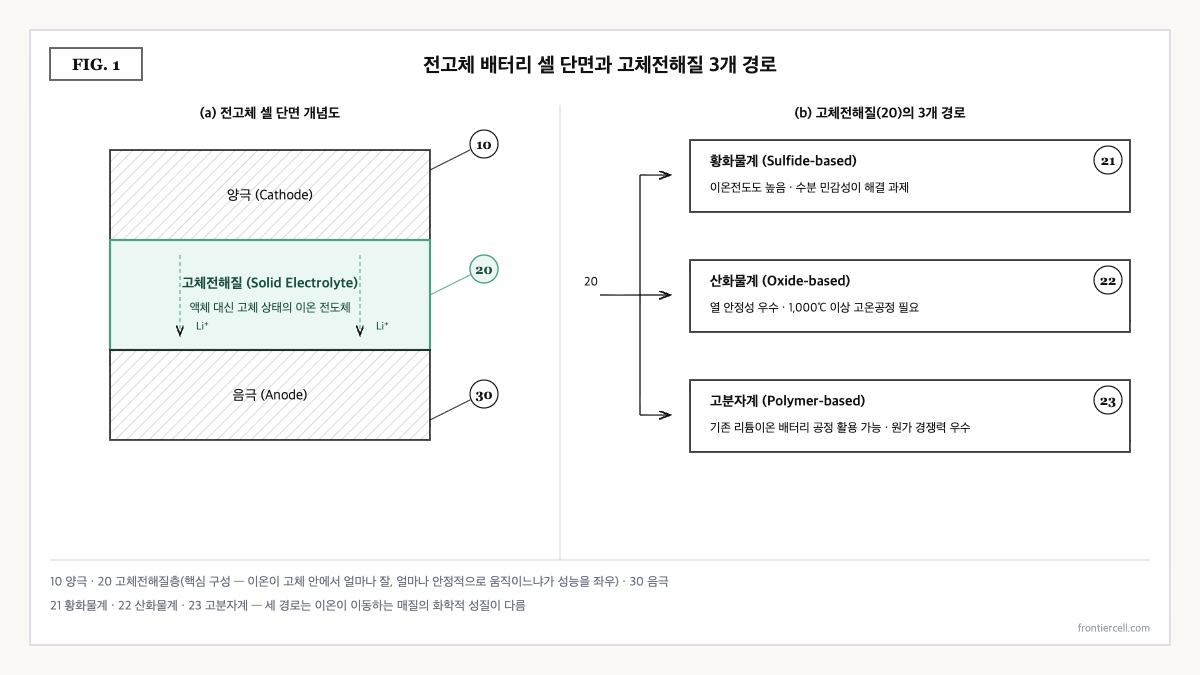
Source: editorial reconstruction based on secondary-battery market trend data, week 3 of September 2026
As an analogy: a liquid electrolyte is a river the ion swims across, while a solid electrolyte is a corridor the ion must walk through. If the corridor is wide and smooth, ions move quickly (high ionic conductivity); if the corridor material is sensitive to moisture or requires a high-temperature process to build, constructing the building itself becomes difficult. The three pathways currently competing differ precisely in the chemical nature of this “corridor” — that is, the chemical nature of the medium through which ions travel.
③ Comparison
The table below carries over only the items confirmed in the source data. Where the source did not provide a quantitative figure, that item is left marked as “no quantitative figure given” or “not mentioned in source.”
| Category | Sulfide-based | Oxide-based | Polymer-based |
|---|---|---|---|
| Ionic Conductivity | High | Relatively disadvantaged (no quantitative figure given) | Relatively disadvantaged (no quantitative figure given) |
| Thermal stability | Not mentioned in source | Excellent | Not mentioned in source |
| Process burden | Moisture sensitivity is the challenge to solve | Requires high-temperature process above 1,000°C | Can reuse existing lithium-ion battery processes |
| Cost competitiveness | Not mentioned in source | Relatively disadvantaged due to high-temperature process burden | Excellent (reuses existing processes) |
Source: editorial reconstruction based on secondary-battery market trend data, week 3 of September 2026 (items without a quantitative figure are marked as such)
What this table shows — The three pathways each occupy a different point on the triangle of “ionic conductivity (performance) – process difficulty (manufacturability) – cost.” Sulfide represents the performance-leading option, polymer represents the cost- and manufacturability-leading option, and oxide is the path that trades process burden for stability.
④ Patent Perspective
The source data for this piece does not include a patent publication number, applicant, or claim information directly tied to Samsung SDI’s choice of the sulfide-based path. This article therefore does not assert a definite claim scope, infringement risk, or design-around approach for any specific patent. Making an FTO (Freedom to Operate) determination based on an unconfirmed publication number is something to avoid from a risk-management standpoint.
That said, the structure of the comparison table itself is suggestive. Since the difference among the three pathways comes down to the “chemical nature of the medium,” any future claim-scope review is likely to start along two branches — composition claims and process claims. This means that, for sulfide, addressing moisture sensitivity (process and protective layers); for oxide, reducing the high-temperature process; and for polymer, compatibility with existing processes could each end up being the core effect captured in the claims. This is only a general direction inferable from the source data, and until the actual claims are checked, any design-around scenario must remain a hypothesis.
⑤ Limits and Outlook
The provided source data conveys only Samsung SDI’s material direction (a focus on sulfide) and does not present concrete ionic-conductivity figures, a mass-production timeline, or a solution for moisture sensitivity. This article’s conclusion likewise does not go beyond that scope.
Source: editorial reconstruction based on the counter-scenario and strategic alternative discussed in Section ⑤ of this article.
Counter-scenario — If the moisture-sensitivity problem persists longer than expected, it cannot be ruled out that polymer-based electrolytes, leading with cost competitiveness, could establish themselves first in the early commercialization phase.
Strategic alternative — There is no need to view the three pathways as mutually exclusive; a phased approach moving from early commercialization (polymer hybrid) to a high-performance transition (sulfide-based) is also worth considering.
Action for readers — Patent/IP staff are advised to look up Samsung SDI’s published patent numbers related to sulfide-based electrolytes directly on KIPRIS or Google Patents to confirm the claim scope.
※ This article is a commentary on technology trends and does not constitute legal advice.
Worth Reading Together — Related Reading
- In-Depth Analysis of Samsung SDI’s Sulfide Solid-Electrolyte Patent (US11955601B2) — The Narrow but Solid Fence of the “XRD Peak Ratio”
- Breaking Down the Samsung SDI–Sejong University Argyrodite Sulfide Electrolyte Patent
- Why Did Solid Power Choose Korea? — The Real Meaning of the Sulfide Solid-Electrolyte Joint Venture
- The Bottleneck in Solid-State Battery Mass Production, Beyond Isostatic Pressing — The Surface-Pressure/Roll-Press Alternative M Plus Is Opening Up