1. What’s the news
The cost of sulfide solid electrolyte has been controlled by its raw material, lithium sulfide. In the third quarter of 2026, pilot lines capable of synthesising that raw material by the hundred tonnes entered commissioning in China.
Start with where the industry stands. Most global automakers and cell makers have pencilled in 2027–2028 as the “B-sample” window for sulfide solid-state cells — B-sample meaning cells actually installed in a vehicle for validation. Here is the tension. Lithium sulfide (Li2S), the key precursor of sulfide solid electrolytes, accounts for roughly 80–90% of the electrolyte’s bill of materials and has been quoted at thousands of dollars per kilogram[1]. However elegant the cell design, when a single input holds eight-tenths of the cost sheet there is no route underneath it.
So this article asks one question. What does bringing a hundred-tonne pilot line online actually change — and what does it leave untouched?
2. The underlying principle — synthesis as baking without moisture
Sulfide solid electrolytes are generally made by mixing and milling lithium sulfide with a phosphorus sulfide such as P2S5, letting them react, and then heat-treating the result. In baking terms, lithium sulfide is the flour and the phosphorus sulfide is the yeast. The problem is that this particular flour detests water. On contact with moisture it releases hydrogen sulfide (H2S), which means the entire synthesis train has to be held under a dry, inert atmosphere.
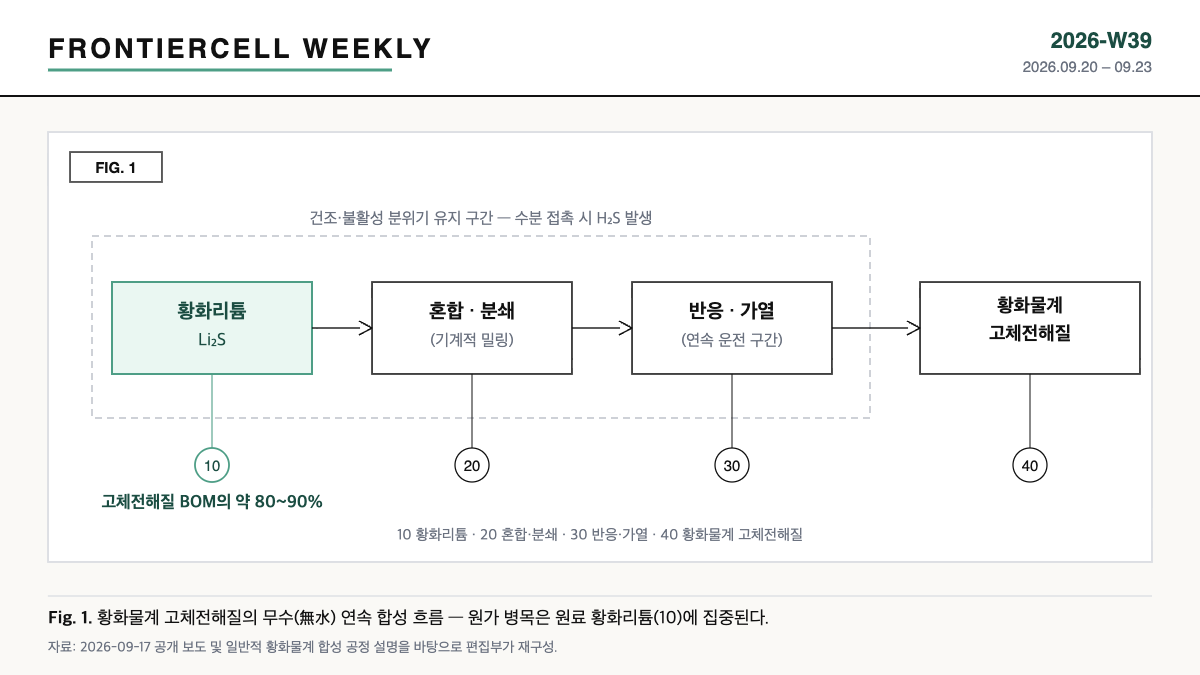
Source: Reconstructed by the editorial desk from the 2026-09-17 report and general descriptions of sulfide synthesis processes.
The difficulty of this process therefore lies not in making the reaction happen but in keeping it going without stopping. A laboratory batch process and a line that has to run for weeks without shutting down are different problems. That is why a pilot line commissioning is news at all. The tonnage figures (50 tonnes, 100 tonnes) matter less than the fact that equipment now exists to produce them continuously.
3. Comparison — the pilot capacity actually running
| Company | Product | Reported scale | Stage (as of Q3 2026) |
|---|---|---|---|
| Tinci Materials | Lithium sulfide / sulfide solid electrolyte | 50 t of Li2S and 100 t of solid electrolyte per quarter, continuous | Hundred-tonne pilot line completed, commissioning begun in Q3 |
| Xiamen Tungsten | High-purity lithium sulfide | Not disclosed | Trial production succeeded via a proprietary process |
| Beijing Easpring | Cathode material for all-solid-state cells | Over 50 t shipped cumulatively | Supplied to CATL, Qingtao, WeLion, ProLogium, Ganfeng Lithium and others |
| Beijing Easpring (same) | Cathode material for solid-liquid hybrid cells | Past 1,000 t cumulative; composite cathode above 100 t/month | Commercial shipment |
Source: Reconstructed by the editorial desk from a 2026-09-17 report citing Shanghai Metals Market (SMM) weekly analysis[1].
What this table says: electrolyte precursors have only just reached “tens of tonnes per quarter,” while cathode materials are already past “a thousand tonnes cumulative.” The bottleneck in the solid-state value chain is still the electrolyte side — and within it, concentrated on a single compound.
4. The patent view — cheaper material does not buy you the mixing order
A falling raw-material price and the freedom to turn that material into electrolyte are two different things. Sulfide electrolyte synthesis is protected not only by composition (what goes in) but by process sequence (what gets milled first and what gets added later).
Consider US11183708B2, filed jointly by Idemitsu Kosan and Toyota Motor. Priority date 2015-04-17, filing date 2016-04-13, grant and publication date 2021-11-23, current assignee Toyota Motor, legal status Active (adjusted expiration 2036-08-16), with 8 granted claims[2]. Restating claim 1 by element rather than quoting it verbatim:
| Element of claim 1 (restated) | Significance for claim scope |
|---|---|
| (a) A method of producing a sulfide solid electrolyte containing Li, S, P, I and Br | Compositional limitation — narrows to systems containing both iodine and bromine |
| (b) Mixing and grinding lithium sulfide with lithium bromide by a slurry method in an organic solvent | Process-route limitation — slurry, not dry milling |
| (c) Carried far enough that no LiBr-derived diffraction peak is observed in CuKα powder XRD of the ground mixture | Pins the intermediate state to a measurable indicator — the baseline for any infringement read |
| (d) Thereafter adding phosphorus sulfide and lithium iodide and reacting to form a powder | Order-of-addition limitation — “afterwards” is a requirement |
| (e) Heating the resulting powder | Post-treatment step |
Source: Reconstructed by the editorial desk from the claim structure of US11183708B2 (original claim language and drawings are not reproduced).
The axis of this claim is not composition but sequence, plus a verification indicator for the intermediate state. Element (c) in particular — “no lithium bromide diffraction peak observed” — fixes the state of the intermediate as a measurable condition, and is the first thing that would be tested in any dispute over infringement.
If one were to sketch design-around scenarios: (i) reversing the order so that lithium bromide is added downstream; (ii) taking a dry-milling route rather than a slurry method; or (iii) securing a process window in which some LiBr peak persists when moving to the next step. Whether any of these actually holds may vary with the specific embodiment and with how the doctrine of equivalents is applied, so a freedom-to-operate review has to consider all 8 claims and the wider family, not claim 1 alone.
5. Limits and outlook
On the optimistic read, falling precursor prices become the trigger that brings 2027–2028 B-sample production cost down to a workable level[1].
The counter-scenario deserves equal weight. Fifty tonnes per quarter does not cover the demand of a single gigafactory. Pilot-derived unit costs are figures taken before depreciation and real yield are fully loaded, and if impurity and moisture control costs reassert themselves during scale-up, the decline may be shallower than hoped. That supply is concentrated in a handful of companies is itself a procurement risk.
One strategic alternative: manage raw-material sourcing and process patents as separate files. Securing cheap Li2S and ensuring the synthesis route that uses it is clear of third-party rights are decided at different negotiating tables. If the supply agreement carries no warranty covering the synthesis route, the cost savings can return later as licence fees.
Action to take (for planning and IP teams): put your solid-state roadmap’s sulfide electrolyte synthesis route on a single page, then map its order of addition element-by-element against the claims of US11183708B2 and its family. If they overlap, the design-around conclusion needs to land before the supply contract is signed.
Items requiring confirmation
- Actual per-kilogram selling prices for lithium sulfide at Tinci and Xiamen Tungsten are not disclosed. The “thousands of dollars” figure cited above refers to prior market reporting; post-pilot pricing has not been verified.
- The national family composition of US11183708B2 and whether a Korean counterpart has been granted were not examined for this article.
Sources
- Global Economic, “China completes pilot mass-production facilities for lithium sulfide, the key precursor of sulfide solid-state batteries,” 2026-09-17 (citing Shanghai Metals Market weekly analysis, Research and Markets and Wood Mackenzie). Article link
- Google Patents, US11183708B2 “Method for producing sulfide solid electrolyte and sulfur-based material,” bibliographic data and claim 1 (verified against the original on 2026-09-20).
RELATED READING
- The Three-Way Fight Over Solid-State Battery Electrolytes — Why Samsung SDI Is Betting on Sulfide
- Solid-State Batteries Aren’t Actually Fully Solid — The Interface Problem Seen Through QuantumScape’s Catholyte Patent
- [Patent Analysis] The Sun That Warms Also Locks the Heat Path — The Claim Boundary of Lockheed Martin’s Satellite Battery Thermal Management Patent (US7967256B2)
FRONTIERCELL WEEKLY · 2026-W39 (20–23 Sep 2026)
Also in this issue
- [Patent Analysis] Two Layers in the Lid When the Cell Lets Go — Samsung SDI’s Venting Cover Application (US2025/0112325A1) (21 Sep)
- Inspection That Watched the Surface Has Started Looking Inside — Where Battery Total Inspection Turns Radiographic (22 Sep)
- [Patent Analysis] They Spun the Cell Instead of Speeding Up the Scanner — Vieworks’ US11378527B2 (23 Sep)