1. What’s at Stake
The point most often missed when reading satellite battery thermal management patents is that the claim boundary is drawn not around “using a heat pipe” but around “where the reservoir is placed.”
As covered in an earlier piece, low-Earth-orbit satellite batteries must shed heat in a vacuum with no convection, and cannot be serviced if something fails. That’s why patents in satellite power systems cluster around thermal and structural design rather than cell chemistry. But this area has one persistent problem: a structure good at shedding heat sheds heat even when it isn’t needed. During orbital eclipse, when the battery actually needs warming, the radiator keeps pulling heat away regardless. The result is that a heater has to warm it back up, eating into the power budget.
This piece follows the claim structure of the granted patent US7967256B2 (title: Spacecraft battery thermal management system), which solves this problem structurally, and pinpoints exactly where the claim scope actually narrows.
2. The Basic Mechanism — A Self-Closing Faucet
An ordinary heat pipe is an always-open channel that moves heat from one end to the other. If there’s heat, it moves it — no exceptions.
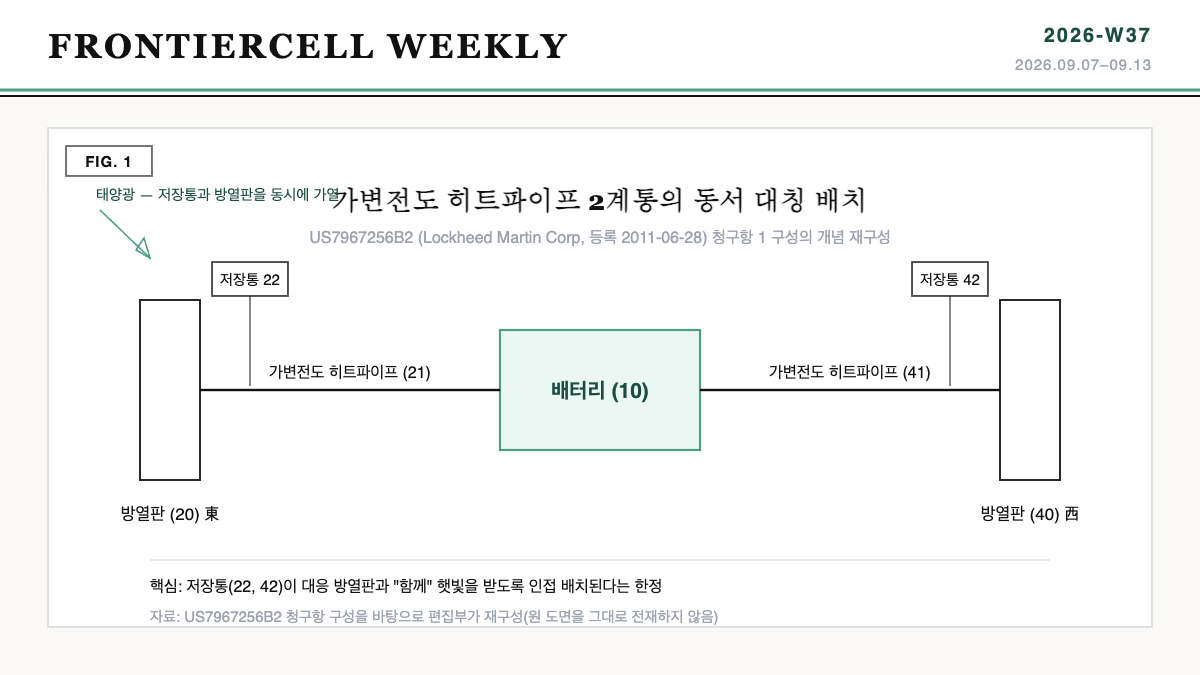
Source: reconstructed by the editorial team based on the claim language of US7967256B2 (the original drawings are not reproduced).
A Variable Conductance Heat Pipe (VCHP) adds a regulating mechanism to this. A reservoir is attached to the end of the pipe and filled with non-condensable gas. The working fluid circulating inside the pipe carries heat through repeated evaporation and condensation, while the non-condensable gas stays uncondensed and “blocks” part of the condenser section with gas. Heat-transfer capacity drops in proportion to the blocked area.
This is where the patent’s core idea comes in. Non-condensable gas expands when heated and contracts when cooled. In other words, heating the reservoir pushes the gas toward the pipe, narrowing the channel; cooling it draws the gas back into the reservoir, widening the channel. Heat-transfer volume can be regulated without any separate valve. Think of it as a faucet that closes and opens itself.
The decisive element that Claim 1 limits is where that reservoir is placed. The reservoir is positioned right next to its corresponding radiator, arranged so that the reservoir and the radiator are exposed to sunlight at the same time. That means at the exact moment sunlight heats the radiator and degrades its radiating performance, the same sunlight also heats the reservoir and narrows the channel. With no sensor and no controller, physics alone achieves “close the path on the sunlit side, dump heat through the shaded side.”
3. Comparison — Three Approaches to Thermal Management
| Fixed-Conductance Heat Pipe | Active Control (Sensor + Heater/Valve) | US7967256B2 Claim 1 Configuration | |
|---|---|---|---|
| Heat-transfer regulation | Not possible — always constant | Possible — controller decides | Possible — self-regulated by reservoir temperature |
| Additional electronics | None | Sensor, controller, actuator required | Not required under Claim 1 (added in dependent claims) |
| Failure mode | Simple | Thermal management fails if control system fails | Relatively insensitive to electronics failure |
| Eclipse-period loss | Large — heater power draw | Can be reduced through control | Reduced structurally |
| Number of claims / legal status | – | – | 7 claims / Active, estimated expiry 2030-09-24 |
What this table says: This patent’s commercial value lies less in raw thermal performance than in gaining a regulating function without adding parts. In an environment where servicing is impossible, fewer parts means fewer possible failure points — and that is reliability.
4. Patent Perspective — Claim Mapping and Design-Around Points
| Element of Claim 1 | Functional Role | Gate for Design-Around Analysis |
|---|---|---|
| (a) Battery | Heat source | Essential — cannot be designed around |
| (b) First radiator, arranged so its first surface faces a first direction | First thermal path | Directional limitation attached |
| (c) First variable-conductance heat pipe thermally coupled to the battery and the first radiator (main line holding working fluid + reservoir holding non-condensable gas) | Regulable heat channel | VCHP structure specified |
| (d) Second radiator, arranged so its first surface faces a second direction opposite the first | Second thermal path | Symmetric dual circuits required |
| (e) Second variable-conductance heat pipe thermally coupled to the battery and the second radiator | Second-circuit regulation | Not satisfied by a single circuit alone |
| (f) First reservoir positioned adjacent to the first radiator such that both are heated by the sun simultaneously | Trigger for self-regulation | Core differentiating element |
| (g) Second reservoir arranged in the same relationship | Symmetric trigger | Core differentiating element |
| [Claims 2–5] Heater and controller for the reservoir, plus temperature or light sensor | Active assist | Dependent claims — sensor approach branches two ways |
| [Claim 6] First direction is East, second direction is West | Orbital-orientation limitation | Dependent-claim limitation |
| [Claim 7] Solar cells arranged on the first surface of each radiator | Dual-purpose radiator/solar panel | Dependent-claim limitation |
Source: compiled by the editorial team, element by element, from the published claim language of US7967256B2. This is not a legal opinion on infringement.
Design-around points. Claim 1 has many elements with specific limitations, which leaves comparatively broad room for literal design-around.
- Number of circuits: Using only a single radiator-and-VCHP circuit does not satisfy elements (d) and (e). That said, single-sided radiation may underperform depending on orbital conditions.
- Directional relationship: Arranging the two radiators to face, say, perpendicular directions rather than “opposite” directions may fall outside the literal scope of (d).
- Reservoir placement: The most important point. Placing the reservoir away from the radiator, inside a structure shielded from sunlight, and instead regulating its temperature purely with a heater does not satisfy the “heated by the sun simultaneously” limitation of elements (f) and (g).
A counterargument to this design-around scenario. The third option looks clean on paper, but the cost is clear. The moment the reservoir is controlled with a heater, the power consumption and control-system failure risk that this invention eliminated come right back. In other words, the design-around succeeds, but it is a textbook case of the resulting structure being inferior to the original. What’s more, the heater-plus-controller combination is already covered by Claims 2–5 of this same patent, so exposure under the dependent claims needs to be checked as well.
One more point. This patent is Active, with an estimated expiration date of September 24, 2030. For a satellite program starting its design now, the development and qualification timeline overlaps substantially with the patent’s remaining term. Conversely, for a program targeting mass production in the mid-2030s or later, waiting out the expiration can be a more realistic option than designing around it. Locking in an inferior structure just to avoid a soon-to-expire patent is a common mistake.
5. Limits and Outlook
To be clear about the limits here: this piece is an element-by-element breakdown based on published claim language, not a legal opinion on infringement. In particular, phrases such as “arranged adjacent to” and “heated by the sun simultaneously” can be interpreted more broadly or narrowly depending on the specification’s definitions and prosecution history. The assignee, legal status, and estimated expiration date shown by Google Patents are also reference values; actual legal status should be confirmed through each country’s own patent register. This family has corresponding applications EP2156507A4 and WO2008136880A1, so claims may differ by jurisdiction.
A scenario against the optimistic reading. The conclusion that “a passive structure is always better” has a counterexample. On platforms like small LEO satellites with short design lives and high production volumes, it can be more cost-effective overall to simplify thermal control altogether and simply over-design the battery. In that case, the dual-VCHP-circuit structure becomes an over-engineered solution. It’s more accurate to say this patent’s effective reach lies with large, long-life satellites.
A strategic alternative. For a domestic company entering this space, rather than redesigning a VCHP structure that overlaps head-on with this patent, a lower-patent-density path is to reduce temperature swings through the thermal mass design and cell layout of the battery pack itself. That shifts the competition away from moving heat efficiently and toward making the temperature swing less in the first place.
Action item (for planning and IP teams): Compare the mass-production target date of any satellite program you’re evaluating against September 2030. If production begins after expiration, it makes more sense to review an expiration-based strategy before spending a design-around budget.
Also in this week’s Frontiercell Weekly
FRONTIERCELL WEEKLY 2026-W37 · 2026.09.07–09.13
- The Year an “EV Fire Pavilion” Appeared at the Trade Show — What K-Battery Show 2026 Reveals About Where Equipment Orders Are Headed
- [Patent Analysis] Filling the Electrolyte “Atmospheric Pressure First,” Not “Vacuum First” — The Claim Boundary US10476097B2 Draws Around the Pressure-Reduction Cycle
- Every Time a Satellite Enters Shadow — Where Space-Grade Batteries Diverge From Terrestrial Cells