Mixing manganese into lithium iron phosphate (LFP) raises the average voltage and, with it, energy density. But three costs arrive on the same invoice: conductivity, structural stability, and manganese dissolution. This article reads that cost structure together with one patent that captured the costs as a “composition window.”
① What’s the Topic
LMFP is not simply “LFP with more manganese.” It is a composition-design problem of choosing how much manganese to add and what to compensate it with, and part of that composition window is already occupied by patents.
Start with the industry context. LFP has expanded its footprint in ESS and entry-level EVs because its raw materials are cheap and it is safe, but it carries a known limit: its average electrode potential stays at about 3.4 V (vs. lithium), capping its theoretical gravimetric energy density at around 578 Wh/kg[1]. Lithium manganese iron phosphate (LMFP), which keeps the same olivine crystal structure while replacing part of the iron with manganese, draws attention because it can lift the potential above 3.8 V and the theoretical energy density above 646 Wh/kg[1].
The tension is that manganese is not free. Reports indicate that as the manganese ratio rises, the trivalent manganese ions (Mn3+) formed during charging distort the crystal (Jahn-Teller distortion), and manganese leaching into the electrolyte becomes more pronounced[1]. The olivine structure’s inherent weakness of slow electron and ion transport also remains.
So the question this article answers is this: when voltage is raised with manganese, what exactly is being paid, and how did a patent capture that payment structure within its scope of rights?
② Basic Principle — Two Elevators in One Building, and the Upper One Breaks Down More Often
An olivine cathode can be likened to a building whose lithium passageways run in a single direction. In LFP, iron ions shuttle between the divalent and trivalent states to exchange electrons, and the height (voltage) at which this reaction occurs is about 3.4 V. In LMFP, an additional reaction in which manganese ions shuttle between the divalent and trivalent states is activated at about 4.1 V[1]. It is as if a second elevator reaching higher floors has been installed in the same building.
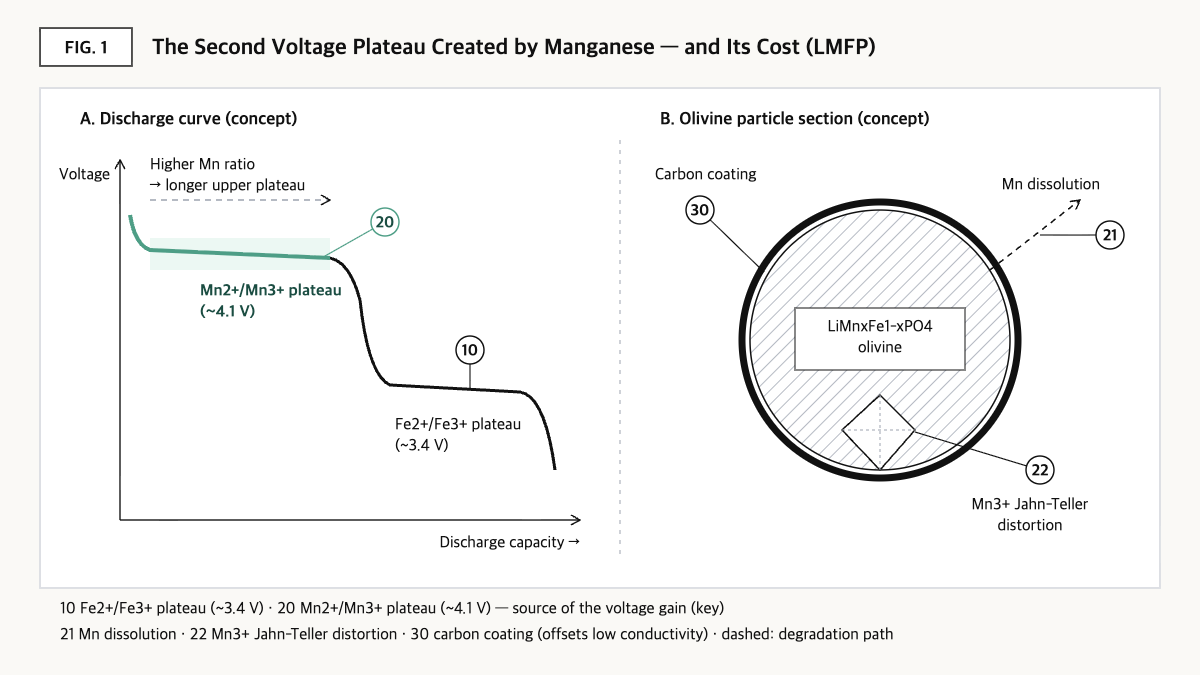
Source: reconstructed by the editorial team from the review by Jung, Oh, and Han (2025), Energy Materials.
The problem is that the upper elevator breaks down more often. When manganese reaches the trivalent state, a Jahn-Teller distortion stretches the surrounding oxygen coordination in one direction, and repetition accumulates stress in the crystal. Add manganese dissolution (Mn dissolution) from surfaces in contact with the electrolyte, and capacity erodes slightly with every cycle[1]. That is why one view in the research community holds that a manganese ratio in the 0.5–0.8 range is generally suitable[1]. Too little manganese yields a small voltage gain; too much, and the upper elevator stalls frequently.
There is also the question of elevator speed. The olivine structure inherently has low electronic conductivity and slow lithium diffusion. Optimizing the uniformity, content, and degree of graphitization of the conductive carbon coating that wraps particle surfaces is therefore cited as a key task for LMFP as well[1]. In short, LMFP’s voltage gain is a trade in which one new plateau is obtained in exchange for compensation costs in three directions: structure, conduction, and interface.
③ Comparison — LFP vs. LMFP: What Is Gained and What Is Given Up
| Item | LFP (LiFePO4) | LMFP (LiMn1-yFeyPO4) |
|---|---|---|
| Average electrode potential | About 3.4 V vs. Li+/Li [1] | Above 3.8 V [1] |
| Theoretical gravimetric energy density | About 578 Wh/kg [1] | Above 646 Wh/kg [1] |
| Additional redox plateau | None (Fe2+/Fe3+ only) | Mn2+/Mn3+ at about 4.1 V [1] |
| Main degradation factors | Low conductivity and diffusion rate | Same, plus Mn3+ Jahn-Teller distortion and Mn dissolution [1] |
| Manganese ratio generally considered suitable | Not applicable | 0.5–0.8 [1] |
| Tap density and low-temperature performance (vs. NCM) | Inferior [1] | Inferior [1] |
Source: reconstructed by the editorial team from the review by Jung, Oh, and Han (2025), Energy Materials[1].
What this table shows: On a theoretical energy-density basis, LMFP sits at least 10% above LFP (about 578 → above 646 Wh/kg)[1], but that gain comes from a single manganese plateau near 4.1 V, while the list of degradation factors actually grows. The gain is one line; the costs are several.
④ Patent Perspective — Rights Anchored Not on the Manganese Ratio but on a “Deliberately Skewed Charge-Balance Window”
As an example of capturing LMFP’s cost structure in a single composition formula, consider US9793538B2 (title: LMFP cathode materials with improved electrochemical performance). The original assignee is Dow Global Technologies LLC, and Google Patents lists the current assignee as Jiangsu Hengtron Nanotech Co Ltd. Priority date 2012-12-21, filing date 2013-03-07, grant date 2017-10-17, legal status Active, anticipated expiration 2033-03-07 (as displayed by Google Patents; the granted patent carries a terminal disclaimer notice, so the actual expiration may be earlier), with 3 granted claims[2].
The specification points out that substituting manganese for iron raises the working voltage but degrades structural stability and charge transport, that actual capacities fall well short of theoretical levels, and that capacity loss with cycling is a problem[2]. The solution is a composition window with slightly more lithium than stoichiometric, a small amount of metal dopant, and a total cation charge deliberately set below 3. Restating claim 1 element by element gives the following.
| Element of claim 1 (restated) | Meaning for the scope of rights |
|---|---|
| (a) A particulate cathode material containing an electroactive material of empirical formula LiaMnbFecDdPO4 | Product (composition) claim — infringement judged by composition alone, regardless of the manufacturing method |
| (b) Lithium a is 1.025–1.10 (excess over stoichiometry) | Lithium-excess limitation — a boundary verifiable by quantitative analysis |
| (c) Manganese b is 0.70–0.85, iron c is 0.1–0.3 | High-manganese limitation — the 0.5–0.7 manganese range falls outside the literal scope |
| (d) Dopant D is 0.01–0.075, one or more of Mg, Ca, Sr, Co, Ti, Zr, Mo, V, Nb, Ni, Sc, Cr, Cu, Zn, Be, La, Al | A broad dopant list that makes escape by element substitution alone difficult |
| (e) (a+2b+2c+dV) is 2.85–2.99 (V is the valence of D) | Limitation fixing the total cation charge below 3 — the baseline for judging infringement |
| (f) At least a portion of the electroactive material has an olivine structure | The word “portion” may encompass mixed phases |
Source: reconstructed by the editorial team from the claim structure of US9793538B2 on Google Patents[2] (original claim language and drawings not reproduced verbatim).
The dependent-claim structure is also short. Claim 2 narrows the dopant to magnesium, cobalt, or a mixture of the two, and claim 3 limits each coefficient to narrower ranges (e.g., a charge sum of 2.95–2.98)[2]. Because there are few claims but a single independent claim demands six numerical windows at once, literal infringement requires all six conditions to be met simultaneously, which is the starting point for a freedom-to-operate (FTO) assessment.
Design-around scenarios (including counterarguments). (a) Setting the manganese ratio below 0.70 (e.g., 0.6) may fall outside the literal scope of element (c). (b) Keeping lithium near stoichiometry (a≈1.0), or (c) designing a composition whose total cation charge exceeds 2.99, are also directions worth examining. The counterarguments are clear. For numerically limited inventions, compositions near a boundary could fall inside or outside the range depending on analytical error and the choice of measurement method, and whether the doctrine of equivalents applies is likely to be judged differently depending on jurisdiction and case. Moreover, lowering the manganese ratio to design around the claim means giving up part of the voltage gain, so the technical goal and the design-around could collide head-on.
Cross-check of similar patents. A123 Systems’ US8541136B2 (priority date 2008-01-17, granted 2013-09-24, Active, anticipated expiration 2032-04-13) also claims an olivine lithium metal phosphate with lithium and phosphate contents above stoichiometry[3], suggesting that the design axis of “off-stoichiometric composition” may be occupied in layers by multiple rights holders.
⑤ Limits and Outlook
On the optimistic side, LMFP is regarded as a realistic path to raising energy density by 10% or more while keeping LFP’s cost and safety framework[1]. As research continues on optimizing carbon coating and doping in the 0.5–0.8 manganese range, the options for cathode materials in entry-level EVs may widen.
There is also a contrary scenario. The fact that the entire voltage gain comes from the manganese plateau means degradation is also concentrated in the same place. If manganese dissolution and Jahn-Teller distortion appear larger than expected over long cycling or at high temperature, the energy-density gain felt at the cell level could be smaller than the theoretical difference. Tap density lower than NCM[1] also remains a burden for volumetric energy density.
The strategic alternative is to place the composition roadmap and the claims’ numerical windows on the same coordinate system. Build a composition map with manganese ratio, lithium excess, and charge sum as axes, then overlay the company’s candidate compositions with the numerical windows of key rights such as US9793538B2 and US8541136B2; this reveals early which zones stay outside the scope of rights without seriously compromising performance targets. The perspective this article wants to emphasize is this: LMFP’s patent risk is more likely to materialize first in secondary coefficients that drift with process variation, such as lithium excess and charge sum, than in the headline number of “what percent manganese.”
Action to check (planning/IP teams): Obtain ICP analysis values (molar ratios of lithium, manganese, iron, and dopants) for your own or your supplier’s LMFP product, calculate the (a+2b+2c+dV) value directly, and check how far it sits from the 2.85–2.99 window, including lot-to-lot variation.
Items Requiring Verification
- The timing and circumstances of the transfer of US9793538B2 (Dow → Jiangsu Hengtron Nanotech), and whether corresponding family members in Korea, China, and Europe were granted, were not separately verified in this article.
- Specific figures such as high-temperature cycle retention in the specification’s examples were not re-verified at the level of the original tables and were therefore not included in the text.
- Measured cell-level (Wh/kg) energy densities of LMFP vary widely by product and design, so this article cites only theoretical values.
Sources
- Heechul Jung, Chungsun Oh, Dongwook Han, “Lithium manganese iron phosphate (LiMn1-yFeyPO4) rechargeable batteries: bridging material innovation with practical cell design,” Energy Materials, 2025, DOI 10.20517/energymater.2025.29. Link
- Google Patents, US9793538B2 “LMFP cathode materials with improved electrochemical performance,” bibliographic data and claims 1–3 (original checked 2026-09-23). Link
- Google Patents, US8541136B2 “Mixed metal olivine electrode materials for lithium ion batteries,” bibliographic data (checked 2026-09-23). Link
This article is a technology and patent trend commentary, not legal advice. Specific FTO judgments require professional review.
Related Reading