① What’s at Stake
What if the problem of renewable energy waiting to connect to the grid could be solved without building a single new substation? On July 10, Korea’s Ministry of Climate, Energy and Environment and Korea Electric Power Corporation (KEPCO) signed a memorandum of understanding with nine companies selected for the “Grid-Distribution Energy Storage System (ESS) Construction-Support Project,” formally launching the initiative. In regions where solar generation is concentrated, such as Honam and Jeju, the capacity of substations and distribution lines has already reached saturation, so newly built solar facilities have had to wait in a queue without connecting to the power grid, or existing connected plants have had to endure output curtailment that cuts their generation.
To resolve this bottleneck, the government’s chosen approach is not “expansion” but “buffering.” ESS (batteries) are installed directly on distribution lines: they store power during the hours when renewable generation is concentrated, and discharge that stored power during hours of concentrated demand, artificially creating spare capacity on the existing distribution grid. Nine virtual-power-plant (VPP) operators were selected in this round — LG Energy Solution, KEPCO KDN, SK Eternix, HD Hyundai Electric, Gridwiz, Korea East-West Power, Korea Midland Power, and Hyundai Engineering & Construction, among others.
Among them, LG Energy Solution formed the “Haetbit Distribution Grid Energy” consortium with Shinhan Asset Management and secured the maximum volume a single operator can win — all seven distribution lines (20MWh per line, 140MWh in total). There is a separate reason this news is interesting from the perspective of battery-cell manufacturing equipment: this is the first time the requirement to deploy batteries at scale across distribution lines — dispersed sites with no one permanently on-site — has been made concrete as a national-scale project. That inevitably brings along a technical challenge: fire safety at unmanned sites.
② Basic Mechanism
The operating principle of grid-distribution ESS is easiest to understand through the analogy of a reservoir’s spillway. Just as water is held back in a reservoir during periods of concentrated rainfall and released during the dry season, ESS stores power during the daytime hours when solar generation is concentrated, and releases that stored power during evening hours of concentrated demand or whenever the grid has spare capacity. According to the government’s announcement, this project is designed to install 4MW (20MWh) of ESS per distribution line, allowing an additional 5.7MW of solar power that had been waiting to connect to be brought onto the grid early. The distribution line’s own physical capacity stays the same; ESS effectively increases usable capacity by redistributing the flow of power across different times of day.
Source: reconstructed by the editorial team from figures in the Ministry of Climate, Energy and Environment and KEPCO announcement on the distribution-grid ESS program
Layered on top of this is the concept of a virtual power plant (VPP). A VPP is a system that bundles distributed resources scattered across many regions — solar generation, ESS, and the like — into a single software platform and controls them together as if they were one power plant. LG Energy Solution stated that it is applying advanced AI forecasting algorithms and VPP platform technology to this project, with a plan to newly connect 40MW of regional solar generation facilities that had been waiting to connect and to accommodate an additional 52.4GWh of renewable energy per year. The company describes this as a turning point in expanding its business from a battery supplier into an “energy platform company.”
③ Comparison (Table): Substation Expansion vs. Grid-Distribution ESS
| Category | Substation/distribution-grid expansion | Grid-distribution ESS deployment |
|---|---|---|
| Additional time required | Typically several years (including permitting and resident-acceptance procedures) | Relatively short, centered on battery installation |
| Scale addressed per line | Expansion of the line itself (large-scale civil and electrical works) | Installing 4MW (20MWh) of ESS to bring 5.7MW of solar online early |
| Target scale by 2030 | – | Approx. 700MW of ESS deployed, 1GW of additional renewable-energy connection |
| Expected additional annual generation | – | Approx. 1,350GWh (daily average 3.7GWh), equivalent to roughly 50,000 households per day |
| 5-year government funding scale | – | KRW 558.6 billion |
| Main burden factor | Cost, time, resident acceptance | Fire-safety management of batteries at dispersed sites |
Source: compiled by the editorial team from the Ministry of Climate, Energy and Environment and KEPCO program announcement (expansion lead times are a general description)
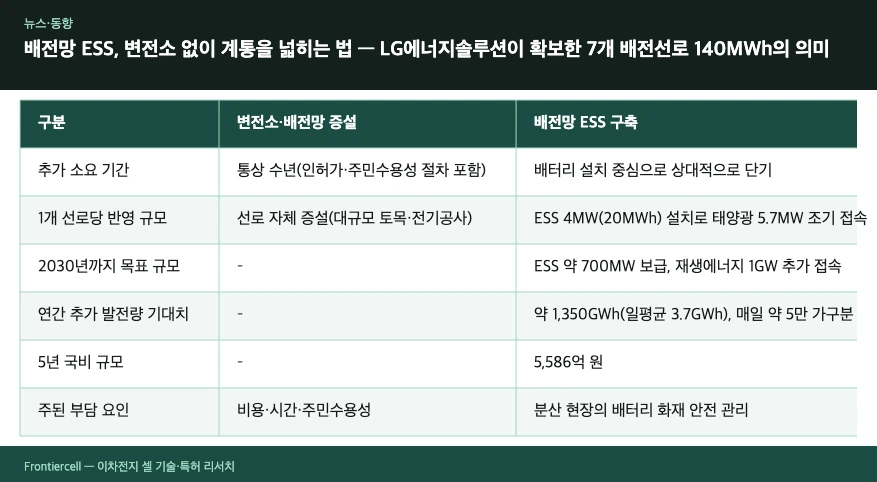
What this table shows: grid-distribution ESS creates 5.7MW of additional connection capacity per line far faster than expanding a substation would, but in exchange it takes on a new safety-management burden: batteries must be operated unmanned, on a permanent basis, across hundreds of dispersed sites.
④ Patent Perspective
Operators in this round were selected mainly around NCM (nickel-cobalt-manganese) and LFP (lithium iron phosphate) batteries, but the Ministry of Climate, Energy and Environment stated that, starting with the next round of selections planned for August, it intends to actively steer next-generation batteries with strengths in long duration, long cycle life, and fire safety toward market entry. Given the particular nature of unmanned distribution-line sites, the scope of rights covering technology that “detects fires early” and “actively suppresses” them is likely to emerge as a key variable in future operator selection and equipment-spec competition.
In fact, two separate domestic patents already exist: one that detects the sound of a gas leak with an acoustic sensor and outputs a fire-imminent signal (KR102254734B1, registered 2021), and another that controls bypass switching, forced cooling and liquid extinguishant injection based on the rate of temperature rise (dT/dt) or temperature difference (ΔT) (KR102406230B1, registered 2022). A detailed comparison and analysis of the two patents’ claim elements and scope of rights is covered in the patent-analysis piece that follows.
The fact that detection technology and suppression technology are split across separate patents suggests that an operator seeking to build an integrated safety system may need to conduct an FTO (freedom-to-operate) review covering multiple patents.
⑤ Limits and Outlook
There is, however, a scenario in which this plan does not unfold as intended. Because distributed ESS at the distribution-line level is managed by multiple different operators, the question of where responsibility lies and how the initial response is organized in the event of a fire or malfunction could become more complex than with a centralized, substation-based ESS. If even a single safety incident occurs in a pilot section, the possibility cannot be ruled out that the schedule for the next round of selections could be delayed, or that certification standards could be tightened sharply.
As a strategic alternative, operators could consider standardizing, early on, a platform that monitors battery status across distribution lines in real time on an integrated basis, and codifying initial-response protocols with local governments and fire authorities from the project’s launch stage onward. Planning and IP staff are advised to spend some time this week checking, on their own, whether their company’s ESS fire detection/suppression design — whether already supplied or still under review — incorporates the claim elements of registered domestic patents such as KR102254734B1 and KR102406230B1 as they stand.
This content was prepared based on published press materials and patent-office registration information, and does not guarantee any specific company’s business outcomes.