An electrode is made by ‘gluing’ active-material powder onto a metal foil. This article explains, from both a chemistry and a patent perspective, why that glue — the binder — splits into water-soluble CMC/SBR on the anode and PVDF dissolved in the organic solvent NMP on the cathode.
① What’s the Topic
Binder selection is decided first not by ‘how well it sticks’ but by ‘which solvent it uses and which potential it must withstand.’ And the bottleneck in switching the cathode to water lies not in the binder, but in the cathode active-material surface that reacts with water and in the aluminum current collector.
Start with the industry situation. For lithium-ion battery anodes, an aqueous process using water as the solvent is already the standard. For graphite and silicon-based anodes, a blend of sodium carboxymethyl cellulose (Na-CMC) and styrene-butadiene rubber (SBR) has become the standard binder choice[2]. Cathode slurries, by contrast, still widely use N-methyl-2-pyrrolidone (NMP) as the solvent and polyvinylidene fluoride (PVDF) as the binder[1].
The tension comes from regulation and cost. NMP is a substance of reproductive-toxicity concern, and in the EU a restriction has applied since May 2020 under which mixtures containing 0.3% or more NMP may be marketed and used only if worker exposure limits are complied with[3]. Exposure levels of 14.4 mg/m³ by inhalation and 4.8 mg/kg/day by dermal exposure are also specified[2][3]. On top of that, NMP recovery equipment and an energy-intensive drying process are said to push up manufacturing costs[1], and PVDF is also within the scope of per- and polyfluoroalkyl substances (PFAS) regulatory discussions[2]. Even so, a 2024 review assesses that alternative formulations have not yet reached a level where they can compete with conventional NMP/PVDF on price or performance, and so have not been widely adopted across the industry[1].
So the question this article seeks to answer is this: Why does the anode use water while the cathode uses NMP within the same cell, and where do patents put up fences along that boundary?
② Basic Principle — A Binder Is ‘Glue Water Sprinkled on a Sandcastle’
An electrode composite layer consists of active-material particles, a conductive additive, and a binder. In the analogy of a sandcastle on the beach, the active material is the grains of sand, and the binder is the glue water that seeps between the grains and hardens. The glue water must hold both the grains to each other (cohesion) and the sandcastle to its base plate, the current collector (adhesion). At the same time, it must not block the gaps between the grains — the pores through which electrolyte flows in and out.
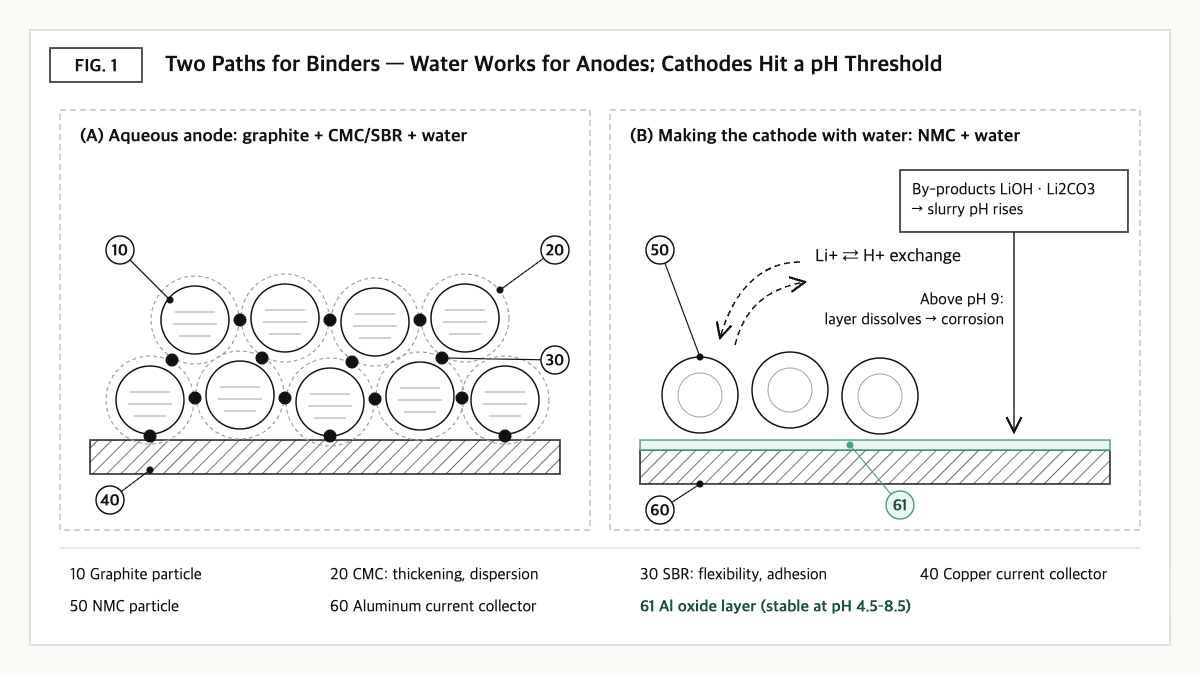
Source: reconstructed by the editorial team from the description of aqueous processing in the Rolandi et al. (2024) review.
In aqueous anodes, CMC/SBR splits this role in two. CMC dissolves in water and acts as a thickener that makes the slurry viscous and as a dispersant that spreads particles evenly, while SBR adds flexibility and adhesion strength to the electrode[2]. In glue-water terms, CMC is the ‘consistency adjuster’ and SBR is the ‘rubber-based adhesive.’ PVDF on the cathode, by contrast, works as a single binder: it wraps the particles while dissolved in NMP and leaves binding points behind as the solvent evaporates.
Why can’t the cathode use water? The key is that water reacts not only with the glue water but with the grains of sand themselves. When a layered-oxide cathode (NMC) is placed in water, an exchange reaction occurs in which lithium ions on the particle surface swap places with protons from water, releasing lithium hydroxide (LiOH) and lithium carbonate (Li2CO3) as by-products[2]. As a result, the slurry tilts alkaline.
The thin aluminum-oxide protective layer on the aluminum current collector is stable roughly within pH 4.5 to 8.5, but once slurry pH rises above 9, that protective layer dissolves and the aluminum current collector corrodes[2]. In other words, converting the cathode to an aqueous process is, before being a matter of finding ‘a good glue that dissolves in water,’ a matter of making grains of sand and a base plate that are not damaged by contact with water.
③ Comparison — Aqueous CMC/SBR vs. Organic PVDF/NMP
| Item | Aqueous: CMC/SBR + water | Organic: PVDF + NMP |
|---|---|---|
| Main application | Standard binder blend for graphite and silicon-based anodes[2] | Standard solvent/binder combination for cathode slurries[1] |
| Division of binder roles | CMC: thickening and particle dispersion / SBR: flexibility and adhesion strength[2] | PVDF as a single binder handles binding[1] |
| Manufacturing energy | Reported to consume about one order of magnitude (roughly one-tenth) less energy than NMP electrodes[2] | NMP recovery equipment and energy-intensive drying are cost factors[1] |
| Regulatory exposure | Regulatory burden of the solvent (water) itself is relatively low (qualitative comparison) | EU: exposure-limit compliance required at 0.3% NMP or more; inhalation 14.4 mg/m³, dermal 4.8 mg/kg/day[2][3] / PVDF within PFAS regulatory discussions[2] |
| Challenge when applied to cathodes | Li+/H+ exchange → LiOH and Li2CO3 formation; Al protective layer dissolves above pH 9 (stable range pH 4.5–8.5)[2] | Current mass-production standard; alternatives assessed as still uncompetitive on price and performance[1] |
Source: reconstructed by the editorial team from Mun et al. (2024)[1], Rolandi et al. (2024)[2], and a report on the NMP restriction (2020)[3].
What this table shows: The aqueous process has a clear advantage in consuming about one-tenth the manufacturing energy[2], but on the cathode a single threshold — pH 9 — triggers both aluminum corrosion and active-material degradation[2]. The fork between anode and cathode arises at this threshold, not from binder performance.
④ Patent Perspective — Rights to a ‘Commodity Material’ Hide in Grades and Test Methods
CMC is a commodity cellulose derivative also used in food and cosmetics. Does that mean battery-grade CMC carries no rights? Not so. The more commodity-like a material is, the more often the rights are hidden not in ‘the substance’ but in parameter claims that define ‘what grade it must be’ through numerical values and test methods.
A representative example is Nippon Paper Industries’ US9240583B2. Priority date 2008-11-26, filing date 2009-11-26, grant date 2016-01-19, current assignee Nippon Paper Industries, legal status Active (adjusted expiration expected 2031-07-21), with 2 granted claims[4]. The problem the specification targets is that when CMC is dissolved in water to make a slurry, undissolved CMC lumps remain and create streak and pinhole defects on the coated surface[4]. Restated element by element, claim 1 reads as follows.
| Elements of claim 1 (restated) | Meaning for the scope of rights |
|---|---|
| (a) A carboxymethylcellulose or a salt thereof | The substance itself is a commodity — this element alone can hardly establish a scope of rights |
| (b) When 2 liters of a 0.3 mass% aqueous solution are filtered under reduced pressure (−200 mmHg) through a 250-mesh filter, the dry mass of the residue on the filter is less than 50 ppm of the dry mass of the CMC charged | A limitation that quantifies ‘undissolved residue’ by a specific test method — the baseline for infringement judgment |
| (c) A volume cumulative 100% particle diameter, measured by laser diffraction with methanol as the dispersion medium, of 31 μm or more and less than 50 μm | Powder particle-size limitation — a condition linked to dissolution speed |
| (d) A degree of carboxymethyl substitution per anhydrous glucose unit of 0.45 or more and 2.0 or less | Molecular-structure range limitation — a relatively broad range |
| (e) A B-type viscosity at 25°C of a 1 mass% aqueous solution of 1,000–20,000 mPa·s | Viscosity-grade limitation |
| (f) Adapted to function as a binder for an electrode of a nonaqueous electrolyte secondary battery | Use limitation — narrows the scope to battery electrode binder use |
Source: reconstructed by the editorial team from the bibliographic data and claim structure of US9240583B2 on Google Patents (original claim language and drawings not reproduced verbatim).
The axis of the scope of rights here is (b). Values commonly listed in catalogs, such as degree of substitution or viscosity, span broad ranges that many products may fall within, but when a risk of infringement is actually contested, the first point likely to be tested is “is it below 50 ppm when measured by that test method?” Considering the All Elements Rule, under which infringement is established only when every element is met at the same time, design-around scenarios can be sketched along three lines: (i) keeping particle size at 50 μm or more and managing the dissolution process separately, (ii) setting the viscosity grade outside the claimed range, and (iii) using a water-soluble polymer other than CMC as the thickener.
There are clear counterarguments, however. (i) and (ii) may sacrifice slurry properties and coating quality, making the technical ‘cost of design-around’ high, and for products near the numerical boundaries the judgment could turn on differences in measurement conditions alone. Moreover, since this patent belongs to a material supplier, it may be more realistic for a cell maker to manage the risk through warranties in the supply contract rather than a direct design-around. As a cross-check of similar patents, there is Zeon’s US11552297B2 (priority date 2014-06-04, granted 2023-01-10, Active). Rather than CMC, it claims a copolymer binder based mainly on (meth)acrylic acid and (meth)acrylamide, with the condition of a degree of swelling in electrolyte of less than 120 mass%[5], illustrating the same trend of aqueous-binder rights being designed as ‘composition + property parameter’ combinations.
⑤ Limits and Outlook
On the optimistic side, as regulatory and cost pressures overlap, pressure to shift to aqueous or non-NMP processes on the cathode is likely to grow. The report that aqueous electrodes consume one order of magnitude less manufacturing energy than NMP electrodes[2] is a strong incentive in itself.
There is also a counter-scenario. The higher the nickel content of a cathode, the more sensitively its surface lithium may react with water, which could create a paradox in which the energy-density race itself raises the difficulty of the aqueous transition. Add the assessment that alternative formulations cannot yet compete with conventional NMP/PVDF on price or performance[1], and it is hard to rule out the possibility that cathode aqueous conversion proceeds more slowly than ‘the pace regulation forces.’
As a strategic alternative, the binder could be managed not as ‘a material swap’ but as ‘a process-condition package.’ Developing pH-control additives, current-collector surface treatment, and binder grade as one combination, and checking prior art and the scope of rights at the level of that combination, can reduce unexpected risk of infringement or performance loss caused by partial substitution.
Action to check (planning/IP teams): Collect the specification sheets of your current CMC, SBR, and PVDF suppliers (degree of substitution, viscosity, particle size, undissolved-matter test method) and compare in a table whether each value overlaps with the parameter-claim scope of the supplier or competing material makers. Also check whether the supply contract includes a patent indemnity clause.
Items Requiring Verification
- The Japanese, Korean, and Chinese family members of US9240583B2 and their grant and maintenance status in each country were not separately checked in this article.
- Actual mass-production cases of aqueous cathode processing (cell makers and products) could not be confirmed from public sources in this research.
- The final scope and schedule of EU PFAS restrictions on PVDF are still under discussion, and no confirmed content could be verified.
Sources
- Sung Cik Mun, Yeong Hoon Jeon, Jong Ho Won, “Progress and challenges for replacing n-methyl-2-pyrrolidone / polyvinylidene fluoride slurry formulations in lithium-ion battery cathodes,” Progress in Natural Science: Materials International 34(1), 194–206, 2024. Link
- Rolandi et al., “Unlocking sustainable power: advances in aqueous processing and water-soluble binders for NMC cathodes in high-voltage Li-ion batteries,” RSC Sustainability 2, 2024. Link
- European Coatings, “NMP restriction to take effect soon,” 2020-01-27. Link
- Google Patents, US9240583B2 “Carboxymethylcellulose or salt thereof for electrodes of nonaqueous electrolyte secondary battery and aqueous solution thereof,” bibliographic data, specification, and claim 1 (original checked 2026-09-23). Link
- Google Patents, US11552297B2 “Binder composition for lithium ion secondary battery electrode-use …,” bibliographic data and claim 1 (original checked 2026-09-23). Link
This article is a technology and patent trend commentary, not legal advice. Specific FTO judgments require professional review.
Related Reading
- Dry Electrodes: Remove the Solvent and the Binder Becomes the Bottleneck — The Material Constraint of PTFE Fibrillation
- How Slurry Dispersion Pressure Affects Cell Performance — Why 3,500bar Ultra-High-Pressure Dispersion Technology Is Getting Attention
- Dry Electrode Process Patents — Tesla vs. Korea’s Big Three Battery Makers