Take apart a lithium-ion cell and you find that the anode is slightly wider than the cathode at every edge. This article explains why this ‘anode overhang’ is needed, what it costs in return, and what a patent that claims ‘the conditions under which no overhang is needed’ tells us in reverse.
① What’s the Topic
The anode overhang is ‘insurance’ taken out because we use anodes, such as graphite, that operate at low potential, and its premium is paid in energy density and in the measurement confusion known as ‘reversible capacity shift.’ The fact that a patent claim exists stating this insurance is unnecessary when the anode potential is high enough shows this in reverse.
Start with the industry context. Making the anode larger than the cathode has long been treated as a basic design rule in cell design. If lithium leaving the edge of the cathode reaches a spot with no anode to receive it, there is a risk that it will deposit there as metallic lithium (lithium plating). Medtronic’s patent specification likewise describes having the anode extend beyond the edges of the cathode as the traditional design for preventing lithium plating[3].
The tension is the cost of this insurance. The part of the anode that does not face the cathode, the overhang, takes up space and material without contributing directly to energy storage. On top of that, the overhang slowly absorbs and releases lithium while the cell rests, shaking capacity measurements[1][2]. So the question this article answers is this: what exactly does the overhang prevent and what does it cost, and at which point of this design rule do patents stake their rights?
② Basic Principle — Why the Saucer Must Be Wider Than the Flowerpot
The overhang is like the relationship between a flowerpot and its saucer. If the saucer is smaller than the pot when you water it, water running over the edge drips onto the floor. Charging is the process of moving lithium from the cathode (flowerpot) to the anode (saucer). If lithium starting from the edge of the cathode cannot find an anode to receive it, it may crowd at the anode’s end or build up as metal. That is why the saucer is made slightly wider than the pot.
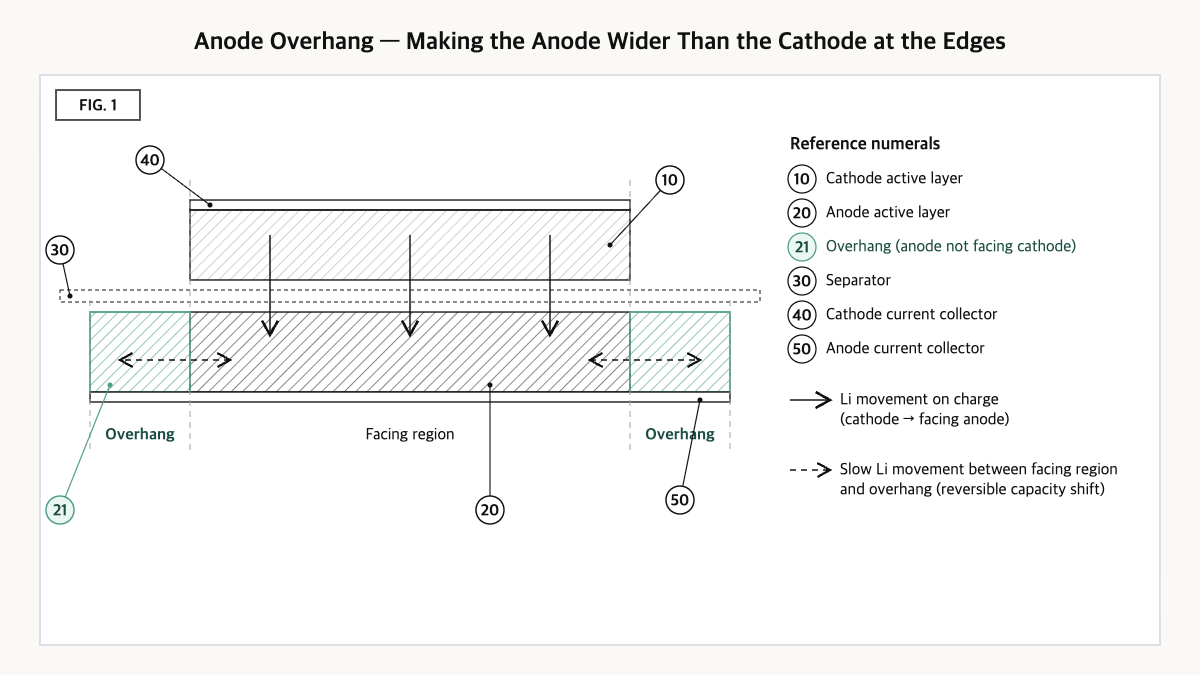
Source: reconstructed by the editorial team from Lewerenz et al. (2018), Fath et al. (2020), and the US8105714B2 specification.
But lithium also migrates little by little into the saucer’s outer rim, the overhang. A lithium concentration difference develops between the facing region opposite the cathode and the overhang, and lithium slowly moves sideways along this difference. A study analyzing calendar aging (aging during storage) tests at five states of charge (SOC) distinguished the initial non-linear capacity decline as a ‘reversible’ loss caused by lithium migration into the overhang, and the subsequent linear decline over 100–200 days as ‘irreversible’ aging. Extrapolating the linear portion to t = 0 allows the amount of lithium lost to the overhang to be estimated, and this lateral lithium flow showed temperature dependence[1].
Another study modulated overhang area in three-electrode cells by varying the cathode diameter and reported that separator properties significantly influence the rate of balancing between the overhang and the active region. Such a model is described as helping to separate reversible and irreversible losses more reliably in cyclic and calendar aging tests and to evaluate the actual state of health (SOH)[2]. The overhang is a structure that protects the cell and, at the same time, one that confuses whoever reads the cell’s lifetime data.
③ Comparison — Three Designs for Handling the Overhang
| Item | Conventional overhang design (low-potential anode) | No-overhang design (US8105714B2) | Overhang + alignment-holding structure (US20240429455A1) |
|---|---|---|---|
| Electrode area relation | Anode coated area > cathode coated area[3] | Anode coated area ≤ cathode coated area[3] | An extension at the anode edge, with a separator bent portion covering the cathode side[4] |
| Anode potential condition | No limitation (graphite, etc.) | Greater than 0.2 V vs. lithium[3] | No limitation[4] |
| Main purpose | Preventing lithium plating at the edges[3] | Improved energy density, simplified manufacturing[3] | Preventing misalignment under vibration/impact and lithium plating[4] |
| Side effect | Reversible capacity shift from lithium migration into the overhang[1][2] | Not quantified in this article | Not quantified in this article |
Source: reconstructed by the editorial team from Lewerenz et al. (2018)[1], Fath et al. (2020)[2], US8105714B2[3], and US20240429455A1[4].
What this table shows: The need for an overhang is tied to the operating potential of the anode material. That a claim exists stating the area relation can be reversed when anode potential is raised above 0.2 V vs. lithium means the overhang is not a ‘universal rule’ but a ‘conditional rule of the graphite era.’
④ Patent Perspective — A Claim That Says ‘The Anode Need Not Be Larger’
Medtronic’s US8105714B2 (“Lithium-ion battery”) has a claim that directly reverses the overhang rule. Per Google Patents, its priority date is 2004-10-29, filing date 2007-07-13, grant 2012-01-31, and legal status Active (anticipated expiration 2028-03-09), and it is shown as a continuation-in-part (CIP) of earlier applications from 2004–2005. It has 35 claims[3][5]. Restating claim 1 element by element gives the following.
| Elements of claim 1 (restated) | Meaning for the scope of rights |
|---|---|
| (a) A lithium-ion battery in which generally planar positive and negative electrodes are arranged alternately to form an electrode stack | Structural limitation — planar stack (a wound jelly roll may not be covered by the literal language) |
| (b) Each electrode comprises a current collector with two surfaces and active material provided on at least one surface | Ordinary electrode configuration |
| (c) The active material of the negative electrodes has a potential greater than 0.2 V versus a lithium reference electrode | Material-condition limitation — low-potential anodes such as graphite are likely excluded |
| (d) The area of the negative current collectors covered by active material is not larger than the area of the positive current collectors covered by active material | Reversal of the overhang rule — the key limitation that anode coated area ≤ cathode coated area |
Source: reconstructed by the editorial team from the bibliographic data and claim 1 of US8105714B2 on Google Patents (cross-checked against the full claim text on Justia Patents) (original claim language and drawings are not reproduced verbatim).
The specification explains, in effect, that using a high-potential anode such as lithium titanate makes it possible to maintain lithium-plating prevention without the traditional overhang rule while gaining improved energy density and simplified manufacturing[3]. The scope of rights of this claim is defined by the combination of (c) and (d). Since graphite-anode cells are likely not to satisfy (c), the risk of infringement is likely to be low for most commercial graphite cells.
Design-around scenarios (with counterarguments): For cells using a high-potential anode, (i) a design that keeps the anode coated area even slightly larger than the cathode and (ii) a design that adopts a wound rather than planar-stack structure may fall outside the literal scope. There are counterarguments. In (i), if the difference is as small as measurement error, a dispute may arise over the interpretation of ‘not larger’; in (ii), the possibility cannot be entirely ruled out that the phrase ‘generally planar’ is argued to cover the flat portions of a wound structure. Moreover, since this patent is expected to expire in 2028, the practical value of a freedom to operate (FTO) judgment itself changes with the launch timing of high-potential-anode products.
Cross-check of similar patents: There are also rights on the side of ‘protecting’ the overhang in graphite-type cells. LG Energy Solution’s US20240429455A1 (priority 2022-01-04, filed 2023-01-03, published 2024-12-26, pending) claims a configuration with an extension of predetermined length at the anode edge and the separator edge bent at a predetermined angle to cover part of the cathode’s side surface. The specification cites as its purpose preventing the problem in which electrodes shift under vibration or impact, the overhang collapses, and lithium plates. The Japanese family member JP7726454B2 is shown as active[4]. In effect, one side is claiming the conditions for eliminating the overhang, and the other the structure for maintaining it.
⑤ Limits and Outlook
On the optimistic side, if methods for separating the overhang-driven reversible capacity shift with quantitative models become established[1][2], the accuracy of cell lifetime evaluation could improve, and design optimization that trims overhang width to the necessary minimum could become possible.
There is also a counter-scenario. As materials with large volume change, such as silicon-blended anodes, spread or cells grow larger, assembly tolerances and electrode movement in use may increase, so that the overhang becomes something to protect rather than to shrink. The fact that structures preventing misalignment under vibration and impact are newly being filed[4] can be read as a signal of this.
The strategic alternative is to manage overhang width doubly, as a ‘safety margin’ and a ‘measurement correction variable.’ Setting the width at the design stage based on assembly tolerance and in-use movement, and judging life at the evaluation stage with capacity data corrected for the overhang effect, can reduce the chance of misjudging an initial capacity shift as aging or, conversely, mistaking irreversible aging for a reversible shift.
Action to check (planning/IP teams): Confirm in your cell lifetime evaluation reports whether the capacity decline in the early calendar-aging period has been corrected for the overhang effect, and if you are considering high-potential-anode products (lithium titanate, etc.), compare the anode/cathode coated-area relation against elements (c) and (d) of claim 1 of US8105714B2.
Items Requiring Verification
- Typical overhang width (mm) and anode/cathode capacity ratio (N/P ratio) values for commercial cells could not be confirmed from sources in this article, so they are not given.
- The full text of claim 1 of US8105714B2 could not be extracted from the Google Patents page, so it was cross-checked against the full claim text on Justia Patents.
- US20240429455A1 is pending in the United States, and whether it will be granted and its final claim scope are not settled. The current status of EP4322310A4 was also not verified.
- Whether the configuration of US8105714B2 has been applied to actual commercial products was not verified.
Sources
- M. Lewerenz, G. Fuchs, L. Becker, D. U. Sauer, “Irreversible calendar aging and quantification of the reversible capacity loss caused by anode overhang,” Journal of Energy Storage, vol. 18, pp. 149-159, 2018, DOI 10.1016/j.est.2018.04.029. Link
- J. P. Fath, L. Alsheimer, M. Storch, J. Stadler, J. Bandlow, S. Hahn, R. Riedel, T. Wetzel, “The influence of the anode overhang effect on the capacity of lithium-ion cells – a 0D-modeling approach,” Journal of Energy Storage, vol. 29, 101344, 2020, DOI 10.1016/j.est.2020.101344. Link
- Google Patents, US8105714B2 “Lithium-ion battery,” bibliographic data and specification (original checked 2026-09-23). Link
- Google Patents, US20240429455A1 “Electrode Assembly Including Negative Electrode Having Extension Portion,” bibliographic data and claim 1 (original checked 2026-09-23). Link
- Justia Patents, US Patent 8,105,714 full claims (claim 1, 35 claims in total, checked 2026-09-23). Link
This article is a technology and patent trend commentary, not legal advice. Specific FTO judgments require professional review.
Related Reading