Manganese and nickel ions dissolved from the cathode cross the electrolyte, accumulate on the anode, disturb the anode’s protective film and cut the life of the whole cell. This article summarizes the path of this “cathode-originated anode degradation,” the role of the cathode surface film (CEI), and a patent that claims countermeasures at the cell level.
① What’s the Topic
Transition metal dissolution begins as a cathode problem but shows up as an anode problem, which is why countermeasures and patent claims are structured to tie the cathode and anode together. The explanation that nickel and manganese ions dissolved from the cathode pass through the electrolyte, deposit on the anode and accelerate electrolyte decomposition, causing degradation, also appears as-is in patent specifications[3].
In the industry, cathodes have moved toward higher nickel content and higher charging voltages to raise energy density. One review summarizes that at high voltages above 4.3 V, conventional electrolytes begin oxidative decomposition, increasing cathode surface reactivity and transition metal dissolution[1]. Transition metal dissolution, manganese in particular, has been held responsible for severe capacity fading in lithium-ion batteries[2].
The tension lies in the fact that “what needs fixing” is not clear. Dissolution occurs at the cathode, but the damage appears at the anode and throughout the electrolyte. The question this article answers is this: by what path do transition metals dissolve and spread to the anode, and at which layer of the cell, and how, are countermeasures secured as rights?
② Basic Principle — Upstream Factory Wastewater Clogs the Downstream Water Plant
Compare a lithium-ion battery to a river. Upstream is a factory called the cathode, downstream is a water treatment plant called the anode, and between them flows a river called the electrolyte. The water plant (anode) wears a filter membrane on its surface called the solid electrolyte interphase (SEI), which lets only lithium ions through and blocks further decomposition of the electrolyte.
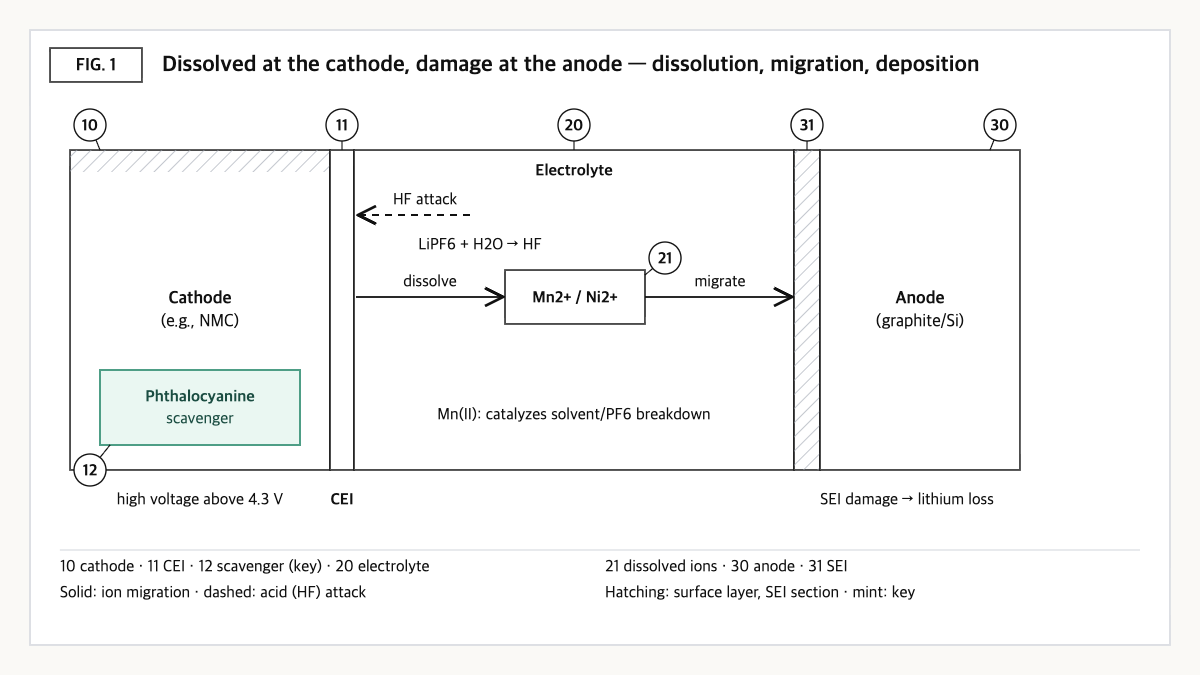
Source: reconstructed by the editorial team from the Batteries (2023) review, Nature Communications (2019) and US12211998B2 on Google Patents.
The first reason wastewater leaks from the upstream factory is acid. The electrolyte salt LiPF6 decomposes into LiF and PF5, and when PF5 meets moisture it forms hydrofluoric acid (HF) and POF3. This HF attacks the NMC cathode surface, causing loss of active lithium and accelerating the dissolution of transition metal ions[1]. The second reason is high voltage. Above 4.3 V, the electrolyte begins oxidative decomposition and the cathode surface becomes unstable[1].
The dissolved nickel and manganese ions flow downstream with the river and deposit on the anode[3]. In the words of the specification, this process not only changes the surface and structure of the cathode but also catalyzes electrolyte decomposition[3]. When foreign matter lodges in the filter membrane (SEI), lithium keeps being consumed as the membrane is rebuilt, and cell capacity declines[1]. In addition, a study published in 2019 reported that not only manganese accumulated on the anode surface but also divalent manganese (Mn(II)) dissolved in the electrolyte itself catalyzes the decomposition of carbonate solvents and PF6– anions through its unique solvation structure[2]. It means the wastewater was polluting the river itself before reaching the water plant.
The line of defense that can be built on the upstream factory side is the cathode surface film, that is, the cathode electrolyte interphase (CEI). Among electrolyte additives, tris(trimethylsilyl) phosphite (TMSPi) is summarized as decomposing to form a CEI layer, preventing excessive electrolyte decomposition and transition metal dissolution[1]. It is like putting a filter on the factory’s drain.
③ Comparison — Lines of Defense Can Be Built at Four Layers
| Defense layer | Point of action | Representative means | Reported figures / basis |
|---|---|---|---|
| Electrolyte additive (CEI formation) | Cathode surface film | TMSPi + VC (vinylene carbonate) | With 1% TMSPi + 1% VC, NMC811/graphite cell capacity retention of 91% after 200 cycles at C/3[1] |
| Electrolyte salt composition | Cathode and anode interfacial stability | LiTFSI-LiBOB dual salt | Over 90% retention after 300 cycles at 4.3 V[1] |
| Scavenger additive in the cathode | Capturing dissolved metal cations | Metal-coordinated phthalocyanine | Claims addition of about 1–2 wt% relative to cathode active material[4] |
| Managing Mn(II) in the electrolyte | Bulk electrolyte | Electrolyte design that considers solvation structure | Qualitative comparison: mechanism reported in which Mn(II) catalyzes solvent and anion decomposition[2] |
Source: reconstructed by the editorial team from the Batteries (2023) review[1], Nature Communications (2019)[2] and the claims of US12211998B2[4].
What this table shows: Countermeasures identified in the public literature divide mostly into “reducing dissolution” (additives, salt composition) and “capturing what has dissolved” (scavengers). Figures such as 91% at 200 cycles and over 90% at 300 cycles are all results for the whole cell, including the anode, not the cathode alone, showing that the performance indicator for dissolution countermeasures is ultimately cell life.
④ Patent Perspective — A Claim That Ties a Cathode Additive to a “Silicon Anode Cell”
That dissolution countermeasures are a whole-cell issue also shows in the structure of patent claims. Enevate’s US12211998B2 (title: Method and system for aromatic macrocyclic compounds (phthalocyanines) as cathode additives for inhibition of transition metal dissolution and stable solid electrolyte interphase formation) is an example. The applicant and current assignee is Enevate Corp; the priority date is 2020-03-27, the filing date 2022-09-19, the grant date 2025-01-28, the legal status Active (anticipated expiration 2040-04-07), with 6 claims[3][4]. This patent is a continuation of US11456457B2, filed 2020-03-27 (granted 2022-09-27)[4][5].
| Elements of claim 1 (restated) | Meaning for the scope of rights |
|---|---|
| (a) A lithium-ion battery including a silicon-dominant anode, an electrolyte and a cathode | Cell (battery) claim — not a stand-alone cathode material |
| (b) The cathode includes a cathode active material and a phthalocyanine additive coordinated with a metal cationic center and having electrochemically active functional groups | Configuration placing the scavenger inside the cathode |
| (c) The cathode active material is selected from lithium nickel-, iron-, cobalt- and manganese-based oxides | Broadly covers the main cathode chemistries |
| (d) The silicon-dominant anode contains more than 50 wt% silicon | Anode composition is a requirement of the cathode additive claim — graphite-based cells are literally outside the scope |
| (e) The phthalocyanine additive is about 1–2 wt% relative to the cathode active material | Numerical content limitation |
| (f) The additive is selected from listed compounds, including cobalt-, nickel-, manganese-, zinc-, iron-, aluminum-, titanium- and silicon-coordinated phthalocyanines and lithium phthalocyanine | Closed Markush-type list |
Source: reconstructed by the editorial team from the bibliographic data and specification of US12211998B2 on Google Patents[3] and its granted claims[4] (original claim text and drawings are not reproduced).
The specification explains that phthalocyanine acts as a transition metal cation scavenger that prevents cation migration and lowers the dissolution rate through coordination bonds[3]. What is interesting is that the scope of rights for a cathode additive is narrowed by the anode composition (more than 50 wt% silicon). The technical recognition that dissolution is linked to SEI stability on the anode side is reflected directly in the claim structure.
Design-around scenario (counterargument). (i) Using the same additive in a graphite-based anode cell with 50 wt% silicon or less does not satisfy (d), so the likelihood of literal infringement appears low. (ii) Another route is to design the addition amount outside the 1–2 wt% range (although the interpretive breadth of the word “about” could be disputed). (iii) Using other macrocyclic compounds outside the listed ones, or scavengers of a different family, is also a direction to examine.
There are counterarguments, too. Because this is a cell-level claim, a company that supplies only cathode material or additives may not be the direct practitioner, but if it supplied them knowing that the destination was a silicon-dominant anode cell, an indirect infringement issue could be raised. In addition, the parent US11456457B2 is confirmed to claim a battery system using phthalocyanine with nickel-rich, lithium-rich or spinel cathodes[5], so freedom to operate (FTO) should be judged by setting the scopes of the continuation and the parent side by side.
Cross-check of similar patents. The same-family US11456457B2 (Active, anticipated expiration 2040-07-23) was checked[5]. Transition metal scavenger and CEI-forming additive patents by other applicants were not searched in this article.
⑤ Limits and Outlook
Optimistic outlook. Since capacity retention of around 90% over 200–300 cycles has been reported for CEI-forming additives and dual-salt electrolytes[1], an outlook is possible that electrolyte and additive combinations can manage much of the dissolution problem of high-voltage, high-nickel cathodes.
Opposing scenario. CEI-forming additives work by decomposing themselves[1], so they may be consumed as cycles accumulate. There is no guarantee that laboratory results at the level of hundreds of cycles carry over directly to vehicle and ESS lives of thousands of cycles. Also, considering the report that Mn(II) in the electrolyte catalyzes decomposition in the bulk[2], countermeasures that protect only the anode surface may be insufficient.
Strategic alternative. Manage dissolution countermeasures not as a cathode material spec but as a “cathode–electrolyte–anode combination spec.” Do not judge by the cathode supplier’s dissolution data alone; evaluate by the life of cells combining the anode (graphite/silicon ratio) and electrolyte actually to be adopted. Reduced to one line, this article’s view is that transition metal dissolution is degradation “whose cause arises at the cathode and whose result appears at the anode,” so both technical evaluation and FTO must be done at the level of cell combinations, not individual components.
Action to check (planning/IP teams): If you are developing cells with high-silicon anodes, list the metal-coordinated compound additives and their contents in the cathode and electrolyte, compare them against (d), (e) and (f) of US12211998B2 claim 1, and check whether supplier contracts include the scope for sharing cell configuration information and IP warranty clauses.
Items Requiring Verification
- Other dissolution mechanisms, such as the disproportionation of trivalent manganese ions, and quantitative figures for temperature dependence were not covered because this article could not secure sources.
- The cycle figures in the table are reported values for different cells and conditions cited in a review; the detailed conditions of the original papers were not verified.
- Because the claims section of US12211998B2 did not load on the Google Patents page, the claim 1 text was supplemented with the granted claims on Justia.
- Claim 1 of US11456457B2 was checked only at summary level, and whether it has Korean or other foreign counterparts was not verified.
- The landscape of transition metal scavenger and CEI additive patents by other applicants was not searched.
Sources
- Das, D., Manna, S. & Puravankara, S., “Electrolytes, Additives and Binders for NMC Cathodes in Li-Ion Batteries—A Review,” Batteries 9(4), 193, 2023. Link
- Wang et al., “Overlooked electrolyte destabilization by manganese (II) in lithium-ion batteries,” Nature Communications 10, 3423, 2019. Link
- Google Patents, US12211998B2 bibliographic data and specification (original checked 2026-09-23). Link
- Justia Patents, U.S. Patent 12,211,998 granted claims (checked 2026-09-23). Link
- Google Patents, US11456457B2 bibliographic data (checked 2026-09-23). Link
This article is a technology and patent trend commentary, not legal advice. Specific FTO judgments require professional review.
Related Reading