Patent Analysis
‘Recovers even after being left at 0 V (0伏搁置可恢复).’ The line comes from a Chinese trade article on the sodium-ion batteries[1] for electric two- and three-wheelers that Tianneng (天能股份), one of China’s largest lead-acid battery makers, launched on October 20, 2026. Lithium-ion owners are told never to leave a battery fully drained; this product advertises the opposite, crediting an aluminium-based current collector[2] and battery management that wakes up from very low voltage. To a patent reader, that sounds like a description of how cells are handled. So I wanted to check two things: why a sodium-ion battery can be left empty, and, if someone already holds a patent on storing and moving cells in that empty state, how far that fence reaches into China’s two-wheeler market.
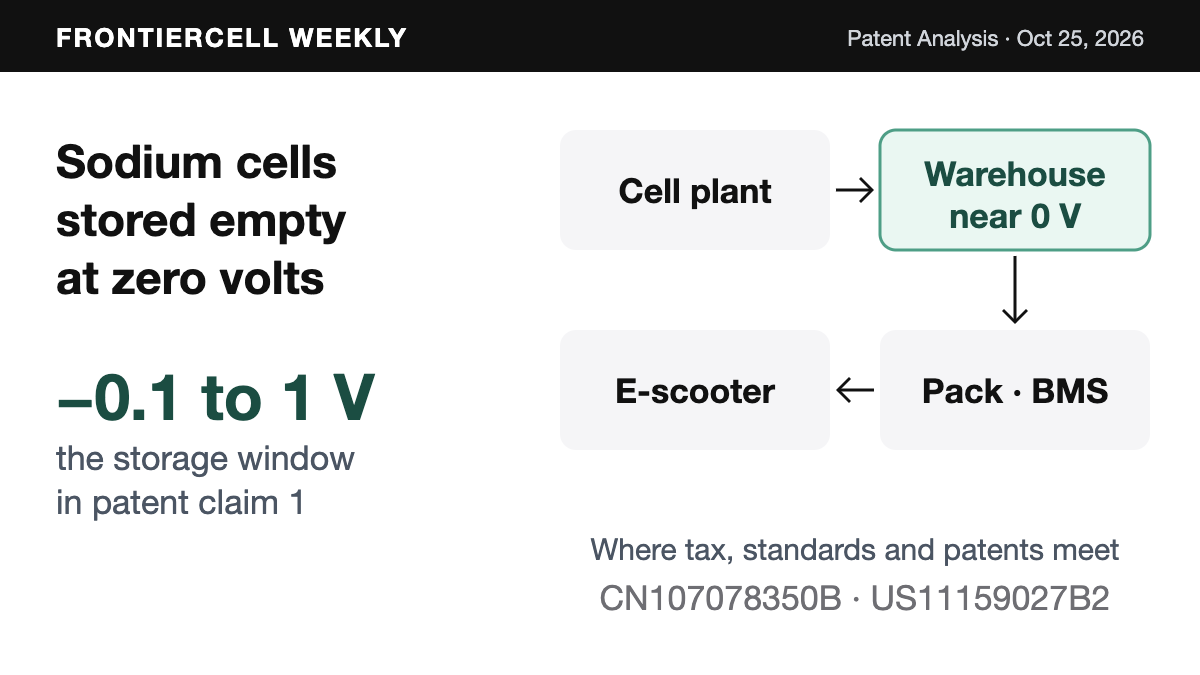
Source: redrawn by the author from Faradion US11159027B2 and CN107078350B claims and ofweek (2026-10-23)
A cell is made in the top-left box of Figure 1, follows the arrows through a warehouse and a truck, and ends up in a two-wheeler. The warehouse-and-shipping step is where companies say sodium-ion batteries can travel nearly empty, close to 0 V, and on that short stretch a tax rule, a national standard and a patent filed more than ten years ago all overlap.
Tianneng’s 72 V sodium pack and China’s September 1 lithium tax
According to ofweek (2026-10-23) and Caixin (2026-10-22), the products Tianneng unveiled on October 20 come in two voltages, 60 V and 72 V, and four capacity tiers from 24 Ah to 72 Ah, with standard and low-temperature versions. What the company put up front was charging at −30℃ for the low-temperature version, recovery after resting at 0 V, and a 39-month warranty. In the three years and seven months since its first sodium product, the Tianna T1 (天钠T1), appeared in March 2023, start-stop batteries for cars and construction machinery were added, and this launch filled out a range for electric two- and three-wheelers and small low-speed vehicles. Caixin reported cell capacity of 2 GWh a year.
The cost picture is still thin. In the same article, Caixin noted that sodium-ion has not yet shown a cost advantage and named northern China, with its long winters, as a two-wheeler market that could become a breakthrough. A lead-acid maker probably has several reasons to push sodium without a cost edge, but the one you can put a number on is a tax notice issued in July.
Notice No. 20 of 2026, issued on July 16, 2026 by China’s Ministry of Finance, General Administration of Customs and State Taxation Administration, ended the consumption tax[3] exemption that lithium-ion batteries had enjoyed since 2015. From September 1, 2026 to August 31, 2027 the rate is 2%, and 4% after that, charged at the production stage. The same notice exempts sodium-ion batteries, solid-state batteries and fuel cells from September 1, 2026 to December 31, 2028. Lead-acid batteries have paid 4% since January 1, 2016 under a 2015 notice (Caishui [2015] No. 16) and are not on this notice’s adjustment list. For a single two-wheeler battery, chemistry now decides whether the rate is 4%, 2% or 0%.
The exemption comes with conditions. Article 4 of the notice says products for which no national standard exists, or that fail to meet one, do not qualify, and before first claiming the exemption a company needs a report from a testing body holding provincial-level or higher CMA[4] accreditation confirming the product meets the standard. When I searched China’s national standards public service platform on October 25, 2026, the national standard titled “Sodium-ion batteries for electric bicycles” was listed as a planned project with no standard number. The 18-month work period set when it was announced in August 2024 has already passed.
Two national standards for sodium-ion batteries in energy storage systems (GB/T 48072-2026 and GB/T 48098-2026), by contrast, were published on August 28 and take effect on March 1, 2027. The articles do not say which national standard Tianneng’s 60 V and 72 V products would use to qualify for the exemption, and I could not confirm how the tax authorities would rule.
While tax and standards set the price of a battery, storage at 0 V changes the route it takes from factory to customer. Figure 2 lays out that route step by step.
Source: redrawn by the author from ofweek (2026-10-23) and Faradion’s website safety page
Lithium-ion cells travel this route holding a certain amount of charge. Faradion’s patent specification describes the known practice of cycling lithium-ion cells a few times after manufacture and then charging them to roughly 40% or more, and the company’s website says lithium-ion cells should not be discharged below 30% state of charge for transport or storage. That means every cell stacked in a warehouse or a container still holds a fair amount of energy. If sodium-ion cells can pass through this stretch near 0 V, packaging and storage conditions may change, and the reason starts with two thin metal foils inside the cell.
The chemistry that lets the anode collector switch from copper to aluminium
Inside a battery, the electrode materials are coated onto thin metal foils that collect electrons and pass them to the outside circuit. A lithium-ion battery uses aluminium foil on the cathode and copper foil on the anode. The specification of Faradion’s US patent US11159027B2 explains the weakness of this design. If a cell is stored fully discharged or taken close to 0 V, the copper collector on the anode side dissolves, discharge capacity drops and cycle life shortens. Using aluminium instead of copper might seem like the fix, but the specification notes that lithium forms alloys with aluminium at low potential, so that route is closed too.
Sodium does not alloy with aluminium. A sodium-ion cell can therefore use aluminium foil on both electrodes and bring the cell voltage down near 0 V without worrying about the anode collector dissolving (Figure 3). The same patent cites, as background, a 2013 Sumitomo Chemical report in which sodium cells with a layered oxide cathode and a hard carbon[5] anode were discharged to 0 V, recharged, and then cycled between 2.0 and 4.0 V. The passivation of an aluminium-based collector that Tianneng cites for 0 V recovery rests on the same property.
Source: redrawn by the author from the background section of US11159027B2
Picture a water tank on a rooftop. If it has iron pipes and you drain it completely, the inside of the pipes is more likely to corrode, so people leave a little water in it even in the off-season. The copper anode in a lithium-ion battery is like those iron pipes, while a sodium-ion battery is a tank whose pipes have been swapped for a material that does not rust, so it can sit empty through the winter. The comparison breaks down on speed. Tank pipes corrode over months of contact with air, but the copper in a battery starts to dissolve electrochemically the moment the anode potential rises. A lithium-ion battery can be damaged by even a brief trip to the bottom.
One thing newcomers to this field often mix up is the relationship between 0 V and state of charge (SOC)[6]. An SOC of 0% means the energy in the defined operating window has been used up; a cell voltage of 0 V means the potential difference between cathode and anode has disappeared. They are not the same. A lithium-ion cell still sits well above 0 V when the screen shows 0%, and the battery management system (BMS)[7] cuts the current to keep it from going lower.
Saying a sodium-ion battery can rest at 0 V is a claim that the cell itself can survive the last stretch the BMS used to guard. For a whole pack to come back on after sitting at 0 V, the management circuit also has to wake up at that low voltage, which is why I read Tianneng’s mention of low-voltage wake-up technology alongside the collector as no accident.
When stored energy is close to zero, less energy can be released if something goes wrong in transit. It is a bit like letting the last gas out of an empty butane canister before throwing it away. But just as the canister itself is still there, a cell at 0 V still contains flammable organic electrolyte. Faradion’s website says a sodium-ion cell at 0 V produced over 15 times less heat in a heating comparison than a fully charged lithium-ion cell, but that is company material, and an independent test under the same conditions did not turn up.
From the Tianna T1 to the new line: 145 Wh/kg out, 39 months in
In Figure 4, the left column holds figures for Tianneng’s first product, the Tianna T1, launched in Tianjin in March 2023 (evcev.com, 2023-03-31), and the right column holds figures from articles on the October 2026 products. Neither announcement stated test conditions, and there is no guarantee the same items were measured the same way. The table is safer read as a record of what the company chose to put forward than as a performance league table.
| Item | Tianna T1 (March 2023) | New two/three-wheeler line (October 2026) |
|---|---|---|
| Voltage platforms (V) | 48 / 60 / 72 | 60 / 72 |
| Capacity (Ah) | Not in published material | 24 to 72 (four tiers) |
| Battery-level energy density (Wh/kg) | 145 or more | Not in published material |
| Cycle life (cycles) | 3,000 or more | Not in published material |
| Performance at −30℃ (%) | Capacity retention 88 or more | Discharge retention about 90; charging possible |
| High-rate performance | 15C instantaneous discharge; 85% charge in 15 min | 3C charge, 5C discharge |
| Recovery after resting at 0 V | Not mentioned | Recoverable (company statement) |
| Warranty (months) | Not in published material | 39 |
Source: evcev.com (2023-03-31), ofweek (2026-10-23), Caixin (2026-10-22)
The −30℃ figure moved within 2 percentage points, from 88% or more to about 90%, and the wording shifted from capacity retention to discharge retention. The 145 Wh/kg and 3,000-cycle figures disappeared from the new-product coverage, while the 24 to 72 Ah capacity tiers, the 39-month warranty and recovery after 0 V were added. I read this as the company putting usage conditions first, meaning use in winter, storage in a warehouse and a long warranty, rather than cell performance numbers. That choice fits a market where the long-standing incumbent in two-wheeler batteries is the lead-acid battery[8], and a company that started in lead-acid is explaining sodium in language its customers already know.
China battery consumption tax rate (%, production stage)
Source: Ministry of Finance, General Administration of Customs and State Taxation Administration Notice No. 20 of 2026 (2026-07-16); Caishui [2015] No. 16
The empty sodium bar in Figure 5 only holds if the conditions are met. Because the tax is levied at the production stage, the gap is likely to flow into the costs of companies that buy cells and build packs. No published figures show how much of the rate difference will reach two-wheeler retail prices. The changes you can confirm in numbers are tax and usage conditions, and among those conditions, storage at 0 V needs to be reread in the language of patents.
A US claim that sets a holding time, and a Chinese claim that does not
One of the companies that put 0 V storage into patent claims is the British sodium-ion battery company Faradion Ltd. This patent family[9], claiming priority from a UK filing on August 22, 2014, was granted in the United States as US11159027B2 (2021) and in China as CN107078350B (2020), and two Korean patents, KR102292491B1 and KR102472937B1, were also granted. Faradion became a wholly owned subsidiary of Reliance New Energy Ltd (RNEL), part of India’s Reliance group, when RNEL bought the remaining 7.99% stake in October 2024 (Mercom India, 2024-10-30).
A claim[10] is the fence that sets out the scope of a right in words. Granted US claim 1 does not claim the cell as a product; it claims “a process for making a sodium-ion cell capable of safe storage or transportation.” Its elements break down into four parts: a full cell with cathode, anode and electrolyte; an anode active material that is one or more of amorphous carbon, hard carbon, or silicon with an alloying metal; a treatment that brings the cell to a state of charge of 0 to 20%; and the method of that treatment.
Under that method, a cell that has never been charged is left in its as-made state, a cell that has been cycled is discharged to −0.1 to 1 V, and in either case the cell voltage is kept at −0.1 to 1 V for at least 8 hours. Because this is a process claim, infringement turns on whether those steps were actually carried out.
Dependent claims build narrower rooms inside that fence. Claims 2 to 5 cover a cell with a removable shorting device, claims 6 and 8 cover current collectors that do not alloy with sodium and household-grade aluminium, and claim 12 is a method of balancing at discharge in which several cells are discharged to −0.1 to 1 V and held for at least 8 hours.
The granted Chinese claim reads differently. CN107078350B claim 1 has no step of holding the cell for any period at all; it ends with discharging a cycled cell to −0.1 to 1 V to reach a state of charge of 0 to 20%. The step of holding the voltage has been moved down to dependent claim 2. The fewer elements a claim has, the more activities contain all of them, so on the wording alone the Chinese fence is wider than the US one. Chinese claim 12 narrows the scope with a number, defining household-grade aluminium as 92% to less than 100% aluminium by mass.
| Claim element (US11159027B2 claim 1) | In plain words | What Tianneng’s published material shows |
|---|---|---|
| A. A full sodium-ion cell with cathode, anode and electrolyte | A real cell, not a lab half-cell | Likely met (finished product) |
| B. Anode active material: one or more of amorphous carbon, hard carbon, silicon with an alloying metal | The list of anode materials | T1 used hard carbon (2023 launch); the new line’s anode is not in the articles |
| C. Treatment to a state of charge of 0 to 20% | Making the cell nearly empty | Only the property of recovering after 0 V is published; shipping and storage state of charge not disclosed |
| D. Uncharged cell left as made, cycled cell discharged to −0.1 to 1 V, and in either case held at −0.1 to 1 V for at least 8 hours (CN107078350B claim 1 has no holding step) | Staying at a low voltage for a set time | Holding time not disclosed |
| Dependent claims 2, 6, 8: removable shorting device, current collectors that do not alloy with sodium, household-grade aluminium | Narrower embodiments | Mentions passivation of an aluminium-based collector; shorting device not disclosed |
Source: redrawn by the author from Google Patents claims for US11159027B2 and CN107078350B (checked 2026-10-25), ofweek (2026-10-23) and evcev.com (2023-03-31)
Figure 6 sets that fence against Tianneng’s published material. Since the 2023 T1 was said to use a hard carbon anode, the anode element is likely to overlap. But to judge freedom to operate (FTO)[11], meaning whether a product can be made and sold without infringing someone else’s patent, you would need to know what state of charge Tianneng ships cells at, how it stores them, and how long it holds them at that voltage. The line about recovering after 0 V describes a property of the product; it does not say the company treats and stores cells in that state.
If the shipping standard is above 20% state of charge, there may be room to fall outside the wording of claim 1, and a rider who leaves a discharged battery standing all winter is a different scene from the one a manufacturing process claim targets.
As the specification itself acknowledges by citing Sumitomo Chemical’s 2013 report, the fact that sodium cells recover from 0 V was known before the filing. That is presumably why Faradion could not claim the chemical property itself, and why the claims were narrowed to a process for treating, storing and moving cells using that property, with voltage and time conditions.
Design-around options start from the same conditions. Keeping storage voltage above 1 V, or in the United States keeping the time spent at that low voltage under 8 hours, could be argued to fall outside the wording. In China, where there is no time element, voltage is close to the only lever. Going that way gives up part of the benefit of shipping at 0 V, and the scope may still be read more broadly under the doctrine of equivalents[12].
The United States has one more variable. The published claims of continuation application US20220014029A1 shorten the holding time to at least 1 minute and add a product claim (claim 30) covering a cell that is itself at a state of charge of 0 to 20% and has sat at −0.1 to 1 V for at least 1 minute. Google Patents shows this application as pending; if it were granted as published, the US fence would be wider than it is today. Published claims are often narrowed during examination, though, and I did not confirm the annuity status of the granted patents in each patent office’s register.
Tianneng’s own patents were the next thing to check. A Google Patents search on October 25, 2026 for applicant 天能 combined with sodium and low voltage, wake-up or over-discharge returned 131 results, and none of the top 15 dealt with 0 V storage or low-voltage wake-up. Applications may have been filed but not yet published, so this result alone does not prove there are none.
The tax window that closes on December 31, 2028
The direction Caixin’s article anticipates is that the exemption will make sodium-ion batteries more price-competitive and their cold tolerance will open up winter demand in the north. Add 0 V storage, and it is easy to sketch sodium pushing both lead-acid and lithium out of the two-wheeler market. The premise I doubt is how long the exemption can actually be used. It has a little over two years and two months left, yet the published material does not show which national standard 60 V and 72 V two- and three-wheeler batteries would rely on, and the closest-looking one, the electric bicycle sodium standard, is still at the planning stage.
The longer it takes to secure a standard and a CMA test report, the shorter the real exemption period becomes, and if no cost advantage appears in the meantime, the tax gap alone is unlikely to move the market much.
The exemption ends in late 2028, but the ability to store at 0 V will outlast it. What cell makers can do now is show in numbers how much 0 V storage actually changes logistics costs and warehouse safety rules, and put that process into a form they can use without patent trouble. A company that makes treating cells to a 0 to 20% state of charge for storage and transport its standard process in China could approach Faradion and its parent RNEL about a license; adjusting shipping voltage to stay outside the claim wording is another route. Either way, making sure the marketing copy and the logistics manual say the same thing leaves a record to point to if a dispute arises.
Surviving 0 V is a property proven in the lab, but the claims built on it target the process on the warehouse floor and the truck bed.
Faradion’s patent family has written that warehouse-and-truck scene into its claims. The granted Chinese claim without a holding-time element (CN107078350B claim 1) is worded more broadly than the granted US claim (US11159027B2 claim 1), so any company in China that makes shipping at 0 V its standard process should check its infringement risk first, and I think the likelihood of infringement being found is higher in China than in the United States. That risk stays on the table until August 18, 2035, the anticipated expiration[13] shown by Google Patents. This judgment rests on the premise that companies actually ship cells below 20% state of charge, and I could not confirm Tianneng’s shipping standard.
The patent fence may stand until around 2035, while the tax window closes at the end of 2028. When a national standard for sodium-ion two- and three-wheeler batteries will appear, and how many products will have that standard and a test report in hand before the window closes, cannot be answered from what is public today.
For a product planner about to put “storable at 0 V” into a sodium-ion cell brochure, there is a sensible order of work. Before finalizing the wording, pass three items from the logistics manual, namely shipping state of charge, storage voltage and how long that voltage is held, to the IP team, and have them lay those items out on one page against the wording of CN107078350B claims 1 and 2, US11159027B2 claims 1 and 12, and, for operations in Korea, the granted claims of KR102292491B1 and KR102472937B1. If the cells are headed for China, tying this comparison to the schedule for preparing the CMA test report needed for the tax exemption lets one set of documents answer both questions.
Glossary
- Sodium-ion battery — A rechargeable battery in which sodium ions, instead of lithium ions, shuttle between cathode and anode. Its raw materials are abundant and it tends to handle cold well, but it usually stores less energy per kilogram than lithium-ion. ↩
- Current collector — The thin metal foil that carries the electrode material and gathers electrons for the outside circuit. Lithium-ion batteries mostly use aluminium on the cathode and copper on the anode. ↩
- Consumption tax — A Chinese indirect tax levied on certain goods at the production or import stage. When batteries became taxable at 4% in February 2015, lithium-ion and some other types were exempted; that exemption ended in September 2026. ↩
- CMA (inspection body accreditation) — The accreditation a Chinese testing or inspection body needs to issue legally valid reports. The tax exemption requires a report from a body accredited at provincial level or higher. ↩
- Hard carbon — Carbon that does not stack into an orderly graphite structure even at high temperature. Its many voids let sodium ions in and out, making it the standard anode material for sodium-ion batteries. ↩
- State of charge (SOC) — The remaining energy in a battery’s defined operating window, as a percentage. An SOC of 0% does not mean the cell voltage is 0 V. ↩
- Battery management system (BMS) — The hardware and software that monitor cell voltage, temperature and current, and open or close the circuit to prevent overcharge and over-discharge. ↩
- Lead-acid battery — An old rechargeable chemistry using lead and sulfuric acid. Cheap enough to dominate Chinese electric two-wheelers for years, but heavy and low in energy density. ↩
- Patent family — A group of patent filings in different countries that share the same original (priority) application. The granted claims can differ from country to country. ↩
- Claim — The part of a patent that sets out the protected scope in words. An independent claim stands alone; a dependent claim refers back to an earlier claim and narrows it. ↩
- Freedom to operate (FTO) — An assessment of whether making and selling a product would infringe someone else’s valid patents, based on the granted claims in each country. ↩
- Doctrine of equivalents — A legal principle under which something that differs slightly from the claim wording can still infringe if it performs substantially the same function in the same way with the same result. The requirements vary by country. ↩
- Anticipated expiration — An estimated expiry date that Google Patents calculates from the filing date and patent term. It can come earlier if annuities go unpaid or the patent is invalidated. ↩
References
- ofweek Lithium Battery, “钠电轻型动力进入‘可交付’时刻,天能全矩阵产品率先交卷”, 2026-10-23 (checked 2026-10-25). Link
- Caixin, “铅酸电池行业龙头加码钠电 轻型动力市场应用前景如何?”, 2026-10-22 (checked 2026-10-25). Link
- Caixin Global, “China’s Battery Makers Expand Sodium-Ion Push for Light Electric Vehicles”, 2026-10-23 (checked 2026-10-25). Link
- State Taxation Administration regulations database, MOF/GACC/STA Notice No. 20 of 2026, 2026-07-16 (checked 2026-10-25). Link
- Ministry of Finance and State Administration of Taxation, Caishui [2015] No. 16 on consumption tax on batteries and coatings, 2015-01-26 (checked 2026-10-25). Link
- National Public Service Platform for Standards Information, “电动自行车用钠离子蓄电池” national standard project (checked 2026-10-25). Link
- nacells.com, “两项电能存储用钠离子电池国家标准8月28日发布”, 2026-10-05 (checked 2026-10-25). Link
- evcev.com, Tianneng Tianna T1 launch report, 2023-03-31 (checked 2026-10-25). Link
- Google Patents, US11159027B2 (checked 2026-10-25). Link
- Google Patents, CN107078350B (checked 2026-10-25). Link
- Google Patents, US20220014029A1 (checked 2026-10-25). Link
- Google Patents, WO2016027082A1 (checked 2026-10-25). Link
- Google Patents, KR102292491B1 (checked 2026-10-25). Link
- Google Patents, KR102472937B1 (checked 2026-10-25). Link
- Mercom India, “RNEL Completes Acquisition of UK-Based Sodium-Ion Battery Company Faradion”, 2024-10-30 (checked 2026-10-25). Link
- Faradion, “Superior Safety” (checked 2026-10-25). Link
This piece explains technology and patent information; it is not investment or legal advice, and whether a specific product infringes needs professional review. I describe the scope of patent rights and dispute outcomes only as possibilities.