At InterBattery 2026, held in Seoul last March, Samsung SDI attached the brand name “SolidStack” to its all-solid-state battery for the first time, and unveiled a pouch-type sample aimed at Physical AI devices (a term covering applications in which robots or machines with a physical body are controlled by AI) such as humanoid robots. The company stated that it holds approximately 1,100 all-solid-state-related patents, and that figure exceeds 1,200 when its U.S. prismatic-battery patents are added in.
① What’s the Story
To summarize the industry situation: over the past several years, all-solid-state batteries have been talked about almost exclusively as “the future of electric vehicles,” and their mass-production timing kept giving the impression of being pushed back to around 2027. However, with CATL and BYD also recently reaffirming (in August 2026) the same 2027 all-solid-state pilot-production timetable, the three companies have effectively ended up at the same starting line in the automotive battery market. This is where the tension arises. If competing from the same starting line, whoever opens the market first has the advantage — but that market does not necessarily have to be automotive. Robots, and humanoids in particular, which momentarily need a large amount of force, can open up a low-volume, high-value market far faster than finished vehicles can.
This article sets out to answer one question: why did Samsung SDI choose robots, rather than automobiles, as the first real-world application for its all-solid-state battery, and what does that choice mean for its patent strategy?
② Basic Principle
The easiest analogy for understanding an all-solid-state battery is “replacing a liquid distribution network with a solid conveyor belt.” In the lithium-ion batteries we use today, a liquid electrolyte carries lithium ions back and forth between the cathode and anode. Liquid can flow anywhere, but if the temperature rises, it can boil or decompose, creating a risk of fire. An all-solid-state battery replaces this liquid distribution network with a solid-state electrolyte. Because ions move only through a fixed pathway, like a conveyor belt, the risk of leaking and catching fire is much lower, and because the pathway itself can be pressed thin, more energy can be packed into the same volume.
Source: concept diagram reconstructed by the editorial team from Samsung SDI's InterBattery 2026 presentation
The problem is that actually building this “solid conveyor belt” well is very difficult. Solid-to-solid contact is not as smooth as liquid contact, so resistance can rise at the interface (the boundary where two solids meet), and gaps can widen the more charge-discharge cycles are repeated. The sulfide-based electrolyte (a solid electrolyte whose main component is sulfur) that Samsung SDI adopted has the advantage of resolving this interface problem relatively well and delivering high ionic conductivity, but it also carries the weakness of being able to react with moisture in the air to produce harmful gases.
This is where robot batteries diverge from automotive ones. For EV batteries, “how far it can run (energy density)” is the key metric, but for a robot that walks, runs, and lifts objects, “how much force it can deliver instantaneously (power density)” and “how lightly it can fit into a tight space inside the body (light weight and miniaturization)” matter more. Because a pouch-type (a flat shape wrapped in aluminum film) all-solid-state battery has more shape freedom than prismatic or cylindrical formats, making it advantageous for designs that fit into the tight spaces around a robot’s joints, Samsung SDI’s choice of form factor reads not as coincidence but as a design fitted to the application.
③ Comparison: Liquid-Electrolyte Lithium-Ion vs. Sulfide-Based All-Solid-State
| Category | Liquid-Electrolyte Lithium-Ion (Mass-Production Standard) | Sulfide-Based All-Solid-State (Samsung SDI SolidStack Family) |
|---|---|---|
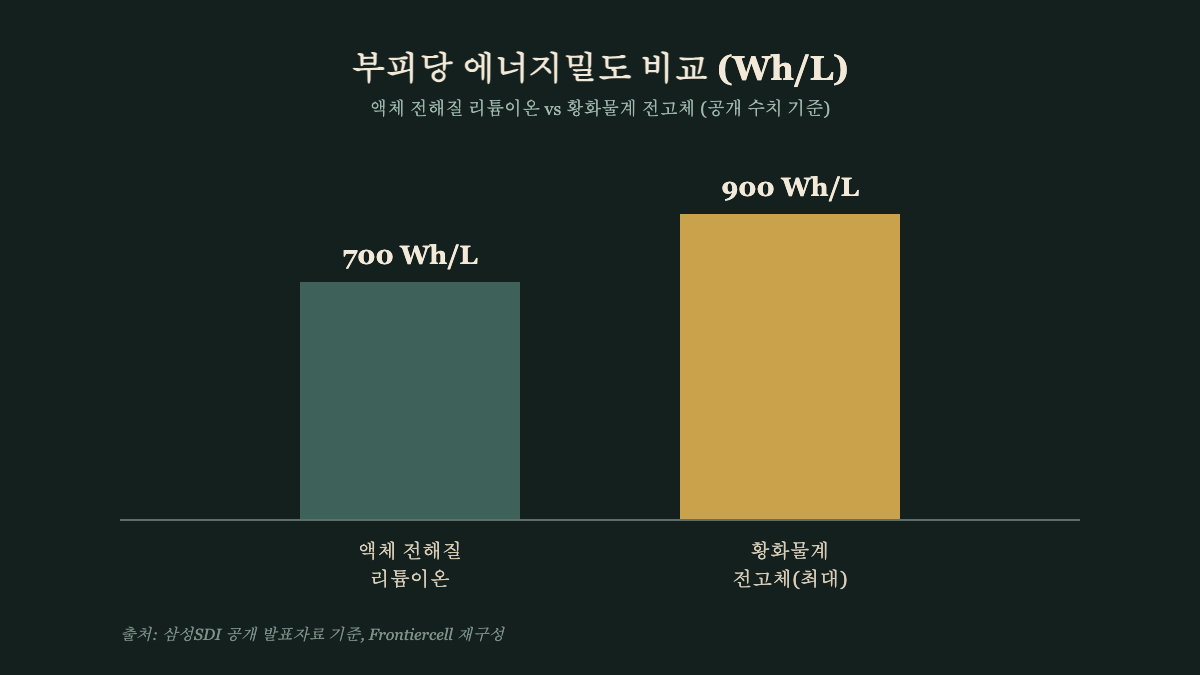
| Energy density (by volume) | Approx. 700 Wh/L or so (typical figure for pouch cells) | Up to approx. 900 Wh/L (per disclosed figures) |
| Ionic conductivity | High at room temperature due to the liquid medium | Sulfide-based types have superior room-temperature conductivity compared to oxide-based types |
| Thermal safety | Fire and thermal-runaway risk persists | Fire risk structurally lower due to the solid electrolyte |
| Air/moisture stability | Few issues since it is sealed inside a pouch | Moisture reactivity is a structural weakness for sulfide-based types |
| Shape freedom | Prismatic, cylindrical, and pouch formats are all mature | Pouch format is being developed first, advantageous for light weight and miniaturization |
| Main application scenarios | EVs, ESS, small IT devices | Robots/humanoids, aerospace, wearables (development stage) |
Source: compiled by the editorial team from Samsung SDI’s disclosed figures (up to about 900Wh/L) and typical industry values
What This Table Tells Us: The fact that all-solid-state exceeds conventional lithium-ion in energy density by volume (up to around 900 Wh/L) while also structurally lowering fire risk makes for a particularly attractive combination for devices that move alongside people, such as robots. However, the moisture reactivity inherent to sulfide-based types remains an unresolved variable.
④ Patent Perspective
One of Samsung SDI’s representative all-solid-state-related patents confirmed to exist is US11955601B2 (Sulfide-Based Solid Electrolyte and All-Solid-State Secondary Battery Comprising the Same; jointly filed by Samsung SDI and Sejong University’s Industry-Academic Cooperation Foundation; priority date claimed 2020-08-31; grant date 2024-04-09). This patent’s scope of claims is not pinned on the broad concept of a “sulfide-based electrolyte” alone, but on a composition, within an argyrodite-type electrolyte (a specific crystal structure with an octahedron as its basic unit), whose impurity phase is suppressed so as to satisfy a specific peak-intensity ratio (such as a ratio of 0.06 or below between the 2θ 29° and 30° peaks) measured by X-ray diffraction (XRD) analysis.
In simple terms, the claims are pinned not on the fact itself of “having made a sulfide-based solid electrolyte,” but on the very specific physical-property indicator of “how high-purity a crystal structure was, and how it was verified and controlled.”
This kind of claim design leaves open two scenarios from the perspective of a design-around (an alternative design intended to achieve the same technical effect without infringing the patent). First, even if a competitor uses the same argyrodite structure, choosing a synthesis process that falls outside the XRD peak-ratio condition may place it outside this patent’s literal scope of claims.
Second, as with POSCO JK Solid Solution’s recently disclosed KR20250018801A (an argyrodite sulfide-based solid electrolyte with improved air and moisture stability), even within the same higher-level concept (the argyrodite structure), making a different technical problem — “improving moisture stability” rather than “controlling purity” — the axis of the claims can lower the risk of infringement while opening up an adjacent market. That said, in both scenarios, infringement cannot actually be determined definitively without a precise comparison through a claim chart (a table mapping claim elements against the target product), and the relationship with related family patents, such as Samsung SDI’s subsequently filed US12341154B2 (grant date 2025-06-24, solely owned by Samsung SDI), must also be examined.
The fact that Samsung SDI has amassed roughly 1,100 patents on all-solid-state alone suggests a strategy in which the “fence density” of the whole portfolio matters more than the scope of any single patent. This is because the structure is such that even if a later entrant avoids one claim, the probability of being caught by another adjacent claim rises. This is also a factor that makes an FTO (Freedom to Operate) review more difficult.
⑤ Limitations and Outlook
Viewed optimistically, all-solid-state batteries for robots could be commercialized far faster than those for automobiles, because robots are a low-volume, high-value market that does not have to go through as strict crash-safety regulations and large-scale mass-production verification as automobiles do. However, an opposing scenario also exists. The humanoid robot market itself is still at a stage before mass commercialization, and as robot makers prioritize the maturity of actuators and control software over batteries, the battery-adoption cycle could be delayed longer than expected. In that case, the initial volumes for cell makers including Samsung SDI may not be as large as hoped.
As a strategic alternative, given the uncertain pace at which the robot market will mature, one could consider simultaneously expanding the patent portfolio into adjacent applications sharing the same “high-value, low-volume” market characteristics, such as aerospace and medical devices. Samsung SDI’s stated plan to extend its applications into aerospace and next-generation wearables can also be read as this kind of risk diversification.
Action Item for Planning and IP Staff: If your company is considering supplying batteries for new applications such as robots or aerospace, it is recommended that you build your own claim chart to run a first-pass screening of whether the composition and crystal structure of the sulfide-based electrolyte you intend to adopt overlaps with the claim elements of Samsung SDI’s US11955601B2 and its related family patents (particularly the XRD peak-intensity-ratio condition). Please use this only as a starting point that requires separate review, not as a definitive conclusion.