Phosphorus (P)-based flame-retardant additives that keep electrolytes from burning are an old idea, but they have not become mainstream in commercial electrolytes because of a trade-off: the more is added, the weaker the anode’s protective film becomes. This article looks at three routes to a solution—small-dose addition, solvent replacement, and localized high-concentration design—together with the structure of rights in a cyclophosphazene additive patent.
① What’s the Topic
The real cost of a flame-retardant additive is not its price but the anode’s protective film (SEI). The more phosphorus-based flame-retardant is added, the less the electrolyte burns, but the less properly it builds a protective film on carbon anodes such as graphite, and cycle life wavers. So flame-retardant electrolyte design should be read as a trade between ‘how much less it burns’ and ‘how well it protects the anode.’
Start with the industry situation. As concern over fires in large batteries grows, attempts to lower the flammability of the electrolyte itself continue. It has long been noted that conventional organic electrolytes are highly flammable and volatile and can lead to fires or explosions[3]. The tension is as the same paper points out: efforts to introduce flame-retardant solvents into electrolytes have generally compromised battery performance, because those solvents do not suitably passivate carbon anodes[3].
So the question this article answers is: should the flame-retardant component be added in small amounts as an ‘additive,’ swapped in as the ‘solvent,’ or solved through ‘structure’? And which patents does each route run into?
② Basic Principle — How Much Extinguisher Before the Engine Stops
Phosphorus compounds are described as intervening in the combustion process to slow the spread of flame. By analogy, it is like mixing small fire extinguishers into the electrolyte. The problem is that these extinguishers also interfere with the engine (the anode reaction). During the first charge, the anode must decompose part of the electrolyte to build a protective film; if the flame-retardant component disrupts this process or forms a poor film, electrolyte decomposition continues afterward.
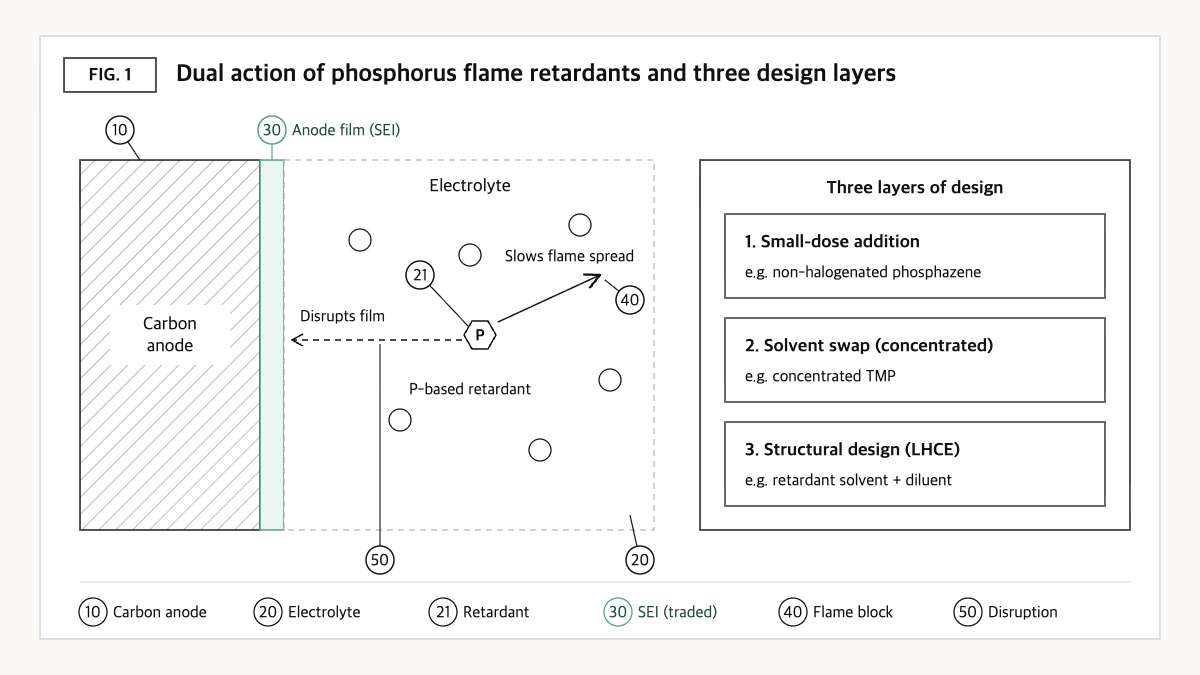
Source: reconstructed by the editorial team from the US6455200B1 specification and the abstracts of Wang et al. (2018) and Jia et al. (2025).
Ways to resolve this trade-off can be divided into three layers. The first is small-dose addition: the main solvent is left as is and only a few wt% of flame-retardant component is added, minimizing the effect on the anode’s protective film. The second is solvent replacement: a flame-retardant solvent such as trimethyl phosphate (TMP) is used as the main solvent, but the salt concentration is raised greatly to build a robust anion-derived inorganic film. A concentrated TMP electrolyte operated stably for more than 1,000 cycles on hard-carbon and graphite anodes[3]. The third is structural design, which combines a flame-retardant component with a high-flash-point diluent in a localized high-concentration electrolyte (LHCE)[4].
An accelerating rate calorimeter (ARC) is often used to evaluate thermal behavior. It heats a sample step by step and measures the temperature at which it starts to self-heat and the rate of that heating (self-heat rate, °C/min). When discussing flame-retardant effects, it is worth remembering that ‘whether it catches fire’ and ‘how fast it heats itself up’ are different indicators.
③ Comparison — Three Layers of Flame-Retardant Design and Reported Figures
| Layer of approach | Representative example | Reported figures | Trade-off |
|---|---|---|---|
| Small-dose addition | Non-halogenated cyclophosphazene (hexamethoxycyclotriphosphazene), 1M LiPF6 in EC:DMC (50:50 wt%) | ARC maximum self-heat rate reduced about threefold, from 0.68°C/min (177.6°C) to 0.1957°C/min (170.2°C); increased charge/discharge capacity reported for cells with 1.5 wt%[1] | Effect size tied to dosage; the temperature range of maximum heating does not change much |
| Solvent replacement (high concentration) | TMP-based concentrated electrolyte | Over 1,000 cycles on hard-carbon and graphite anodes with negligible degradation[3] | Fails to passivate carbon anodes at ordinary concentrations; cost burden from high concentration[3] |
| Structural design (LHCE) | Sulfone (TMS) + TMP solvents with a high-flash-point fluorinated ether diluent | Non-flammable; graphite∥NCM811 retained 87.1% (25°C) and 81.7% (45°C) after 500 cycles vs. 75.2% and 38.5% for conventional electrolyte[4] | More components such as diluents make formulation design more complex (qualitative) |
| Gas-generating type (reference) | Compounds that release CO2 on decomposition | Concept at the claim level; quantitative values not verified[2] | Qualitative comparison |
Source: reconstructed by the editorial team from the US6455200B1 specification[1], US5830600A claims[2], Wang et al. (2018)[3], and Jia et al. (2025)[4].
What this table shows: Small-dose addition cut the self-heat rate about threefold, but the temperature range of maximum heating (177.6°C→170.2°C) barely moved. By contrast, structural approaches such as high concentration and LHCE have reports of raising both flame retardancy and life (87.1% after 500 cycles), suggesting a shift in emphasis from ‘addition’ to ‘structure.’
④ Patent Perspective — The Gap Left by the ‘Non-Halogenated’ Limitation
As a representative case of the small-dose route, consider US6455200B1 (title: Flame-retardant additive for Li-ion batteries) from the Illinois Institute of Technology. The inventors are Jai Prakash, Chang Woo Lee, and Khalil Amine; priority date 1999-09-02; filing date 2000-08-24; grant date 2002-09-24; 16 granted claims. The legal status is shown as Expired – Fee Related[1]. Restated, claim 1 reads as follows.
| Claim 1 elements (restated) | Meaning for the scope of rights |
|---|---|
| (a) A lithium-ion battery | Product claim at the cell level |
| (b) Including an anode electrode and a cathode electrode | Electrode materials are not limited |
| (c) An electrolyte containing a non-aqueous solvent and lithium | Broadly covers solvent and salt types |
| (d) A flame-retardant additive containing at least one non-halogenated cyclophosphazene, disposed in that non-aqueous solvent lithium electrolyte | Structural limitation on the additive — covers only ‘non-halogenated’ cyclophosphazenes |
Source: reconstructed by the editorial team from the Google Patents bibliographic data and the original claims and specification of US6455200B1 (checked 2026-09-23); original claim wording is not reproduced.
The independent claim does not limit the dosage and so looks broad, but the key limitation is the ‘non-halogenated’ in (d). Phosphazenes substituted with fluorine or other halogens may fall outside this claim’s literal scope. Had the patent still been in force, the first design-around scenarios considered would likely have been ⓐ using a halogenated (e.g., fluorinated) phosphazene and ⓑ using a phosphate ester (e.g., TMP) instead of a phosphazene. There are counterarguments. For ⓐ, room for an equivalence argument may depend on how the specification explains the advantages of the non-halogenated structure; for ⓑ, even if this patent is avoided, there is a possibility of running into separate rights on phosphate esters. As this patent is now shown as expired, the risk of infringement from the patent itself is likely to be low, but improved-composition patents must be reviewed separately.
The insight to take here is that the ARC data in this patent greatly reduced the ‘heating rate’ but barely shifted the ‘temperature range of maximum heating.’ The ARC test in the specification used a sample of 3 g of electrolyte and 10 mg of lithium metal with 300 mg of additive[1]. A flame-retardant additive can change ‘how fast it heats up,’ but whether it changes ‘when thermal runaway begins’ remains a separate question.
As a cross-check of similar patents, there is SRI International’s US5830600A (title: Nonflammable/self-extinguishing electrolytes for batteries; priority and filing date 1996-05-24; grant date 1998-11-03; Expired – Lifetime, anticipated expiration 2016-05-24; a US Department of Energy confirmatory license recorded in 2006). Its claim 1 covers a battery comprising an electrolyte with conductivity above a certain level at ambient temperature that contains a compound releasing CO2, a fire-retardant gas, on decomposition, and the dependent claims add silanes, phosphates, halogenated carbonates, cyclophosphazenes, phospholanes, and fluorinated polyethers as further options[2]. At the structural-design layer, Battelle’s US10472571B2 (low-flammability localized high-concentration electrolytes, Active) remains in force, so LHCE-style flame-retardant designs need a freedom to operate (FTO) comparison against this family[5].
⑤ Limits and Outlook
On the optimistic side, structurally designed flame-retardant electrolytes may settle in as a route that improves safety and life at the same time. The basis is a report that, while securing non-flammability, retained 81.7% after 500 cycles at 45°C—far higher than the conventional electrolyte’s 38.5%[4].
There is also a contrary scenario. Electrolyte flame retardancy is only one factor in cell fire risk. As the ARC result above shows, the heating rate may fall while the temperature range at which heating begins does not change much, and there are heat-generation paths that start outside the electrolyte, such as oxygen release from the cathode or internal short circuits. Expecting a flame-retardant electrolyte alone to stop even thermal-runaway propagation may overestimate the design margin.
As a strategic alternative, one approach is to manage electrolyte flame retardancy not as a standalone solution but as a ‘layered safety portfolio’ tied to pack-level thermal-propagation barriers. For the patent portfolio as well, viewing electrolyte composition, cell structure, and pack barrier structure together as one FTO map, rather than separately, reduces omissions.
Action to check (planning/IP teams): In your flame-retardant electrolyte evaluation sheet, record not only self-extinguishing time but also the ARC self-heating onset temperature, maximum self-heat rate, and first-cycle Coulombic efficiency in the same row, so it is visible at a glance whether improved flame retardancy was traded for loss of the anode’s protective film.
Items Requiring Verification
- The exact date on which US6455200B1 lapsed for non-payment of fees was not checked against the official register beyond the Google Patents summary information.
- The lower conductivity limit in claim 1 of US5830600A is not cited numerically because its exponent notation was corrupted during extraction from the original PDF.
- The bibliographic data and legal status of follow-on patents covering fluorinated phosphazene additives could not be verified against original documents in this work.
Sources
- Google Patents, US6455200B1 “Flame-retardant additive for Li-ion batteries,” bibliographic data and original claims/specification PDF (checked 2026-09-23). Link
- Google Patents, US5830600A “Nonflammable/self-extinguishing electrolytes for batteries,” bibliographic data, event record, and original claims PDF (checked 2026-09-23). Link
- J. Wang et al., “Fire-extinguishing organic electrolytes for safe batteries,” Nature Energy 3 (2018) 22–29. Link
- H. Jia et al., “Rational Electrolyte Design for Elevated-Temperature and Thermally Stable Lithium-Ion Batteries with Nickel-Rich Cathodes,” ACS Applied Materials & Interfaces 17 (2025), DOI 10.1021/acsami.4c17629 (OSTI abstract). Link
- Google Patents, US10472571B2 “Low flammability electrolytes for stable operation of electrochemical devices,” bibliographic data (checked 2026-09-23). Link
This article is a technology and patent trend commentary, not legal advice. Specific FTO judgments require professional review.
Related Reading