Anode graphite splits into two routes: natural graphite that is mined and refined, and synthetic graphite that is baked into existence. What separates their costs is not the raw material but the processing steps of spheroidization, coating and graphitization, and those processing steps are also where patent claim boundaries are drawn.
① What’s the Topic
The cost debate over graphite anodes is not about “natural or synthetic” but about “which process you spend money and energy on.” Natural graphite costs money to round off after mining (spheroidization) and to cover its surface (coating), while synthetic graphite costs money to bake raw coke at roughly 2,800–3,000℃ (graphitization)[1][2].
Start with the industry situation. Graphite remains the base material for lithium-ion battery anodes, and one analysis states that about 70% of anodes in 2023 were made of artificial graphite (AG)[1]. The same review puts natural graphite anode material at USD 4–8 per kg and synthetic graphite at USD 12–13 per kg[1]. On unit price alone, natural graphite is cheaper. The fact that synthetic graphite still holds the larger share is the starting point of this article.
The tension runs in two directions. First, natural graphite loses a lot of feedstock during spheroidization. One report says the yield after the process averages only about 30%[2], and another says up to 70% of feedstock is lost during conversion[1]. Second, synthetic graphite has a large carbon footprint. Natural graphite is reported at about 2.3–7.8 kg CO2e per kg, while synthetic graphite is reported as high as 20.6 kg CO2e/kg[1]. Cost and carbon, yield and uniformity pull against each other.
So the question this article answers is this: where does the cost gap between natural and synthetic graphite come from, and how free, in patent terms, is the spheroidization and coating process that closes the gap?
② Basic Principle — The Jeweler Who Cuts Rough Stones and the Kiln That Bakes Bricks
Graphite is a stack of thin sheets (graphene layers) in which carbon atoms are arranged in a honeycomb pattern. During charging, lithium ions enter between these layers (intercalation) and leave during discharge. The theoretical capacity of graphite is 372 mAh/g, a limit that natural and synthetic graphite share[1][2]. The difference lies in “what shape and surface the same layered structure is given.”
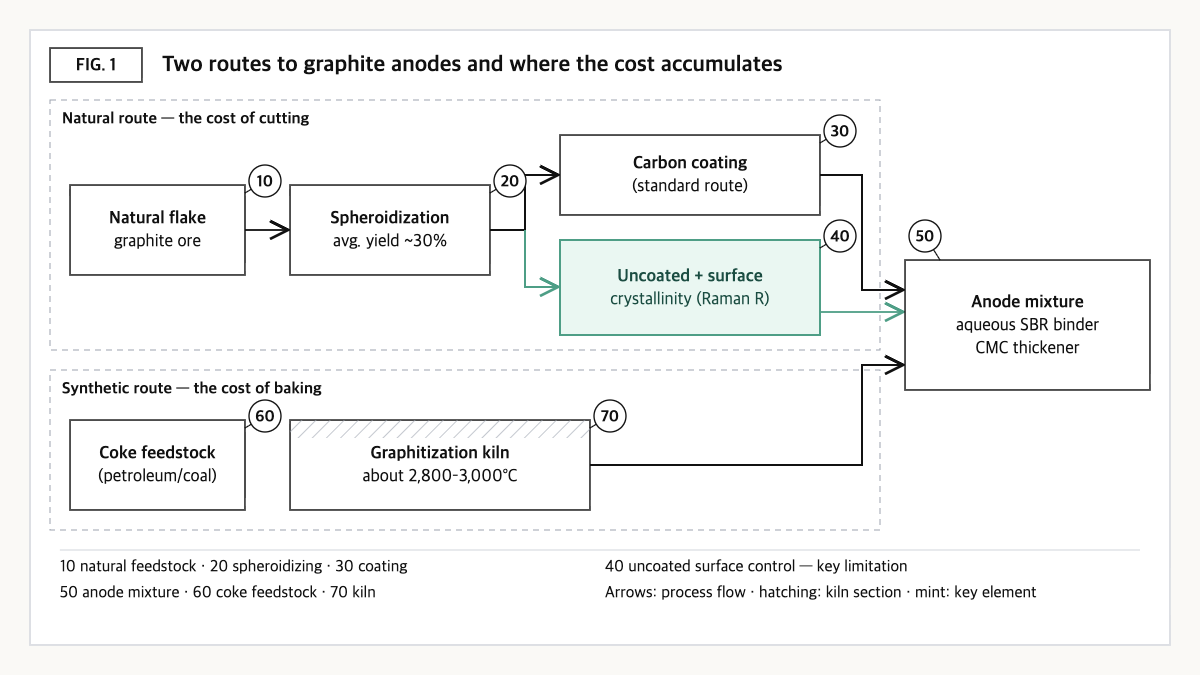
Source: reconstructed by the editorial team from the Batteries (2026) review, Geosciences Journal (2025) and US9853289B2 on Google Patents.
Natural graphite can be compared to a jeweler cutting rough stones. Flake graphite from the mine is flat and full of edges. Many edges (edge planes) mean a larger area in contact with the electrolyte, so more lithium is consumed in forming the solid electrolyte interphase (SEI) during the first charge. That is why the flakes are rolled into rounded particles through spheroidization. One review notes that spherical particles expose more uniformly curved surfaces, improving initial coulombic efficiency (ICE) and fast-charging durability[3]. The problem is that, as with cutting stones, a lot of debris is produced. The 30% yield mentioned above is exactly this loss.
Spheroidization is often followed by coating the surface with amorphous carbon or similar materials. Coatings are described as reducing direct contact with the electrolyte and stabilizing interphase composition[3]. However, a trade-off is also reported in which a coating layer that increases surface area lowers first-cycle efficiency[3].
Synthetic graphite is closer to a brick kiln. When petroleum- or coal-based coke is shaped and baked at around 2,800℃ or higher, the carbon atoms rearrange themselves into graphite layers[1]. Because the raw material’s shape can be designed from the start, the structure is uniform and the degree of graphitization is high[1], but the electricity cost of keeping the kiln hot for a long time, and the carbon emissions that follow, become the center of gravity of the cost.
③ Comparison — Cost, Carbon and Yield Pile Up in Different Places
| Item | Natural graphite (spheroidized, coated) | Synthetic graphite (graphitized) |
|---|---|---|
| Theoretical capacity | 372 mAh/g[1] | 372 mAh/g (same graphite layer structure)[1] |
| Key high-cost process | Spheroidization, purification, coating | Graphitization at about 2,800–3,000℃[1][2] |
| Feedstock yield / loss | Average yield about 30% after spheroidization[2] / up to 70% loss[1] | Qualitative comparison: raw material shape can be designed (no numerical source) |
| Anode material price (review figures) | USD 4–8 per kg[1] | USD 12–13 per kg[1] |
| Carbon footprint | 2.3–7.8 kg CO2e/kg[1] (9.6 produced in China, 3–7 outside China[2]) |
Up to 20.6 kg CO2e/kg[1] (20–25[2]) |
| Structural uniformity | Relatively more defects and pores[1] | Uniform structure, high degree of graphitization[1] |
Source: reconstructed by the editorial team from the Batteries (2026) review[1] and Geosciences Journal (2025)[2].
What this table shows: Per kg, natural graphite costs roughly one-third to two-thirds of synthetic graphite, but if the spheroidization yield is only about 30%, the cost on a raw-ore basis swells accordingly. Synthetic graphite, by contrast, is higher in both price and carbon footprint but buys a quality variable called uniformity. In the end, the competition between the two is a fight over the exchange rate between “yield loss” and “electricity and carbon cost.”
④ Patent Perspective — LG’s Contrarian Claim to “Uncoated Natural Graphite”
Natural graphite anodes are commonly thought to follow the standard recipe of “spheroidize, then carbon-coat.” Yet there is a patent that draws its scope of rights by turning this recipe upside down: US9853289B2 (title: Lithium secondary battery comprising spherical graphite as anode active material). The original assignee is LG Chem and the current assignee is LG Energy Solution; the priority date is 2011-12-09, the filing date 2014-03-31, the grant date 2017-12-26, the legal status Active (anticipated expiration 2034-02-08), with 12 claims[4]. Family members include KR101325555B1, EP2752926B1, JP6356066B2 and CN103843179B[4].
Restated element by element, rather than quoting the original text, claim 1 reads as follows.
| Elements of claim 1 (restated) | Meaning for the scope of rights |
|---|---|
| (a) An anode mixture for secondary batteries containing an anode active material, an aqueous binder and an aqueous thickener | The subject is the “mixture (slurry composition)” — a combination, not a stand-alone material |
| (b) The thickener is CMC and the binder is SBR | Limited to aqueous processing — distinguished from organic binder processes |
| (c) The active material includes spherical natural graphite particles formed of agglomerated graphite sheets | Material type limited to spheroidized natural graphite |
| (d) The outer surfaces of the particles are not coated with a carbon-based material | Negative limitation — using a coating process falls literally outside the scope |
| (e) The particle surface has a degree of amorphization of 0.3–0.5 and a Raman R value (I1350/I1580) of 0.3–1.0 | Fixes “surface crystallinity” as a measurable indicator instead of a coating — the baseline for proving infringement |
Source: reconstructed by the editorial team from the bibliographic data and claims of US9853289B2 on Google Patents[4] (original claim text and drawings are not reproduced).
The core of this claim is the combination of (d) and (e). Instead of adding a separate coating step, the claim controls the surface disorder created during spheroidization (degree of amorphization) and the Raman R value within set ranges to secure slurry viscosity and stability. The specification also presents preferred ranges such as a particle diameter of 21–25 μm and a specific surface area of 4.5–5.5 m²/g[4]. From a cost perspective, a design that omits one coating step has itself become the scope of rights.
Design-around scenario (counterargument). (i) Spherical natural graphite with a carbon-based coating does not satisfy (d), so the likelihood of literal infringement appears low. (ii) Using synthetic graphite alone also falls outside (c). (iii) Even with uncoated natural graphite, there may be room for a design-around if the Raman R value or degree of amorphization lies outside the claimed ranges. There are counterarguments, too. It could be argued that an extremely thin or incomplete coating is substantially the same as an “uncoated” state, and the values may shift with measurement conditions (Raman laser wavelength, method of calculating the degree of amorphization), which could unsettle the interpretation of the ranges. In a freedom to operate (FTO) review, it is safer to fix the measurement protocol first.
Cross-check of similar patents. Google Patents lists LG Chem’s anode slurry patent US10644316B2 as a later patent citing this one[4]. Since the same assignee may be extending its rights toward slurry composition, anyone evaluating uncoated natural graphite should check this line as well.
⑤ Limits and Outlook
Optimistic outlook. Natural graphite has favorable figures on both price and carbon footprint[1], so as carbon regulation tightens, its competitiveness against synthetic graphite could grow if only the spheroidization yield improves.
Opposing scenario. The 30% spheroidization yield also means the disposal cost and environmental burden of “the discarded 70%”[2]. Without an outlet for recycling the debris, the per-kg price advantage could be offset by the burden of the ore volume that must be procured. In premium vehicle segments with strong fast-charging and long-life requirements, a preference for more uniform synthetic graphite is also likely to continue.
Strategic alternative. Rather than choosing one or the other, varying the natural-to-synthetic blend ratio by product line is more realistic. The IP point here is to map separately, component by component, which scope of rights the natural graphite in the blend falls into in terms of “coating or not” and “surface crystallinity indicators.” Reduced to one line, this article’s view is that cost savings in graphite anodes come from removing process steps, and the moment a step is removed, the empty space it leaves may be someone else’s claim.
Action to check (planning/IP teams): Obtain “coating status, Raman R value and measurement laser wavelength” from the spec sheets of your own or your supplier’s natural graphite anode material, compare them one-to-one against elements (d) and (e) of US9853289B2 claim 1, and also review the claims of the Korean counterpart KR101325555B1.
Items Requiring Verification
- The natural vs. synthetic graphite prices (USD 4–8 vs. 12–13 per kg) are summary figures from a review paper; variation by survey date, grade and region was not verified in this article.
- The process yield of synthetic graphite and a quantitative comparison of cycle life and expansion between natural and synthetic graphite were left as qualitative comparisons because reliable public figures could not be obtained.
- Country-by-country claim differences and the current legal status of family patents such as KR101325555B1 were not individually verified.
- For US10644316B2, only the citation relationship with US9853289B2 was verified, not its claims.
Sources
- Rezaei, M. et al., “A Review of Graphite Anode Recycling in Lithium-Ion Batteries: Technical Challenges and Geopolitical and Economic Implications,” Batteries 12(7), 259, 2026. Link
- Park, J. et al., “Overview of graphite supply chain and its challenges,” Geosciences Journal 29(3), 329–341, 2025. Link
- “Challenges and Issues in Using Coated and Uncoated Graphitic Anodes in Lithium-Ion Batteries,” Batteries 12(5), 154, 2026. Link
- Google Patents, US9853289B2 “Lithium secondary battery comprising spherical graphite as anode active material,” bibliographic data and claim 1 (original checked 2026-09-23). Link
This article is a technology and patent trend commentary, not legal advice. Specific FTO judgments require professional review.
Related Reading