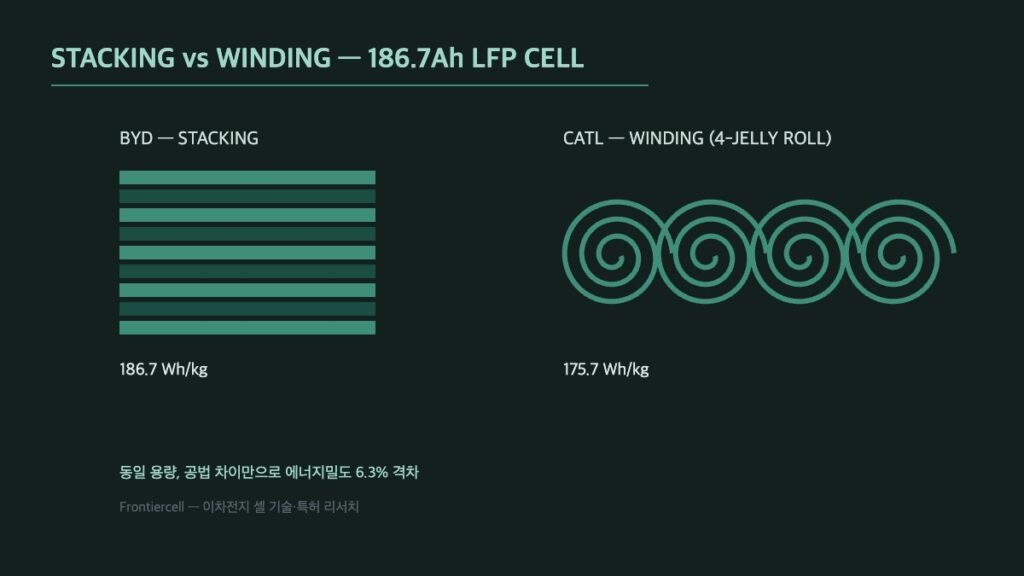
Stacking vs. Winding: The 6.3% LFP Cell Energy-Density Gap Revealed by the Xiaomi SU7 Teardown
A hands-on comparison of BYD Blade (stacking) and CATL (winding) 186.7 Ah LFP cells, and its patent and strategy implications.

A hands-on comparison of BYD Blade (stacking) and CATL (winding) 186.7 Ah LFP cells, and its patent and strategy implications.
Fast charging comes up almost as often as driving range in an EV purchase decision, but what actually caps charging speed is not the charger.

The move to replace graphite anodes is not converging on a single substitute; it is proceeding along two tracks, lithium metal at the premium end and hard carbon at the entry-level end.

U.S. solid-state battery company Solid Power has fleshed out a plan to produce sulfide-based solid electrolyte through a joint venture (JV) with a major Korean company, presenting a blueprint that starts at an initial 500 tons in 2028 and adds 2,000-ton modules to reach a final 20,000 tons per year.
CATL has signaled solid-state pilot production for 2027. This piece explains, from an IP perspective, the phase in which its 39.9% first-half global market share converts into patent negotiating leverage.

Choosing a stacking method isn’t a matter of taste — it’s a design decision about which defect you’re willing to accept. This piece looks at why the location of curvature determines cell life, and at the patent landscape split across structure and equipment axes.

What the dry electrode process sells is process cost; what it pays for it is freedom in material choice. This piece lays out how the constraint of PTFE fibrillation narrows the composition patent landscape.
In the fight over the foundational patents for LFP (lithium iron phosphate) batteries, what matters more than “there was a patent” is “how the patent collapsed in China.”
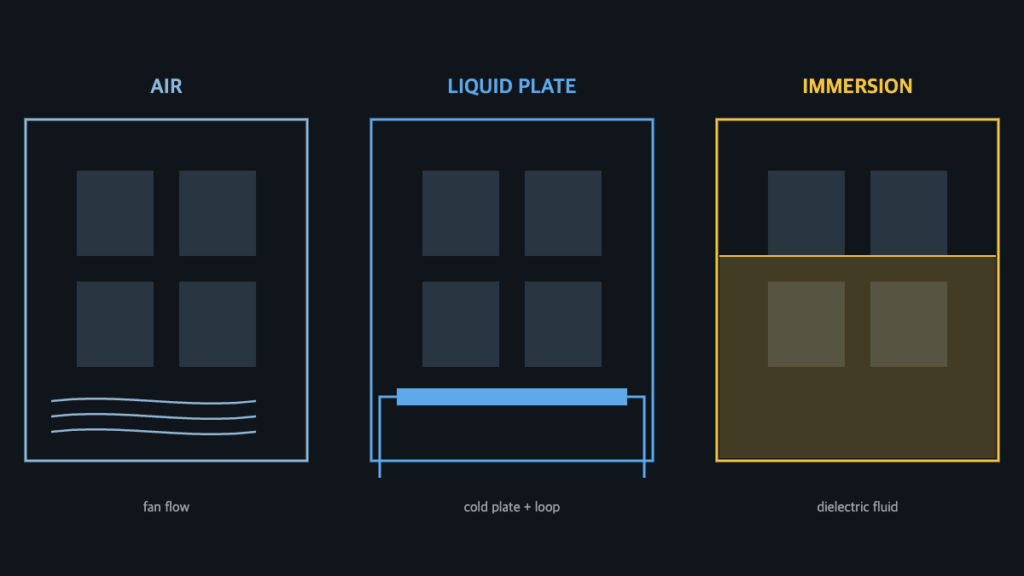
Where do you pay the cost of passing a thermal-runaway propagation test? This piece compares three cooling architectures — air, liquid, and immersion — from the standpoint of standards, material properties, and cost.
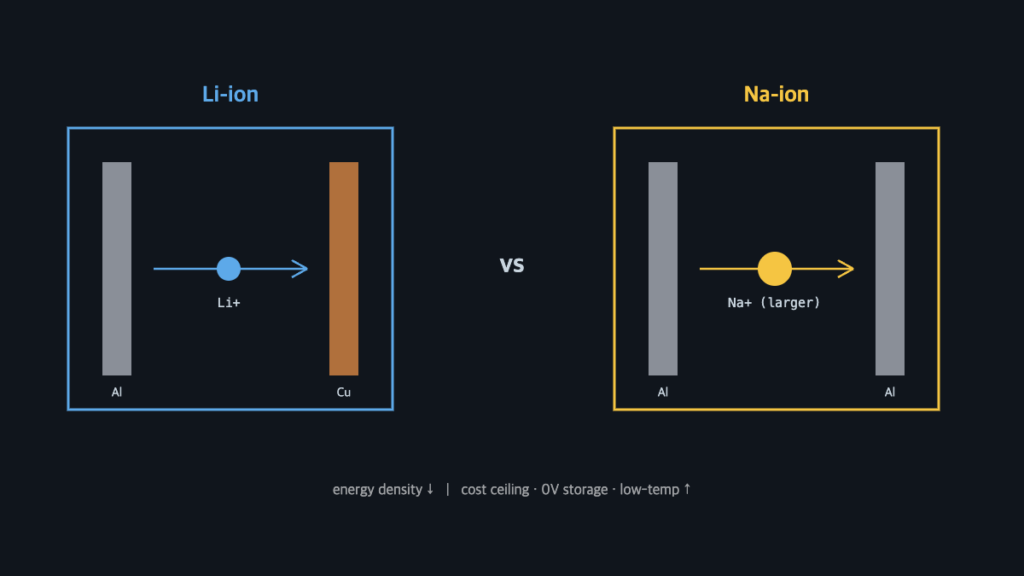
A trade — giving up energy density in exchange for a cost ceiling, full-discharge handling, and low-temperature performance: the profit-and-loss statement of sodium-ion chemistry, and why the UPS market was bound to be its first stage.