① What’s the Story
In August 2026 alone, the pilot-production timeline for all-solid-state batteries (batteries that use a solid-state electrolyte instead of a liquid electrolyte to lower fire risk and increase energy density) was updated three separate times within a single month. On August 11, CATL formally announced plans to begin small-scale pilot production in 2027. In early August, BYD disclosed six patents in succession combining a halide (a halogen-compound-based solid electrolyte) with a sulfide, reaffirming the same 2027 pilot timeline. Samsung SDI had already signaled its entry earlier by unveiling, at InterBattery 2026, the world’s first pouch-type all-solid-state prototype for humanoid robots.
The industry has long treated all-solid-state batteries as a technology that is “coming eventually.” But the information disclosed over the past few weeks brings one point of tension clearly into focus: the phrase “2027 pilot,” as each company uses it, actually refers to technologies at different levels of maturity. Some are cell-level pilot production; others remain at the patent-filing stage for material coatings. That leaves us with one real question to answer at this point — what concrete changes is the accelerating commercialization timeline for all-solid-state batteries making to the cell-format market and the quality-inspection equipment market? This article answers that question.
② Basic Principle
The easiest analogy for understanding an all-solid-state battery is “road construction.” The liquid electrolyte in a conventional lithium-ion battery is like water flowing freely between the cathode and anode, so lithium ions can move relatively easily in any direction. A solid electrolyte, by contrast, is like a road network laid down in advance for ions to travel on. The problem is that if this “road” does not bond perfectly with the electrode surface, detours with broken sections appear here and there. Simply mixing and pressing the electrode and the solid electrolyte together leaves the road winding and broken in places, which sharply lowers the initial charge-discharge efficiency (first-cycle coulombic efficiency) and fast-charging performance (rate capability).
Source: reconstructed by the editorial team from the claims of CN121964524A and CN121768970A and the article text
On top of that, using an ultra-high-nickel cathode material with a very high nickel content to boost energy density causes a side effect: the cathode material chemically reacts with the sulfide solid electrolyte at the point where they meet. It is similar to how corrosion starts at the joint when two materials that are vulnerable to moisture are bonded together. The patents CATL and BYD have recently disclosed are, in the end, attempts to solve this “road-connection problem” and this “joint-corrosion problem,” each in its own way. The specific differences between their solutions are covered in Section ④, Patent Perspective.
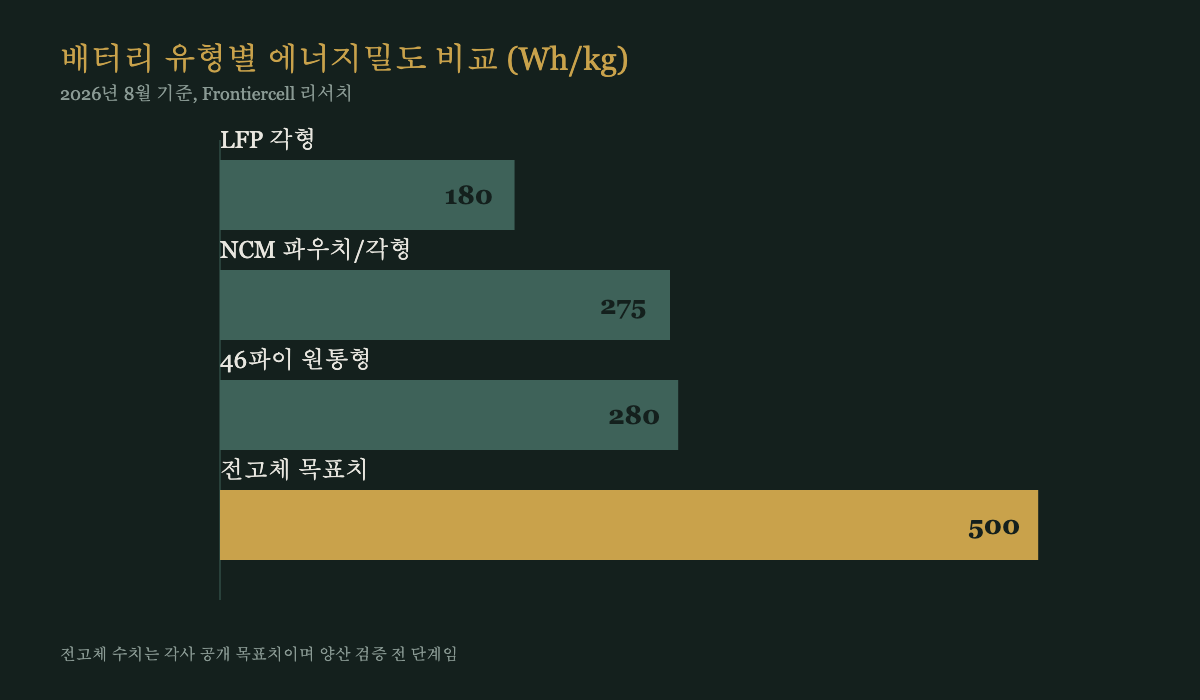
③ Comparison: All-Solid-State Batteries vs. Conventional Lithium-Ion Batteries by Cell Format
| Category | Energy Density (Wh/kg) | Main Cell Format | Stage as of August 2026 |
|---|---|---|---|
| Conventional liquid-electrolyte NCM (ternary) pouch/prismatic | Approx. 250-300 | Pouch, prismatic | In mass production (mature stage) |
| LFP (lithium iron phosphate) prismatic | Approx. 160-200 | Mainly prismatic | In mass production, expanding into ESS and low-cost EVs |
| 46-series cylindrical (4680 family) | Approx. 260-296 (estimated) | Large cylindrical | Tesla has produced a cumulative 100 million units; LG Energy Solution preparing Arizona transfer |
| BYD all-solid-state (halide + sulfide dual electrolyte, pilot target) | Limited disclosed quantitative figures | Estimated to be usable in both prismatic/pouch | Patent-filing stage, targeting 2027 pilot |
| CATL all-solid-state (ultra-high-nickel + NASICON coating, pilot target) | Limited disclosed quantitative figures | Undisclosed | Patent-filing stage, targeting 2027 pilot |
| Samsung SDI all-solid-state (pouch, robot-use prototype) | Approx. 500 (target) | Pouch | Prototype unveiled; mass-production target requires separate confirmation |
Source: compiled by the editorial team from company announcements, press reports and CN121768970A / CN121964524A (Google Patents); solid-state figures are published targets
What This Table Tells Us: Batteries currently in mass production remain in the 250-300 Wh/kg range, while the target figures put forward by the all-solid-state camp (500 Wh/kg) are still numbers from the prototype/patent stage — meaning there is a real gap in maturity between the two groups. In addition, while cylindrical and prismatic formats are becoming the dominant standard for EVs, the three all-solid-state companies’ cell-format strategies have not yet settled between pouch and prismatic.
④ Patent Perspective: Claim Trends and Room for Design-Arounds
From a patent attorney’s perspective, what is interesting about this rush of all-solid-state battery patent filings is that each company sets up its scope of claims differently. BYD tends to make the physical structure of the electrode active-layer surface (geometric parameters such as recess depth ratio, recess spacing and opening diameter, with solid electrolyte filled into the recesses) the core axis of its claims, while CATL tends to make the chemical composition of the coating material that suppresses the interfacial reaction (a type of NASICON-type phosphate compound) its axis (publication numbers CN121768970A and CN121964524A, confirmed against the original text on Google Patents as of August 2026).
This difference suggests that a structural opening already exists for the two companies to lower their mutual risk of infringement while each solving a similar problem (interface degradation) — in other words, a design-around option (changing a design to fall outside the scope of a specific patent’s claims) is already built into the situation.
That said, a counter-scenario also needs to be considered alongside this reading. If, in follow-up filings, both companies simultaneously assert claims that combine their respective coating-layer structure with their coating-material composition (for example, a recess structure within a specific thickness range combined with a specific phosphate-based material), it cannot be ruled out that a gray zone could emerge where the scope of the two currently distinct patent families overlaps. In that case, finalizing a design at the actual mass-production stage may become difficult without an FTO (Freedom to Operate — whether implementing a given technology infringes a third party’s patent) analysis. A detailed claim-by-claim comparison is covered in a separate patent-analysis article we have prepared.
⑤ Limitations and Outlook
The prevailing view in the industry leans toward the optimistic scenario of “2027 pilot production, full-scale mass production around 2029.” However, an opposing scenario also deserves serious consideration. Even if the technology for suppressing the interfacial reaction between the ultra-high-nickel cathode material and the sulfide solid electrolyte holds up at the laboratory stage, it is possible that the coating layer’s uniformity cannot be maintained at current yield levels in a large-area mass-production process. In that case, even if pilot production proceeds on schedule, the timing of full-scale mass production could still be pushed back further — a possibility that cannot be ruled out.
As a strategic alternative, rather than betting on all-solid-state technology alone, it appears more sound from a risk-management standpoint for automakers and battery makers to pursue a dual-track strategy — investing in parallel in improved versions of proven formats such as 46-series cylindrical and prismatic cells, alongside all-solid-state pilot lines. In fact, LG Energy Solution’s transfer of its cylindrical mass-production know-how and POSCO Future M’s conversion of its LFP line can already be viewed as circumstances supporting this kind of dual-track trend.
Action Item: For next quarter’s patent monitoring, planning and IP staff are advised to prioritize tracking CATL’s and BYD’s follow-up filings related to their coating layers (whether the family expands within six months of the claimed priority date), in order to catch early the point at which the scope of the two patent families actually begins to overlap.
※ The patent registration status and commercialization timelines mentioned in this article are projections based on published application information and corporate announcements, and do not guarantee actual registration or the realization of mass production. Individual matters require separate review.