All-Solid-State Batteries Are No Longer a Question of “When,” But of “Who Grasps the Rights First”
In the secondary-battery industry, all-solid-state batteries (a next-generation battery that uses a solid-state electrolyte instead of a liquid one to raise both safety and energy density) have, over the past several years, been a technology whose commercialization timing kept slipping further back, always under the label of a “dream battery.” However, a notable shift in this pattern has been detected starting in August 2026. Samsung SDI has actually started operating a 6,500 m² all-solid-state pilot line at its Suwon R&D center and put forward 2027 mass production as its official target, and around the same time, China’s CATL and BYD also both declared 2027 pilot production.
What is interesting is that CATL and BYD are pouring out patent filings at the same time as these announcements. In particular, BYD disclosed as many as six dual-electrolyte cathode patents in succession over a period of just over ten days, from late July to early August 2026.
What lies behind a technology the industry has long said was “still years away” suddenly moving to the stage of patent contention? This article organizes what technical choices Samsung SDI, CATL, and BYD have each made in all-solid-state batteries, and what advantages or disadvantages those choices could create in future disputes over the scope of claims (the technical scope a patent actually protects).
Basic Principle: Why Being “Solid” Becomes a Problem
As an easy analogy for understanding a liquid-electrolyte battery, the electrolyte plays the role of providing a water-like flowing pathway for the lithium ions moving back and forth between the cathode and anode. Because the liquid seeps, like flowing water, even into the fine contours of the electrode surface, it is relatively easy to secure contact area.
Source: reconstructed by the editorial team from the US20240039041A1 and CN122474592A publications and CarNewsChina reports
The problem is that this liquid is flammable. The alternative that emerged is the solid electrolyte, and it is easiest to understand if you think of a solid not as water but as a rigid plate. No matter how hard you press two rigid plates together, they never bond as completely as water does, and a fine gap remains. As charging and discharging repeat and the electrode swells and shrinks slightly over and over, this gap gradually widens, and as the pathway for ions to travel through that gap is cut off, battery performance drops sharply. The real core challenge in developing all-solid-state batteries lies less in “the ionic conductivity of the solid electrolyte itself” and more in “how to maintain contact at the interface (the contact boundary) between two solids for a long time.”
The three companies’ approaches diverge in how they solve this problem. Samsung SDI took the direction of making a sulfide-based solid electrolyte its basic axis while stabilizing the surface with a lithium-metal-oxide coating, while BYD approached it head-on with a dual-electrolyte cathode structure that mixes and uses two entirely different types of solid electrolyte (halide-based + sulfide-based) together. It arranges the small-particle halide-based electrolyte together with the large-particle sulfide-based electrolyte, filling the contact gaps inside the cathode much like fine sand fills the gaps between large gravel.
Comparison: The Three Companies’ All-Solid-State Battery Specs and Roadmaps
| Category | Samsung SDI | CATL | BYD |
|---|---|---|---|
| Electrolyte type | Sulfide-based (argyrodite) + oxide in parallel | Not officially disclosed (presumed sulfide-based) | Halide + sulfide dual-electrolyte cathode |
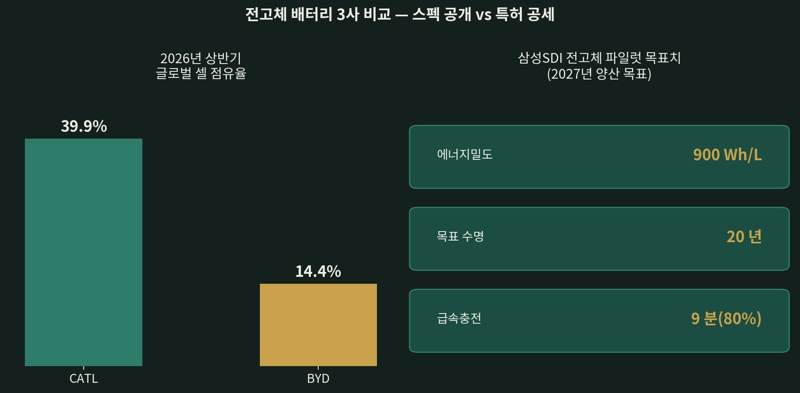
| Target energy density | 900 Wh/L (by volume) | Not officially disclosed | Not officially disclosed (a 600 Wh/kg-class figure was separately announced by Chery Automobile) |
| Target lifespan | 20 years | Not officially disclosed | Not officially disclosed |
| Fast-charging target | 9 minutes (to 80%) | Not officially disclosed | Not officially disclosed |
| H1 2026 cell market share | No separate figure (all-solid-state still at pilot stage) | 39.9% (242.7 GWh, +25.3% YoY) | 14.4% (87.7 GWh, +1.6% YoY) |
| Pilot/mass-production target | Mass production in 2027 | Pilot production in 2027 | Pilot production in 2027 (accompanied by numerous simultaneous patent disclosures) |
Source: compiled by the editorial team from Samsung SDI announcements, CnEVPost (H1 2026 EV battery market share) and CarNewsChina reports
What This Table Tells Us: Samsung SDI has disclosed concrete numbers for performance specs such as energy density, lifespan, and charging speed, whereas CATL and BYD have chosen the opposite communication strategy of showcasing their technical capability through the number of patent filings rather than disclosing specs. In BYD’s case, it is also worth reading its patent offensive as serving, in part, as a kind of signal to investors and the market at a time when its core automaker/battery market share is wavering (having fallen to 14.4%).
Patent Perspective: The Scope of Claims and Design-Around Possibility for the Dual-Electrolyte Cathode
BYD’s cathode composite-structure patent (publication number CN122474592A), disclosed via the China National Intellectual Property Administration (CNIPA) on July 28, 2026, sets as the core gist of its claims a structure that composites halide-based electrolyte particles and sulfide-based electrolyte particles together with the cathode active material. The subsequently disclosed follow-up patents (a total of six, including one presumed to carry publication number CN122494747A) deal with a structure that inserts an interlayer, possessing both ionic conductivity and electrochemical stability, between the two halide and sulfide electrolytes, to prevent the two dissimilar materials from reacting with each other and degrading performance.
Examining this patent family’s scope of claims from a patent attorney’s perspective, the core appears to lie less in “the combination of dissimilar electrolytes” itself and more in “a packing structure that exploits the particle-size difference” and “the interlayer configuration that blocks the interfacial reaction.” In other words, there is a possibility that prior art already exists in academia and industry for the simple idea of mixing and using two electrolytes, so the parts BYD can actually defend strongly are likely to be the particle-size ratio, the interlayer’s composition, and the specific manufacturing-process conditions that implement them.
This also means there is room for a design-around (an alternative design that achieves the same technical effect without infringing the scope of claims). For example, a scenario for lowering the risk of infringement could hold if a competitor combines the same dissimilar electrolytes but designs the particle-size ratio outside the numerical range the claims specify, or achieves interface stabilization through a surface-coating method (in a direction similar to the lithium-metal-oxide coating approach in Samsung SDI’s co-filed application) instead of an interlayer. In fact, the separate application Samsung SDI co-filed with Hyundai Motor and Kia for coating a lithium metal oxide onto a sulfide surface (US20240039041A1, published 2024-02-01, pending) can be viewed less as a coincidence and more as an example of solving the same problem of combining dissimilar materials through a different claim configuration.
That said, all of this judgment remains an interpretation at the level of “possibility” that could change depending on the actual examination outcome and the finally settled scope of the claims, and it cannot yet be determined whether BYD’s patent will actually be granted with a definitive scope of claims, or how broadly that scope will be recognized. It is also common for the scope of claims to end up narrower than at the time of filing, through prior-art searches and claim amendments during prosecution.
Two Other Developments This Week Worth Watching Alongside This
Two trends that are easy to miss if you look only at the “future technology” race of all-solid-state batteries, but that actually underpin the same industry landscape, were recently observed together.
The first is on the equipment axis. On August 19, 2026, U.S.-based Forge Nano held a groundbreaking ceremony in Morrisville, North Carolina, for a production-facility expansion it named “America’s Battery Gigafactory.” This facility is designed to introduce manufacturing equipment in stages over the next two years and begin production from 2028, in line with the battery-procurement requirements of the U.S. National Defense Authorization Act (NDAA) that take effect in 2028. Samsung SDI has already signed a conditional contract to purchase cells produced at this plant.
The second is on the demand axis. In mid-August, the U.S. Federal Energy Regulatory Commission (FERC) ordered grid operators to submit, within 60 days, revised proposals to respond to the surging power demand from AI data centers. U.S. data-center power demand has surged from 23 GW in 2023 to 42 GW in 2026, and global ESS demand is projected to expand from 230 GWh in 2024 to 359 GWh in 2026. This demand axis is exactly what lies behind the three companies — LG Energy Solution, Samsung SDI, and SK On — recently pivoting their strategy from an EV-battery-centered focus toward a greater share of ESS.
Overlaying these two trends with the all-solid-state battery race sketches out a single picture. In the space left by slowing EV demand for automakers, the three battery makers are filling in with ESS-bound volume and defense/security-bound local supply-chain contracts, while at the same time preparing for the next round: 2027 all-solid-state mass production.
Limitations and Outlook
Viewed optimistically, 2027 could become the first year of commercial pilot production of all-solid-state batteries for all three companies. However, the opposing scenario must also be noted. All-solid-state batteries have a history, over the past decade, of repeated announcements of “commercialization in three years” while the actual mass-production timing kept getting pushed back, and in particular, the mass-production process for solid electrolytes (dry-room humidity control, ultra-thin sheet forming, and so on) still has a large gap between success on a pilot line and success in gigawatt-hour (GWh)-scale mass production.
As a strategic alternative, it is reasonable from a risk-management standpoint for automaker and ESS customers to consider, in parallel, improved versions of the currently proven LFP and high-nickel NCM lines (4680 cylindrical cells, dry-electrode processes, and so on), rather than waiting for the actual mass-production timing of all-solid-state batteries.
There is one practical action planning and IP staff reading this article should take today: if your company is reviewing or has already filed a solid-electrolyte-related patent, it is recommended that you promptly cross-check, via KIPRIS and Google Patents, whether its claim scope overlaps with BYD’s dual-electrolyte cathode patent family (CN122474592A and others).
Sources referenced: CarNewsChina, CnEVPost, Battery-News.de, Verdict, Google Patents (US11955601B2)
- Samsung SDI Plans Mass Production of Solid-State Batteries Starting in 2027
- Global EV battery market share in H1 2026
- BYD files six solid-state battery patents
- US11955601B2 – Google Patents