A semi-solid electrode is made by packing a thick, clay-like paste in which active material and conductive additive are mixed directly into the electrolyte. This article explains how cell structure and process change when drying and electrolyte filling are removed, and where the center of gravity of rights shifts.
① What’s the Topic
The core of the semi-solid electrode cell is that it replaces the ‘coat and dry the electrode’ process with a ‘fill the paste and cover it immediately’ process. The fewer the process steps, the more the mechanical details of the few remaining steps become the barrier to entry.
Start with the industry context. Most lithium-ion electrodes today are made by thinly coating metal foil with a slurry of active material, conductive additive, and binder dissolved in a solvent, driving off the solvent in a long drying oven, calendering, assembling into cells, and finally injecting electrolyte. US-based 24M Technologies has promoted a different, semi-solid approach. In 2015, MIT News reported that this approach reduces the number of distinct layers in the cell architecture and the amount of nonfunctional material by 80%, and greatly simplifies manufacturing by eliminating the drying stage[1]. In January 2020, Japan’s Kyocera announced the launch of its residential energy storage system ‘Enerezza,’ built using 24M’s semi-solid electrode manufacturing process, in three capacities of 5.0, 10.0, and 15.0 kWh[2].
The tension lies in thickness. Making the electrode thick reduces inactive components (current collectors and separators) in the same volume, but it also lengthens the distance ions must travel to reach deep into the electrode. Thickness is both the gain and the risk.
So the question this article answers is this: By what principle can semi-solid electrodes become thick, and what are patents holding onto in the place where the process has become simpler?
② Basic Principle — Plastering, Not Painting
Compare conventional electrode manufacturing to painting a wall. The paint (slurry) is applied thinly, dried completely (drying), and the surface is pressed again (calendering). Paint it thick and it takes a long time to dry and cracks easily while drying. Moreover, the solvent that thinned the paint is a ‘waste liquid’ that must ultimately all be driven off.
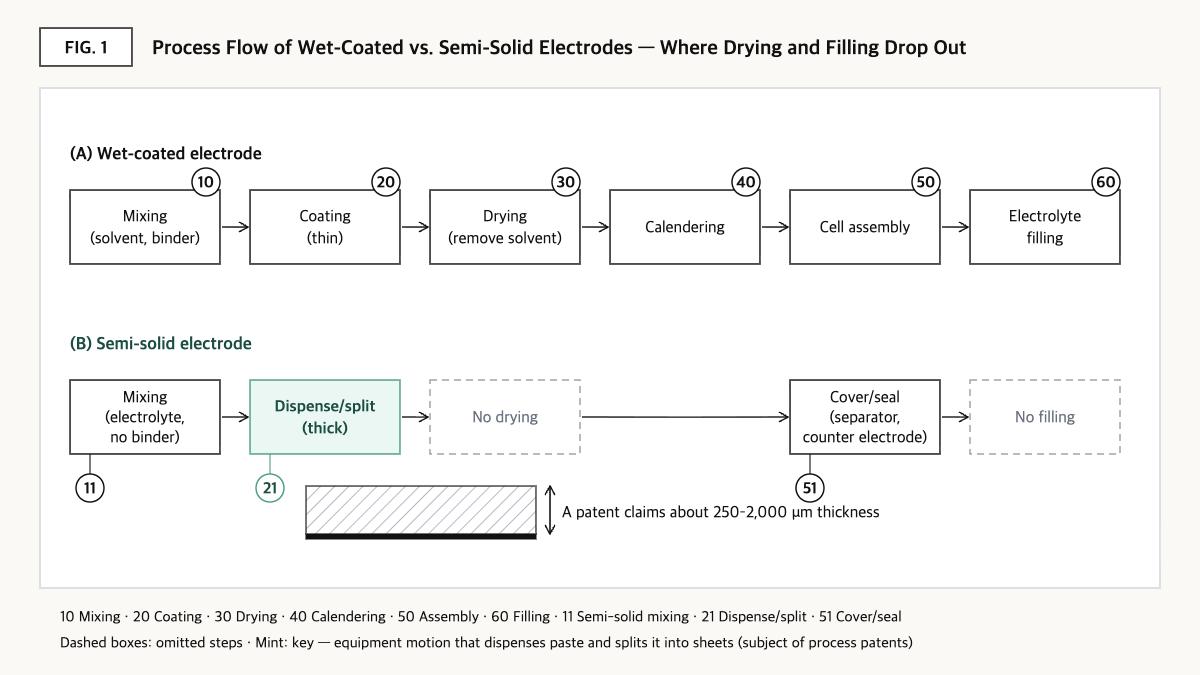
Source: reconstructed by the editorial team from MIT News (2015), the Kyocera–24M announcement (2020), and the claims of US12125984B2 and US8993159B2.
The semi-solid electrode is closer to plastering. Active material and conductive additive are mixed with electrolyte from the start to form a clay-like paste, and no binder is used[2]. This paste is packed thickly into a frame and immediately covered with a separator and the counter electrode. Because the liquid in the paste is the electrolyte itself, there is no solvent to drive off, and so neither a drying step nor a separate electrolyte filling step after assembly is needed[2]. MIT News explained that reducing the winding of the path ions travel, known as tortuosity, makes it possible to use thicker electrodes, which in turn simplifies production and lowers cost[1].
Why thick electrodes lower cost is easy to see in terms of ‘layer count.’ If the same capacity is built from many thin electrodes, each sheet requires a current collector and separator. As electrodes get thicker, the number of sheets falls, and inactive materials such as current collectors and separators decrease with it. This is the background to the semi-solid approach’s claim of ‘an 80% reduction in layers and nonfunctional material’[1]. This figure, however, is one reported from the company’s explanation.
③ Comparison — Wet-Coated Electrodes and Semi-Solid Electrodes
| Item | Wet-coated electrode (conventional) | Semi-solid electrode |
|---|---|---|
| Liquid in the paste | Solvent — removed by drying | The electrolyte itself — not removed[2] |
| Binder | Used | Not used[2] |
| Drying and electrolyte filling steps | Required | Not required[2] |
| Electrode thickness | Relatively thin | A patent exists claiming a range of about 250–2,000 μm[4] |
| Area-specific discharge capacity | Relatively low | A patent exists claiming at least 7 mAh/cm² at C/4 (a 4-hour discharge rate)[4] |
| Layer count and nonfunctional material | Baseline | 80% reduction (company explanation, 2015)[1] |
| Commercialization examples | Across EV and ESS | Residential ESS (Kyocera Enerezza, 5.0/10.0/15.0 kWh)[2] |
Source: reconstructed by the editorial team from MIT News (2015-06-23)[1], the joint Kyocera–24M announcement (2020-01-06)[2], and claim 1 of US8993159B2[4]. Thickness and area-specific capacity in the wet-coated electrode column are qualitative comparisons.
What this table shows: The numerical advantages of semi-solid all come from ‘thickness (250–2,000 μm)’ and ‘omitted steps (drying and filling)’[1][2][4]. Put the other way around, whether ions reach the deep parts of a thick electrode, that is, rate capability, is the single variable that decides the success or failure of this structure.
④ Patent Perspective — The Center of Gravity of Rights Moves from Materials to Equipment Motion
An example showing what fills the place where the process has been simplified is 24M Technologies’ US patent US12125984B2 (title: Methods of continuous and semi-continuous production of electrochemical cells). The inventors are Raymond Zagars and seven others; the priority date is 2020-10-09, the filing date is 2021-10-12, and the grant date is 2024-10-22. The applicant and current assignee is 24M Technologies Inc; according to Google Patents, the legal status is Active (anticipated expiration 2041-10-12), with 17 granted claims (independent claims 1 and 10)[3].
Restating claim 1 element by element without reproducing the original wording gives the following.
| Claim 1 elements (restated) | Meaning for the scope of rights |
|---|---|
| (a) Rotating current collector material around a plurality of pallets (including first and second pallets) arranged around the outside edge of a rotating drum — the drum includes a plate cam, and the pallets are coupled to the cam | Equipment configuration limitation — the combination of drum, pallets, and cam |
| (b) Drawing a vacuum from inside the drum to pull part of the current collector material into the gap between the first and second pallets | The step of pulling the current collector into the gap by vacuum — the key motion that creates uncoated areas between electrode pieces, and the branching point of infringement analysis |
| (c) Frictionally gripping that part between the edges of the two pallets | Fixing-method limitation — frictional engagement |
| (d) Dispensing semi-solid electrode material onto the first and second pallets | Limitation to use of semi-solid electrode material |
| (e) Separating the edges of the two pallets to form two discrete portions of electrode material | The step that divides continuous feed into individual electrodes |
Source: reconstructed by the editorial team from the bibliographic data and claim structure of US12125984B2 on Google Patents (the original claim wording and drawings are not reproduced).
The other independent claim, claim 10, limits the same drum-and-pallet configuration so that when the two pallets pinch and then separate from the current collector, the portion of the current collector not coated with electrode material is removed from between the pallets[3]. In other words, this patent captures, at the level of equipment motion, ‘a method of continuously feeding clay-like paste while leaving uncoated areas that will become tabs between electrode pieces.’
Adding one more perspective from this article: in semi-solid electrodes, the center of gravity of rights shifts from ‘what is mixed’ to ‘how the clay-like electrode is cut and moved.’ On a line without drying ovens and fillers, the few motions of dividing the paste into metered portions, placing it on the current collector, and separating it into individual sheets are effectively the entire process.
Sketching design-around scenarios, the following could be considered: ⓐ partitioning electrode material with a flat conveyor and masks instead of a rotating drum, ⓑ holding the current collector with mechanical clamps instead of vacuum suction, and ⓒ making individual sheets by curing and cutting after continuous dispensing. The counterargument lies outside this patent. Even if the equipment motions are avoided, the possibility remains of falling under the base patent family that claims the thickness and area-specific capacity of the finished cell itself.
Cross-check of similar patents: the same assignee’s US8993159B2 (Semi-solid electrodes having high rate capability; priority date 2012-12-13, filing date 2013-04-29, grant date 2015-03-31, Active, anticipated expiration 2033-04-29) claims in claim 1 an electrochemical cell having an anode, a semi-solid cathode in which about 35–75 vol% active material and about 1–8 vol% conductive material are suspended in a non-aqueous liquid electrolyte (thickness about 250–2,000 μm, mixing index about 0.8–0.975), and an ion-permeable separator, with an area-specific capacity of at least 7 mAh/cm² at C/4[4]. This family continues with granted continuation patents such as US9184464B2, US9362583B2, and US11811119B2[4]. Avoiding process patents and avoiding product patents should be treated as separate tasks.
⑤ Limits and Outlook
Optimistically, removing the drying oven and electrolyte filling equipment could reduce line capital investment, floor space, and energy use. With less binder and nonfunctional material, there is also room to pack more active material into the same volume[1][2].
There is also an opposing scenario. The commercialization example confirmed so far is residential ESS[2], and whether thick electrodes maintain sufficient rate capability in EV cells requiring high power and fast charging remains a separate verification task. Targets introduced in the 2015 article, such as ‘half the cost’ and ‘less than $100 per kWh by 2020’[1], were only the company’s outlook at the time, and whether they were actually achieved could not be confirmed in this article. Because a thick electrode puts more energy into a single cell, the thermal management burden in the event of an abnormality may also grow.
A strategic alternative is ‘partial adoption.’ Even without introducing the entire semi-solid process, reviewing only those of the three elements, thick electrode, binder-free, and dry-free, that fit your line can spread investment risk. In any case, each element must be compared separately against the product claims (thickness, area-specific capacity) and process claims (drum and pallet motions) of the 24M portfolio.
Action to check (planning/IP teams): Compare the target thickness and area-specific capacity at C/4 in your thick-electrode roadmap with the figures in claim 1 of US8993159B2 (about 250–2,000 μm, at least 7 mAh/cm²), and if introducing semi-solid equipment, confirm whether the contract with the equipment supplier includes an intellectual property warranty clause covering process patents such as US12125984B2.
Items Requiring Verification
- Representative thickness and area-specific capacity for wet-coated electrodes could not be secured as sourced figures, so they were treated as a qualitative comparison.
- Whether the cost targets introduced in the 2015 article (half the cost, less than $100 per kWh by 2020) were actually achieved could not be confirmed.
- Whether, and at what scale, 24M-type cells have been applied to EV mass production after Kyocera Enerezza was not confirmed from original sources in this search.
- The claim scope of overseas counterparts of US12125984B2 and its continuation (related to US18/896,564) was not checked in this article.
Sources
- MIT News, “New manufacturing approach slices lithium-ion battery cost in half,” 2015-06-23. Link
- Business Wire, “Kyocera and 24M Develop World’s First SemiSolid Lithium-ion Battery System with Improved Safety, Longer Life, and Lower Cost,” 2020-01-06. Link
- Google Patents, US12125984B2 “Methods of continuous and semi-continuous production of electrochemical cells,” bibliographic data and claims (original checked 2026-09-23). Link
- Google Patents, US8993159B2 “Semi-solid electrodes having high rate capability,” bibliographic data and claim 1 (original checked 2026-09-23). Link
This article is a technology and patent trend commentary, not legal advice. Specific FTO judgments require professional review.
Related Reading
- Dry Electrodes: Remove the Solvent and the Binder Becomes the Bottleneck — The Material Constraint of PTFE Fibrillation
- How Slurry Dispersion Pressure Affects Cell Performance — Why 3,500bar Ultra-High-Pressure Dispersion Technology Is Getting Attention
- Dry Electrode Process Patents — Tesla vs. Korea’s Big Three Battery Makers