The aluminum laminate film that serves as the outer garment of a pouch cell is a multilayer composite film of nylon, aluminum, and CPP. This article explains what each layer guards against, why the seal is the weakest link, and the scope of rights that Dai Nippon Printing (DNP) has drawn around ‘the hardness of a thin insulating layer.’
① What’s the Topic
The weakness of pouch film lies not in the aluminum at its center but in the ‘polymer boundaries’ on either side. The outer nylon is vulnerable to electrolyte and moisture, and the inner sealant to the heat, pressure, and contaminants of the sealing process. That is why patents, too, stake rights not on the aluminum itself but on how those boundaries are reinforced.
Start with the industry context. A pouch cell wraps the electrode assembly in a flexible aluminum laminated film instead of a metal can and seals it by bonding the edges with heat (heat sealing). This film is generally described as a three-layer composite of outer nylon, middle aluminum foil, and inner cast polypropylene (CPP)[1]. Without a can it is light and free in shape, but the cell’s sealing performance depends entirely on this thin film and its seal.
The tension shows up in two places. One is deterioration when electrolyte leaked during manufacturing gets on the outside of the film[1]; the other is loss of strength when the seal bears load and temperature for a long time[2]. So the question this article answers is this: what does each layer of the pouch film handle, and how is the weakness of the seal being reinforced through rights?
② Basic Principle — A Sandwich Wrapper and a ‘Glued Edge’
Pouch film resembles a retort food pouch. The outer nylon is the ‘outer shell’ that resists scratches and tears, the middle aluminum foil is the ‘barrier wall’ that blocks moisture, and the inner CPP is the ‘glue’ that melts and bonds when heated. To seal a cell, the CPP faces of two films are placed against each other and pressed with a hot bar to melt them together.
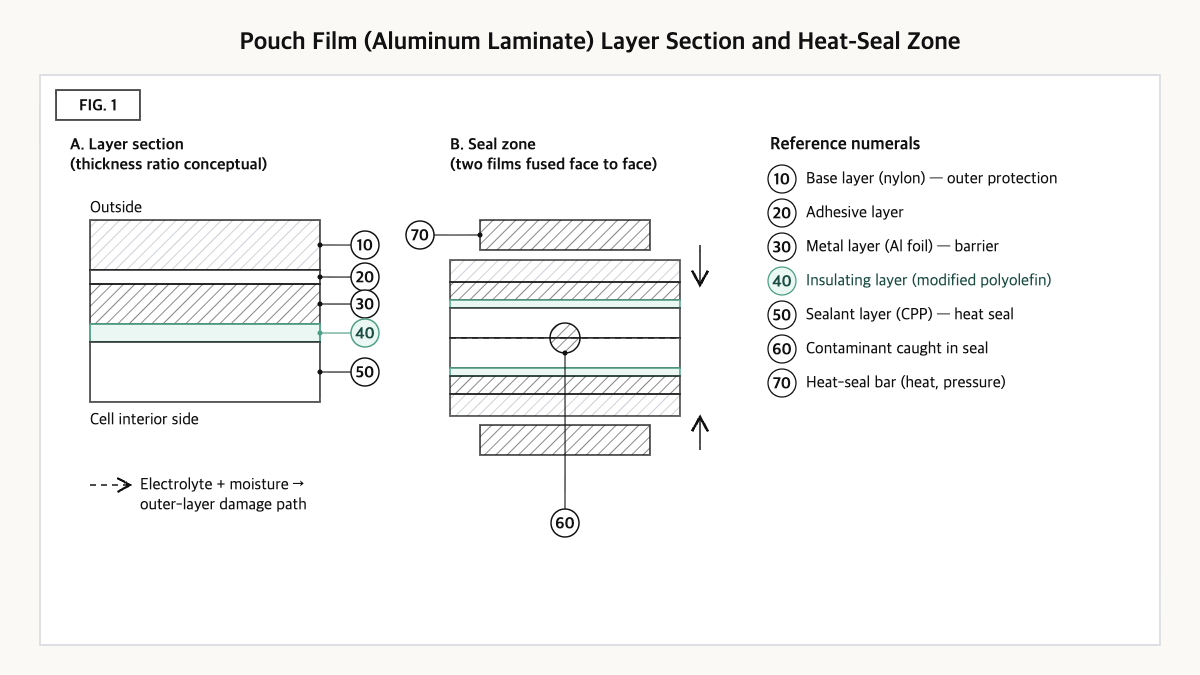
Source: reconstructed by the editorial team from Park et al. (2021) and the layer configuration described in the US10777785B2 specification.
In this structure aluminum is the key layer that blocks moisture, but the problem lies in the layers before the aluminum. One study reported that when electrolyte containing lithium salt reacts with the outer nylon layer in the presence of atmospheric moisture, the nylon is damaged and cracks and peels, exposing the thin aluminum layer beneath, where severe corrosion develops, eventually allowing moisture to penetrate the cell and degrading long-term performance and durability[1]. Once the outer shell is breached, the barrier wall does not hold out for long.
Something similar happens on the inside. If fine contaminants such as electrode debris or tabs remain stuck to the sealant surface while heat and pressure are applied during sealing, the sealant in that spot can be squeezed thin and the insulation between the aluminum and the cell interior can break down[3]. Another study reported that the strength of the sealing-edge adhesive area declines slowly over time under a given load and temperature, and that the rate of decline is faster at higher load and temperature[2]. A glued edge is tested twice: at the moment of bonding and years later.
③ Comparison — Role, Thickness, and Weakness by Layer
| Layer (outer → inner) | Main role | Thickness range in patent specification | Reported weakness |
|---|---|---|---|
| Base layer (biaxially oriented nylon) | Outer-layer protection[1] | About 5–50 μm[3] | Cracking and peeling on reaction with lithium-salt electrolyte + moisture[1] |
| Adhesive layer | Bonding base layer to metal layer (optional)[3] | Not confirmed | Not confirmed in this article |
| Metal layer (aluminum foil) | Blocking moisture ingress[1] | 10–200 μm[3] | Corrosion when exposed by outer-layer damage[1] |
| Insulating layer (modified polyolefin) | Preventing insulation defects caused by contaminants[3] | 0.1–20 μm[3] | (The layer the patent sets out to solve) |
| Sealant layer (CPP) | Heat-seal closure[1][2] | Not confirmed | Seal strength declines slowly under load and temperature[2] |
Source: reconstructed by the editorial team from Park et al. (2021)[1], Han et al. (2023)[2], and the US10777785B2 specification[3].
What this table shows: In the specification the metal layer is 10–200 μm, the range with the largest upper bound, while the insulating layer is only 0.1–20 μm. The layer that governs film reliability is not necessarily the thickest, and every reported weakness originates in the polymer layers outside and inside the aluminum.
④ Patent Perspective — Rights Drawn by ‘Hardness’ Measured at a 5 μm Indent
US10777785B2 (“Power-cell packaging material”) of Dai Nippon Printing places a thin insulating layer between the aluminum and the sealant and limits the hardness of that layer numerically. Its priority date is 2013-02-18, US filing date 2019-01-28, and grant 2020-09-15; per Google Patents its legal status is Active (anticipated expiration 2034-05-03)[3]. The problem presented in the specification is that fine contaminants (electrode debris, tabs, etc.) stuck to the sealant during sealing thin that spot under heat and pressure, causing insulation defects[3]. Restating claim 1 element by element gives the following.
| Elements of claim 1 (restated) | Meaning for the scope of rights |
|---|---|
| (a) A battery packaging material comprising a laminate in which at least a base material layer, a metal layer, an insulating layer, and a sealant layer are laminated in this order | Lamination-order limitation — the insulating layer must lie between the metal layer and the sealant layer |
| (b) The insulating layer is formed of a resin composition containing a polyolefin resin modified with an unsaturated carboxylic acid or its anhydride | Material limitation — acid-modified polyolefin family |
| (c) The hardness measured by pressing a nanoindenter tip 5 μm into the insulating layer from a cross-section of the laminate in the laminating direction is 10–300 MPa | A hardness range specified down to the measurement conditions — the baseline for infringement analysis |
| (d) The elastic modulus of the sealant layer measured with a nanoindenter under the same conditions (cross-section, laminating direction, 5 μm indentation) is 100–1000 MPa | Also limits a sealant-layer property — both the insulating-layer hardness and the sealant modulus must be met |
Source: reconstructed by the editorial team from claim 1 of US10777785B2 on Google Patents (original claim language and drawings are not reproduced verbatim).
The center of gravity of this claim is (c), and (d) adds one more window on the sealant-layer side. Because the measurement conditions ‘from a cross-section, in the laminating direction, at a 5 μm depth’ are included, the same film may yield different numbers if measured differently. The scope of rights is determined less by material composition than by the hardness window (10–300 MPa) measured by the specified method.
Design-around scenarios (with counterarguments): (i) a configuration without a separate insulating layer between the metal layer and the sealant layer, (ii) a configuration whose insulating layer hardness falls outside 10–300 MPa under those measurement conditions, (iii) a configuration using a resin other than acid-modified polyolefin for the insulating layer, and (iv) a configuration whose sealant-layer modulus falls outside 100–1000 MPa under those measurement conditions may fall outside the literal scope of claim 1. There are counterarguments, however.
In case (i), the adhesive layer bonding the metal layer to the sealant could itself be interpreted as an ‘insulating layer,’ and (iv) may be limited in effect by its relationship with the same-priority patent below, which has no sealant-modulus requirement. Moreover, since hardness is sensitive to measurement conditions, if your measured values are near the boundary, the freedom to operate (FTO) judgment should rest on measurement data that reproduces exactly the conditions set by the claim.
Cross-check of similar patents: US10236479B2 from the same applicant (priority 2013-02-18, filed 2014-02-17, granted 2019-03-19, Active, anticipated expiration 2035-01-08) limits in claim 1 the same lamination order of base, metal, insulating, and sealant layers and the same-condition hardness range (10–300 MPa), and limits the insulating-layer resin to a composition containing both an acid-modified polyolefin and a curing agent (a carbodiimide or epoxy compound), but sets no sealant-layer modulus requirement. It also has a separate independent claim (such as claim 16) built on an acid-modified polyolefin-based resin alone[4]. With the same priority date and nearly the same claim skeleton, the two patents may be in a continuation relationship within the same family. In that case, a design-around that only changes the sealant modulus, as in (iv), could still fall within the scope of rights of US10236479B2 even if it escapes US10777785B2.
⑤ Limits and Outlook
On the optimistic side, adding functional layers such as an insulating layer is a way to raise seal reliability without greatly increasing overall film thickness, so it may evolve toward lowering defect rates while preserving the light, thin advantages of pouch cells.
There is also a counter-scenario. Seal strength has been reported to fall faster at higher load and temperature[2], and the outer nylon can be damaged by nothing more than electrolyte and moisture picked up during processing[1]. However carefully the film is designed, if process contamination and long-term heat and load conditions are not managed, a pouch cell’s life may be shorter than the numbers on the film specification sheet.
The strategic alternative is to bundle film specifications and process control items into a single checklist. Managing post-filling exterior cleaning, pre-seal contaminant inspection, and the compressive load and temperature the seal experiences inside the module alongside film selection criteria allows patent review and quality review to be done at once when changing film suppliers or adjusting layer configuration.
Action to check (planning/IP teams): Confirm from the supplier’s specification sheet whether the pouch film in use has an insulating layer (or an equivalent adhesive layer) between the metal layer and the sealant, and if so, obtain the insulating-layer nanoindentation hardness and sealant-layer modulus under the conditions set by the claim (cross-section, laminating direction, 5 μm indentation) and compare it against both US10777785B2 and US10236479B2.
Items Requiring Verification
- Typical thickness ranges of the sealant (CPP) and adhesive layers could not be confirmed from sources in this article, so no figures are given.
- The exact legal relationship between US10777785B2 and US10236479B2 (whether a continuation), and why the later-filed US10777785B2 has an earlier anticipated expiration (term adjustment, terminal disclaimer, etc.), were not verified.
- The claim structure from independent claim 16 onward and the total number of claims of US10236479B2 were not examined in detail this time.
- Whether DNP film is actually supplied to specific cell manufacturers was not verified.
Sources
- B. K. Park, Y. K. Jeong, S. Y. Yang, S. Kwon, J. H. Yang, Y. M. Kim, K. J. Kim, “Deterioration behavior of aluminum pouch film used as packaging materials for pouch-type lithium-ion batteries,” Journal of Power Sources, vol. 506, 230222, 2021, DOI 10.1016/j.jpowsour.2021.230222. Link
- L. Han, L. D. Chai, Y. C. Wei, W. F. Zhang, M. Wang, W. Zhang, “Investigating the strength of heat-sealed cast polypropylene film for lithium-ion pouch cells considering thermo-mechanical coupling effects,” Composite Structures, vol. 322, 117368, 2023, DOI 10.1016/j.compstruct.2023.117368. Link
- Google Patents, US10777785B2 “Power-cell packaging material,” bibliographic data, claim 1, and specification (original checked 2026-09-23). Link
- Google Patents, US10236479B2 “Power-cell packaging material,” bibliographic data and claim 1 (original checked 2026-09-23). Link
This article is a technology and patent trend commentary, not legal advice. Specific FTO judgments require professional review.
Related Reading