A high-concentration electrolyte (HCE), with a very large amount of salt dissolved, stabilizes interfaces by changing the ‘solvation structure’ around lithium ions, but it is expensive and viscous. The localized high-concentration electrolyte (LHCE) solves this with ‘a diluent that cannot dissolve the salt,’ and its core idea has been claimed in patents from a US national laboratory.
① What’s the Topic
The core of LHCE is not ‘adding a lot of salt’ but ‘deliberately mixing in a solvent that cannot dissolve the salt.’ It is a design that lowers the overall concentration to an ordinary level while leaving only the micro-environment right next to each lithium ion in a high-concentration state.
Start with the industry situation. As highly reactive anodes such as lithium metal and silicon spread, how stable an interface the electrolyte can build has become a variable that determines life. High-concentration electrolytes (HCE), which raise salt concentration substantially, drew attention as one solution. For example, a concentrated electrolyte using the flame-retardant solvent trimethyl phosphate (TMP) cycled stably on hard-carbon and graphite anodes for more than 1,000 cycles (over one year) without any additives, which was explained by the spontaneous formation of a robust inorganic passivation film on the anode[3].
The tension lies in cost and physical properties. Concentrated electrolytes are stable with lithium metal but have been noted for high cost and poor wettability[2]. So researchers at the US Pacific Northwest National Laboratory (PNNL) proposed the localized high-concentration electrolyte (LHCE), which dilutes a concentrated electrolyte with an ‘inert’ diluent. The question this article answers is: what does changing the solvation structure mean, and with what wording did the patent fence in that design?
② Basic Principle — A ‘Packed Elevator’ and ‘Partition Packing’
Lithium ions in an electrolyte do not travel alone. Solvent molecules surround them, and this group is called the solvation structure. At ordinary salt concentrations there is plenty of solvent, so several solvent molecules wrap each lithium ion and the anion stays a little apart. In that case it is mainly the solvent that decomposes first at the anode, producing an interface rich in organic species.
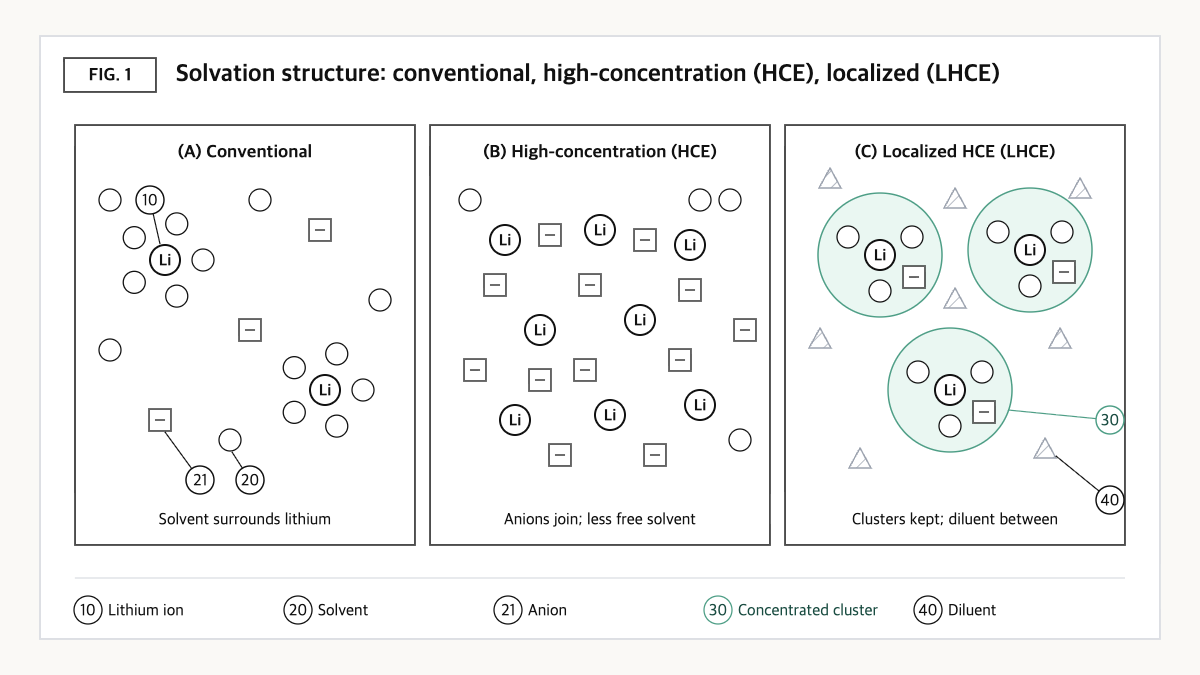
Source: reconstructed by the editorial team from the claims of US10367232B2 and the abstracts of Chen et al. (2018) and Wang et al. (2018).
Add a great deal of salt and the situation changes. Picture a packed elevator. With too few people (solvent), even anions press right up against the lithium ion, and ‘idle solvent (free solvent)’ almost disappears. Anions then take part in decomposition at the interface, forming a film rich in inorganic components; the inorganic passivation film of the TMP concentrated electrolyte above is an example[3]. The problem is that with the whole elevator packed, movement is sluggish (higher viscosity) and the salt bill is large.
LHCE adds ‘partition packing.’ A diluent is a liquid that mixes well with the solvent but can barely dissolve the salt. So even when the diluent is poured in, the small groups (clusters) of lithium ions bound with solvent and anions do not break apart; the diluent only fills the space between them. The overall concentration falls, but the microstructure next to the lithium ion stays in its high-concentration state. The idea that a concentrated electrolyte can be diluted with a low-polarity solvent while keeping its original functions, lowering viscosity and raising ionic conductivity, has also been summarized in a related review[4]. Indeed, the dependent claims of the PNNL patent separately claim a state in which at least 90% of solvent molecules are associated with cations while fewer than 10% of diluent molecules are[1].
③ Comparison — Conventional, High-Concentration, and Localized High-Concentration Electrolytes
| Category | Conventional electrolyte | High-concentration electrolyte (HCE) | Localized high-concentration electrolyte (LHCE) |
|---|---|---|---|
| Structure around the lithium ion | Plenty of solvent surrounding it (qualitative) | Anions participate next to lithium; less free solvent (qualitative) | Local clusters stay concentrated; diluent sits outside the clusters (at least 90% of solvent associated with cations, fewer than 10% of diluent — dependent claims)[1] |
| Nature of the interface (SEI) | Centered on solvent-derived components (qualitative) | Robust inorganic passivation film reported[3] | Aims to achieve an HCE-like interface at a lower overall concentration[2] |
| Concentration design example | — | High concentration relative to solvent (qualitative) | 0.5–2 M in the whole electrolyte, above 3 M relative to solvent (dependent claim 2)[1] / 1.2 M LiFSI in DMC:BTFE = 1:2 (molar ratio)[2] |
| Reported performance | — | TMP-based; stable over 1,000 cycles on hard carbon and graphite[3] | Coulombic efficiency 99.5%; over 80% capacity after 700 cycles in Li∥NMC333[2] |
| Practical weakness | Unstable interface on reactive anodes (qualitative) | High cost, poor wettability[2] | Reduced ion-transport kinetics noted as a limit to practical use[7] |
Source: reconstructed by the editorial team from the claims of US10367232B2[1], Chen et al. (2018)[2], Wang et al. (2018)[3], and Weintz et al. (2026)[7].
What this table shows: LHCE is a design that carries the interfacial stability shown by HCE (Coulombic efficiency around 99.5%) over to an overall concentration of about 1.2 M. In exchange, the weakness has moved from ‘cost and wettability’ to ‘ion-transport speed.’
④ Patent Perspective — ‘Function’ at Publication, a ‘List’ at Grant
The representative patent for the LHCE concept is US10367232B2 (title: Localized superconcentrated electrolytes for stable cycling of electrochemical devices) from Battelle Memorial Institute (the operator of PNNL). The inventors are Ji-Guang Zhang, Jianming Zheng, and Shuru Chen; priority date 2017-03-02; filing date 2017-05-18; published as US20180254524A1 (2018-09-06); grant date 2019-07-30; 21 granted claims. The legal status is shown as Active (expected expiration 2037-08-20), and a US Department of Energy (DOE) confirmatory license was recorded on 2018-01-11[1]. Restated, granted claim 1 reads as follows.
| Granted claim 1 elements (restated) | Meaning for the scope of rights |
|---|---|
| (a) Active salt: one or more of the listed salts, such as LiFSI, LiTFSI, NaFSI, NaTFSI, LiBOB, NaBOB, LiPF6, LiAsF6, and LiDFOB | A Markush-type list broadly enumerating lithium and sodium salts |
| (b) Solvent: one or more of the listed solvents, such as DME, DMC, DOL, EMC, DEC, DMSO, sulfones, EC, VC, FEC, TMP, TEP, GBL, and water (in which the salt is soluble) | Covers carbonates, ethers, and even phosphate esters |
| (c) Molar ratio of active salt to solvent of 0.7–1.5 | Numerically limits the locally concentrated state |
| (d) Diluent: one or more of TTE, BTFE, TFTFE, MOFB, and EOFB | Limits the diluent to a list of five fluorinated ethers — the key limitation narrowed during prosecution |
| (e) The active salt’s solubility in the diluent is at least 10 times lower than in the solvent | Functional limitation of ‘a diluent that cannot dissolve the salt’ |
Source: reconstructed by the editorial team from the Google Patents bibliographic data and the original claims of the granted publication of US10367232B2 (checked 2026-09-23); original claim wording is not reproduced.
The insight to take from this patent is that the scope of rights narrowed during prosecution from ‘function’ to ‘list.’ Claim 1 of the published application (US20180254524A1) consisted only of the functional combination “active salt + solvent + a diluent in which the salt is at least 10 times less soluble”[1]. Granted claim 1 added a list of five diluents and a salt:solvent molar ratio of 0.7–1.5. The concept itself is widely known, but the granted fence is tied to specific diluent names.
So the first-priority design-around scenario is a diluent outside the list. Indeed, the search for new diluents is active: one study introduced two fluorinated ethers used as heat transfer fluids as co-diluents to raise ion mobility[7]. But there are counterarguments. First, the same patentee is filling the area outside the list with follow-on filings. There is US10472571B2 (title: Low flammability electrolytes for stable operation of electrochemical devices; filing date 2017-10-19; grant date 2019-11-12; Active, expected expiration 2037-09-01), which shares the same priority date (2017-03-02)[5], and a patent abstract from the same researchers registered with OSTI separately covers fluorinated orthoformate diluents[6]. Second, even for a diluent outside the list, the possibility of a dispute over equivalence cannot easily be excluded if the function is the same. Ultimately, freedom to operate (FTO) must be judged against the whole family, not a single patent.
⑤ Limits and Outlook
On the optimistic side, LHCE may become a standard tool for solving the life problem of reactive anodes. In silicon-anode research, LHCE containing 200–300 ppm of water was reported to retain up to 8% more capacity than dried electrolyte over 200 days of calendar testing[8].
There is also a contrary scenario. LHCE may be disadvantaged in high-rate cycling because of slower ion transport[7], and research on lithium-metal batteries shows that transition-metal ions dissolved from the cathode significantly reduce the Coulombic efficiency and cycle life of LHCE[9]. It is hard to conclude that 99%-level lab efficiencies will be reproduced as-is in large cells.
As a strategic alternative, it is worth considering securing, as in-house IP, methods and reference values for measuring ‘solvation-structure indicators’ rather than competing on composition patents. Diluent names keep changing, but methods and criteria for measuring how much solvent is associated with cations are likely to be reusable even as compositions change.
Action to check (planning/IP teams): For each in-house LHCE candidate formulation, build a table filling in two columns, ‘Is the diluent one of TTE, BTFE, TFTFE, MOFB, or EOFB?’ and ‘Is the salt:solvent molar ratio within 0.7–1.5?’, and send formulations that meet both to FTO review against the entire US10367232B2 family.
Items Requiring Verification
- The claims and status of US11094966B2, which appears in the event record as a later continuation, were not checked against the original.
- The exact publication/grant number and legal status of the PNNL patent covering fluorinated orthoformate diluents[6] could not be verified.
- The price, mass-supply conditions, and applicability of environmental regulations for the diluents discussed (TTE, BTFE, etc.) are outside the scope of this work and require separate review.
Sources
- Google Patents, US10367232B2 bibliographic data, event record, and original claims of the granted publication; claim 1 of published application US20180254524A1 (checked 2026-09-23). Link
- S. Chen et al., “High-Voltage Lithium-Metal Batteries Enabled by Localized High-Concentration Electrolytes,” Advanced Materials 30 (2018), DOI 10.1002/adma.201706102 (OSTI abstract). Link
- J. Wang et al., “Fire-extinguishing organic electrolytes for safe batteries,” Nature Energy 3 (2018) 22–29. Link
- Y. Yamada et al., “Advances and issues in developing salt-concentrated battery electrolytes,” Nature Energy 4 (2019) 269–280. Link
- Google Patents, US10472571B2 “Low flammability electrolytes for stable operation of electrochemical devices,” bibliographic data (checked 2026-09-23). Link
- OSTI, X. Cao, J.-G. Zhang, W. Xu, “Electrolyte for stable cycling of rechargeable alkali metal and alkali ion batteries,” patent abstract (listed 2023-03-07). Link
- D. Weintz et al., “Heat Transfer Fluids as Co-Diluents in Localized High-Concentration Electrolytes for High-Rate Lithium Metal Batteries With Enhanced Safety,” Angewandte Chemie International Edition 65 (2026) (OSTI abstract). Link
- L. Meyer et al., “Long cycle and calendar life of Si-based Li-ion batteries enabled by localized high-concentration electrolytes and their surprising water tolerance,” Journal of Energy Storage 168 (2026) (OSTI abstract). Link
- Z. Guo et al., “Crossover Effects of Transition-Metal Ions on Lithium-Metal Anode in Localized High Concentration Electrolytes,” Advanced Functional Materials (2025), DOI 10.1002/adfm.202501743 (OSTI abstract). Link
This article is a technology and patent trend commentary, not legal advice. Specific FTO judgments require professional review.
Related Reading