In August 2026, Six Patents Out of China Are Redrawing the Industry’s FTO Map
Starting with the disclosure of BYD’s cathode composite-structure patent (publication number CN122474592A) by the China National Intellectual Property Administration (CNIPA) on July 28, 2026, BYD disclosed a total of six related patents in succession over a period of just over ten days, through August 6. All of them deal with a dual-electrolyte structure that uses two different types of solid electrolyte — halide-based and sulfide-based — together in the cathode of an all-solid-state battery.
There is a question that any company developing an all-solid-state battery is bound to run into at some point: “If we also mix and use dissimilar electrolytes, wouldn’t that infringe this patent?” The industry situation is as follows. Most companies developing all-solid-state batteries, including Samsung SDI, LG Energy Solution, and SK On, are attempting similar material combinations to solve the interface-contact problem, and as a result, patent density in this field is unusually high. This article organizes exactly where BYD’s patent claims draw the line on their scope of protection, and how that relates to patents Korean companies have already filed or secured (for example, US20240039041A1, co-filed by Samsung SDI with Hyundai Motor and Kia).
Basic Principle: Understanding the Dual-Electrolyte Structure Through a “Gravel and Fine Sand” Analogy
The cathode of an all-solid-state battery is made by mixing the cathode active material (particles that actually store and release lithium ions) with a solid electrolyte (solid particles that serve as the pathway for ions to travel through). The problem is that, no matter how much solid particles are pressed together, they never bond as seamlessly as a liquid does.
Source: reconstructed by the editorial team from the CN122474592A publication and CarNewsChina reports (2026-07-29, 2026-08-06)
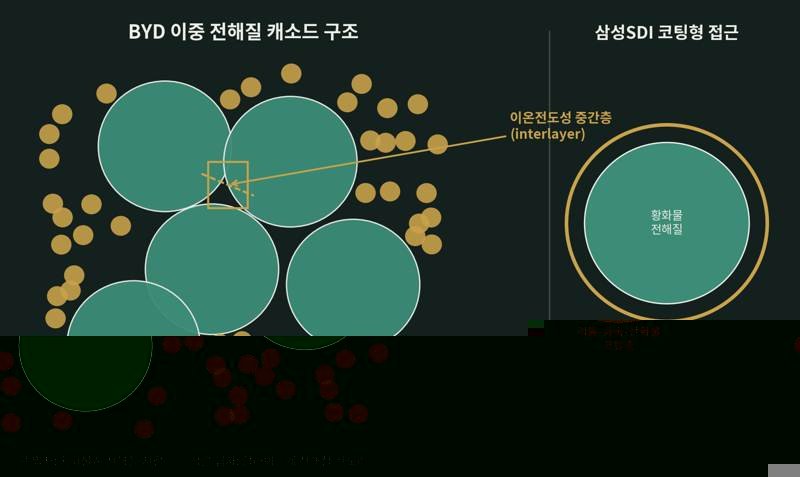
BYD’s approach is easier to understand as an analogy to filling a space with gravel and fine sand together. Filling it with only the large-particle sulfide-based electrolyte (the gravel) leaves large gaps, and the small-particle halide-based electrolyte (the fine sand) fills those gaps, widening the overall contact area. On top of this, the follow-up patents deal with a structure that adds a thin interlayer, acting as a buffer, at the point where the gravel (sulfide) and the fine sand (halide) directly touch, so that the two materials do not chemically react with each other and degrade performance.
Comparison: BYD’s Dual-Electrolyte Patent Family vs. Samsung SDI’s Solid Electrolyte Patent
| Category | BYD (CN122474592A and 6 Patents in Total) | Samsung SDI (US20240039041A1, co-filed with Hyundai/Kia) |
|---|---|---|
| Approach | Compositing halide-based + sulfide-based particles inside the cathode | Coating a lithium-metal-oxide layer on the surface of a single sulfide-based (argyrodite) electrolyte |
| Means of solving the interface problem | Packing based on particle-size difference + an ion-conductive interlayer | Particle-surface coating layer (heat treatment at approx. 250-350°C) |
| Core claim elements (estimated) | Electrolyte-type combination ratio, interlayer composition | Lithium-metal-oxide coating, XRD main-peak FWHM of about 0.160 or less |
| Publication/grant timing | Published July-August 2026 (presumed under examination) | Published 2024-02-01 (pending examination) |
Source: compiled by the editorial team from CarNewsChina reports on CN122474592A and the US20240039041A1 publication (Google Patents)
What This Table Tells Us: Both companies start from the same problem awareness of “stabilizing the interface by combining dissimilar materials,” but BYD chose to mix two types of electrolyte itself (a composition-type claim), while Samsung SDI chose to apply a coating to a single electrolyte (a surface-treatment-process-type claim), so the grain of their claims differs. This suggests the two patents are less likely to directly infringe each other’s scope of claims than to coexist as different, potentially design-around-able routes to solving the same problem.
Patent Perspective: Claim Summary, Filing History, and Design-Around Points
The claim summary of BYD’s representative patent (CN122474592A, published 2026-07-28) is understood to be an electrode structure that composites a cathode active material with two types of solid electrolyte of different particle sizes (halide-based and sulfide-based). The subsequently disclosed follow-up patent family (including the other patents among the six) appears to claim a configuration that interposes, between these two electrolytes, an interlayer that has both ionic conductivity and electrochemical stability.
There are three points worth noting from the perspective of the scope of claims. First, there is a high likelihood that prior art already exists in academia and industry for the higher-level concept itself of “using dissimilar electrolytes together,” so it may be difficult to be granted a broad scope of claims on this point alone during examination. If it does proceed to grant, the claims may well be narrowed by numerical limiting elements such as the particle-size ratio, and the specific composition or thickness of the interlayer.
Second, US20240039041A1, co-filed by Samsung SDI, addresses a similar problem awareness of “coating with a dissimilar material” through a surface-treatment process, which puts it in a different category from BYD’s composition-type claims of “mixing the electrolyte itself.” Because of this, it is possible that the two patents do not directly block each other’s implementation. However, if Samsung SDI later expands its R&D direction to a dissimilar-electrolyte-mixing structure, at that point a separate re-examination of conflict with the BYD patent family would become necessary.
Third, sketching out a design-around scenario in concrete terms: if a Korean company combines the same halide-sulfide dissimilar electrolytes but designs outside the numerical range of the particle-size ratio that BYD’s claims specify, or secures interface stability by modifying the active-material surface itself instead of inserting a separate interlayer, that could be an alternative route to lowering the risk of infringement. However, this remains, until BYD’s patent’s final granted claim scope is settled, only a projected scenario, and the possibility remains open that the claims could end up broader or narrower than now depending on the actual examination outcome.
Limitations and Outlook
The optimistic scenario is one in which BYD’s patent family is granted, as expected, with a narrow, numerically limited scope of claims, creating a setup in which Korean companies can sufficiently design around it with their own coating-type or modification-type approaches. However, an opposing scenario also exists. If, during examination by the Chinese patent office, BYD is granted a broader scope of claims than expected, and it subsequently extends the same application to Korea, the U.S., and Europe via the PCT route, it cannot be ruled out that Korean companies’ design freedom for all-solid-state cathodes could be constrained more significantly than expected.
As a strategic alternative, it is recommended that Korean companies, at this point, further reinforce their own patents on coating-type and modification-type approaches, and at the same time consider preemptive, defensively purposed filings on dissimilar-electrolyte combination structures as well.
The practical action IP staff reading this article should take today is to promptly check, via WIPO Patentscope and KIPRIS, whether this BYD patent family (publication number CN122474592A and related follow-up applications) has been extended via the PCT route or via priority claims in Korea and the U.S.
- BYD files six solid-state battery patents, eyes 2027 production
- BYD’s new solid-state battery patent reveals a dual-electrolyte cathode approach
- Samsung SDI files patent for solid electrolyte with sulfide particles
- US11955601B2 – Google Patents