① What’s the Story
In March and August 2026, CATL and BYD each successively published patents that directly target ‘interface degradation’ — the performance decline that occurs at the point where the electrode and the solid electrolyte meet — the most challenging problem in all-solid-state batteries. Both companies state the same goal of pilot production in 2027, but a direct review of the original text on Google Patents shows that their approaches to solving the problem are close to opposite. CATL chose a materials-centered solution of “chemically coating the cathode material surface,” while BYD chose a structure-centered solution of “physically modifying the electrode structure itself.”
The industry often lumps all-solid-state battery patents together under the single umbrella of ‘solid electrolyte composition.’ But when the actual claims are taken apart, they solve the same problem at different levels — materials versus structure — and whether these two patent families can coexist in the future without infringing on each other’s claim scope, or whether a point of collision will eventually emerge, is a practical concern among IP strategists in this industry. This article places the two patents side by side to gauge the answer.
② Basic Principle
What happens if an ultra-high-nickel cathode material (a ternary material with a very high nickel content that has high energy density but tends to be chemically unstable) is simply placed directly against a sulfide solid electrolyte? To use an analogy, it’s similar to “mixing two highly reactive chemicals directly, without any buffer.” As charge-discharge cycles repeat, unwanted side reactions occur at the contact surface, building up residues such as lithium fluoride (LiF) and nickel sulfide (NiS), and this residue layer increases electrical resistance, eating into the battery’s initial efficiency and lifespan.
Source: reconstructed by the editorial team from claim 1 of CN121964524A and CN121768970A
CATL’s solution is to insert an additional “buffer coating layer” between these two chemical substances. It is a two-stage coating method that first applies a lithium zirconate (LZO)-based coating to the surface of the cathode material (the base material), and then applies a second coating on top of that, based on NASICON (a solid electrolyte material with a phosphate framework structure that ions pass through easily). BYD’s solution, on the other hand, is not a coating but a “carving a path” approach. It deliberately cuts concave grooves (recesses) into the electrode surface and fills those grooves with solid electrolyte, making the pathway ions travel through short and straight. To reuse the “road construction” analogy above, CATL is the side laying a buffer layer of gravel between the road and the ground, while BYD is the side reducing the curvature of the road itself.
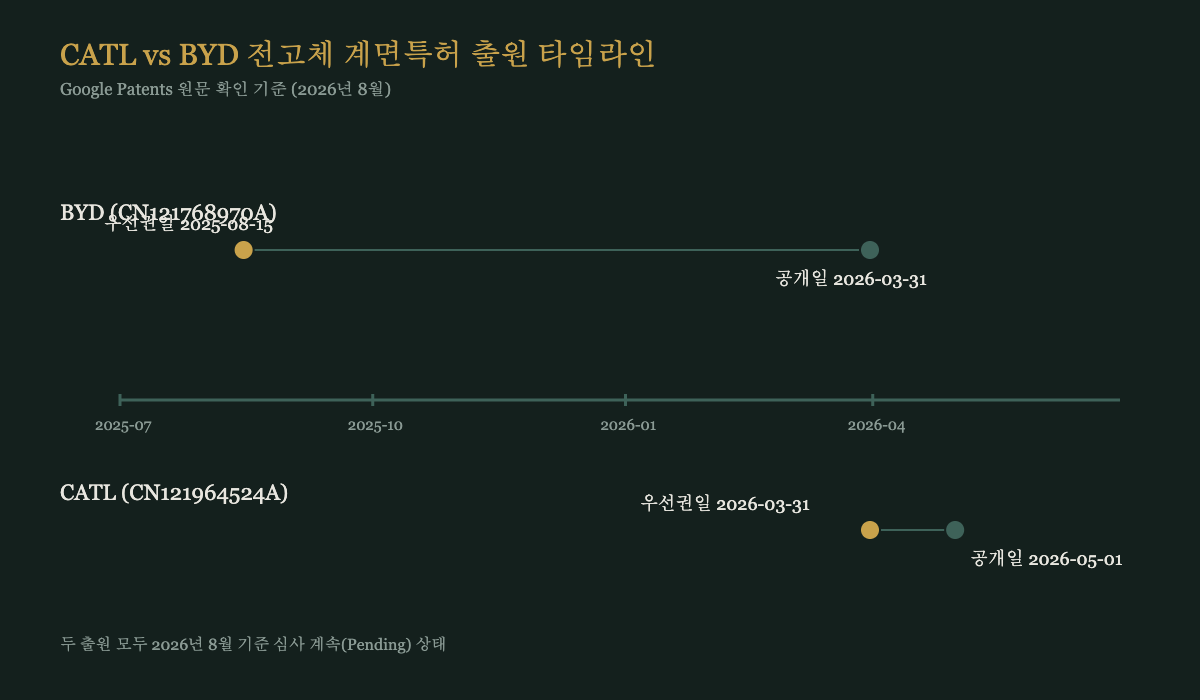
③ Comparison: CATL vs. BYD All-Solid-State Interface Patents
| Category | CATL (CN121964524A) | BYD (CN121768970A) |
|---|---|---|
| Applicant | Contemporary Amperex Technology Co., Ltd. | BYD Co., Ltd. |
| Application number / priority date | CN202610409310.1A / 2026-03-31 | CN202511149912.XA / 2025-08-15 |
| Publication date / status | 2026-05-01 / Under examination (Pending) | 2026-03-31 / Under examination (Pending) |
| Level of solution | Materials chemistry (two-stage coating composition) | Electrode structure (recess-filling design) |
| Core claimed subject matter | A cathode active material having an LZO first coating layer plus a NASICON-type phosphate-based second coating layer | An electrode plate structure in which a recess on the surface of the active material layer is filled with a first solid electrolyte |
| Solid electrolyte type (as stated in claims) | Phosphate-based (lithium-germanium/silicon/aluminum/boron/titanium/niobium phosphate) | Selected from oxide, sulfide, halide, or polymer (preferably sulfide) |
Source: compiled by the editorial team from CN121964524A and CN121768970A (Google Patents public records)
What This Table Tells Us: The two patents’ priority dates are about 7 months apart (BYD comes first), and CATL’s publication date is also roughly a month later. Since the core claim elements sit at different levels — “coating material” (CATL) versus “electrode structure” (BYD) — the claim scopes appear, on the surface, more likely to coexist than to directly collide (though this is only a preliminary assessment based on the published claims and not a definitive conclusion).
④ Patent Perspective: Claim Summary, Filing History, and Design-Around Points
The independent claim (Claim 1) of CN121964524A has a structure stating that “the positive electrode active material includes a matrix material, a first coating material (containing LZO) covering part of the matrix surface, and a second coating material (a solid electrolyte material) covering the surface of the first coating material,” so the claim scope is tied to the configuration of “two-layer coating” itself. For a latecomer seeking to design around this claim without risking infringement, there appears to be room to consider a design-around such as reducing the coating to a single layer, or using a different buffer material instead of LZO (for example, a lithium lanthanum zirconate-based material).
However, since CATL’s dependent claims cover detailed numerical ranges for the matrix composition, the first coating (Li₂O-ZrO₂-based) composition ratio, particle sizes and the active-material-to-electrolyte mass ratio (Claims 4 through 9), an actual FTO determination would require comparing your own company’s precise coating-process thickness and composition data claim-language by claim-language.
CN121768970A claims, in its independent claim (Claim 1), a structure in which “in an electrode comprising a current collector and an active material layer, a recess is formed on the surface of the active material layer, the depth of the recess is less than the thickness of the active material layer, and the recess is filled with a filler containing a first solid electrolyte.” The dependent claims specify, in numerical terms, the ratio between recess depth and active material layer thickness (0.4 to 0.8), the minimum distance between recesses, and the arrangement pattern (rectangular, planar, etc.) (Claims 2 through 4), so the claim scope relies on fairly specific geometric parameters.
As design-around scenarios, one could theoretically consider designing the recess depth ratio outside the claimed range (0.4 to 0.8), or modifying the recess into a continuous fine-groove form instead. As a counterargument, it should also be considered that BYD has already filed six related patents in succession, tightly defending the parameter range through numerous finely subdivided dependent claims, so a design change that merely nudges a specific figure slightly out of range may not be enough to design around it.
Since both applications are still pending, prior to grant, the scope of the final claims may change through amendment during examination. Whether they will be granted and what their final claim scope will be are matters that, for now, can only be watched at the level of possibility.
⑤ Limitations and Outlook
Viewed optimistically, since the two companies’ solutions sit at different levels, each could proceed to mass production without needing a cross-license. But an opposing scenario must also be left open as a possibility. If CATL, in a follow-on application, files a combined claim that adds a recess structure on top of its coating material (or, conversely, if BYD combines a multilayer coating concept with its recess filler), the possibility cannot be ruled out that, at the implementation stage, the two patent families would end up simultaneously covering essentially a single cell structure.
As a strategic alternative, it seems worth considering that domestic cell makers or materials companies could separately patent and preempt the gray zone between these two patents — a third approach that uses “neither coating nor structure at the same time” (for example, a method that lowers interface reactivity by using a compositional gradient within the electrolyte itself). This is a direction that could secure a favorable position in licensing leverage as commercialization competition intensifies.
Action Item: IP personnel are advised to first set up legal-events alerts for both CN121964524A and CN121768970A, and to establish a process, within this quarter, for cross-checking against your own company’s all-solid-state development roadmap at the moment a grant decision or amended claims are published, so as not to miss that timing.
※ The patent analysis in this article is a preliminary interpretation based on the application information and claims published on Google Patents as of August 2026, and it does not make a final determination of grant status, claim scope, or infringement. Matters requiring an actual design-around or FTO determination should always undergo separate expert review.