1. What’s at Stake
The decisive point where space-grade batteries diverge from ground-use cells is not energy density — it’s the premise that they “cannot be fixed.” This premise rewrites every decision, from material selection to thermal design.
Here’s the industry context. As the number of satellite launches grows rapidly, centered on low Earth orbit (LEO, roughly 200–2,000 km altitude), demand for satellite power components is growing alongside it. Published market forecasts put the space-grade battery market at roughly $3.4 billion in 2025, growing to roughly $5.41 billion by 2030 at a CAGR of 9.73%. Korean cell makers have already entered this space. LG Energy Solution has supplied lithium-ion batteries for NASA’s space-exploration spacesuits since 2016, and stated in 2024 that it had begun a project to supply batteries for SpaceX spacecraft. Samsung SDI has built a collaborative framework with CAMX Power, which has signed a contract to supply lithium-ion satellite batteries to the U.S. Space Force (USSF).
This is where the tension arises. The ground EV market currently competes on “cost per kWh.” Satellite applications, by contrast, involve small volumes and high unit prices, with requirements sitting on an entirely different axis. So what exactly is the technical asset a battery company needs to carry into space — that is the question this piece sets out to answer.
2. The Basic Mechanism — A Power System Where Day and Night Arrive Several Times a Day
A satellite power system runs on a division of labor between the solar array and the battery. During the sunlit portion of the orbit, the solar array generates power and the surplus charges the battery. During the portion in Earth’s shadow (eclipse), power generation stops, so the battery becomes responsible for the entire satellite’s power.
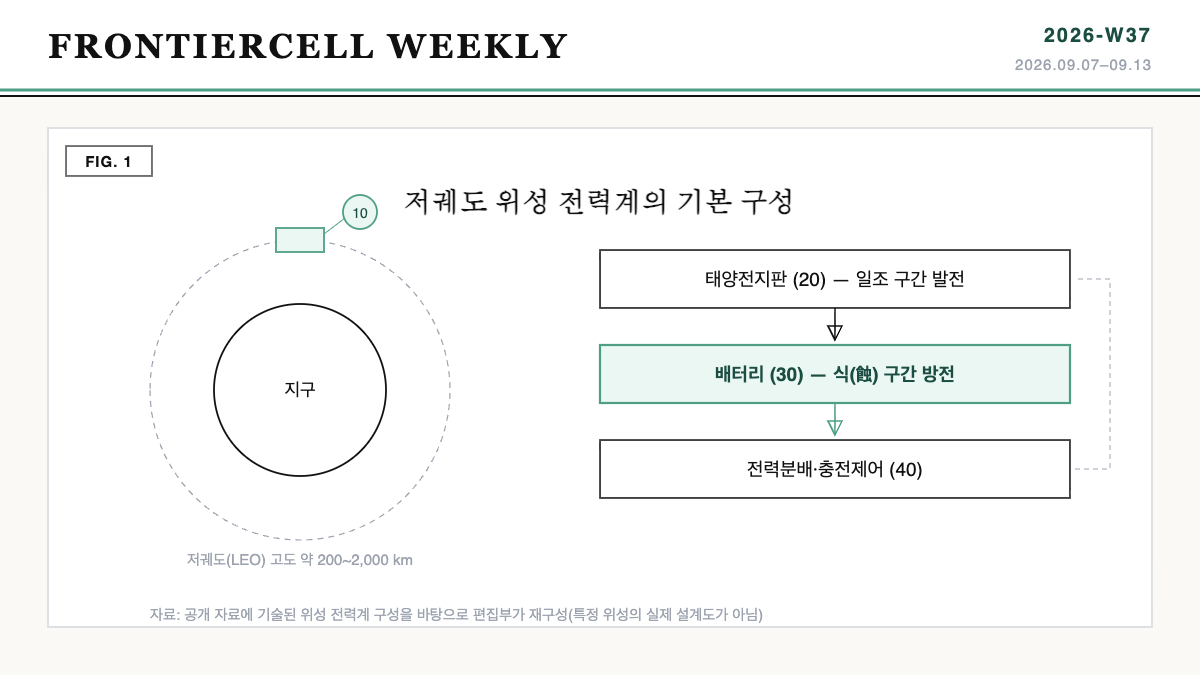
Source: editorial reconstruction based on satellite power-system configurations described in public materials (not the actual design of any specific satellite).
Unlike geostationary satellites, which experience eclipse only a limited number of times per year, LEO satellites have short orbital periods, so the same cycle repeats several times a day. Where a ground EV battery charges and discharges roughly once a day, a LEO satellite’s battery goes through far more frequent, shallow charge-discharge cycles, sustained over years.
This difference reshapes the design. EV cells are optimized for infrequent, deep discharge, while LEO satellite cells are optimized for very frequent, shallow discharge. Designers trade off by keeping the depth of discharge (DOD) low to extend cycle life, while adding more cells to secure the capacity that requires.
The environmental conditions differ too. During launch, the battery must withstand severe shock and vibration; once in orbit, it faces vacuum, temperature swings between extreme cold and extreme heat, radiation, and micrometeoroids. A failure that could simply be “replaced” on the ground means mission termination here.
3. Comparison — Requirements for Ground Cells vs. Satellite Cells
| Item | EV Cell (Ground) | LEO Satellite Cell |
|---|---|---|
| Top priority metric | Cost per kWh, gravimetric energy density (Wh/kg) | Failure-free operation over the mission life (reliability), cycle count |
| Charge/discharge pattern | Deep discharge, relatively infrequent | Shallow discharge, very frequent (repeating with each short orbital period) |
| Operating environment | In atmosphere, HVAC/cooling available | Vacuum, repeated extreme cold/heat, radiation, micrometeoroids |
| Initial loading | Driving vibration | Severe shock and vibration during launch |
| Serviceability | Module replacement/refurbishment possible | Not possible — a failure means mission loss |
| Heat-rejection path | Air/coolant convection | Radiator-centered — no convection |
| Market size (reference) | Mass market | ~$3.4B (2025) → ~$5.41B (2030), CAGR 9.73% |
What this table shows: the item that changes most in the transition to space is not chemical composition but the heat-rejection path and serviceability. Because there is no convection in a vacuum, heat must be gathered by conduction and rejected by radiation, and because maintenance is impossible, there is no way back once thermal control fails. If cell chemistry is the asset a battery company can bring, the real contest is likely decided by the thermal and structural design outside the cell.
4. Patent Perspective — The Claims Cluster Not Around the Cell, but Around the ‘Periphery of the Battery’
This assessment is also borne out in the patent landscape. A scan of granted patents in the space power-system space shows a tendency for claims to cluster around the control, thermal-management, and bypass structures surrounding the cell, rather than around cell composition itself.
- US7967256B2 (Lockheed Martin Corp, priority 2007-05-08, granted 2011-06-28) — A variable-conductance heat pipe configuration that controls heat transfer between a satellite battery and a radiator. The claims are examined in detail in a separate article in this issue.
- US6034506A (Lithium ion satellite battery charge control circuit) — A configuration combining charge control and cell bypass for satellite lithium-ion batteries.
- US6025696A (Battery cell bypass module) — A module configuration that bypasses an individual cell when it fails.
The common thread across these three is clear. “A structure that keeps the mission alive even if a single cell fails” is the object of the claims. In an environment where maintenance is impossible, lowering the failure rate alone is not enough, because a configuration that keeps operating even after a failure occurs is what has value.
From a design-around perspective, patents in this area tend to specify components in physical terms (heat pipes, bypass switches, radiator placement, and so on), which leaves somewhat more room for literal design-around than process-parameter patents typically allow. However, flight heritage functions as a de facto barrier to entry for space components. Even a newly designed structure that avoids the patent will not be adopted without a track record of verification — a barrier that exists outside the patent system itself.
Source: editorial reconstruction based on the published patent bibliographic data cited in the text.
5. Limits and Outlook
Let’s state the limits first. The market size and growth rate cited in this piece are estimates from private research firms, and direct comparison is difficult because each firm defines scope differently (cell only, versus pack/power-system inclusive). The Korean companies’ supply cases described here are compiled from what those companies have publicly disclosed; contract size and volume were not disclosed. Concrete operating figures such as orbital period and annual cycle count vary by satellite, so this article does not assert definite quantitative values for them.
Counter-scenario to the optimistic outlook. The premise that “more satellite launches means proportionally more battery demand” may be weaker than it looks. Commercial LEO satellites are trending toward shorter design lifetimes with frequent replacement, and in that case the number of cycles required of any individual satellite actually decreases. As required specifications relax, there is more room for space-dedicated cells to be replaced by screened and qualified commercial cells (upscreened COTS). If that happens, volume may rise, but the unit-price premium erodes quickly.
Strategic alternative. To prepare for this scenario, building assets around the qualification/screening system and pack-level safety design offers more defensibility than space-grading the cell itself. Even when commercial cells are used, screening criteria and pack structure are still needed, and as shown above, that is a segment where patenting is possible.
Action item (for planning/IP staff): Check whether your company’s cell screening and reliability-testing procedures exist only as internal standard documents, or whether they have been organized as a method patent or a test-data asset. In entering the space market, it is often this qualification system — more than the cell specification itself — that actually provides negotiating leverage.
Also in This Week’s Frontiercell Weekly
FRONTIERCELL WEEKLY 2026-W37 · 2026.09.07–09.13
- The Year Equipment Shows Got an ‘EV Fire Special Zone’ — What K-Battery Show 2026 Revealed About the Center of Gravity in Equipment Orders
- [Patent Analysis] Filling Electrolyte ‘Atmospheric-Pressure First,’ Not ‘Vacuum First’ — The Claim Boundary of the Reduced-Pressure Cycle Drawn by US10476097B2
- [Patent Analysis] The Sun That Warms Also Locks the Heat Path — The Claim Boundary of Lockheed Martin’s Satellite Battery Thermal Management Patent (US7967256B2)