This article was written on 2026-09-23 and backdated to the date of the event (2026-02-05). Patent bibliographic data and claims were verified against the original on Google Patents on the writing date.
1. What’s the news
On 5 February 2026, Changan Automobile, together with CATL, unveiled a mass-production passenger vehicle equipped with sodium-ion batteries, and CATL announced that its sodium-ion battery “Naxtra” reaches an energy density of up to 175 Wh/kg, a pure-electric range of more than 400 km, and about three times the discharge power of equivalent LFP batteries at –30 °C. The vehicle was announced to reach the market by mid-2026[1].
Here is the industry context. Sodium-ion has been described as having raw-material supply and low-temperature performance as strengths, and low energy density as its weakness. CATL framed this announcement as the beginning of a “dual-chemistry era” and put forward an ecosystem in which sodium-ion and lithium-ion complement each other[1]. The tension arises here. The moment two chemistries are used together, the rights in the design shift from the material to the way they are combined.
The question this article answers is this: with what figures was sodium-ion’s low-temperature advantage claimed, and where are the rights to designs that mix two chemistries in one battery tied up?
2. The underlying principle — the paradox of a heavier ion that handles cold better
Sodium ions are larger and heavier than lithium ions. That is why less energy can be stored in the same volume. At low temperatures, on the other hand, sodium-ion is generally described as having the advantage in power, and a commonly cited reason is that the threshold for the process in which an ion in the electrolyte sheds its solvent molecules at the electrode surface (desolvation) is relatively low. By analogy, it is a truck that carries less load (energy) but starts easily on a cold day. This explanation, however, varies with material composition and electrolyte design, so the figures for any individual product should be judged only by that company’s disclosed values.
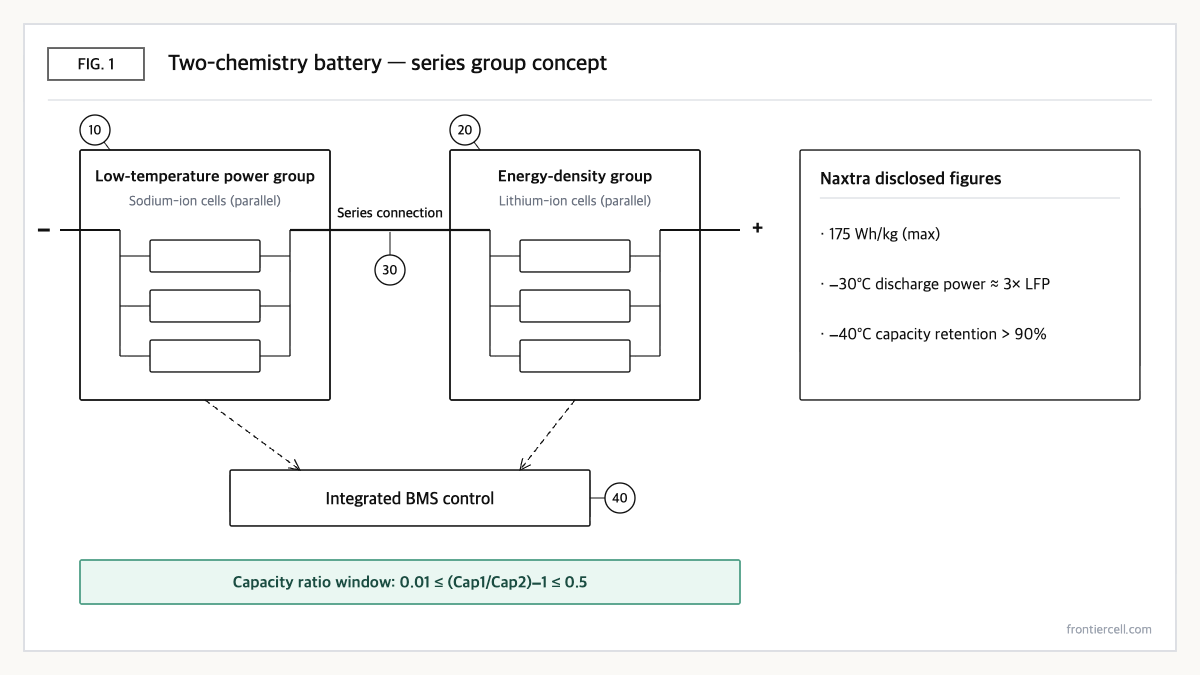
Source: reconstructed by the editorial team from CATL’s announcement[1] and the structure of claim 1 of US12113162B2[2]. Whether the Changan production car adopts this configuration has not been disclosed.
The reason for mixing two chemistries is clear. On cold days, sodium-ion backs up power; in normal conditions, lithium-ion supplies range. But tying cells with different voltage curves, capacities, and thermal properties into one string creates the problem of one side running empty or overheating first. So the core of a combined battery lies in the design window of “at what ratio must they be mixed so that one side isn’t dragged along by the other.”
3. Comparison — the sodium-ion figures CATL disclosed
| Item | Disclosed figure | Reference / conditions |
|---|---|---|
| Energy density | Up to 175 Wh/kg | Highest in mass production for sodium chemistry, per the company |
| Range | More than 400 km pure-electric | With CTP (Cell-to-Pack) system + BMS |
| Low-temperature discharge power | About 3× equivalent LFP | –30 °C |
| Low-temperature capacity retention | Over 90% | –40 °C |
| Low-temperature operation | Stable power delivery | Down to –50 °C |
| Safety tests | No smoke or fire, continues to provide power | Crushing, drilling, sawing |
| Projected range | 500–600 km pure-electric; 300–400 km range-extended/hybrid | Company projection as supply chain matures |
| R&D investment | Started 2016, nearly 10 billion RMB, nearly 300,000 test cells | Over 300 R&D personnel |
Source: reconstructed by the editorial team from CATL’s announcement[1]. All items are company-announced values, not third-party test results. The specifications of the reference “equivalent LFP” were not disclosed.
What this table shows: the centre of gravity of the disclosed figures is not energy density (175 Wh/kg) but power and capacity retention in the –30 to –50 °C range. In other words, this announcement reads as a signal that sodium-ion was positioned not as a replacement for lithium-ion but as a complement that takes on cold conditions.
4. The patent view — the rights attach not to “sodium” but to “the mixing ratio”
A case showing how a design that ties two chemistries into one battery was turned into rights is CATL’s US12113162B2, “Battery comprising first-type battery cell group and second-type battery cell group which are connected in series…”[2]. Current assignee Contemporary Amperex Technology (Hong Kong) Ltd; priority date 2020-04-30; filing date 2021-12-20; grant date 2024-10-08; status Active; adjusted expiration 2041-08-21; 12 claims.
| Claim 1 element (gist of original) | Design-around review point |
|---|---|
| (a) A first-type cell group and a second-type cell group connected in series; the first-type group is multiple cells in parallel, the second-type group is at least one cell in parallel | A configuration with groups in parallel, or separated by DC-DC, may fall outside the literal scope |
| (b) The two cells are of different chemical systems; the volume energy density of the first-type cell < that of the second-type cell | Not limited to “sodium” — covers chemistry combinations in general |
| (c) Group capacity Cap1 > Cap2, 0.01 ≤ (Cap1/Cap2) − 1 ≤ 0.5 | Design the capacity ratio below 1.01 or above 1.5 |
| (d) At least one of: specific heat ratio 0.9 ≤ C1/C2 ≤ 10 / heat conductivity coefficient ratio 0.5 ≤ λ1/λ2 ≤ 3 / plateau voltage V1 from 3.15 V±0.05 V to 4.75 V±0.05 V, V2 from 3.60 to 3.80 V±0.05 V / density ratio 0.6 ≤ ρ1/ρ2 ≤ 3 | “At least one” condition means meeting a single item suffices — the hardest element to design around |
Source: reconstructed by the editorial team from claim 1 of US12113162B2 on Google Patents[2]. Numerical ranges are transcribed as written in the original; no infringement determination for any product is made.
There are two insights to take from this patent. First, claim 1 does not use the word sodium-ion. The axis of the rights is not the material but a ratio window: “make the capacity of the lower-energy-density group 1–50% larger.” Second, (d) requires only one of four conditions to be met, so unless the physical properties of the two chemistries differ greatly, it is hard to step outside. As design-around scenarios, candidates for review are placing the capacity ratio outside the window, and operating the two chemistries not in series but in a parallel structure separated by power converters. The latter, however, brings component cost and efficiency loss with it. The announcement did not say whether the Changan production car actually mixes two chemistries, so there is no basis for linking this patent to that vehicle. Korean and European counterpart filings were not checked this time.
5. Limits and outlook
On the optimistic view, CATL supplies sodium-ion across Changan’s brands, and adoption widens alongside the battery-swap network, centred on cold regions[1].
There is also a counter-scenario. A low-temperature advantage generally pays off only on cold days. In markets with mild temperatures year-round, the cost of lower energy density may loom larger, and if lithium prices stay low the raw-material advantage is diluted too. That all disclosed figures are company-announced values is another reason to reserve judgement.
As a strategic alternative, review sodium-ion adoption not at the “cell level” but at the “combination level.” If the goal is not stand-alone adoption but a configuration mixed with lithium-ion, patents claiming combination ratios and thermal-property ratios are more likely than material patents to be the first obstacle.
Action to check (planning and IP staff): If you have a pack concept that ties cells of different chemistries in series, calculate the design’s group capacity ratio (Cap1/Cap2)−1 and its specific-heat, heat-conductivity-coefficient, and density ratios, and compare them with the numerical windows in claim 1 of US12113162B2.
Items requiring verification
- The model name of the Changan production car, its battery pack configuration (whether single-chemistry), and its sales start date were not confirmed in the announcement.
- The specifications and test conditions of the reference “equivalent LFP” were not disclosed.
- The desolvation-energy explanation is a commonly offered description of the principle, not a mechanism verified for the Naxtra product.
- Korean and European counterpart filings and the registration status of US12113162B2 were not checked.
Sources
- CATL, “CATL and CHANGAN Launch World’s First Mass-Production Sodium-Ion Passenger Vehicle,” 2026-02-05. Original
- Google Patents, US12113162B2, bibliographic data and claim 1 (verified against the original on 2026-09-23). Original
RELATED READING