Prussian blue analogues (PBAs) became sodium-ion cathode candidates thanks to cheap raw materials and simple synthesis, but water hiding inside the crystal keeps holding them back. This article summarizes where and how that water settles, and how the question of “which water must be removed” has been drawn as a line in patent claims.
① What’s the Topic
The quality of a PBA cathode is decided not by “how much water was removed” but by “which water was removed and which was left.” Zeolitic water, physically trapped in the crystal framework, and bound water, chemically bonded to metal, differ in behavior, removal temperature and patent significance[1].
Start with the industry situation. Sodium-ion batteries are drawing attention as low-cost batteries that use abundant sodium instead of lithium. When CATL announced its first-generation sodium-ion battery in July 2021, it used a Prussian white material as the cathode and stated a cell energy density of up to 160 Wh/kg, 80% charging in 15 minutes at room temperature and over 90% capacity retention at -20℃[4]. This means the PBA family has reached the stage of being discussed as the cathode for actual commercial cells.
The tension is crystal water. A review of sodium-ion cathode materials summarizes that PBAs offer low cost, convenient synthesis and excellent electrochemical properties but often have interstitial water content above 10% within the framework, leading to structural collapse and capacity fading[3]. The question this article answers is this: why is water in PBAs a problem, which water must be removed, and how has that baseline been secured as rights in patents?
② Basic Principle — A Jungle Gym Full of Empty Rooms and Uninvited Tenants
The crystal structure of a PBA is a three-dimensional lattice in which metal ions and cyanide (CN) bridges alternate. Picture a playground jungle gym. Steel pipes (metal–CN–metal bonds) run in every direction, leaving wide empty spaces between them. These empty spaces are the rooms through which sodium ions move in and out. Wide rooms and straight passages that let ions move easily are the strength of PBAs.
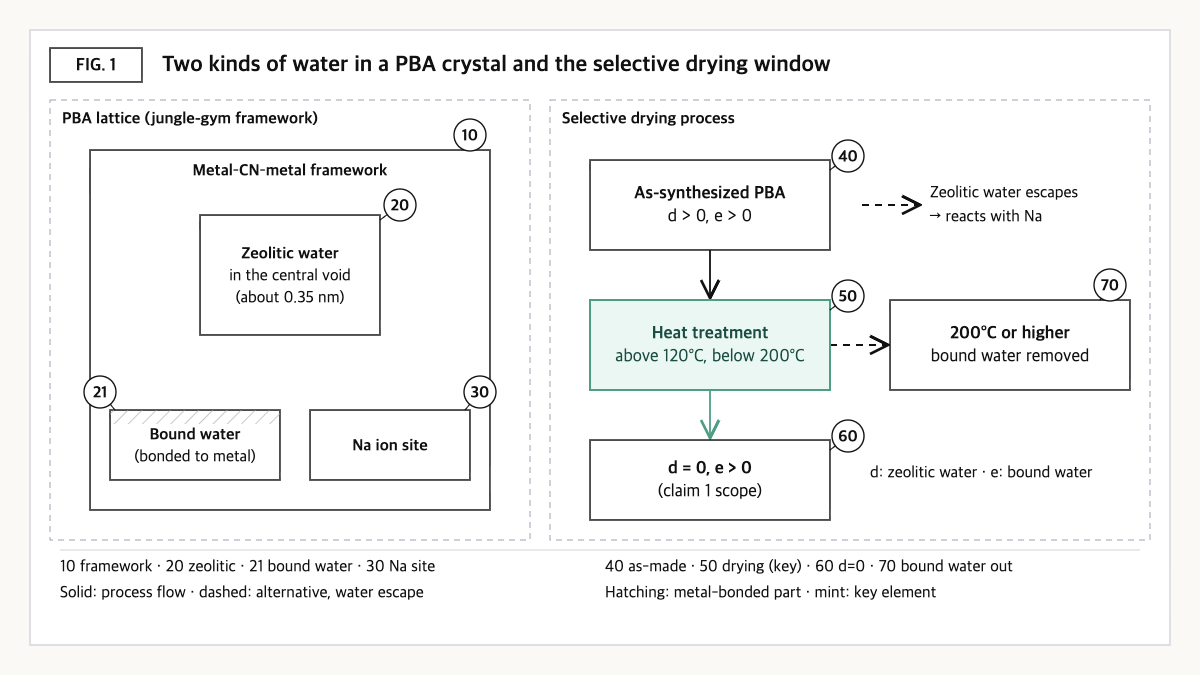
Source: reconstructed by the editorial team from the US9478798B2 specification on Google Patents.
The problem is that water molecules move into these rooms uninvited. Because PBAs are usually made by precipitation in water, water naturally enters the crystal during synthesis. Sharp’s patent specification divides this water into two types. Zeolitic water is water physically trapped in the roughly 0.35 nm empty space at the lattice center, and bound water is water chemically bonded to the metal in the crystal[1]. In jungle gym terms, zeolitic water is a guest sitting in the middle of the room, and bound water is a guest with hands tied to the steel pipes.
The troublemaker of the two is the guest in the middle of the room: zeolitic water. According to the specification, zeolitic water can freely escape into a non-aqueous electrolyte, and the escaped water reacts with sodium or decomposes at high voltage, quickly degrading battery performance[1]. Abnormal behavior with unstable charge/discharge curves is also recorded[1].
Then why not dry everything? The specification explains that heat treatment above 120℃ and below 200℃ can remove zeolitic water while leaving bound water, and that removing bound water requires 200℃ or more[1]. In other words, the method uses a temperature window to “remove only the bad water.” Indeed, in the specification’s example, a conventional sample showed a capacity of 135 mAh/g and a treated sample 150 mAh/g[1].
③ Comparison — Three Paths for Sodium-Ion Cathodes, with Weaknesses in Different Places
| Item | Layered oxide | Polyanion (NVP, Na3V2(PO4)3) | PBA (Prussian blue analogue) |
|---|---|---|---|
| Capacity | Theoretical about 240 mAh/g[3] | Theoretical about 117.6 mAh/g[3] | Patent example: conventional 135 → 150 mAh/g after zeolitic water removal[1] |
| Operating voltage | Qualitative comparison (no figure obtained in this article) | Plateau of about 3.4 V[3] | Qualitative comparison (no figure obtained in this article) |
| Energy density (material basis) | — | Theoretical about 400 Wh/kg[3] | Patent example: about 440 → about 540 Wh/kg[1] |
| Structural weakness | Cycling stability reduced by interlayer sliding and complex phase transitions[3] | Small volume change of 8.26% (a strength)[3] | Cases of interstitial water above 10%, structural collapse and capacity fading[3] |
| Commercial cell example | — | — | CATL first generation (Prussian white) cell up to 160 Wh/kg[4] |
Source: reconstructed by the editorial team from the US9478798B2 specification[1], the Nano-Micro Letters (2025) review[3] and the CATL announcement (2021)[4].
What this table shows: For the same PBA, whether zeolitic water was removed alone changed capacity from 135 to 150 mAh/g, a difference of about 11%[1]. If the weakness of layered oxides is “structural transitions” and that of polyanions is “low capacity,” the weakness of PBAs lies less in the material itself than in the “drying process.”
④ Patent Perspective — A One-Line Boundary: “Zero Zeolitic Water, Bound Water Retained”
The case that most directly secures rights over the crystal water problem is Sharp’s US9478798B2 (title: Prussian blue analogue electrodes without zeolitic water content). The original assignee is Sharp Laboratories of America Inc and the current assignee is Sharp Corp; the priority date is 2012-03-28, the filing date 2015-08-20, the grant date 2016-10-25, the legal status Active (anticipated expiration 2032-03-28), with 18 claims[1][2]. Numerous related applications sharing the 2012-03-28 priority are indicated[1].
| Elements of claim 1 (restated) | Meaning for the scope of rights |
|---|---|
| (a) A battery having a cathode composed primarily of hexacyanometallate (PBA) particles over a current collector | Battery (cell) claim — at the cell level, not a stand-alone material |
| (b) Particle composition AXM1MM2N(CN)Z·d[H2O]ZEO·e[H2O]BND; A is a Group 1A, 2A or 3A metal, M1 and M2 are 2+/3+ metals | A broad framework covering not only sodium but other alkali metals such as potassium |
| (c) X 0.5–2, M 0.5–1.5, N 0.5–1.5, Z 5–6 | Numerical ranges of composition ratios — including non-stoichiometric compositions |
| (d) Zeolitic water coefficient d = 0; bound water coefficient e greater than 0 and less than 8 | “Zero bad water, some good water present” — the distinction between the two waters is itself the core of the scope of rights |
| (e) A non-aqueous electrolyte and an anode | Aqueous electrolyte batteries are literally excluded |
Source: reconstructed by the editorial team from the bibliographic data and specification of US9478798B2 on Google Patents[1] and its granted claims[2] (original claim text and drawings are not reproduced).
What stands out in this claim is that (d) does not require “no water at all.” Zeolitic water must be zero, but bound water must be greater than zero. In other words, the scope of rights is tailored to “selectively dried PBA.”
Design-around scenario (counterargument). (i) A fully anhydrous PBA with all bound water removed (e = 0) may fall outside the “e > 0” requirement of (d). However, removing bound water requires 200℃ or more[1], which carries the technical cost of higher process temperatures, and the performance of a fully anhydrous state needs separate verification. (ii) A PBA with trace zeolitic water remaining (d > 0) literally does not satisfy (d).
(iii) Aqueous electrolyte batteries fall outside (e). There are counterarguments, too. The biggest issue is measurement. Distinguishing zeolitic from bound water in a finished electrode requires interpreting weight loss by temperature range with methods such as thermogravimetric analysis (TGA), and if the boundary temperature between the two waters shifts with composition and measurement conditions, both proof and disproof of “d = 0” could be unsettled. If the material reabsorbs moisture from air exposure after cell assembly, “d at which point in time” could also be disputed. In a freedom to operate (FTO) judgment, it is important to agree on the timing and method of measurement first.
Cross-check of similar patents. Sharp’s US9159502B2, which has the same priority date (2012-03-28), claims a supercapacitor combining dried hexacyanometallate particles with an activated carbon anode and is shown as Active (anticipated expiration 2032-10-13)[5]. This suggests the same applicant may have secured rights to dried PBA materials across several cell formats.
⑤ Limits and Outlook
Optimistic outlook. PBAs are simple to synthesize and low in cost[3], and a major cell maker has made a commercial announcement[4], so if the drying process is stabilized, they could expand their position in low-cost ESS and low-temperature applications.
Opposing scenario. Selective drying has a narrow process window. Only zeolitic water must be removed between 120 and 200℃[1], and controls to prevent moisture reabsorption during subsequent electrode and cell processes may also be needed. If these control costs grow, the raw material cost advantage could be offset, and demand could shift to polyanion materials, whose moisture control is relatively easier.
Strategic alternative. Manage PBAs not as a material spec but as a “process spec that includes drying history.” Specifying measurement methods and tolerances for zeolitic and bound water in supply contracts can manage quality and patent risk at the same time. Reduced to one line, this article’s view is that in PBAs, “water” is both a quality variable and a numerical limitation in a claim, and changing the drying recipe means moving in and out of the scope of rights.
Action to check (planning/IP teams): Obtain the moisture loss by temperature range from the TGA data of the PBA cathode material under evaluation, confirm with the supplier the criteria used to distinguish zeolitic from bound water, compare against (d) of US9478798B2 claim 1, and overlay the anticipated expiration date (2032-03-28) on the product launch schedule.
Items Requiring Verification
- The average operating voltages of layered oxides and PBAs were left as qualitative comparisons because this article could not obtain sourced figures.
- The exact composition of CATL’s first-generation sodium-ion cathode and whether it is combined with layered oxides were not confirmed in the announcement.
- The energy densities in the US9478798B2 specification (about 440 and 540 Wh/kg) read as material-basis values, but their calculation basis (counter electrode, voltage range) was not verified in detail.
- The specification’s detailed explanation of why bound water is retained (structural stability, etc.) was not verified in this article.
- Whether US9478798B2 has Korean or Chinese counterparts and the individual content of the 26 related applications were not verified.
- Because the full claims section of US9478798B2 did not load on the Google Patents page, the claim 1 text was supplemented with the granted claims on Justia.
Sources
- Google Patents, US9478798B2 “Prussian blue analogue electrodes without zeolitic water content,” bibliographic data and specification (original checked 2026-09-23). Link
- Justia Patents, U.S. Patent 9,478,798 granted claims (checked 2026-09-23). Link
- Hu, J. et al., “Optimization Strategies of Na3V2(PO4)3 Cathode Materials for Sodium-Ion Batteries,” Nano-Micro Letters 17, 33, 2025. Link
- CATL, “CATL Unveils Its Latest Breakthrough Technology by Releasing Its First Generation of Sodium-ion Batteries,” 2021-07-29. Link
- Google Patents, US9159502B2 “Supercapacitor with hexacyanometallate cathode, activated carbon anode, and non-aqueous electrolyte” (checked 2026-09-23). Link
This article is a technology and patent trend commentary, not legal advice. Specific FTO judgments require professional review.
Related Reading