This article was written on 2026-09-23 and backdated to the date of the event (2025-11-27). Patent bibliographic data and claims were verified against the original on Google Patents on the writing date.
1. What’s the news
Nuri’s fourth launch, lifting off at 01:13 on 27 November 2025, placed 13 satellites into a 600 km orbit, and the primary payload, CAS500-3 (Compact Advanced Satellite 500-3), made first contact with the King Sejong Antarctic Station at 01:55 — 42 minutes after launch. What kept the satellite alive during those 42 minutes is the starting point of this article.
Here is the industry context. Nuri’s fourth flight was the first night launch of a Korean launch vehicle, carrying one primary satellite (516 kg) and 12 CubeSats[1][2]. The early-morning launch time was reported to follow from the orbital conditions required by the aurora imager (ROKITS) aboard CAS500-3[3]. The tension is power. Right after launch, a satellite reaches orbit with its solar panels folded, and it cannot generate its own electricity until deployment and attitude stabilisation are complete. CubeSats add volume and mass constraints on top of that.
The question this article answers is this: where is the first gate of satellite power, and why does the design that gets through it move into patent territory the smaller the satellite gets?
2. The underlying principle — a satellite that has just reached orbit is a phone without a charger
A satellite’s electrical power system (EPS) stores electricity generated by the solar panels in a battery and distributes it at bus voltage. In normal operation, the solar cells carry the load on the sunlit side and the battery carries it through the Earth’s shadow (eclipse). From launch through the launch and early orbit phase (LEOP), however, the order is different. The solar panels are folded inside the fairing, and just after separation the attitude is not pointed at the sun. By analogy, it is a phone boarding a plane without a charger, running on battery alone until it finds a socket after landing.
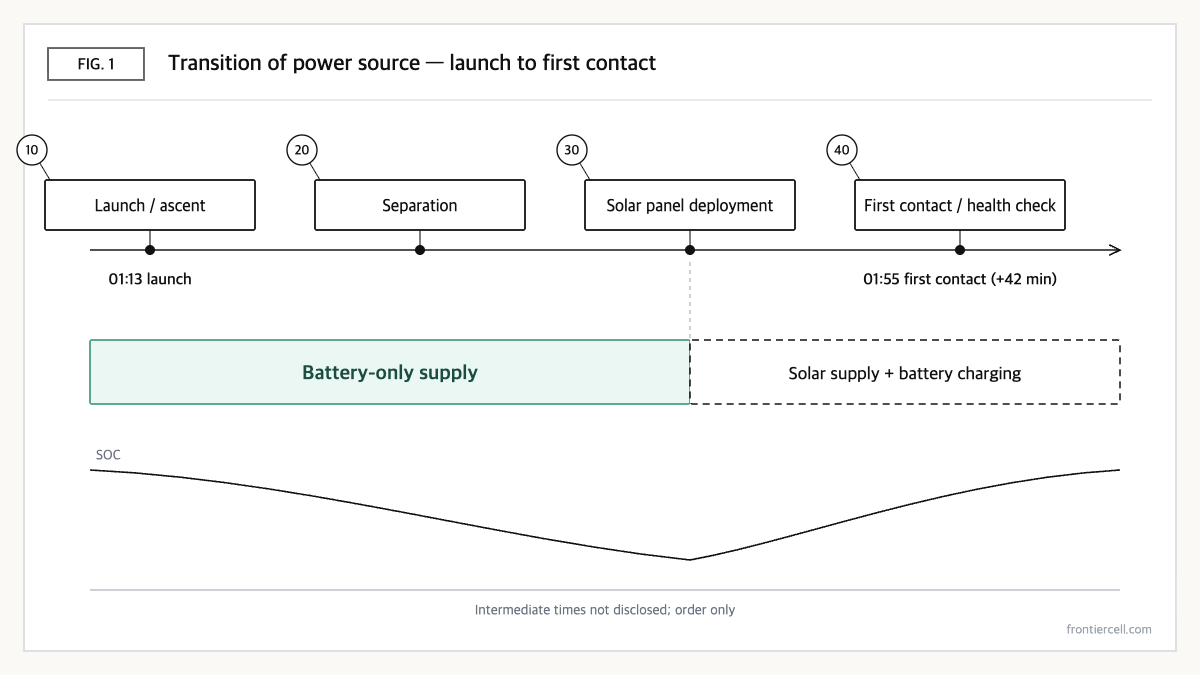
Source: reconstructed by the editorial team from the times in reports of the Korea AeroSpace Administration’s announcement[1][2] and the general operating sequence of satellite power systems.
So the core of early-operations design lies less in battery capacity itself than in how short and predictable the time the battery must hold out alone can be made. If the deployment sequence slips or attitude stabilisation takes longer, the battery’s depth of discharge grows accordingly. For CAS500-3, the Korea AeroSpace Administration confirmed at first contact that the satellite’s condition, including solar panel deployment, was good, and said the satellite would carry out its mission for one year after about two months of initial operations[1].
3. Comparison — initial contact status of the 13 satellites on launch day
| Item | Disclosed specification / status | As of (per reports) |
|---|---|---|
| Primary payload CAS500-3 | Mass 516 kg, 600 km sun-synchronous orbit, solar panel deployment confirmed. First contact at 01:55 via King Sejong Station; additional contact at 02:48 via KARI ground station in Daejeon | As of 13:00, 2025-11-27[1] |
| CAS500-3 payloads | Bio 3D-printing stem cell differentiation culture verification (BioCabinet), space plasma and magnetic field instrument (IAMMAP), wide-field airglow imager (ROKITS) | 2025-11-27[1] |
| 12 secondary CubeSats | 5 in contact (ETRISat, JACK-003 and 004, INHA-RoSAT, K-HERO); 7 still attempting contact | As of 13:00, 2025-11-27[1] |
| Operations plan | About two months of initial operations, then a one-year mission, about 15 orbits per day | 2025-11-27[1] |
Source: reconstructed by the editorial team from ZDNet Korea and Seoul Shinmun reports[1][2]. Figures are as reported from the Korea AeroSpace Administration’s announcement and are not third-party verified.
What this table shows: even on the same launch vehicle, the timing of “first contact” differed by satellite. As the Korea AeroSpace Administration explained, secondary satellites each communicate through their own institution’s ground station, so a timing gap is not in itself a warning sign[1]; but because the time before first contact is time the battery holds out alone, the smaller the satellite, the tighter its power-margin design becomes.
4. The patent view — put a battery on the back of a solar cell and the rights attach to the path of heat
The power system of a small satellite is generally described as a separated architecture, with the solar panels and battery kept apart. A case showing where the scope of rights is drawn when the two are merged into one panel is Roccor LLC’s US11670955B2, “Integrated power module devices, systems, and methods”[4].
| Claim 1 element (gist of original) | Separated power system (reference) | Correspondence |
|---|---|---|
| (a) One or more integrated power modules | Solar panel and battery pack are separate components | Not applicable |
| (b) One or more solar cells in each module | Present on the solar panel | Partial |
| (c) One or more rechargeable energy storage cells coupled to the solar cells | Battery connected remotely by harness | Depends on interpretation |
| (d) At least one circuit coupling the solar cells and storage cells includes thermal control circuits configured to conduct heat from the solar cells to the storage cells and to avoid losing heat through heat conducting back to the solar cells | Heat path not deliberately designed | No |
Source: reconstructed by the editorial team from claim 1 of US11670955B2 on Google Patents[4]. The reference is a generic configuration, not a specific satellite, and no infringement determination for any product is made.
The bibliographic data are as follows. Current assignee Roccor LLC; priority date 2017-05-11; filing date 2019-11-11; grant date 2023-06-06; status Active; adjusted expiration 2039-06-23; 26 claims[4]. Claim 2 further limits the storage cells to being coupled to the back side of the solar cells, and claims 3 and 4 add series and parallel coupling between modules.
The insight to take from this patent is that the axis of the rights is not “they were stuck on one panel” but “which direction the heat was made to flow”. In orbit, solar cells run hot while keeping the battery at a suitable temperature is a challenge, so a configuration that uses solar-cell heat to keep the battery warm while blocking backflow was written into claim 1 as an essential element.
As design-around scenarios, candidates for review are (1) a configuration that thermally isolates the solar cells from the storage cells and keeps the battery warm with a separate heater, and (2) a configuration that allows heat conduction but has no directionality (no backflow blocking). However, results may vary with how broadly “thermal control circuits” is construed, so actual non-infringement requires review of each specific embodiment. The existence of Korean or European counterpart filings was not checked this time.
5. Limits and outlook
On the optimistic view, Nuri continues with its fifth and sixth launches, giving Korean CubeSats more opportunities for on-orbit verification[1], and power-system integration widens the usable volume of small satellites.
There is also a counter-scenario. Integrated power modules make fault isolation harder. When solar cells and battery are bound into one panel, damage to one side is more likely to spread to the other, and the cost of verifying heat paths in ground testing rises with it. For early satellites with limited opportunities for on-orbit verification, choosing a proven separated configuration may be the more reasonable path.
As a strategic alternative, review power-system design not as “integrated or separated” but as “where the heat path is cut”. A design document that states where the heat path is interrupted becomes the object of comparison in an FTO review and the reference point for claims in any future in-house filing.
Action to check (planning and IP staff): On the power-module drawings of satellites or high-altitude equipment under development, mark the heat-transfer path (contact, thermal interface material, brackets) between the solar cells and battery, and check whether that path is designed as “one-way conduction.” If so, put claim 1 of US11670955B2 on the FTO review list.
Items requiring verification
- The detailed times from separation to completion of solar panel deployment and the battery specifications of CAS500-3 were not confirmed in public sources.
- The power-system configurations of the CubeSats aboard Nuri’s fourth launch were not checked, and the patent comparison in the text does not suggest infringement by any specific satellite.
- Whether US11670955B2 has Korean, European, or Japanese counterpart filings was not checked.
Sources
- ZDNet Korea, “CAS500-3 deploys solar panels… all functions normal” (in Korean), 2025-11-27. Article link
- Seoul Shinmun, “CAS500-3 signal of life confirmed [Nuri 4th launch]” (in Korean), 2025-11-27. Article link
- Kyunghyang Shinmun, “Why Nuri made its first night launch… the reason is ‘aurora observation’” (in Korean), 2025-11-27. Article link
- Google Patents, US11670955B2, “Integrated power module devices, systems, and methods,” bibliographic data and claim 1 (verified against the original on 2026-09-23). Original
RELATED READING