Competition among solid electrolytes for all-solid-state batteries is often described as a two-way race between sulfides and oxides. Between them, halide solid electrolytes centered on chlorides are carving out a distinctive position as “electrolytes that are strong on the cathode side.” This article summarizes the physical basis of that position and its patent landscape.
① What’s the Topic
Halide solid electrolytes are more accurately read not as candidates to replace sulfides, but as division-of-labor candidates that take on the “high-voltage cathode interface” where sulfides are weak. The representative composition Li3YCl6 has a reported oxidation stability up to about 4.21 V, whereas the stability window of sulfides is summarized at about 2.5 V[1].
In the industry, all-solid-state battery development is led by sulfides, which have the highest ionic conductivity. The sulfide Li10GeP2S12 (LGPS) drew attention with a room-temperature ionic conductivity of 12 mS/cm, on par with liquid electrolytes[2]. The garnet-type oxide LLZO (Li7La3Zr2O12) has a room-temperature ionic conductivity of about 10–3 S/cm and high chemical stability toward lithium metal, but carries sintering temperatures usually above 1,200℃ and interfacial contact problems[3].
The tension is that each camp’s weaknesses lie in different places. Sulfides can release hydrogen sulfide (H2S) on contact with moisture and are weak at high voltage. Oxides are hard, making it difficult to bond particles together. Since a 2018 report by Asano et al. raised the room-temperature ionic conductivity of halides to 1.7 mS/cm[1], the question has been whether halides can move into this gap. The question this article answers is this: what role, exactly, can halides take between sulfides and oxides, and how are their compositions divided in patent terms?
② Basic Principle — A Wall Built from Soft Clay
A solid electrolyte is a solid wall that lets only lithium ions pass. For this wall to work well, three things are needed. Ions must pass quickly (ionic conductivity), the wall must not decompose when it touches the cathode and anode (electrochemical stability), and it must make gap-free contact with active material particles (formability).
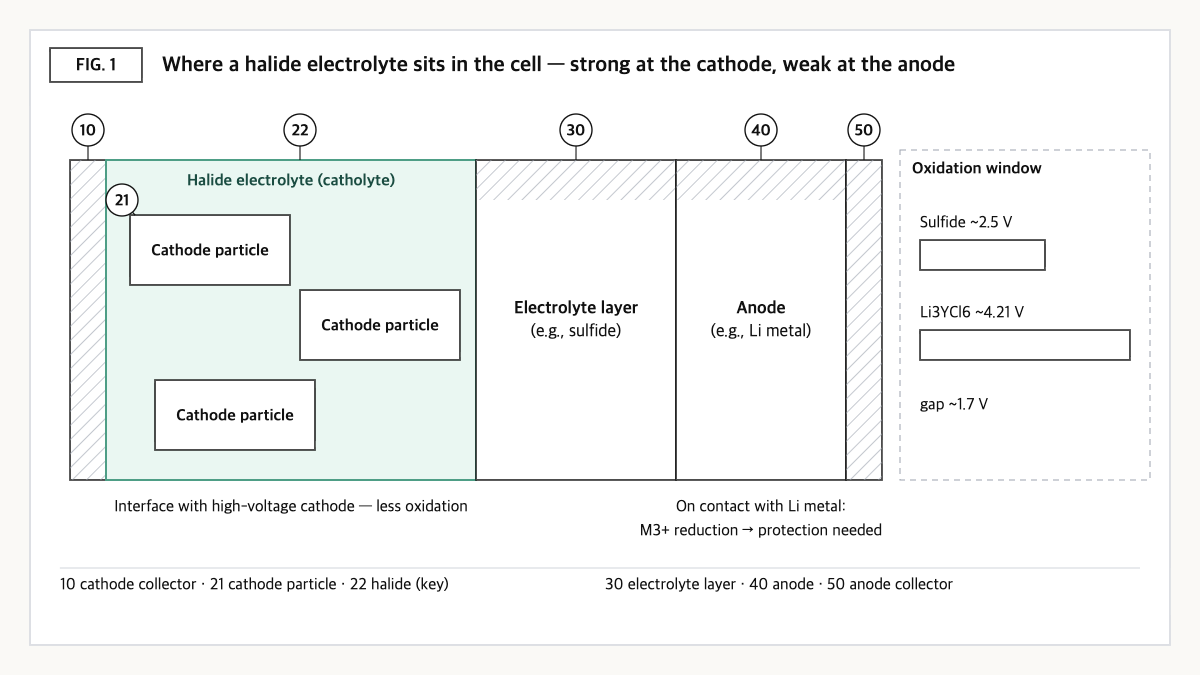
Source: reconstructed by the editorial team from the Chemical Science (2023) review and US11784345B2 on Google Patents.
In wall terms, oxides are hard bricks. They are sturdy, but filling the gaps requires firing them together in a kiln (high-temperature sintering). Sulfides are soft earth that is easy to press together, but when wet with rain (moisture) they give off a smelly gas (H2S) and are weak under hot sun (high voltage). Halides are closer to clay in between. Halide anions are summarized as having weaker bonds, softer lattices and higher anionic polarizability than oxides and sulfides, giving good mechanical deformability[1]. This means they are easy to press into the spaces between particles.
Halides are strong at high voltage because halogen anions such as chlorine do not easily give up electrons. As a result, they undergo less oxidative decomposition even in contact with 4 V-class cathodes[1]. Their weakness, conversely, is on the anode side. Trivalent metal cations in halides, such as yttrium and indium, are easily reduced to the metallic state on contact with lithium metal, creating a mixed ionic-electronic conducting interphase through which side reactions can continue[1]. In other words, halides suit the “cathode-side wall” but need a protective layer to serve as the “anode-side wall.”
Moisture sensitivity also differs by composition. Indium-based Li3InCl6 showed reversible behavior, recovering about 92% of its ionic conductivity by vacuum heating after hydration, whereas yttrium-based Li3YCl6 retained only 0.8% after the same treatment, degrading essentially irreversibly, according to one report[1]. Note that the advantage of “no H2S” does not by itself mean “moisture-resistant.”
③ Comparison — The Three Camps’ Strengths and Weaknesses Lie on Different Axes
| Item | Sulfide | Oxide (garnet LLZO) | Halide (chloride-centered) |
|---|---|---|---|
| Room-temperature ionic conductivity | LGPS 12 mS/cm[2] | About 10–3 S/cm (about 1 mS/cm)[3] | Li3YCl6 0.51, Li2ZrCl6 0.81, Li3YBr6 1.7, Li3InCl6 2.04, Li3ScCl6 3.02 mS/cm[1] |
| Oxidation stability | Stability window about 2.5 V[1] | High chemical stability toward cathode materials[3] | Li3YCl6 up to about 4.21 V[1] |
| Relationship with lithium metal | Qualitative comparison: interfacial decomposition possible (no numerical source) | High chemical stability, but high resistance from poor interfacial contact[3] | Trivalent metal cations reduced, forming a mixed conducting interphase[1] |
| Moisture / air | Concern of H2S generation[4] | Qualitative comparison: relatively stable | No H2S[4]; Y-based irreversible degradation, In-based reversible recovery[1] |
| Forming / processing | Qualitative comparison: soft, favorable for pressure forming | Sintering usually above 1,200℃[3] | Excellent mechanical deformability from a soft lattice[1] |
Source: reconstructed by the editorial team from the Chemical Science (2023) review[1], Nature Materials (2011)[2], Inorganics (2026)[3] and the US11784345B2 specification[4].
What this table shows: Sulfides (12 mS/cm) still hold the top ionic conductivity, but in oxidation stability halides (about 4.21 V) have a window roughly 1.7 V wider than sulfides (about 2.5 V). The competitiveness of halides lies not in being “the fastest electrolyte” but in being “the electrolyte that holds up next to a high-voltage cathode.”
④ Patent Perspective — Keeping Yttrium and What You Mix In Divides the Scope of Rights
Most halide solid electrolyte patents are composition claims. In composition claims, “which element was substituted, and by how much” becomes the boundary of the scope of rights. As a representative case, consider Panasonic’s US11784345B2 (title: Solid electrolyte material and battery). The applicant and current assignee is Panasonic Intellectual Property Management Co Ltd; the priority date is 2018-01-05, the filing date 2020-06-27, the grant date 2023-10-10, the legal status Active (anticipated expiration 2039-06-25), with 15 claims[4]. Family members identified include WO2019135320A1, JP7417925B2, CN111448619B and EP3736829A4[4].
| Elements of claim 1 (restated) | Meaning for the scope of rights |
|---|---|
| (a) A solid electrolyte material represented by the composition formula Li3–3δY1+δ–aMaCl6–x–yBrxIy | Composition claim on a lithium–yttrium–halogen framework |
| (b) M is one or more of Al, Sc, Ga and Bi | Substituting elements closed to four options |
| (c) –1<δ<1, 0<a<2, 0<(1+δ–a) | Both yttrium and the substituting element M must be greater than zero — unsubstituted Li3YCl6 and yttrium-free systems are literally excluded |
| (d) 0≤x≤6, 0≤y≤6, (x+y)<6 | Some chlorine must remain — pure bromides and iodides are excluded |
| (e) Ionic conductivity at room temperature of not less than 1×10⁻⁵ S/cm and not more than 3.0×10⁻³ S/cm | Property limitation — even with the same composition, a measured conductivity outside this range may fall outside the literal scope; measurement conditions may become an issue |
Source: reconstructed by the editorial team from the bibliographic data and claims of US11784345B2 on Google Patents[4] (original claim text and drawings are not reproduced).
The specification cites Li3YCl6 and Li3YBr6 as compounds known from prior literature and claims improvements by partially substituting Al, Sc, Ga or Bi[4]. As examples, it presents an ionic conductivity at 22℃ of 6.3×10⁻⁴ S/cm for Li3Y0.95Bi0.05Cl6 and 1.3×10⁻³ S/cm for a mixed-halide composition, and states that synthesis was carried out in a dry atmosphere with a dew point of –90℃ or lower[4]. Not generating hydrogen sulfide in air is also an emphasis of the specification[4].
Design-around scenario (counterargument). (i) Systems that do not use yttrium, such as zirconium-based Li2ZrCl6 or indium-based Li3InCl6, fall outside the “yttrium amount > 0” requirement of (c) and are likely outside the literal scope of this claim. (ii) Another route is to choose substituting elements outside the four in (b). (iii) Compositions using only bromine and iodine without chlorine also fall outside (d). There are counterarguments, too. Avoiding this one patent does not secure freedom to operate (FTO). The same applicant is likely to have filed several applications with other substituting elements and other frameworks, and indium- and zirconium-based systems may have separate rights holders. Whether an element present at impurity levels counts as “M” could also be disputed in connection with analytical limits.
Cross-check of similar patents. This article verified only the same family (WO2019135320A1, CN111448619B, etc.). Patents on zirconium- and indium-based halides and on halide–sulfide bilayer cell structures require a separate search.
⑤ Limits and Outlook
Optimistic outlook. Halides combine high oxidation stability with good deformability[1], so they may be adopted as electrolytes mixed with high-voltage cathodes in composite cathodes (catholytes). In that case, a division-of-labor structure that compensates for the weaknesses of sulfides could emerge.
Opposing scenario. Elements such as yttrium, indium and scandium could be a burden in terms of cost and supply, and the review also notes that zirconium is more abundant in the Earth’s crust than other rare earth elements, giving it a cost advantage[1]. There are also reports of large irreversible degradation of yttrium-based materials after moisture exposure[1], so dry-room costs may not fall much compared with sulfides. Because of reduction instability on the anode side, building an entire cell from halides is difficult.
Strategic alternative. One approach is to evaluate halides not as “the electrolyte for the whole cell” but as “a material dedicated to the cathode interface,” with lower-cost zirconium-based systems as the first candidates. Reduced to one line, this article’s view is that the rights map for halide solid electrolytes is drawn as coordinates on the periodic table — “which central metal, mixed with what” — and that designing around it is the work of moving those coordinates.
Action to check (planning/IP teams): Organize the composition of the halide electrolyte under evaluation into three coordinates — “central metal (Y, In, Zr, Sc, etc.), substituting element and amount, and halogen ratio” — plug them into (b), (c) and (d) of US11784345B2 claim 1, and run additional searches by applicant name on KIPRIS and Google Patents for the same applicant’s other halide families.
Items Requiring Verification
- The lithium metal interfacial stability and formability of sulfides, and the moisture stability of oxides, were left as qualitative comparisons because this article could not obtain sourced figures.
- Raw material prices for yttrium, indium, scandium and zirconium were not verified.
- Panasonic’s other halide patent families and the rights-holder landscape for zirconium- and indium-based halides were not searched.
- Whether US11784345B2 has a Korean counterpart application was not verified.
Sources
- Tao, B. et al., “Halide solid-state electrolytes for all-solid-state lithium batteries: structural design, synthesis, environmental stability, interface optimization and challenges,” Chemical Science, 2023. Link
- Kamaya, N. et al., “A lithium superionic conductor,” Nature Materials, 2011. Link
- Wang, P. et al., “Research Progress and Prospect of Solid Electrolyte Garnet-Type Li7La3Zr2O12,” Inorganics 14(6), 148, 2026. Link
- Google Patents, US11784345B2 “Solid electrolyte material and battery,” bibliographic data, claim 1 and specification (original checked 2026-09-23). Link · Granted claims: Justia
This article is a technology and patent trend commentary, not legal advice. Specific FTO judgments require professional review.
Related Reading
- The Three-Way Fight Over Solid-State Battery Electrolytes — Why Samsung SDI Is Betting on Sulfide
- Electrolyte, From Liquid to Solid — The Safety-vs-Interfacial-Resistance Tradeoff
- In-Depth Analysis of Samsung SDI’s Sulfide-Based Solid Electrolyte Patent (US11955601B2) — the Narrow but Solid Fence of the ‘XRD Peak Ratio’