At InterBattery in March 2026, Samsung SDI officially stated that it holds approximately 1,100 patents related to all-solid-state batteries. The number alone looks overwhelming, but from the standpoint of handling patent strategy, examining “how broad the scope of claims of one representative patent actually is” gives more practical information than “how many patents it has.”
① What’s the Story
To summarize the industry situation, sulfide-based solid electrolytes — the key material for all-solid-state batteries — are converging to a considerable degree on the argyrodite-type crystal structure (a specific crystalline arrangement composed of lithium, phosphorus, sulfur, and a halogen). This is where the problem begins. Once chemical compositions converge to a similar degree, patent disputes among competitors become a fight not over “what was made” but over “how it was defined.” This article breaks down, claim by claim, Samsung SDI’s representative sulfide-based electrolyte patent, US11955601B2, and examines what room this narrow definition leaves later entrants for design-arounds.
② Basic Principle
To understand this patent, one must first know why “impurities” become a problem in the argyrodite structure. As an analogy, the solid electrolyte through which ions travel is like a well-organized, lattice-shaped road network. If the roads are cut through regularly, ions (the vehicles) pass through quickly, but if a byproduct such as lithium sulfide (Li2S) is left behind like a pile of dirt in the middle of the road during synthesis, congestion occurs in that section. This congestion is exactly what shows up as a drop in ionic conductivity.
Source: reconstructed by the editorial team from the claims of US11955601B2
X-ray diffraction (XRD) analysis is the method used to check the state of this road network. When X-rays are fired at a crystal structure, reflected waves bounce back at specific angles (2θ), and comparing their intensity (peak intensity) lets one estimate how much of which substance is mixed in. Samsung SDI’s patent specifies that the relative intensity of impurity-related peaks appearing near 29° and 27.1°, relative to the argyrodite’s own peak appearing at 30°, must each be suppressed to 0.06 or below. In other words, it pins the scope of claims down to only “a road with almost no piles of dirt.”
③ Comparison: Three Patents Related to Argyrodite Sulfide-Based Solid Electrolytes
| Category | US11955601B2 (Samsung SDI / Sejong University) | KR20250018801A (POSCO JK Solid Solution) | KR20190007028A (Prior-Art Candidate) |
|---|---|---|---|
| Core claim axis | Impurity-phase suppression (XRD peak-intensity-ratio condition, ≤0.06) | Improved air/moisture stability | Non-argyrodite coating applied to argyrodite crystals |
| Problem addressed | Eliminating the cause of ionic-conductivity decline | Reducing process cost and moisture reactivity | Improving interface stability (via coating) |
| Filing (priority) date | 2020-08-31 | Confirmation needed | Confirmation needed |
| Status | Granted (2024-04-09) | Published (grant status requires confirmation) | Confirmation needed |
| Design-around implication | A synthesis process falling outside the XRD condition may avoid literal infringement | Approaches a different technical problem (moisture stability), so the claim axis differs | May be distinguishable by the separate claim element of coating |
Source: compiled by the editorial team from US11955601B2, KR20250018801A and KR20190007028A (Google Patents public records)
What This Table Tells Us: All three patents fall under the same broad chemical umbrella of “argyrodite-type sulfide-based,” but the point each claim actually protects (impurity suppression vs. moisture stability vs. coating) differs. This shows that, even under a single higher-level concept, multiple co-existing scopes of claims can exist depending on how the claims are designed.
④ Patent Perspective
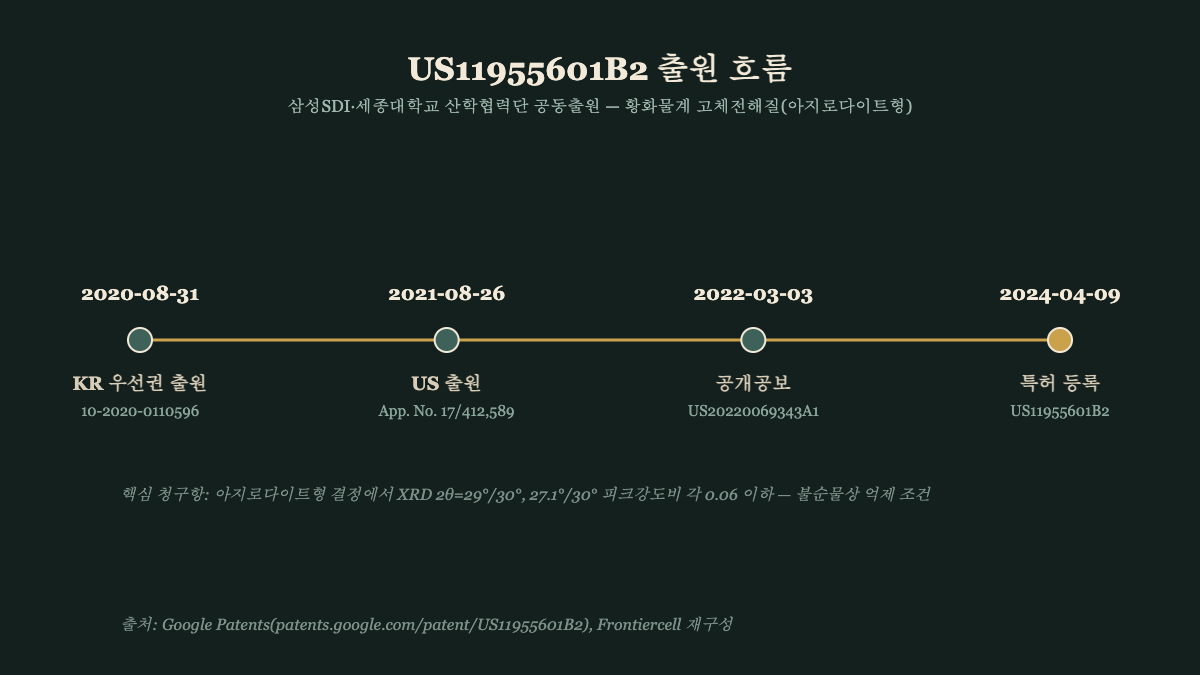
Claim Summary: The independent claim of US11955601B2 (applicant: Samsung SDI / Sejong University Industry-Academic Cooperation Foundation; U.S. application number 17/412,589; Korean priority application 10-2020-0110596) is a sulfide-based solid electrolyte with an argyrodite-type crystal structure containing lithium, phosphorus, sulfur, and a halogen (X), and it sets as its claim elements that the peak-intensity ratio at 2θ = 29±0.1° to 30±0.1°, and the peak-intensity ratio at 2θ = 27.1±0.1° to 30±0.1°, in XRD analysis, must each be 0.06 or below. This is a method of using a physical-property indicator of the resulting product (how it turned out) rather than the composition (what was put in) as the limiting element of the claim.
Filing History: This patent was first filed with the Korean Intellectual Property Office in August 2020, then filed in the United States in August 2021 claiming priority from it, published as publication US20220069343A1 in March 2022, and formally granted in April 2024. Reaching grant took about two years and seven months, which suggests that a property-based claim may have been required, during examination, to submit considerable experimental data (such as XRD data) to demonstrate novelty and inventive step over the prior art. This patent did not start as a Samsung SDI sole application but as a joint application with Sejong University’s Industry-Academic Cooperation Foundation, and interestingly, in a separately filed patent with a similar title, US12341154B2 (application 17/856,008, priority date 2021-07-02, granted 2025-06-24), Sejong University’s share was fully assigned to Samsung SDI in May 2025, so ownership is now consolidated solely in Samsung SDI.
Design-Around Scenario (Counterargument): The fact that this patent’s claim hinges on a “quantitative threshold” of crystal purity paradoxically leaves room for design-arounds. First, even with the same lithium-phosphorus-sulfur-halogen composition, if the synthesis process (ball-milling conditions, calcination temperature and time, etc.) is adjusted to obtain a crystal whose XRD peak-intensity ratio exceeds 0.06, there is a possibility of falling outside a finding of literal infringement (infringement that satisfies the claim wording exactly), even though ionic conductivity would be somewhat lower.
Second, if the claim axis is designed, from the start, around “moisture stability” rather than “purity” — as with POSCO JK Solid Solution’s KR20250018801A — there is room for the competitive relationship to ease even when considering the doctrine of equivalents (the legal principle that infringement can be found where the wording differs but the function and effect are substantially the same). However, both of these scenarios remain hypotheses that can only be resolved by obtaining actual products’ XRD data and preparing a claim chart, and whether the doctrine of equivalents applies can vary by each country’s examination standards and case law, so this article alone cannot make a definitive determination.
Cross-Check Against Similar Patents: Placing KR20190007028A (a prior-art candidate involving argyrodite crystals with a non-argyrodite coating applied) side by side with the Samsung SDI patent, the two patents share a similar goal of “impurity suppression” but differ in approach (coating vs. controlling synthesis conditions), so it appears difficult for the former to directly negate the novelty of the latter as prior art. However, this is only a preliminary judgment based on search results, and a proper FTO review would require re-confirming the applicant and the full claim text against the original documents on KIPRIS and USPTO.
⑤ Limitations and Outlook
The optimistic outlook is that Samsung SDI has built a fairly strongly defended patent fence within the argyrodite family through a precise claim design based on a “physical-property indicator” rather than “composition.” But the opposing scenario must also be considered. A property-based claim is, by the same token that makes it strongly defensive, also difficult to prove and to assess for design-arounds, so if an actual dispute arises, there is structurally significant room for a competitor to contest non-infringement by arguing that its own product’s XRD data falls outside this threshold. In other words, the fact that a company has “many” patents and the fact that “infringement is easy to establish” are separate matters, and even a granted patent cannot guarantee a 100% chance of winning an actual dispute.
As a strategic alternative, rather than looking at this single patent alone, it is more effective to map it together with Samsung SDI’s roughly 1,100 adjacent patents (covering coating, electrode-electrolyte interfaces, stacking processes, and so on) and approach the situation in terms of “portfolio density.” Even where a possibility of designing around one individual claim exists, avoiding all of the adjacent patents as well is far more difficult.
Action Item for Planning and IP Staff: If you are developing a sulfide-based solid electrolyte in-house, or plan to source one, it is recommended that you obtain that material’s XRD data (the 29°/30° and 27.1°/30° peak-intensity ratios) and prepare a preliminary claim chart comparing it against US11955601B2’s claim thresholds. This is not a procedure for confirming grant prospects or infringement, but should be used as a first-pass screening step to gauge the scale of risk ahead of a formal FTO review.