The expected expiry date of US7588623B2, the U.S. patent covering the manufacture of stabilized lithium metal powder (SLMP), is November 25, 2026. That means one of the oldest rights underpinning pre-lithiation technology is about to come off patent. Reading this as “pre-lithiation can now be used freely,” however, is dangerous. The real line of defense has shifted from the material itself to process conditions, and those rights remain in force from 2034 through 2038.
1. What’s the Story — A Laboratory Term Enters the Production Line’s Process Sheet
Let’s start with the state of the industry. In August 2026, the configuration of a solid-state pilot line operated by the Institute of Physics, Chinese Academy of Sciences (IOP CAS) in Suzhou was disclosed. The line, targeting 0.2 GWh on a cell basis, groups electrode integration, ion-conductive membrane, pre-lithiation, thermal lamination, and pressurized stacking into five core processes. The same week brought news that equipment maker Liyuanheng (利元亨) had won and passed acceptance inspection for a solid-state pilot line for a top-tier customer.
This is where the tension arises. Pre-lithiation has appeared steadily in papers and patents since the mid-2000s, but it has rarely made it onto the process list of an actual mass-production line. It had been classified as a “technology we know is good but can’t use” because of safety and cost concerns. Now, however, as the share of silicon-based anodes rises and solid-state pilot lines become real, this process has suddenly started showing up as a line item on quotes.
So this article sets out to answer one question: what patent landscape does a company entering pre-lithiation today actually face? And how valid, in practice, is the commonly cited justification of “the foundational patent has expired”?
2. Basic Principle — Pre-Filling the Lithium That Disappears on the First Charge
When a lithium-ion cell is charged for the first time, a thin protective layer called the SEI (Solid Electrolyte Interphase) forms on the anode surface. This layer is essential to the cell’s lifespan, but forming it consumes lithium. It’s a kind of admission fee — once paid, it is never refunded.
Source: concept diagram reconstructed by the editorial team from the article text
The problem is that the lithium paying this admission fee comes only from the cathode. Since the total lithium in the cell is fixed at whatever amount the cathode brought in initially, whatever the SEI takes becomes a permanent loss of cell capacity. The metric that expresses this loss ratio in reverse is Initial Coulombic Efficiency (ICE).
Graphite anodes have a relatively cheap admission fee. Silicon and silicon oxide (SiOx) anodes, by contrast, have a large specific surface area and undergo large volume changes during charge and discharge, so the SEI keeps re-forming — making the fee much more expensive. This is the structural dilemma: the more silicon content is raised to gain energy density, the larger the initial loss becomes.
Pre-lithiation is a technology that pays this admission fee in advance, before opening. A separate lithium source — not the cathode — is placed inside the cell beforehand to cover the SEI-formation share, allowing all of the lithium the cathode brings to be used purely for capacity. The concept is simple, but the ways to implement it split into three, and that split is exactly where the patent landscape divides.
3. Comparison — Three Pre-Lithiation Routes, What Differs
| Category | ① SLMP (Lithium Metal Powder) Coating | ② Electrochemical Doping | ③ Cathode Sacrificial Additive |
|---|---|---|---|
| Lithium source | Surface-passivated lithium metal powder | Lithium metal strip / counter electrode | Lithium-rich oxide (Li5FeO4, Li6CoO4, etc.) |
| Injection point | Surface, after electrode coating and calendering | Separate reaction tank after electrode completion, or post-stack | Cathode slurry mixing stage |
| Change to existing line | New coating/pressing equipment | Impregnation/current-application equipment + dwell time | Effectively none (formulation recipe change) |
| Environmental/safety requirements | Highest — ultra-low dew-point dry room, ignition control | Moderate — electrolyte handling, current-application control | Low |
| Major side effects | Uneven powder dispersion/adhesion | Increased process time, batch variation | Gas generation on decomposition → degassing burden |
| Representative patent | US7588623B2 (FMC → Livent, granted 2009) | US9705154B2 · US11183683B2 (LG Energy Solution) | US10608279B2 (NanoGraf, granted 2020) |
| Expected expiry of term | 2026-11-25 | 2034-07-07 · 2038-10-23 | 2035-06-22 |
Source: compiled by the editorial team from the bibliographic data of US7588623B2, US9705154B2, US11183683B2 and US10608279B2 (Google Patents)
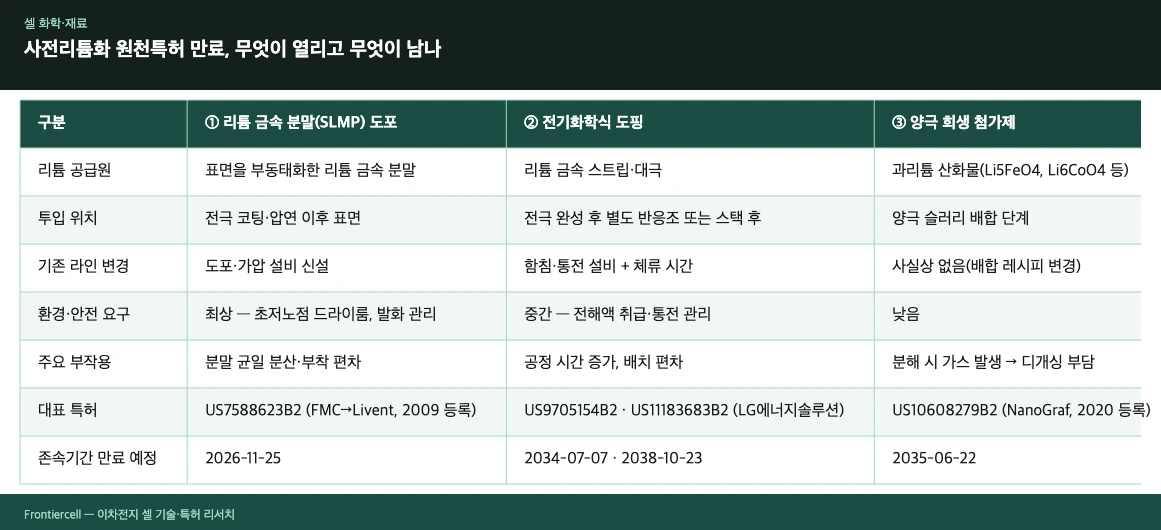
What this table tells us. The three routes diverge not on performance but on “how much of the line has to be torn up.” And looking at the expiry-date row, the order is exactly inverted — the rights covering the powder route, which is hardest to adopt, are released first, while the rights covering the cathode-additive route, which is easiest to adopt, remain in force the longest. Patents expiring does not lower the barrier to entry; rather, the remaining barrier simply shifts from law to equipment and safety. (Expected expiry dates follow Google Patents’ listing and may vary depending on annuity payment status and the country-specific patent family.)
4. Patent Perspective — Rights That Expire, Rights That Remain
4-1. The Axis Nearing Expiry: The SLMP Stabilization Manufacturing Method
Claim 1 of US7588623B2 (filed by FMC Corp, current assignee Livent USA Corp; filed 2006, granted 2009) covers a manufacturing method in which lithium metal is heated above its melting point, sprayed through an atomizer nozzle into droplets, and the droplets are fluorinated in flight to form a protective layer on their surface. In other words, the scope of the right attaches not to “the powder as an object” but to “the method of stabilizing that powder.”
This is where practitioners often stumble. What becomes free once this patent expires is the act of manufacturing SLMP by the same method. But what a cell maker actually does on the line is not making the powder — it’s coating, pressing, and transferring it. A separate layer of follow-on improvement patents has accumulated at exactly that level. The moment expiry of the foundational patent is equated with securing FTO (Freedom to Operate), infringement exposure gets missed.
4-2. The Axis That Lasts Longer: Numerically Limited Process Conditions
LG Energy Solution’s US11183683B2 (filed 2018, granted 2021; family members CN110178252B, KR102261504B1, EP3561918B1) is a textbook numerically-limited claim. The gist of claim 1 has two steps: ① pre-lithiating by pressure-contacting lithium metal against the electrode at 20–50 kgf for 0.5–3 hours in an electrolyte, and ② removing the lithium metal and then stabilizing at the same pressure range for 2–6 hours. The key effect is reducing volume change and active-material contact loss in silicon-based anodes.
The same company’s US9705154B2 (filed 2014, granted 2017) covers the apparatus side. It places unit cells into a reaction tank partitioned by baffles, connects cells of the same polarity by wire, and directly connects a lithium metal plate not to the cathode but to the anode, doping multiple cells simultaneously. It explicitly states the effect of preventing cathode metal ions from migrating into the anode SEI.
On the cathode route, NanoGraf’s US10608279B2 (filed 2018, granted 2020) is worth referencing. It enumerates lithiating agents as Li2O, Li2O2, Li5FeO4, Li6CoO4, Li2S, LiN3, and so on.
4-3. A Design-Around Scenario and Its Rebuttal
Numerically-limited claims look, on the surface, easy to design around. Extending the time at a pressure below 20 kgf, or applying contact pressure through roll tension instead of separate pressing, may leave room to escape literal infringement. The enumerated claim of US10608279B2 similarly leaves room to avoid the literal scope by using a lithium-rich phase outside the enumerated list.
This scenario, however, comes with a rebuttal. If the doctrine of equivalents applies, an implementation that departs slightly from the numerical range may still be found infringing — as a possibility, not a certainty — where the underlying problem-solving principle is the same, the function and effect are substantially identical, and the substitution would have been obvious to a person skilled in the art. Conversely, if the prosecution history shows that the numerical range was narrowed specifically to “the critical band where the effect appears” in order to secure registration, an equivalents argument may be limited under prosecution history estoppel. In the end, whether a design-around is viable cannot be judged from the claim language alone — the specification and the history of office-action responses during examination must be read together to find the answer.
5. Limitations and Outlook — The Other Side of the Optimistic View
Viewed optimistically, the picture is clean: the foundational patent expires, silicon content keeps rising, solid-state pilot lines are adopting pre-lithiation as a standard process, and related equipment and materials demand follows suit.
An opposing scenario also holds. The fundamental reason pre-lithiation is needed is the expansion of silicon content — and if that expansion itself is delayed, the adoption timing of this technology gets pushed back with it. The industry consensus is that oxide-based solid electrolytes will be applied first, with sulfide-based mass production expected around 2028–2030. On top of that, current market demand is tilted toward ESS and LFP — in July 2026, LFP’s share of Chinese EV-battery installations hit an all-time high of 84.6%. In LFP and ESS applications, cycle life and cost take priority over a few percentage points of initial efficiency, so the incentive to invest early in pre-lithiation equipment could be weaker than it appears.
One strategic alternative: instead of investing early in equipment, first validate the cathode sacrificial-additive route as a reversible option. Because the line change stays confined to the formulation stage, it is easy to revert, and the rights that need to be cleared are simpler — just a single composition layer. In exchange, the amount of gas generated on decomposition and the headroom of the existing degassing process must first be quantified. It should also be factored in that this route’s rights remain in force the longest.
What Planning and IP Staff Should Check Today
If an internal or supplier review of pre-lithiation cites “expiry of the foundational patent” as its basis, request two things as a separate attachment alongside that statement. First, the country-by-country patent family and term for that specific patent number. Second, a list of the follow-on patents covering the steps our own line will actually go through (coating, pressing, transfer, formulation). What expires is generally the material/manufacturing axis, while the steps the line actually goes through often sit on a different axis.
This article is a technical and industry explainer based on publicly available patent bibliographic data and press releases, and is not legal advice on any specific matter. Determinations of patent registration, validity, and infringement can vary by jurisdiction and by the specific facts involved, so individual review by a patent attorney or attorney is required for actual decision-making.
References
- US7588623B2 — Stabilized lithium metal powder for li-ion application, composition and process (FMC Corp / Livent USA Corp)
- US11183683B2 · CN110178252B · KR102261504B1 · EP3561918B1 — Pre-lithiation method of negative electrode for secondary battery (LG Energy Solution)
- US9705154B2 — Method for prelithiation, method for fabricating lithium secondary battery comprising the method (LG Energy Solution)
- US10608279B2 — Cathode additives to provide an excess lithium source for lithium ion batteries (NanoGraf Corp)
- SMM (metal.com), Review of Three Major Solid-State Battery Fronts and Listed Companies’ H1 2026 Earnings (2026-08-17~18)
- CnEVPost, China’s July 2026 Power Battery Installation Statistics (2026-08-18)