A lithium titanate (LTO) anode has less than half the capacity of graphite. This article explains why it is still steadily offered for automotive, industrial equipment and stationary applications through a single physical quantity, the electrode potential, the gas problem that appears as its price, and the patents surrounding it.
① What’s the Topic
LTO is a material that holds “less” energy in exchange for fundamentally avoiding lithium building up as metal on the anode surface, and the price is energy density and gas generation. The theoretical capacity of LTO is 175 mAh/g[1], less than half of graphite’s 372 mAh/g[5].
In the industry, the race for electric vehicle cells still revolves around Wh/kg (energy per weight) and cost. In that current, LTO cells look like a niche, yet they have not disappeared. For its SCiB cells, which use an LTO anode, Toshiba states a life of over 20,000 charge/discharge cycles, charging to more than 80% of capacity in 6 minutes, and usability at temperatures as low as -30℃[2]. On the other hand, the same company’s high-energy cell specifications list a nominal voltage of 2.3 V and an energy density of 89–106 Wh/kg[3].
The tension is clear. Is what is gained really worth giving up energy per weight, and how is LTO’s inherent weakness, gas generation, handled? The question this article answers is this: why does LTO accept low energy density, and how is the gas problem, the price of that choice, being claimed in patents?
② Basic Principle — A Reservoir with Raised Embankments
The “operating potential” of an anode is the electrical height at which lithium ions enter and settle in it. For graphite, this height is almost the same as that of lithium metal[1]. It is like a reservoir whose embankment sits at nearly the same height as the water surface. When water (lithium) is poured in quickly (fast charging) or on cold days when the water turns sluggish (low temperature), there is a risk that lithium overflows the embankment and deposits on the surface as metal. This is lithium plating, and in severe cases it can lead to dendrite growth[1].
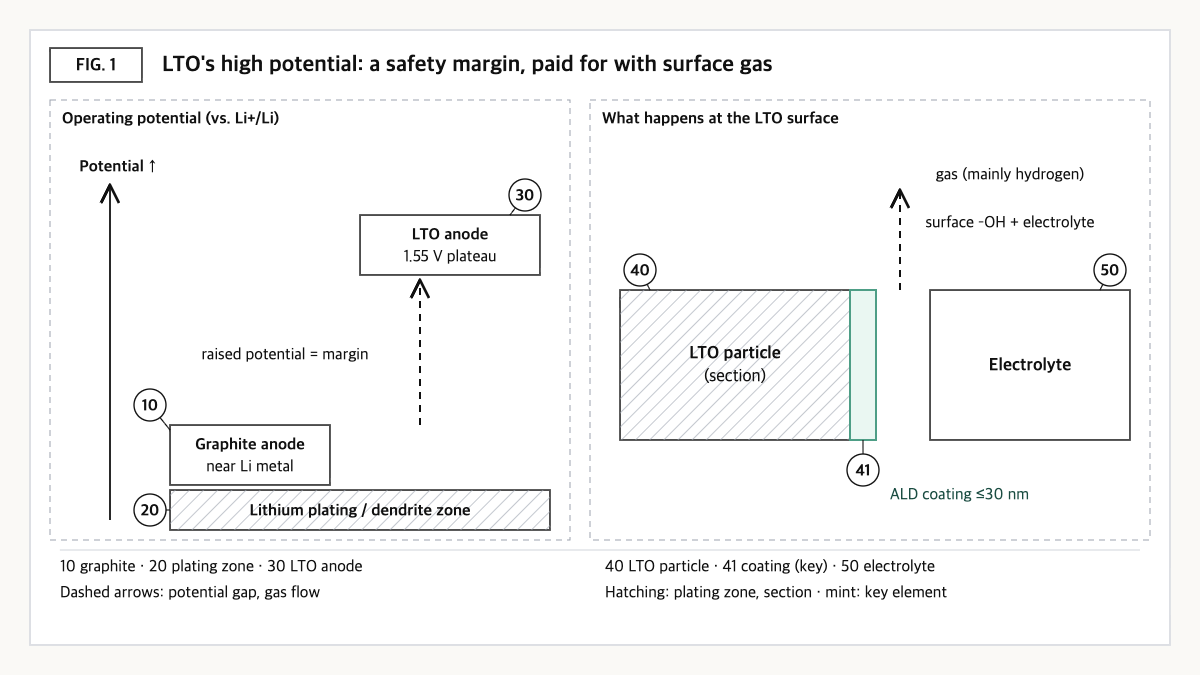
Source: reconstructed by the editorial team from Micromachines (2024), Toshiba SCiB public materials and US9059451B2 on Google Patents.
LTO is a reservoir whose embankment has been raised by 1.55 V (vs. lithium)[1]. The height available for filling water, that is, the cell voltage, shrinks accordingly, and energy is lost. In return, dendritic lithium deposition is avoided[1], and Toshiba also describes the fact that metallic lithium does not precipitate at low temperature as a feature of LTO[2]. LTO is also classified as a “zero-strain” material whose volume barely changes as lithium moves in and out[1]. With less swelling and shrinking of particles that leads to cracks, life becomes longer.
This high potential has one more effect. In a graphite anode, the electrolyte is reductively decomposed during the first charge and a thick solid electrolyte interphase (SEI) forms, while LTO’s high operating potential is described as acting to minimize or avoid this SEI formation[4]. This is where the problem arises. Because the protective film is weak, functional groups such as hydroxyl (–OH) groups on the LTO surface can react directly with the electrolyte and generate gas, mainly hydrogen[4]. Having raised the embankment, the embankment surface is now in direct contact with the water, and bubbles slowly rise.
In addition, LTO has a very low electronic conductivity of about 10–13 S/cm[1], so it must be compensated for by making particles smaller or by adding conductive agents and coatings. But the smaller the particles, the larger the surface area, and the larger the surface area, the wider the stage for gas reactions. Fast-charging performance and gas suppression play tug-of-war over the same variable: the surface.
③ Comparison — Graphite vs. LTO, What Is Given and What Is Received
| Item | Graphite anode | LTO anode (Li4Ti5O12) |
|---|---|---|
| Theoretical capacity | 372 mAh/g[5] | 175 mAh/g[1] |
| Lithium insertion potential (vs. Li+/Li) | Close to lithium metal (qualitative)[1] | 1.55 V[1] |
| Volume change | Qualitative comparison: relatively large | Negligible (zero-strain material)[1] |
| Lithium plating / dendrite risk | Dendrite growth possible on the surface[1] | Dendritic deposition avoided[1]; no metallic lithium even at low temperature[2] |
| Electronic conductivity | Qualitative comparison: high | About 10–13 S/cm[1] |
| Typical side reaction | Lithium consumption through SEI growth (qualitative) | Gas (mainly hydrogen) from surface functional group–electrolyte reactions[4] |
| Cell example (Toshiba SCiB high-energy type) | — | 2.3 V, 20/23/26 Ah, 89/96/106 Wh/kg, 176/202/229 Wh/L[3] |
| Manufacturer-stated performance (SCiB) | — | Over 20,000 cycles, over 80% charge in 6 minutes, use at –30℃[2] |
Source: reconstructed by the editorial team from Micromachines (2024)[1], Toshiba SCiB public materials[2][3], the US9059451B2 specification[4] and Batteries (2026)[5].
What this table shows: LTO reaches only about 47% (175/372) of graphite’s material capacity, and its nominal cell voltage is also low at 2.3 V. What it gains in return is a “safety margin” of 1.55 V, and the manufacturer’s stated 20,000-cycle life, 6-minute charging and use at -30℃ are closely tied to this margin.
④ Patent Perspective — “Gas” Instead of SEI Becomes the Battlefield of the Claims
If making the SEI thin and stable is a main task for graphite anodes, the battlefield shifts with LTO. Because almost no SEI forms and the surface is instead exposed to the electrolyte, what the surface is covered with, and how thinly, to block gas becomes the center of the scope of rights.
A representative case is US9059451B2 (title: Coatings for lithium titanate to suppress gas generation in lithium-ion batteries and methods for making and use thereof). The applicant and current assignee is GM Global Technology Operations LLC; both the priority date and filing date are 2012-10-18, the grant date is 2015-06-16, the legal status is Active (anticipated expiration 2032-10-18), and there are 15 claims[4][6]. The publication US20140113197A1, German DE102013220351B4 and Chinese CN103779550B are identified as belonging to the same line[4].
| Elements of claim 1 (restated) | Meaning for the scope of rights |
|---|---|
| (a) An electroactive material for an electrochemical cell | Product (material) claim — at the active material level, not the whole cell |
| (b) Contains LTO represented by Li4+xTi5O12 (0≤x≤3) | Composition range that also covers charged states |
| (c) A surface coating formed thereon by non-aqueous atomic layer deposition (ALD) | Product limited by its manufacturing method — the coating formation route is the gateway to infringement analysis |
| (d) The coating is selected from fluoride-based, carbide-based and nitride-based coatings | Closed Markush-type options — oxide-based coatings are not on the list |
| (e) Thickness of about 30 nm or less, suppressing gas formation in the cell | Combination of a numerical limitation and a functional limitation |
Source: reconstructed by the editorial team from the bibliographic data of US9059451B2 on Google Patents[4] and its granted claims[6] (original claim text and drawings are not reproduced).
The specification explains that the gas originates from side reactions between the electrolyte and functional groups such as hydroxyl groups on the LTO surface and consists mainly of hydrogen, and presents preferred coating thickness ranges such as about 0.5–10 nm[4]. In other words, this patent defines LTO’s inherent weakness as “surface chemistry” and secures rights to a way of covering that surface at the atomic level.
Design-around scenario (counterargument). (i) Using an oxide-based coating not among the options in (d) lowers the likelihood of literal infringement. (ii) Using a different formation route, such as wet coating or carbon coating instead of ALD, may leave room outside (c). (iii) Using aqueous ALD could also be examined in relation to the “non-aqueous” limitation. There are counterarguments, too. Even without a fluoride precursor, if the surface turns into fluoride by reacting with the electrolyte inside the cell, it may be difficult to distinguish it from a “fluoride-based coating” by analyzing the finished product alone. In addition, how a product claim limited by a manufacturing method is interpreted in infringement analysis may differ by country, so freedom to operate (FTO) judgments should be made separately for each market.
Cross-check of similar patents. JP2015535646A (title: Reduction of gas generation in lithium titanate cells), which approaches the same gas problem from the binder side, is confirmed to claim a method of using a fluoroacrylic hybrid latex in electrode fabrication[7]. Rights to LTO gas suppression are likely divided across several layers, including coating, binder and electrolyte.
⑤ Limits and Outlook
Optimistic outlook. In applications where fast charging and low-temperature operation are key, for example vehicles that charge repeatedly during short stops or equipment in cold regions, LTO’s long life could offset its loss in energy per weight[2].
Opposing scenario. As fast-charging and low-temperature technologies improve on the graphite anode side, LTO’s room could narrow. Moreover, a cell energy density of 89–106 Wh/kg[3] is a disadvantage for passenger EVs that are sensitive to packaging space and weight, and coating and electrolyte designs for gas suppression could raise costs further.
Strategic alternative. A hybrid configuration that deploys LTO not as the “main energy source” but as a “high-power, long-life buffer” is realistic. Reduced to one line, this article’s view is that the unit for evaluating LTO is not the Wh/kg of a single cell but “the total energy that can actually be charged over its life,” and that value depends on who holds the gas suppression technology.
Action to check (planning/IP teams): If you are evaluating LTO cells or materials, obtain written confirmation from the supplier of “the composition of the surface coating (oxide, fluoride, nitride, etc.) and its formation method (ALD or not, aqueous or non-aqueous),” compare it against (c), (d) and (e) of US9059451B2 claim 1, and reflect the anticipated expiration date (2032-10-18) in procurement plans.
Items Requiring Verification
- The volume change rate and electronic conductivity of graphite anodes, and a comparable Wh/kg for graphite-based cells, were left as qualitative comparisons because this article could not obtain sourced figures.
- The test conditions and applicable cell types for Toshiba’s stated life (over 20,000 cycles), charging time (6 minutes) and low temperature (–30℃) are only marked on the manufacturer’s page as “depending on cell type,” so detailed conditions were not verified.
- The applicant and current legal status of JP2015535646A were not verified in this article.
- Differences in claim scope within the US9059451B2 family (DE, CN) were not individually verified.
- Because the claims section of US9059451B2 did not load on the Google Patents page, the claim 1 text was supplemented with the granted claims on Justia.
Sources
- Julien, C. M. & Mauger, A., “Fabrication of Li4Ti5O12 (LTO) as Anode Material for Li-Ion Batteries,” Micromachines 15(3), 310, 2024. Link
- Toshiba, “What is SCiB™” (checked 2026-09-23). Link
- Toshiba, “High-energy type cells | SCiB™” specification table (checked 2026-09-23). Link
- Google Patents, US9059451B2 bibliographic data and specification (original checked 2026-09-23). Link
- Rezaei, M. et al., “A Review of Graphite Anode Recycling in Lithium-Ion Batteries,” Batteries 12(7), 259, 2026. Link
- Justia Patents, U.S. Patent 9,059,451 granted claims (checked 2026-09-23). Link
- Google Patents, JP2015535646A “Reduction of gas generation in lithium titanate cells” (checked 2026-09-23). Link
This article is a technology and patent trend commentary, not legal advice. Specific FTO judgments require professional review.
Related Reading