When making high-nickel cathode materials, manufacturers deliberately add a little extra lithium and fire the material at high temperature. The lithium that fails to enter the crystal remains on the surface and becomes lithium hydroxide (LiOH) and lithium carbonate (Li2CO3). Washing with water reduces residual lithium but damages the surface. This article looks at this trade-off between calcination and washing, together with one patent that inserted itself in between through process order and added elements.
① What’s the Topic
Residual lithium is not a process mistake but a by-product that the calcination recipe leaves behind intentionally. Washing is therefore not a question of “to wash or not,” but a design choice that decides how much surface damage to accept.
Start with the industry context. For layered cathode materials with high nickel content, lithium is often added in an excess of about 1–5% over stoichiometry during synthesis[1]. This is to replenish lithium that volatilizes during high-temperature calcination and to suppress cation mixing, in which lithium ions (0.76 Å) and divalent nickel ions (0.69 Å) of similar size swap sites[1].
The tension is that this excess remains on the surface. Lithium oxide left on the surface after calcination reacts with moisture and carbon dioxide in the air to become LiOH and Li2CO3[1]. This residual lithium can spoil the electrode slurry and cause gas and swelling inside the battery[1]. Washing it off seems simple, but the moment you wash, another problem begins.
So the question this article answers is this: why does residual lithium form and what does it damage, and at what cost does washing reduce it? And through what process configuration did a patent capture this trade-off?
② Basic Principle — Cooking Extra Rice and Scraping Off the Scorched Crust
Calcination is similar to cooking rice. If the rice is undercooked (lithium deficiency), nickel occupies lithium sites in the crystal and disorders the structure, so a little extra water (lithium) is added. But the extra water leaves a scorched crust at the bottom of the pot. In a cathode material, this crust is the residual lithium on the particle surface.
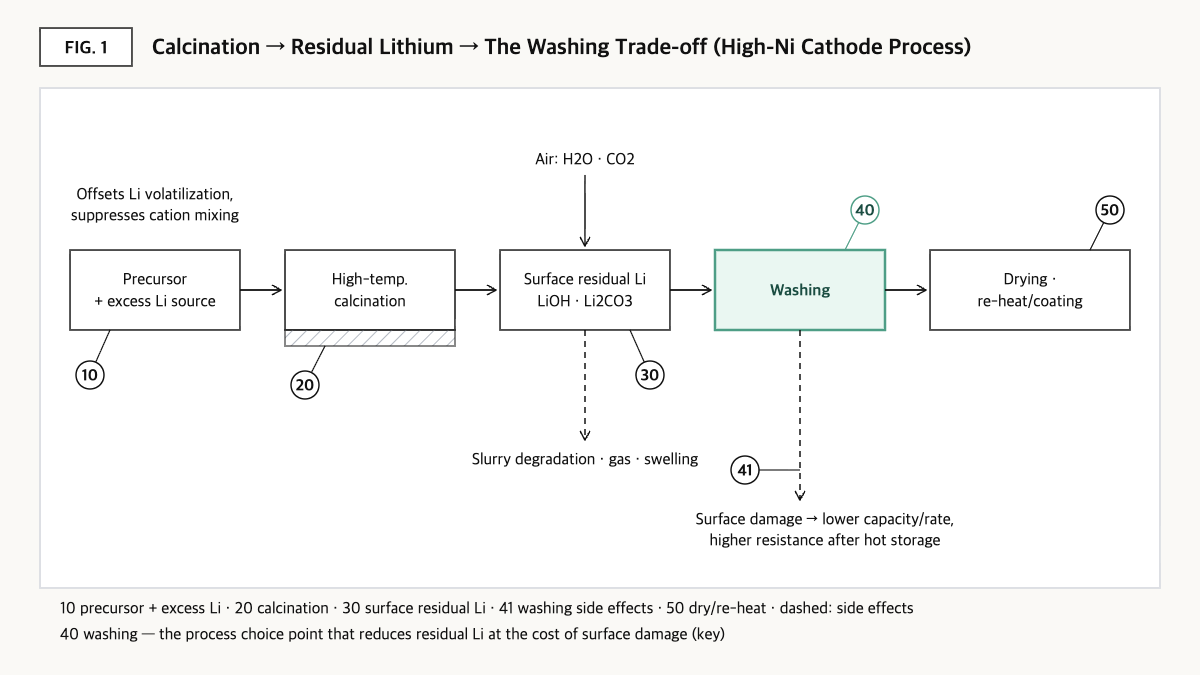
Source: reconstructed by the editorial team from Chen et al. (2020) Frontiers in Energy Research and the US11165061B2 specification.
Leaving the crust as is causes trouble. Residual lithium is alkaline, so PVDF (polyvinylidene fluoride), used as the electrode binder, undergoes a defluorination reaction under alkaline conditions, reducing the slurry’s cohesiveness and even generating water[1]. Inside the cell, Li2CO3 decomposes at high voltage and releases carbon dioxide, and the electrochemical decomposition of residual lithium compounds can lead to safety risks such as swelling and localized heating[1].
That is why a process to scrape off the crust, namely washing, is introduced. The problem is that the rice grains (particle surfaces) are also damaged in the scraping. Ecopro BM’s patent specification states that washing the positive electrode active material damages the surface, causing deterioration of capacity and rate capability and increased resistance during high-temperature storage[2]. There is also a report that washed high-nickel cathode materials have more chemically active surfaces and are more air-sensitive than unwashed materials[1]. In short, washing is an exchange that converts the visible problem of residual lithium into the less visible problem of surface damage.
③ Comparison — Not Washing, Washing, and Washing Plus Reinforcement
| Item | No washing | Washing, then re-heating (patent Comparative Example 1) | Washing, then CeO2 mixing and re-heating (patent Example 1) |
|---|---|---|---|
| Residual LiOH | Relatively high (qualitative) [1] | 1,592 ppm [2] | 782 ppm [2] |
| Residual Li2CO3 | Relatively high (qualitative) [1] | 2,025 ppm [2] | 1,123 ppm [2] |
| Discharge capacity (value in patent table) | — | 219 [2] | 215 [2] |
| Lifetime retention (value in patent table) | — | 45.6% [2] | 76.6% [2] |
| Main concern | Slurry degradation, gas and swelling [1] | Surface damage, air sensitivity [1][2] | Cost of added elements and process steps (qualitative) |
Source: reconstructed by the editorial team from Chen et al. (2020) Frontiers in Energy Research[1] and the specification table of US11165061B2 on Google Patents[2].
What this table shows: Even after the same washing, the sample mixed with cerium oxide and re-heated had residual LiOH and Li2CO3 at roughly half the level (1,592 → 782 ppm, 2,025 → 1,123 ppm) and lifetime retention up from 45.6% to 76.6%, but discharge capacity slightly lower, from 219 to 215[2]. At least in this example, the reduction in residual lithium and the lifetime improvement came with a small capacity cost.
④ Patent Perspective — Claiming “When to Wash” and “What to Add Together”
As an example of addressing the side effects of washing through process configuration, consider Ecopro BM’s US11165061B2 (title: Method of preparing positive electrode active material for lithium secondary battery and positive electrode active material for lithium secondary battery prepared thereby). The applicant and current assignee is Ecopro BM, with priority date 2016-03-25, filing date 2017-03-27, grant date 2021-11-02, legal status Active, anticipated expiration 2037-03-27, and 13 granted claims[2].
Claim 1 is a method claim. What is interesting is that, following its composition limitations, the elements other than nickel (M1, M2) are each limited to 3 mol% or less, making it a configuration aimed at the ultra-high-nickel region with nickel at 94 mol% or more on a precursor basis. Restating it element by element gives the following.
| Element of claim 1 (restated) | Meaning for the scope of rights |
|---|---|
| (i) Producing a nickel composite hydroxide of composition Ni1-x-yM1xM2y(OH)2 (M1 is one or more of Co and Mn, M2 is one or more of Al, Mn, Mg, Si, P, and Ga, 0<x≤0.03, 0<y≤0.03) | Scope limited to ultra-high-nickel precursors |
| (ii) Washing the compound obtained in (i) by adding it to a washing solution | The object of washing is the compound before lithiation — a process-order limitation distinct from conventional “washing after calcination” |
| (iii) Drying the washed compound | Conventional step |
| (iv) Mixing the dried compound with LiOH, Al2O3, Mg(OH)2, and CeO2 | Limitation to a combination of four added raw materials — omitting any one may fall outside the literal scope |
| (v) Heating the mixture to obtain Li1+aNi1-x-yM1xM2yM3zO2, where Al, Mg, and Ce are all present as M3 (0≤a≤0.3, 0<z≤0.03) | Requires coexistence of three elements in the final composition — a boundary verifiable by analysis |
Source: reconstructed by the editorial team from the claim structure of US11165061B2 on Google Patents[2] (original claim language and drawings not reproduced verbatim).
The narrowest neck in the scope of rights is the combination of (ii) and (iv). The claim language requires the order of washing the compound before lithiation and limits the process to adding aluminum, magnesium, and cerium raw materials together with the lithium source all at once. Meanwhile, Example 1 and Comparative Example 1 in the specification are contrasted by whether cerium oxide is mixed into material washed after calcination[2], so the correspondence between the step structure of claim 1 and the example processes could become an interpretive issue. This is why, in a freedom-to-operate (FTO) assessment, not only claim 1 but the remaining 12 claims and the entire specification must be considered together.
Design-around scenarios (including counterarguments). (a) A conventional process that washes only after calcination rather than before lithiation may differ from the order limitation of (ii). (b) Removing cerium from the added raw materials or replacing it with another element may fall outside the literal scope of (iv) and (v). (c) Compositions with less than 94 mol% nickel on a precursor basis are also outside the scope of (i). As counterarguments, method claims tend to be difficult to enforce because the process order is hard to prove from the product alone, but conversely, in joint-development or supply relationships where process data is exposed, the risk of infringement could be examined concretely. It is also hard to rule out a doctrine-of-equivalents argument if cerium is replaced with an element of similar function.
Cross-check of similar patents. The specification of LG Chem’s US11973209B2, which covers single-particle cathode materials, also states that lithium by-products of secondary-particle cathode materials cause gas generation[3], suggesting that the residual-lithium problem may be captured in rights simultaneously on both the morphology-design side (single particles) and the process-design side (washing and coating).
⑤ Limits and Outlook
On the optimistic side, processes that reinforce the surface with coating or doping after washing show room to improve residual lithium and lifetime at the same time[2]. As nickel content continues to rise, the value of such process design may grow.
There is also a contrary scenario. As washing, re-heating, and coating steps increase, the burden of process steps, energy, and wastewater treatment increases with them. Considering the report that washed materials become more air-sensitive[1], the cost of moisture control from post-washing storage and transport through the electrode process could come back into cell cost.
The strategic alternative is to treat residual lithium not as “a defect to eliminate” but as “a process variable to manage.” Bundling excess lithium input, calcination temperature, washing conditions, and post-treatment into a single optimization problem can find combinations that meet the target residual lithium while lowering washing intensity. To summarize this article’s perspective: patent competition in the washing process is likely shifting from “how to wash” to questions of order and combination, “when to wash and what to add together,” which is why a single process flow chart becomes the starting point of an FTO review.
Action to check (planning/IP teams): Obtain the process flow chart of your own or your supplier’s high-nickel cathode material, tabulate at which stage washing occurs (before or after lithiation) and which additive raw materials (Al, Mg, Ce, etc.) are fed together during calcination, and then compare them 1:1 with the steps of claim 1 of US11165061B2.
Items Requiring Verification
- The units of discharge capacity and the measurement conditions of lifetime retention (number of cycles, temperature) in the US11165061B2 table were not verified at the level of the original text in this article.
- The correspondence between the step structure of claim 1 and the process order of the specification’s examples can be confirmed only by reviewing the entire specification together with the prosecution history.
- Whether the Korean and Chinese counterparts of US11165061B2 remain in force was not separately verified.
Sources
- Anqi Chen et al., “The Formation, Detriment and Solution of Residual Lithium Compounds on Ni-Rich Layered Oxides in Lithium-Ion Batteries,” Frontiers in Energy Research, 2020, DOI 10.3389/fenrg.2020.593009. Link
- Google Patents, US11165061B2 “Method of preparing positive electrode active material for lithium secondary battery and positive electrode active material for lithium secondary battery prepared thereby,” bibliographic data, claim 1, and specification Table 2 (original checked 2026-09-23). Link
- Google Patents, US11973209B2 specification (checked 2026-09-23). Link
This article is a technology and patent trend commentary, not legal advice. Specific FTO judgments require professional review.
Related Reading