A separator is a porous film that blocks the space between cathode and anode while letting only lithium ions pass. Focusing on the ‘base film’ itself rather than the coating layer, this article explains how wet-process PE and dry-process PP differ and how the shutdown function is designed, together with the foundational trilayer separator patent.
① What’s the Topic
The essence of separator base-film selection is not ‘which material is better’ but a temperature-window design: ‘at what temperature to close the pores, and up to what temperature to hold the shape.’ The PP/PE/PP trilayer structure is not a verdict on material superiority but a solution that widens, by lamination, a window that is hard to obtain with a single material.
Start with the industry situation. Polyolefin microporous membranes such as polyethylene (PE) and polypropylene (PP) are widely used as base films for lithium-ion battery separators. Manufacturing splits broadly into two routes: the wet process, in which a hydrocarbon liquid is mixed into molten polymer to form a film and the liquid is then extracted with a solvent to create pores, and the dry process, in which a film is extruded without solvent and then stretched to create pores[1]. The wet process pairs mainly with PE and the dry process mainly with PP[1].
The tension lies in safety function and mechanical strength demanding different directions. A separator must perform a ‘shutdown’ function, closing its own pores to cut off current when the cell overheats, and the temperature at which this function begins differs between PE and PP[1]. At the same time, a separator must be thin yet resist puncture and tearing. Heat resistance can be reinforced with a coating layer, but before that, the base film sets the default values for shutdown temperature and strength.
So the question this article seeks to answer is this: How do wet PE and dry PP differ structurally, how is the shutdown function realized through base-film selection and laminate design, and what is the current status of the foundational right?
② Basic Principle — A Separator Is a ‘Self-Closing Fire Shutter’
Let’s compare a separator to a building’s fire-protection system. Normally, countless small doors (pores) are open and people (lithium ions) move freely. When a fire breaks out and the temperature rises, the door-frame material melts and the doors close by themselves. Shutdown is exactly this: a function of rapidly increasing resistance as the micropores block themselves[1]. The problem is that even after the doors close, the wall itself must not melt and collapse. If the wall collapses, the cathode and anode touch directly.
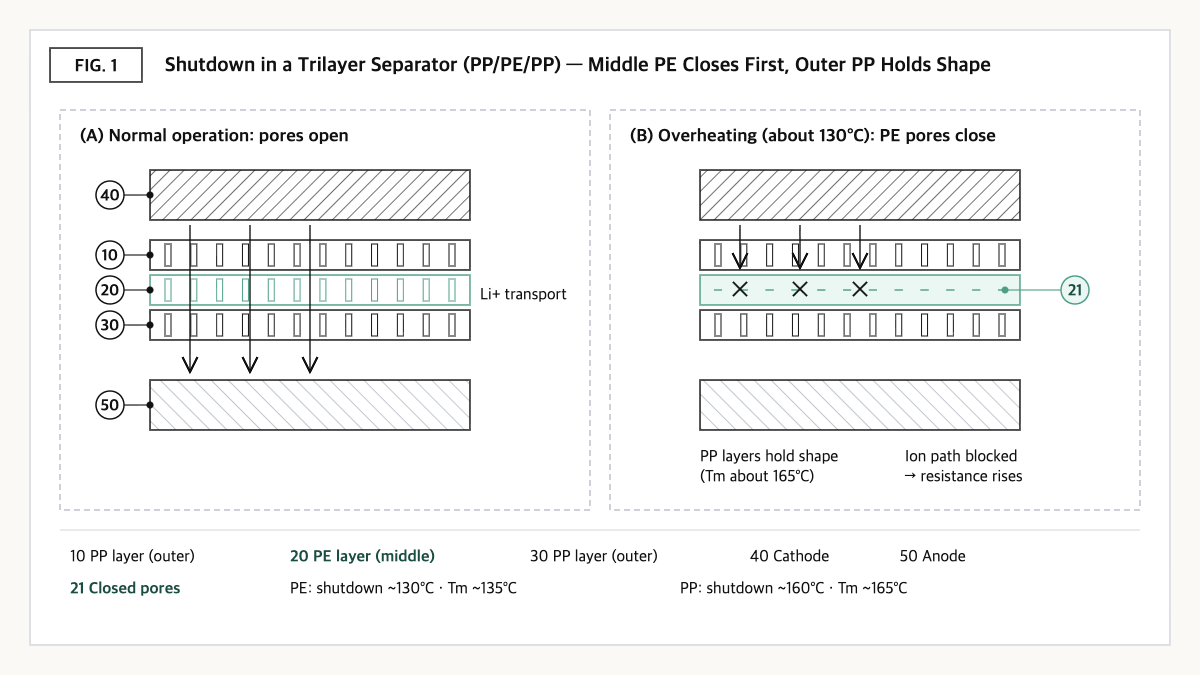
Source: reconstructed by the editorial team from Mun and Won (2021) and the claim structure of US5691077A.
Here the temperature difference between the two materials becomes key. The melting points of PE and isotactic PP are approximately 135°C and 165°C, respectively, and the temperatures at which shutdown is designed to begin are about 130°C for PE and about 160°C for PP[1]. PE closes the doors early but its wall also weakens early; PP’s wall holds longer but it closes the doors late. That is why a trilayer structure emerged with the PE layer in the middle and PP layers outside. It is a division of roles in which the middle PE melts first to drop the shutter, while the outer PP holds the wall’s shape up to a higher temperature (qualitative explanation). Indeed, PE-PP bilayer and PP-PE-PP trilayer structures have been commercialized by separator manufacturers[1].
The manufacturing process changes pore shape. The dry process stretches an extruded, cast film in one direction, tearing the lamellar interfaces between crystals to form highly oriented slit-like micropores[1]. As a result, tensile strength is markedly imbalanced between the machine direction (MD) and the transverse direction (TD)[1]. The wet process stretches the film in both MD and TD and then extracts the liquid to create pores, forming a more developed tortuous pathway that is beneficial for puncture resistance[1]. In analogy, the dry process is closer to ‘a lattice door torn in one direction’ and the wet process to ‘a sponge wall tangled like a maze.’
③ Comparison — Wet PE, Dry PP, and Trilayer PP/PE/PP
| Item | Wet PE | Dry PP | Trilayer PP/PE/PP |
|---|---|---|---|
| Pore formation | Mixed with hydrocarbon liquid above Tm and extruded → biaxial stretching in MD and TD → liquid extracted with volatile solvent[1] | Extruded, then cast or blown film → uniaxial stretching tears lamellar interfaces to form pores[1] | Laminated PE and PP layers; a commercialized structure[1] |
| Pore shape | Well-developed tortuous pathway[1] | Highly oriented slit-like micropores[1] | Differs by layer (qualitative) |
| Melting point (Tm) | About 135°C[1] | About 165°C (isotactic PP)[1] | Tm of both layers coexist (qualitative) |
| Design temperature for shutdown onset | About 130°C[1] | About 160°C[1] | PE layer shuts down + PP layer holds shape (qualitative) |
| Mechanical properties | Structure beneficial for puncture resistance[1] | Imbalanced MD/TD tensile strength[1] | Depends on layer configuration (qualitative) |
| Porosity | Typical porosity of microporous polyolefin separators: 35–55%[1] | ||
Source: reconstructed by the editorial team from Mun and Won (2021)[1].
What this table shows: The shutdown design temperatures of PE and PP, about 130°C and about 160°C, are roughly 30°C apart[1]. The trilayer structure is a design that converts this 30°C gap into a safety margin of ‘close first, hold until later,’ while the directionality of strength is decided separately by the process (wet/dry).
④ Patent Perspective — A Wide Fence Built by a One-Sentence Claim, and Its Expiration
A frequently cited foundational right for trilayer separators is US5691077A. The original assignee is recorded as Hoechst Celanese Corp and the current assignee as Celgard LLC. According to Google Patents, the priority date is 1994-12-20, filing date 1996-05-20, grant date 1997-11-25, with 20 granted claims, and the legal status is Expired – Lifetime (anticipated expiration 2014-12-20)[2]. Claim 1 is very short. Restated element by element, it reads as follows.
| Elements of claim 1 (restated) | Meaning for the scope of rights |
|---|---|
| (a) A battery separator with a shutdown function and a trilayer structure | Subject and function limitation — no numerical limits on thickness, porosity, or process |
| (b) Comprising a first microporous polypropylene membrane | Outer-layer material limitation |
| (c) Comprising a third microporous polypropylene membrane | Opposite outer-layer material limitation |
| (d) The two polypropylene membranes are arranged to sandwich a microporous polyethylene membrane in the middle | Claims the PP/PE/PP stacking order itself — the core of the scope of rights |
Source: reconstructed by the editorial team from the bibliographic data and claim structure of US5691077A on Google Patents (original claim language and drawings not reproduced verbatim).
The lesson of this claim is that ‘the shorter, the broader.’ Because it has no numerical or process limits such as thickness, porosity, or manufacturing method, during its term any shutdown separator laminated in PP/PE/PP order could broadly fall within its scope. Sketching design-around scenarios by the standards of that time, (i) a PE/PP bilayer structure, (ii) a reversed-order structure such as PE/PP/PE, and (iii) giving a single PP layer a different means of shutdown could have been candidates for review.
There are counterarguments. Even if (i) and (ii) fell outside the literal wording, there was room for an equivalence argument based on the functional identity of ‘a heat-resistant layer enclosing the shutdown layer,’ and cell design might have had to give up the shape-holding effect of outer PP layers. Now that this patent has expired, the PP/PE/PP stacking order itself has likely entered an area anyone can practice. However, according to Google Patents event records, US6057060A and US6132654A are linked in the same line, and later patents on improvements in thickness, properties, and process are separate rights.
As a cross-check of similar patents, follow-on patents directed at the microporous membrane itself exist, such as Asahi Kasei Battery Separator Corp’s US9620754B2 (priority date 2008-12-19, granted 2017-04-11, currently shown as Active, titled ‘Polyolefin microporous membrane and separator for lithium ion secondary battery’)[3]. The release of a foundational structure does not automatically secure freedom to operate (FTO) for the latest base-film designs.
⑤ Limits and Outlook
On the optimistic side, with the foundational trilayer patent expired, the options for base-film design have widened, and the design freedom to combine shutdown temperature (PE about 130°C) and shape-holding temperature (PP melting point about 165°C) can be seen as greater[1][2].
There is also a counter-scenario. Shutdown means ‘the pores close,’ not ‘the heat stops.’ If heat generated is much greater than heat dissipated, the whole separator may melt completely (meltdown) and the electrodes may contact each other directly[1], which is why an approach of coating functional layers of ceramic particles or heat-resistant polymers on polyolefin base films to improve meltdown temperature and thermal shrinkage is used alongside[1]. The view that base-film selection alone solves the safety problem may be overconfident.
The strategic alternative is to set rights and sourcing strategies separately for base film and coating. Choosing a base film on top of the expired foundational structure and known processes, while seeking differentiation and rights in the combination of measurable base-film properties (strength ratio, thermal shrinkage, pore structure) and the coating, is also easier to manage from an FTO perspective.
Action to check (planning/IP teams): Tabulate the base-film configuration of the separator you currently use (single/bilayer/trilayer, wet/dry) along with the shutdown and meltdown temperatures and MD/TD strength ratio from the supplier’s specification, and check by supplier whether any in-force microporous-membrane patents claim those property ranges.
Items Requiring Verification
- For US9620754B2, only bibliographic data (title, assignee, dates, status) was checked; the specific content of its granted claims was not verified in this article.
- The claim scope and expiration status of US6057060A and US6132654A, linked to US5691077A, were not separately checked.
- Market share of wet and dry separators and product-level thickness and price data could not be confirmed from public sources and were excluded.
Sources
- Sung Cik Mun, Jong Ho Won, “Manufacturing Processes of Microporous Polyolefin Separators for Lithium-Ion Batteries and Correlations between Mechanical and Physical Properties,” Crystals 11(9), 1013, 2021. Link
- Google Patents, US5691077A “Shutdown, trilayer battery separator,” bibliographic data, legal status, and claim 1 (original checked 2026-09-23). Link
- Google Patents, US9620754B2 “Polyolefin microporous membrane and separator for lithium ion secondary battery,” bibliographic data (checked 2026-09-23). Link
This article is a technology and patent trend commentary, not legal advice. Specific FTO judgments require professional review.
Related Reading