The Blade Battery is a structure in which cells are stretched thin and long so that they span the width of the pack. This article explains what the idea of having the cell also serve as the pack’s reinforcement gains and gives up, and in what ratios BYD turned that cell shape into rights.
① What’s the Topic
The essence of the Blade Battery is not cell chemistry but cell length. The moment a cell becomes long enough to rest on both walls of the pack, it is both a component that holds electricity and a beam that holds up the pack.
Start with the industry context. When BYD announced the Blade Battery on March 29, 2020, it stated that the space utilization of the battery pack had increased by over 50% compared with conventional lithium iron phosphate (LFP, a cathode material based on lithium, iron, and phosphate) block batteries[1]. Since then, BYD has described this cell together with the Cell-to-Pack (CTP) approach, in which cells go directly into the pack without modules, and has also said that a ‘honeycomb-like aluminum’ structure in the pack increases rigidity and safety[2].
The tension lies in the numbers of the cell itself. Taken on its own, a Blade cell has markedly lower energy density than a large cylindrical cell[3]. So where does the Blade Battery’s competitiveness come from? How does the idea of using the cell as a structural member change cell design, and which point of that idea did the patents capture?
So the question this article answers is this: What changes simply by making the cell long, and in what way did that ‘length’ become a right?
② Basic Principle — Floorboards as Long as the Room Is Wide, Instead of Short Bricks
Compare a conventional battery pack to laying a floor. Many short bricks (small cells) are bundled into boxes (modules), and beams (the transverse and longitudinal beams inside the pack) are laid between the boxes to support the floor. It is sturdy, but the space actually holding electricity shrinks by the amount taken up by the box walls and beams.
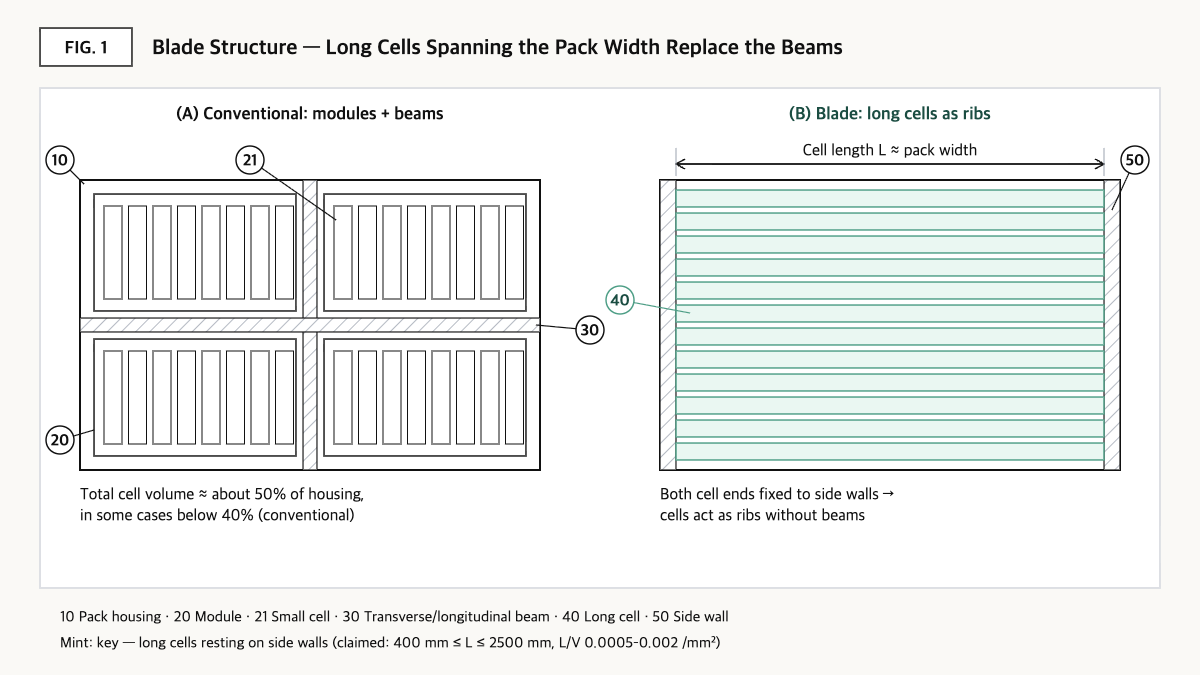
Source: reconstructed by the editorial team from BYD announcement (2020) and the specifications and claims of US12113227B2 and US12300832B2.
The Blade approach is closer to laying floorboards as long as the room is wide, tightly packed and resting on both walls. The specification of a related BYD patent explains that in conventional packs, the total volume of the cells was about 50% of the pack housing volume, and in some cases less than 40%[5]. By contrast, it states that when cells span the entire width of the pack and are fitted to both side walls, no transverse or longitudinal beams are needed in the housing, and the connected cells can directly act as strengthening ribs[5]. The floorboards become the beams.
This structure comes with several conditions. The cell must be long to span the pack width, thin so that many can stand tightly side by side, and its casing must be stiff so that it can share the load. That is why the Blade cell takes the form of an aluminum-cased prismatic cell with an extreme spread of ‘length > width > thickness.’ The fact that placing electrode tabs and explosion-proof valves at both ends of the cell appears in the dependent claims of the related patent[5] can also be seen as a design that goes hand in hand with a structure where both ends of a long cell meet the pack side walls.
③ Comparison — Cell-Level Density and Pack-Level Space Efficiency Are Different Stories
| Item | BYD Blade cell | Tesla 4680 cell |
|---|---|---|
| Cathode material | LFP | NMC811 (ternary with about 80% nickel) |
| Cell format | Large prismatic | Large cylindrical, much smaller volume |
| Gravimetric energy density | 160 Wh/kg | 241.01 Wh/kg |
| Volumetric energy density | 355.26 Wh/L | 643.3 Wh/L |
| Anode | Graphite (no silicon) | Graphite (no silicon) |
| Pack integration | Module-free CTP | Module-free CTP |
| Internal joining | Laser and ultrasonic welding | Laser welding |
Source: reconstructed by the editorial team from the ChemistryViews report[3] introducing the teardown results of Gorsch et al., Cell Reports Physical Science (2025).
What this table shows: At the cell level, the Blade cell’s gravimetric energy density is about 34% lower and its volumetric energy density about 45% lower than the 4680 cell’s (160 vs. 241.01 Wh/kg, 355.26 vs. 643.3 Wh/L)[3]. This means the Blade’s competitiveness comes not from cell density but from reducing the space that used to be wasted inside the pack, that is, from pack space utilization[1].
Adding one more perspective from this article: the moment the cell becomes a structural member, cell dimensions change from a design variable of the cell maker to a design variable of the vehicle. Cell length is tied to pack width, and pack width is tied to vehicle body width. This chain appears directly in the claims of the patent below.
④ Patent Perspective — Capturing the Shape with a ‘Length/Volume’ Ratio
Among BYD’s US patents covering the Blade cell shape, consider US12300832B2 (title: Power battery pack and electric vehicle). The applicant and current assignee is BYD Co Ltd; the priority date is 2019-01-09 (Chinese application 201910020925.5 and others), the filing date is 2024-03-04, and the grant date is 2025-05-13. This patent is a continuation of the US national-stage application (17/421,875, granted as US11955651) of PCT/CN2019/092390, filed on 2019-06-21. According to Google Patents, the legal status is Active (anticipated expiration 2039-06-21), with 20 granted claims[4].
Although the title is ‘pack and vehicle,’ independent claim 1 claims the cell itself. Restated element by element without reproducing the original wording, it reads as follows.
| Claim 1 elements (restated) | Meaning for the scope of rights |
|---|---|
| (a) A cell for use in a power battery pack | Statement of use — claimed at the cell level (pack and vehicle are claimed in dependent claims 17 and 18) |
| (b) The battery body has a length L, a width H, a thickness D, and a volume V | Definition of dimensional variables |
| (c) L is greater than H, and H is greater than D | Shape limitation — a flat, long rectangular box |
| (d) L is in the range of 400 mm or more and 2500 mm or less | Absolute dimension limitation — the first reference line for literal infringement |
| (e) The length divided by the volume, L/V, is in the range of 0.0005–0.002 mm⁻² | A limitation tying the relationship between length and cross-section into a single ratio — effectively determines the breadth of the scope of rights |
Source: reconstructed by the editorial team from the bibliographic data and claim structure of US12300832B2 on Google Patents (the original claim wording and drawings are not reproduced).
Intuitively, L/V in (e) expresses ‘how slender the cross-section is per 1 mm of length.’ For example, for a cell 1,000 mm long, the calculation shows that its volume must be between about 500,000 and 2,000,000 mm³ to fall within this range. A cell that is long but thick has a smaller L/V and falls outside the range.
Claim 18 deserves even closer attention. When a pack made of these cells is mounted in a vehicle, it limits the ratio of cell length L to vehicle body width W to 46–76% if the cell length direction runs along the vehicle width, and the ratio of cell length to vehicle body length X to 40–76% if it runs along the vehicle length[4]. It is a claim that ties cell dimensions to body dimensions, and it can be seen as the point where the idea of the cell becoming a structural member was translated into claim language.
Sketching design-around scenarios, the following could be considered: ⓐ shortening the cell to less than 400 mm and filling the pack width with a two-row arrangement, ⓑ increasing cell thickness or width to lower L/V below 0.0005 mm⁻², and ⓒ designing the cell-length-to-body-width ratio outside 46–76% in vehicle applications. The counterarguments are clear. With ⓐ, the cell no longer spans the pack width, so its role as reinforcement may weaken and beams may be needed again. With ⓑ, the thicker the cell, the harder it is for heat to escape. In other words, the more one avoids this patent, the more the benefits of the Blade structure shrink as well, so this may be a type of right with a high design-around cost.
Cross-check of similar patents: BYD’s US12113227B2, claiming priority from the same date, claims in claim 1 a pack with cells longer than 600 mm, a cell volume of 953,750 mm³ or more, L/H of 4–21, an aluminum-cased prismatic cell, and a total cell volume of 55% or more of the pack volume[5]. Even if one patent’s numerical range is avoided, a different ratio in the same portfolio (L/H, volume ratio) may still apply, so the freedom to operate (FTO) review should put the entire family on one page.
⑤ Limits and Outlook
Optimistically, the idea of using cells as structural members removed beams and module parts to raise pack space utilization[1][5], and opened a path to sufficient driving range even with LFP, whose cell energy density is low. It also lays the groundwork for the next step, integrating the pack top plate with the vehicle floor.
There is also an opposing scenario. Once cell length is tied to body width, the cell becomes a platform-specific part. For each vehicle class with a different body width, the cell length must change or empty space must be accepted, and because one cell occupies the entire pack width, the scope of impact when replacing a defective cell may also grow. The low cell density itself (Fig. 2) also leaves room for the gap to narrow if high-density nickel-based cells follow the same kind of pack integration.
A strategic alternative is ‘cell-length standardization into a series.’ Defining a small number of standard lengths matched to a few body widths first, and then adjusting capacity through thickness and width within those lengths, can reduce platform dependency. Even then, whether the design falls under ratio limitations such as L/V and L/H should be calculated early in design.
Action to check (planning/IP teams): Calculate L/V and L/H from the length, width, and thickness of the long cell under review, compute the ratio of cell length to the body width of the target vehicle, and compare them simultaneously with the numerical ranges of US12300832B2 (claims 1 and 18) and US12113227B2 (claim 1). If either falls within range, extend the FTO review to the entire family.
Items Requiring Verification
- Whether the official dimensions of the Blade cells BYD mass-produces fall within the L/V range of US12300832B2 or the body-ratio range of claim 18 was not confirmed with official specifications.
- The claims of the parent granted patent US11955651, and the granted claim scope of corresponding family members in China, Europe, and elsewhere, were not checked in this article.
- The statement that ‘cells act as strengthening ribs’ is a description in the specification of US12113227B2; whether beams are completely removed in actual mass-production packs was not confirmed (the specification also describes embodiments with beams).
- The figures in Fig. 2 are teardown results for cells taken from specific vehicles and cannot be generalized to all Blade and 4680 cells.
Sources
- BYD Europe, “Today, BYD officially announced the launch of the Blade Battery,” 2020-03-29. Link
- BYD, “BYD’s revolutionary Blade Battery: all you need to know,” 2023-01-22. Link
- ChemistryViews, “Engineers Analyzed Batteries from Tesla and China’s Leading EV Manufacturer” (original paper: Gorsch et al., “Contrasting a BYD Blade prismatic cell and Tesla 4680 cylindrical cell with a teardown analysis of design and performance,” Cell Reports Physical Science, 2025, DOI 10.1016/j.xcrp.2025.102453). Link
- Google Patents, US12300832B2 “Power battery pack and electric vehicle,” bibliographic data and claims (original checked 2026-09-23). Link
- Google Patents, US12113227B2 “Cell, power battery pack, and electric vehicle,” claim 1 and specification (original checked 2026-09-23). Link
This article is a technology and patent trend commentary, not legal advice. Specific FTO judgments require professional review.
Related Reading