An overcharge-protection redox shuttle is a molecular additive that makes the current arriving after a cell is full ‘spin its wheels’ inside the cell without driving any chemical change. This article looks at the match between shuttle potential and cathode charging voltage, the twin challenges of solubility and durability, and the boundaries of rights drawn by the 3M and Argonne National Laboratory patents.
① What’s the Topic
A redox shuttle is not a device that ‘blocks’ overcharge but one that ‘consumes’ the surplus current inside the cell. Because it works by pinning the cathode potential near the redox potential of the shuttle molecule, which cathode it is paired with decides success or failure.
Start with the industry situation. The first line of defense against overcharge is the battery management system (BMS). But when many cells are connected in series, their states of charge drift slightly apart and some cells fill up first. In such situations, a redox shuttle acts as a chemical second line of defense inside the cell. One study explains that shuttle additives protect cells from electrolyte oxidation and overheating during overcharge by taking part in a ‘futile redox cycle’ that pins the cathode potential near the redox potential of the shuttle molecule[4].
There are two tensions. First, the shuttle’s operating potential must be slightly higher than the cathode’s normal charging voltage. Too low, and it interferes with normal charging; too high, and protection comes late. Second, because shuttle molecules are eventually consumed in side reactions, high solubility of the parent molecule and high chemical stability of the oxidized molecule are both required[4]. So the question this article answers is: on which cathodes do shuttles work well, and how narrowly or broadly did the representative patents fence in the molecules?
② Basic Principle — The ‘Spillway’ Opened Before the Dam Overflows
When a dam is full, overflow is sent down a spillway so it does not breach the embankment. A redox shuttle is exactly this spillway. If charging current keeps arriving after the cell is full, the shuttle molecule is oxidized at the cathode the moment the cathode potential reaches the shuttle’s oxidation potential.
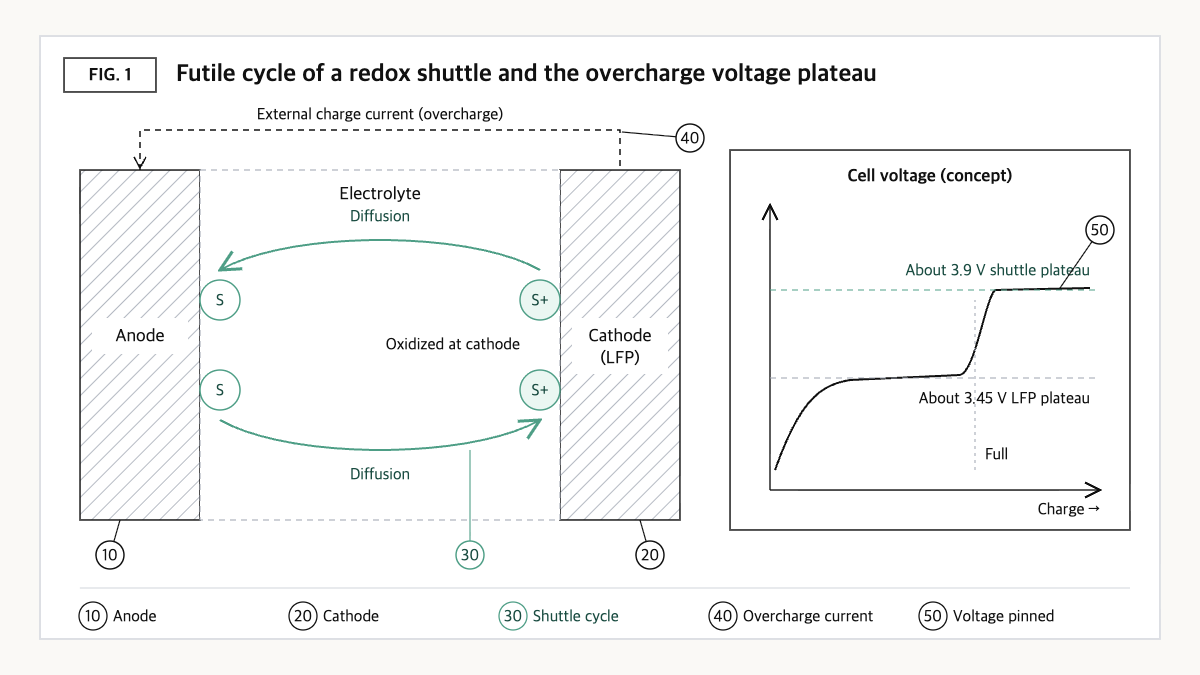
Source: reconstructed by the editorial team from the US7811710B2 and US8609287B2 specifications and the abstract of Zhang et al. (2019).
The oxidized shuttle molecule diffuses across the electrolyte to the anode, where it is reduced back to its original state. It then diffuses back to the cathode and is oxidized again. While the shuttle molecule travels back and forth between the two electrodes, the incoming current only circulates without charging the electrode materials any further. From the outside, the cell voltage appears to stop flat near the shuttle potential.
What sets the width of this spillway? Early research clarified that the limiting current a shuttle can carry depends on the diffusion coefficients of its oxidized and reduced forms[3]. In other words, the faster the shuttle molecules move and the more of them are dissolved, the larger the overcharge current they can pass. This is why solubility is the main target of shuttle improvement.
Matching with the cathode also matters. The 3M patent specification gives the charging plateau of a lithium iron phosphate (LiFePO4) cathode as about 3.45 V versus lithium, and the overcharge plateau at which the shuttle operated in that cell as about 3.9 V[1]. This article’s view is that the flat voltage curve of LFP, often cited as a state-of-charge estimation headache for the BMS, is for a redox shuttle a condition that actually provides a potential margin of about 0.45 V.
③ Comparison — Operating Potential and Durability of Representative Shuttle Molecules
| Shuttle molecule | Rights holder / source | Operating potential (vs. lithium) | Solubility / electrolyte | Reported durability |
|---|---|---|---|---|
| 2,5-di-tert-butyl-1,4-dimethoxybenzene (DDB) | 3M (US7811710B2)[1] | About 3.9 V (overcharge plateau in LiFePO4 cells) | Solubility decreases as lithium salt concentration rises; tested in LiBOB/PC-based and other electrolytes | Stable even after 200 cycles in a C/2.5 test; monitored for over 3,000 hours |
| 1,4-bis(2-methoxyethoxy)-2,5-di-tert-butylbenzene | UChicago Argonne (US8609287B2)[2] | About 3.8–4.1 V (reversible peaks) | Excellent solubility in 1.2M LiPF6 EC/EMC; no issues at 0.1 M | LTO/LiFePO4 cells: discharge capacity down about 10% after 100 cycles at 100% overcharge |
| Highly soluble 1,4-dialkoxybenzene-type shuttle | Argonne National Laboratory researchers[4] | No figure in the original abstract | Soluble to 0.6 M | Protection over 500 cycles at C/2 and 100% overcharge |
| Seven new shuttles (1999) | Lawrence Berkeley National Laboratory researchers[3] | Shuttle current onset potentials above 4.2 V | No figure in the original abstract | Overcharge protection demonstrated in Li/LiMn2O4 cells |
Source: reconstructed by the editorial team from the US7811710B2 specification[1], the US8609287B2 specification[2], Richardson and Ross (1999)[3], and Zhang et al. (2019)[4].
What this table shows: The two representative shuttles stay within a window of about 3.8–4.1 V versus lithium, matched to LiFePO4-class cathodes, and the focus of improvement was solubility (compatibility with carbonate electrolytes, around 0.6 M) and durability (500 cycles) rather than potential.
④ Patent Perspective — The Space Left for Neighboring Molecules by a Single-Compound Claim
A representative shuttle-molecule patent is 3M’s US7811710B2 (title: Redox shuttle for rechargeable lithium-ion cell). The assignee is 3M Innovative Properties Co; priority date 2004-04-01; filing date 2005-03-31; published as US20050221196A1 (2005-10-06); grant date 2010-10-12; 17 granted claims. Google Patents shows the legal status as Expired – Fee Related, alongside an adjusted expiration date (2029-08-12)[1]. Restated, claim 1 reads as follows.
| Claim 1 elements (restated) | Meaning for the scope of rights |
|---|---|
| (a) An electrolyte for a lithium-ion cell | Claims the electrolyte rather than the cell — judged at the electrolyte stage |
| (b) Containing a charge-carrying medium | Solvent type is not limited |
| (c) Containing a lithium salt | Salt type is not limited |
| (d) Containing, as a cyclable redox chemical shuttle, 2,5-di-tert-butyl-1,4-dimethoxybenzene | Specifies the shuttle as a single compound — the scope of rights is tied to one molecule |
Source: reconstructed by the editorial team from the Google Patents bibliographic data, claims, and specification of US7811710B2 (checked 2026-09-23); original claim wording is not reproduced.
Claim 1 leaves the medium and salt wide open but specifies the shuttle itself as a single molecule, DDB. The core of this case is that the ‘neighboring molecule’ space left by this narrow specification was actually filled by another rights holder. UChicago Argonne LLC’s US8609287B2 (title: Polyether-functionalized redox shuttle additives for lithium ion batteries; inventors Zhengcheng Zhang, Lu Zhang, Khalil Amine; priority date 2010-05-25; filing date 2011-05-24; grant date 2013-12-17; 21 granted claims; shown as Active, expected expiration 2031-11-12) claims, in the form of chemical formulas (Formula I–III), a family in which polyether chains are attached where DDB has its methoxy groups[2]. The specification states that this molecule shows excellent solubility in carbonate electrolytes[2].
Sketching design-around scenarios, while the DDB patent was in force, ⓐ using a derivative with different substituents would likely have been the most realistic path. There are counterarguments. A molecule with only its substituents changed could face a dispute over equivalence on the grounds of identical function, and conversely, if that derivative becomes a separate patent, one enters a new rights holder’s fence. US7811710B2 is now shown as expired, so the risk of infringement from using DDB itself is likely to be low, but using the polyether-substituted family would call for a freedom to operate (FTO) comparison against US8609287B2. Whether there are cell-level combination patents tying shuttles to specific high-voltage cathodes also needs to be checked separately.
⑤ Limits and Outlook
On the optimistic side, as LFP adoption grows, redox shuttles have more room to serve as an auxiliary means of absorbing charge imbalance between cells in large series modules, because the margin between the LFP charging plateau and the shuttle potential is an already confirmed match[1]. An improved shuttle offering 500-cycle protection with 0.6 M solubility has also been reported[4].
There is also a contrary scenario. The current a shuttle can pass is bound by diffusion[3], so it may struggle to absorb all of a large overcharge current during high-rate charging. Shuttle molecules are also consumables used up gradually in side reactions[4]. As the report of a roughly 10% drop in discharge capacity after 100 cycles at 100% overcharge suggests[2], repeated overcharge leaves traces on cell life as well. Shuttles above 4.2 V suited to high-voltage layered cathodes were reported early on[3], but it is hard to conclude that they combine commercial-level durability and solubility.
As a strategic alternative, one approach is to position the shuttle not as a replacement for the BMS but as an auxiliary means of ‘chemical passive balancing’ in large LFP series modules. Seen this way, the evaluation metric also changes from ‘did it stop overcharge?’ to ‘how much cell-to-cell imbalance did it absorb?’
Action to check (planning/IP teams): Put the charge cutoff voltage of your LFP cells and the operating potentials of candidate shuttle molecules in one table, and mark in the same table whether each candidate falls within the polyether-substituted formulas (Formula I–III) of US8609287B2.
Items Requiring Verification
- The exact date on which US7811710B2 lapsed for non-payment of fees was not checked against the official register beyond the Google Patents status display.
- The claims and status of cell-level patents combining shuttles with high-voltage cathodes (e.g., follow-on documents found in searches of the Argonne National Laboratory family) could not be verified against original documents.
- Manufacturer disclosures on whether redox shuttles are actually used in commercial cells could not be found.
Sources
- Google Patents, US7811710B2 “Redox shuttle for rechargeable lithium-ion cell,” bibliographic data, claims, and specification (original checked 2026-09-23). Link
- Google Patents, US8609287B2 “Polyether-functionalized redox shuttle additives for lithium ion batteries,” bibliographic data and original claims/specification PDF (checked 2026-09-23). Link
- T. J. Richardson, P. N. Ross Jr., “Redox shuttle additives for overcharge protection in lithium batteries,” Lawrence Berkeley National Laboratory report (1999) (OSTI abstract). Link
- J. Zhang et al., “An extremely durable redox shuttle additive for overcharge protection of lithium-ion batteries,” Materials Today Energy 13 (2019), DOI 10.1016/j.mtener.2019.06.003 (OSTI abstract). Link
This article is a technology and patent trend commentary, not legal advice. Specific FTO judgments require professional review.
Related Reading