At the very center of a cylindrical cell’s jelly roll there is an empty hole, into which a tube called a center pin is sometimes inserted. This article explains why this small part simultaneously takes on three variables — electrode deformation, gas release, and internal void space — and the scope of rights of the Samsung SDI patents surrounding it.
① What’s the Topic
The center pin is a design that packs into one part ‘what is better filled (support),’ ‘what is better empty (gas path),’ and ‘what must be set exactly (void volume).’ So whether to insert a center pin or leave it out, and if inserted how hollow to make it, shakes both life and safety at once.
Start with the industry context. A cylindrical cell places in a can a jelly roll made by stacking the cathode, separator, and anode and winding them up. If a spindle (mandrel) is used at the center for winding and then removed, an empty hole, the hollow core, remains at the center. Some cells leave this hole as it is; others insert a center pin, a metal or resin tube. Patent specifications explain that the center pin fixes and supports the electrode assembly and serves as a passage through which gas generated by internal reactions during charge and discharge escapes[5].
The tension is the conflict with energy density. Removing the center pin allows that much more active material, but the structure that supports the inside of the jelly roll disappears. Indeed, a study that cycled at 0°C two commercial 18650 cells of the same rating (2.6Ah), one with a center pin and one without, reported that the two cells degraded differently[1]. So the question this article answers is this: what role does the empty space at the center of the jelly roll play, and how have patents turned that space into rights?
② Basic Principle — The Cardboard Core of a Toilet Roll
A jelly roll is similar to a roll of toilet paper. With a cardboard core in the middle, the inside does not easily crush even if you squeeze the roll, but remove the core and the innermost few layers tend to collapse into the empty center. In a cell, the electrodes swell and shrink with each charge and discharge, repeatedly loading the windings, so the presence or absence of this ‘core’ determines the shape of the inner windings.
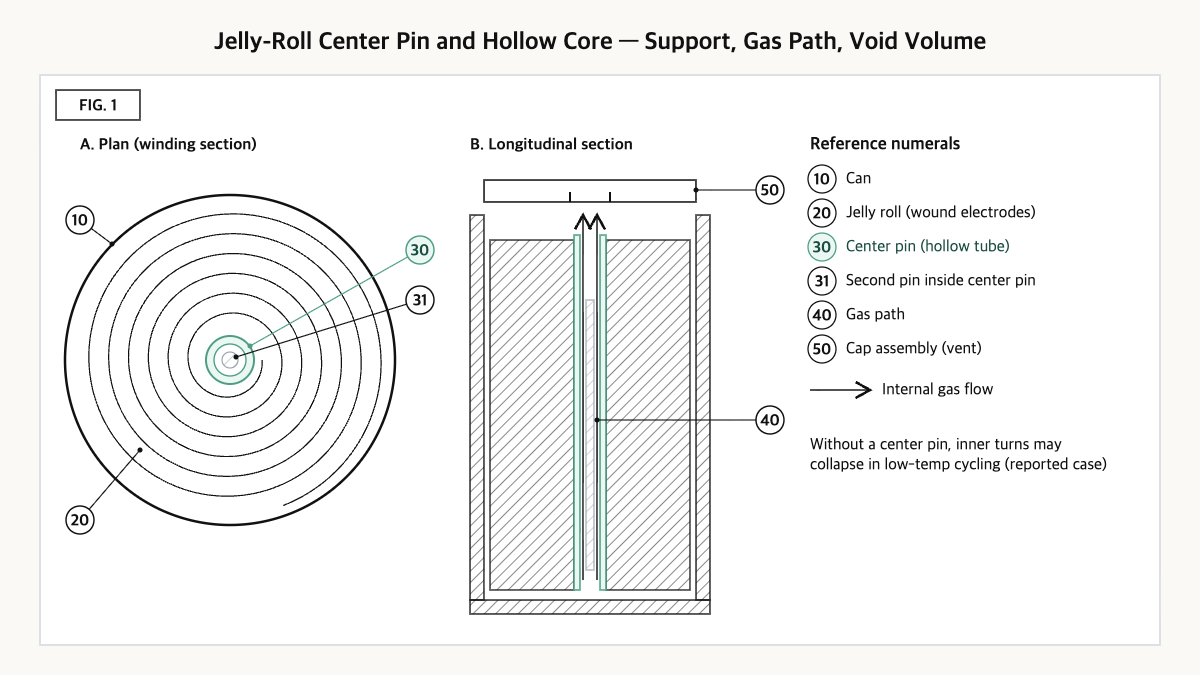
Source: reconstructed by the editorial team from Carter et al. (2019) and the center pin roles described in the US9219263B2 and EP2466668B1 specifications.
The center pin is a tube because of its second role. When gas is generated in the cell by overcharge or abnormal heating, the gas must travel quickly from the bottom of the jelly roll to the vent in the cap at the top. A hollow center pin becomes the ‘chimney’ for that gas. The third role is less well known. On the grounds that insulation and charging characteristics or high-temperature storage characteristics can deteriorate when the void volume inside the cell falls outside a suitable range, a Samsung SDI patent specification set a target of managing void volume within 0.739–0.853 mL[3]. The wider the chimney, the better gas escapes, but the wider it is, the larger the void space becomes.
Measured studies show what happens without a center pin. In 0°C cycling, the cell without a center pin first lost coulombic efficiency through low-temperature polarization, then underwent the mechanical deformation called jellyroll collapse, after which metal plating accelerated. In the cell with a center pin, by contrast, physical constraint of the electrodes prevented both the deformation and metal plating stages[1]. In long-term cycling as well, a study comparing an 18650 cell (LG MJ1) by X-ray CT before and after 1,061 cycles reported that in the cell whose capacity had fallen to 79% of its initial value, part of that fade was attributable to delamination in the innermost region of the jelly roll[2].
③ Comparison — Three Hollow-Core Designs
| Item | Hollow core only, no center pin | Single hollow center pin | Center pin + second inner pin (US9219263B2) |
|---|---|---|---|
| Support of inner jelly roll | None — jellyroll collapse then accelerated metal plating reported in 0°C cycling[1] | Yes — no deformation or metal plating in the same test[1] | Yes (outer pin supports)[3] |
| Gas path | The hollow itself is the path (whether it is maintained under deformation not confirmed) | Tube interior is the path[5] | Gap between the two pins remains as the path[3] |
| Void volume adjustment | Set only by hollow diameter | Set by tube inner diameter | Adjusted separately by the second pin — target 0.739–0.853 mL[3] |
| Space for active material | Relatively large (qualitative) | Reduced by pin thickness (qualitative) | Similar to single pin, based on outer pin (qualitative) |
Source: reconstructed by the editorial team from Carter et al. (2019)[1], the US9219263B2 specification[3], and the EP2466668B1 specification[5].
What this table shows: The key point is that even for the same 2.6Ah-class 18650, the degradation path in 0°C cycling differed depending on whether a center pin was present. The center pin should be seen not as a simple assembly aid but as a structural part that divides low-temperature life and metal-plating risk.
④ Patent Perspective — A Claim That Puts One More Pin Inside the Hole
Samsung SDI’s US9219263B2 (“Center pin for secondary battery and secondary battery having the same”) solved the center pin’s third role, void volume adjustment, structurally. Its priority date is 2008-03-25, US filing date 2013-09-17, and grant 2015-12-22, and it is a divisional of US8563156B2. It has 13 claims, and listed family members include KR100973312B1, JP5279388B2, CN101546850B, and EP2105986B1. The notable point is its legal status. Google Patents shows it as Expired – Fee Related, i.e., lapsed for non-payment of maintenance fees[3]. Restating claim 1 element by element gives the following.
| Elements of claim 1 (restated) | Meaning for the scope of rights |
|---|---|
| (a) A center pin assembly for a secondary battery | Subject limitation — the center pin part, not the whole cell |
| (b) A first center pin having a longitudinal hole | An ordinary hollow center pin |
| (c) A second center pin disposed in that hole to reduce the inner volume of the hole | A separate member that adjusts void volume |
| (d) A gap is defined between the first and second center pins, and the cross-sectional area of the gap is uniform over the entire length of the second center pin | ‘A gap of uniform cross-sectional area’ — the key limitation that reduces volume while leaving a gas path |
Source: reconstructed by the editorial team from claim 1 of US9219263B2 on Google Patents (original claim language and drawings are not reproduced verbatim).
The specification gives polymer resins such as polyethylene, polypropylene, and polyethylene terephthalate as examples of the second center pin material, and cites as its purpose reducing the internal void space increased by, for example, adopting ceramic separators, to balance high-temperature storage characteristics with insulation and charging characteristics[3]. The core of the scope of rights is the ‘gap of uniform cross-sectional area’ in (d), which ties into one sentence the two requirements of reducing volume without blocking the gas path.
Design-around scenarios (with counterarguments): Since this US patent is shown as lapsed, the risk of infringement of this claim itself in the United States is likely to be low. Two counterarguments remain, however. First, the legal status of the parent application US8563156B2 and of the Korean, Japanese, Chinese, and European family members may each differ, and it cannot be ruled out that the ‘sealing member in the hole’ approach described as an alternative in the specification falls within the claims of the parent. Second, a design that deliberately varies the gap’s cross-sectional area along its length (such as a tapered second pin) may fall outside the language of (d), but in countries where a live family patent exists, an argument of equivalence could be raised. Therefore, judging this technology as ‘free to practice’ requires a country-by-country freedom to operate (FTO) check first.
Cross-check of similar patents: US8709625B2 from the same applicant (priority 2009-11-17, filed 2010-08-11, granted 2014-04-29, Active, anticipated expiration 2031-10-11, 16 claims) addresses a different center pin risk. So that the center pin does not shoot out of the cell when internal pressure rises sharply, the end of the center pin is inclined and notched around its circumference so that, on collision with the can bottom or cap, it deforms in a set direction and absorbs the impact[4]. Since this patent is shown as active, a separate comparison is needed if you use a center pin with a machined end.
⑤ Limits and Outlook
On the optimistic side, as some early center pin patents lapse, the room to freely combine hollow-core and center pin designs to suit life and safety requirements may widen.
There is also a counter-scenario. The choice to remove the center pin for energy density may come back at the cost of jellyroll collapse and metal plating in low-temperature cycling[1], and there are also observations that internal structures such as tabs become ‘anchor points’ that constrain jelly-roll movement while initial winding irregularities can become starting points for deformation[2]. Core design is not a matter of ‘present or absent’ but of how the inner windings actually move under the temperature and cycling conditions the cell will experience.
The strategic alternative is to manage void volume and inner-winding shape as specification items. When procuring cells, rather than only checking for a center pin, requesting data comparing inner-winding deformation by X-ray CT before and after low-temperature cycling lets you directly see the results of design choices. This data can also serve as evidence of effect when filing future applications for improved core structures.
Action to check (planning/IP teams): Confirm whether your own or procured cylindrical cells have a center pin and its shape (end notches, inner inserted member), and if it has a machined end, check it against US8709625B2; if it has an inner inserted member, look up the country-by-country legal status of the parent application of US9219263B2 (US8563156B2) and its foreign family members together.
Items Requiring Verification
- The exact lapse date of US9219263B2 was displayed differently at different times of checking the original (December 2019 / January 2020), so it is not specified in this article.
- The current legal status and claim scope of the parent US8563156B2 and foreign family members such as KR100973312B1 were not verified.
- Quantitative data on whether the gas path is maintained when the jelly roll deforms in a hollow structure without a center pin could not be confirmed.
- Whether recent large-format cylindrical cells (such as the 46-series) adopt center pins was not verified in this article.
Sources
- R. Carter, E. J. Klein, R. W. Atkinson III, C. T. Love, “Mechanical collapse as primary degradation mode in mandrel-free 18650 Li-ion cells operated at 0 °C,” Journal of Power Sources, vol. 437, 226820, 2019, DOI 10.1016/j.jpowsour.2019.226820. Link
- M. D. R. Kok, J. B. Robinson, J. S. Weaving, A. Jnawali, M. Pham, F. Iacoviello, D. J. L. Brett, P. R. Shearing, “Virtual unrolling of spirally-wound lithium-ion cells for correlative degradation studies and predictive fault detection,” Sustainable Energy & Fuels, 2019, DOI 10.1039/c9se00500e. Link
- Google Patents, US9219263B2 “Center pin for secondary battery and secondary battery having the same,” bibliographic data, claim 1, and specification (original checked 2026-09-23). Link
- Google Patents, US8709625B2 “Cylindrical lithium secondary battery comprising a contoured center pin,” bibliographic data and claim 1 (original checked 2026-09-23). Link
- Google Patents, EP2466668B1 “Cylindrical rechargeable battery with improved stability,” specification (description of center pin role, original checked 2026-09-23). Link
This article is a technology and patent trend commentary, not legal advice. Specific FTO judgments require professional review.
Related Reading