The metal can of a cylindrical cell stores no electricity, yet it accounts for a considerable share of cell weight. This article looks at how the choice among nickel-plated steel, aluminum, and stainless steel and the can wall thickness divide energy density and safety, together with the scope of rights of a Panasonic patent that claims a ‘thickness distribution.’
① What’s the Topic
Competition over the cylindrical cell can is shifting from ‘which metal to use’ to ‘how differently to thicken the same metal in each region.’ The option of changing the material and the option of keeping the material but redrawing the thickness map are open at the same time.
Start with the industry context. The can (housing) of 18650 and 21700 cylindrical cells is generally made of nickel-coated steel, i.e., nickel-plated steel. One study pointed out that this steel can makes up more than one quarter of total cell mass while contributing nothing to capacity[1]. From the cell designer’s standpoint, the can is ‘an essential part that eats into energy density.’ Meanwhile, aluminum and stainless steel are commonly mentioned as hard-case materials for prismatic and cylindrical cells[3].
The tension comes from two directions. Making the can lighter requires switching to aluminum or thinning the wall; aluminum loses out on volume, and a thin wall raises the risk of gas leakage or can deformation. So the question this article answers is this: how much do can material and thickness change energy density, and at which point in this trade-off do patents stake their rights?
② Basic Principle — The Can Is Both the ‘Body of a Pressure Cooker’ and the ‘Weight of a Backpack’
The can’s role can be compared to a hiking backpack. If the backpack itself is heavy, the total weight goes up even with the same load. In a cell, the load is the electrode (jelly roll) and the backpack is the can. The lighter the can, the more energy can be packed into the same weight. At the same time, the can is also the body of a pressure cooker. When gas is generated inside the cell, the can withstands that pressure and buys time for the safety devices at the lid to operate.
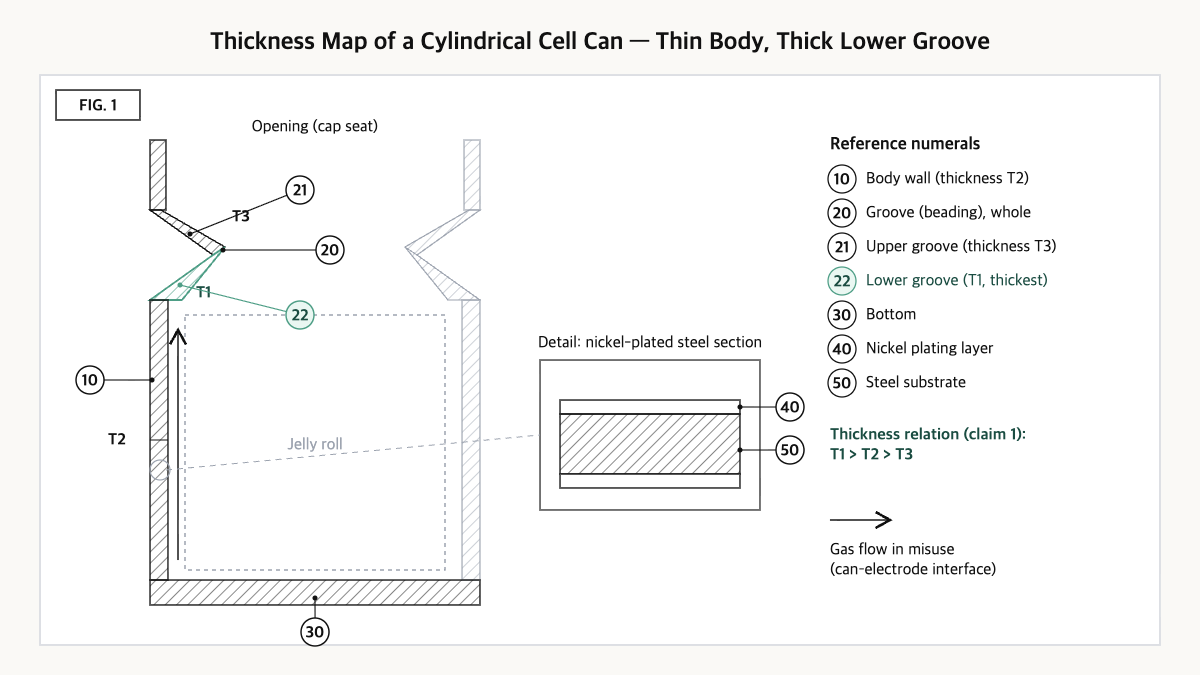
Source: reconstructed by the editorial team from the claims and specification of US11621450B2 and the nickel-plated steel configuration described in US8734961B2.
A cylindrical can is formed into a cup with a closed bottom, and then its upper part is constricted inward to create a ring-shaped recess, the groove (also called beading). This groove serves as the ledge that holds and fixes the cap assembly. The problem is that this constricted region is where the shape changes abruptly. Panasonic’s patent specification raised the issue that, in misuse, gas generated inside the cell can travel along the interface between the can and the power-generating element (electrodes) and damage the groove region[4].
Nickel plating is a thin film that protects the steel surface from corrosion. The plating is thin enough to be described at around 0.3–2 μm[5], yet the fact that post-plating heat treatment and surface roughness conditions govern scratching and mold contamination during can forming has also been addressed in patents[5]. In other words, can performance is determined at two levels: ‘substrate thickness’ and ‘surface treatment.’
③ Comparison — Nickel-Plated Steel vs. Aluminum vs. Stainless Steel
| Item | Nickel-plated steel | Aluminum | Stainless steel |
|---|---|---|---|
| Typical use | Standard can for 18650/21700[1] | Subject of large-format cylindrical and light-weighting research[1][2] | Mentioned as a hard-case material[3] |
| Can mass | More than 1/4 of cell mass[1] | 63% lighter than a steel can (test casing)[1] | Not quantified in this article |
| Gravimetric energy density (Wh/kg) | Baseline | +9–11%[2] / more than 25% boost (LTO/LFP 18650 test)[1] | Not quantified in this article |
| Volumetric energy density (Wh/L) | Baseline | −3–4%[2] | Not quantified in this article |
| Fast charging (4695, bottom cooling) | 13 min 45 s | 11 min 45 s (about 15% shorter)[2] | Not quantified in this article |
| Example wall thickness in patent specification | Body 0.15–0.4 mm, bottom 0.3–0.5 mm (stated in common for nickel-plated steel or aluminum/aluminum alloy)[4] | Not stated | |
Source: reconstructed by the editorial team from Bree et al. (2023)[1], Pegel et al. (2023)[2], Baazouzi et al. (2023)[3], and the US11621450B2 specification[4].
What this table shows: An aluminum can is a trade that raises gravimetric energy density by 9–11% while giving up 3–4% of volumetric energy density. Given that a steel can accounts for more than a quarter of cell mass, can design is an energy-density lever no less important than electrode material improvements.
④ Patent Perspective — Claiming Can Thickness as an ‘Inequality’
A representative way to improve the can without changing the material is to vary the thickness by region. US11621450B2 (“Battery can and cylindrical battery”) of Panasonic Intellectual Property Management stakes rights on exactly this point. Its priority date is 2017-03-24, US filing date 2019-09-20, and grant 2023-04-04; per Google Patents its legal status is Active (anticipated expiration 2038-03-04), with 8 claims. Listed family members include JP6994650B2, CN110226243B, and WO2018173453A1[4]. Restating claim 1 element by element gives the following.
| Elements of claim 1 (restated) | Meaning for the scope of rights |
|---|---|
| (a) A battery can having a cylindrical body section, an opening section at one end, and a bottom section closing the other end | Subject limitation — cylindrical cans in general |
| (b) An annular groove formed by constriction near the open end, divided into an upper-groove section, a narrowest section (innermost), and a lower-groove section | Defines the three groove sections — the reference points for the thickness comparisons that follow |
| (c) The wall thickness T1 of the lower-groove section is larger than the wall thickness T2 of the body section | Lower groove thicker than the body — the key limitation reinforcing the region damaged by gas flow |
| (d) T1 is also larger than the wall thickness T3 of the upper-groove section | Within the groove too, the lower part must be the thickest |
| (e) T3 is smaller than T2 | As a result, the inequality T1 > T2 > T3 must hold |
| (f) T1 and T3 are measured at the thickest portion of each section | Measurement-location limitation — the measurement method may become an issue in infringement analysis |
Source: reconstructed by the editorial team from claim 1 of US11621450B2 on Google Patents (original claim language and drawings are not reproduced verbatim).
The specification describes T1 as 1.01–1.6 times T2 and presents 1.15 times or more, more preferably 1.3 times or more, as preferred ranges[4]. However, since these ratios are not in the language of claim 1, it is natural to read the scope of rights of claim 1 as being defined, regardless of ratio, by the order relation T1 > T2 > T3 itself.
Design-around scenarios (with counterarguments): Because this claim requires all three inequalities to be met, (i) a design in which the lower groove is equal to or thinner than the body (T1 ≤ T2) and (ii) a design in which the upper groove is not made thinner than the body (T3 ≥ T2) may avoid literal infringement. There are two counterarguments. First, the thickness of each region can vary with groove constriction conditions, so the measured values of mass-produced parts may satisfy the inequality even if unintended. Second, measured values can differ depending on where the ‘thickest portion’ in (f) is taken to be, so the risk of infringement is likely to be argued on cross-section measurement data rather than drawings. Freedom to operate (FTO) judgments therefore require cross-section measurements of mass-produced cans along with design drawings.
Cross-check of similar patents: On the can material side there is Toyo Kohan’s US8734961B2 (priority 2009-06-09, filed 2010-05-31, granted 2014-05-27, Active, anticipated expiration 2031-07-08). Its claim 1 limits a nickel-plated steel sheet having an Fe-Ni diffusion layer at the outermost surface to a surface roughness Ra of 0.9–2.0 μm, Ry of 4.0–15 μm, and an Fe ratio of 20–50% by Auger analysis[5]. That thickness (shape) and surface (material treatment) are split into rights held by different applicants shows that a can FTO cannot be finished in one pass.
⑤ Limits and Outlook
On the optimistic side, aluminum cans in large-format cylindrical cells are reported to reduce not only weight but also axial thermal resistance, shortening fast-charging time[2], so discussion of a material switch may accelerate.
There is also a counter-scenario. The more-than-25% energy density gain of aluminum cans was obtained in 18650 cells combining a lithium titanate (LTO) anode and a lithium iron phosphate (LFP) cathode[1], and volumetric energy density actually falls by 3–4%[2]. If a vehicle pack is constrained by space before weight, the benefit of switching to aluminum may appear smaller than the numbers in the table.
The strategic alternative is to optimize the ‘thickness map’ before switching materials. Keeping the body thin and thickening only the lower groove, where gas flow and mechanical loads concentrate, could be a way to reduce mass while keeping existing steel can equipment. However, this is an area where US11621450B2 has already secured rights in the form of an inequality, so when using thickness distribution as a design variable, the direction of the inequality should be checked first.
Action to check (planning/IP teams): Obtain cross-section measurements of the upper-groove, lower-groove, and body wall thickness of your own or procured cylindrical cans, and compare whether the relation T1 > T2 > T3 holds against elements (c)–(f) of claim 1 of US11621450B2.
Items Requiring Verification
- A quantitative comparison of mass and energy density for stainless steel cans could not be confirmed from sources in this article.
- The specific cause of the lower volumetric energy density of aluminum cans (such as increased wall thickness) is not stated in the abstract of the referenced paper, so it is not asserted in the text.
- Whether the configuration of US11621450B2 has been applied to mass-produced cans, and whether the claim scope of the Japanese and Chinese counterparts matches the US patent, were not verified.
- Whether the figures in Pegel et al. (2023) were obtained by measurement or modeling could not be confirmed from the abstract alone, and differences in actual mass-produced cells require separate verification.
Sources
- G. Bree, D. Horstman, C. T. J. Low, “Light-weighting of battery casing for lithium-ion device energy density improvement,” Journal of Energy Storage, vol. 68, 107852, 2023, DOI 10.1016/j.est.2023.107852. Link
- H. Pegel, D. Wycisk, D. U. Sauer, “Influence of cell dimensions and housing material on the energy density and fast-charging performance of tabless cylindrical lithium-ion cells,” Energy Storage Materials, vol. 60, 102796, 2023, DOI 10.1016/j.ensm.2023.102796. Link
- S. Baazouzi et al., “Design, Properties, and Manufacturing of Cylindrical Li-Ion Battery Cells—A Generic Overview,” Batteries, vol. 9, 309, 2023. Link
- Google Patents, US11621450B2 “Battery can and cylindrical battery,” bibliographic data, claim 1, and specification (original checked 2026-09-23). Link
- Google Patents, US8734961B2 “Nickel-plated steel sheet and process for producing battery can using the nickel-plated steel sheet,” bibliographic data and claim 1 (original checked 2026-09-23). Link
This article is a technology and patent trend commentary, not legal advice. Specific FTO judgments require professional review.
Related Reading