The lifespan of a lithium-ion cell depends heavily on the thin protective film that forms on the anode surface during its first charge before shipment. This article looks at why electrolyte additives such as vinylene carbonate (VC) and fluoroethylene carbonate (FEC) became the ‘design tools’ for that film, and traces the structure of rights through the foundational VC patent with a 1994 priority.
① What’s the Topic
SEI-forming additives work less by ‘how much is added’ than by ‘who decomposes first.’ An additive in the electrolyte is reduced at the anode before the main solvent, laying down the first layer of the protective film, and the quality of that first layer carries the cell’s life through the following hundreds to thousands of cycles.
Start with the industry situation. As anodes blend in silicon oxide (SiOx) and cathodes move to new compositions such as lithium manganese iron phosphate (LMFP), additive combinations are becoming increasingly complex. Researchers at Argonne National Laboratory (ANL) compared VC and lithium difluoro(oxalato)borate (LiDFOB) in SiOx/graphite full cells containing FEC, and reported that VC delivered higher capacity and Coulombic efficiency up to 400 cycles[3]. In LMFP/graphite pouch cells, a combination of 2 wt% VC plus 1 wt% of a sulfur-based additive (DTD) raised first-cycle Coulombic efficiency to 89.3% and retained over 85% capacity after 600 cycles at C/3 and 40°C[4].
The tension is clear. Lithium consumed to build the film during the first charge never comes back. If the film is too thin, the electrolyte keeps decomposing; if it is too thick, resistance rises. Additives are practically the only ‘chemical knob’ for striking this balance. So the question this article answers is: what exactly is decided during the first charge, and how far did the patent that first claimed this design draw its fence?
② Basic Principle — The ‘Base Coat of Asphalt’ Laid on a New Road
A graphite anode operates, during charge, at potentials lower than the electrolyte can withstand. So during the first charge, part of the electrolyte is reduced and decomposed at the anode surface, and the decomposition products accumulate into a film called the solid electrolyte interphase (SEI). The SEI is a ‘selective gate’ that blocks electrons while letting only lithium ions pass. When the film forms properly, further electrolyte decomposition stops; when it is poor, decomposition continues and lithium and electrolyte are gradually consumed.
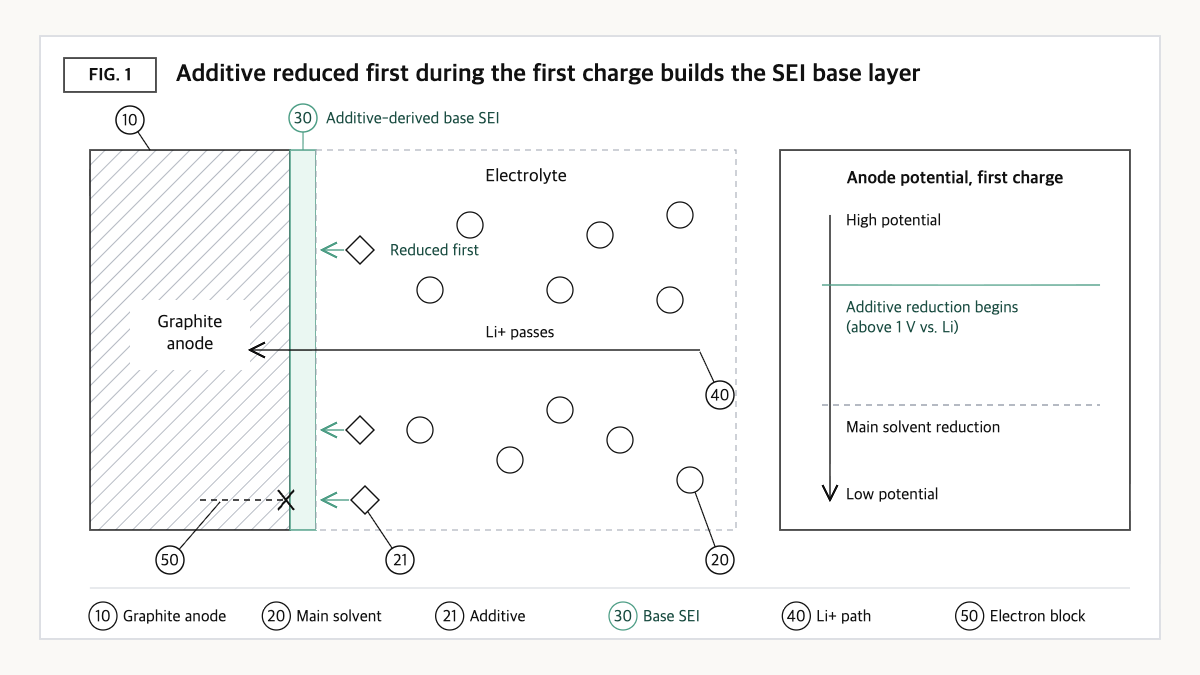
Source: reconstructed by the editorial team from the claims and specification of US5626981A and published research abstracts.
By analogy, the additive is the base coat of asphalt laid on a new road. If the main solvent becomes the road surface directly, the road turns bumpy (a non-uniform SEI), but if a base coat is laid first, the layers stacked on top are also even. The key word is ‘first.’ The additive must be reduced before the main solvent, at a higher potential, to serve as the base coat. Indeed, the foundational VC patent wrote this condition in functional language: “reduced at the anode at a potential of more than 1 V versus lithium to form a passivation layer”[1].
VC is a cyclic carbonate with a carbon-carbon double bond. In lithium-metal battery research, adding VC has been reported to form a polycarbonate-based SEI that reduced lithium corrosion[5]. FEC, by contrast, is a saturated cyclic carbonate with fluorine attached to the ring, and there are silicon-anode studies that keep FEC as a base component while comparing other additives[3]. It is also worth remembering that the two additives are often used together, dividing roles, rather than competing.
Another classic problem is graphite exfoliation. When a solvent such as propylene carbonate (PC) co-intercalates between graphite layers, the layers are pried apart and break down; a base layer formed first can block this co-intercalation. The examples in the foundational VC patent show exactly this exfoliation-suppressing effect with first-cycle data.
③ Comparison — The Difference 5% of Additive Made in the First Cycle
| Example (US5626981A) | Solvent composition (by weight) | VC added | First charge (mAh/g) | First discharge (mAh/g) | Discharge/charge ratio |
|---|---|---|---|---|---|
| Example 1 (prior art) | PC:EC:DMC = 1:1:2, LiTFSI 1M | None | 1,050 | 300 | About 29% (loss over 70%) |
| Example 2 (invention) | Same as Example 1 | 5 wt% of solvent | 350 | 275 | About 79% |
| Example 3 (prior art) | EC:DMC = 1:1 | None | 610 | 300 | About 49% (loss over 50%) |
| Example 4 (invention) | Same as Example 3 | 5 wt% of solvent | 420 | 330 | About 79% |
Source: reconstructed by the editorial team from Examples 1–4 of the US5626981A specification[1]. Discharge/charge ratios calculated by the editorial team from the specification figures.
What this table shows: Without VC, the first-cycle discharge/charge ratio swung widely from about 29% to 49% depending on the solvent composition, whereas both cells with 5 wt% VC converged at about 79%. The additive even ‘flattened’ the differences between solvent compositions.
④ Patent Perspective — A Fence Drawn by ‘Reduction Potential,’ Not by a Substance Name
The document most often cited as the foundational patent for the VC additive is US5626981A (title: Rechargeable lithium electrochemical cell). The original applicant is France’s SAFT, and Google Patents lists Mitsubishi Chemical Corp as the current assignee (assignment recorded in 2004). Priority date 1994-04-22, filing date 1995-04-21, grant date 1997-05-06, 14 granted claims, and legal status Expired – Lifetime (anticipated expiration 2015-04-21)[1]. Restating claim 1 element by element, without copying the original wording, gives the following.
| Claim 1 elements (restated) | Meaning for the scope of rights |
|---|---|
| (a) A rechargeable lithium electrochemical cell including a cathode | Product claim directed to the whole cell |
| (b) An anode with a carbon-containing material whose degree of crystallinity exceeds 0.8 | Limited to highly crystalline graphite-type anodes — low-crystallinity carbon may fall outside the literal scope |
| (c) An electrolyte of a lithium salt and a mixture of two or more aprotic saturated organic solvents (at least one containing a carbonate; the first with a high dielectric constant, the second a low-viscosity solvent chosen from ethers, DEC, DMC, dioxolane (derivatives), THF (derivatives), and propylene oxide) | Broadly covers the standard mixed-solvent systems of the time |
| (d) Further containing a soluble carbonate compound with at least one carbon-carbon unsaturated bond | Structural limitation on the additive — ‘unsaturated’ is required |
| (e) That compound can be reduced at the anode at a potential of more than 1 V versus lithium to form a passivation layer | Functional limitation — scope defined by the action of ‘being reduced first to build a film’ rather than by a substance name |
Source: reconstructed by the editorial team from the Google Patents bibliographic data and claims of US5626981A (checked 2026-09-23); original claim wording and drawings are not reproduced.
The insight to take from this patent is that rights to SEI additives were drawn from the outset by ‘the function of reduction potential,’ not by ‘a substance name.’ The name VC appears only in dependent claim 2. The independent claim reads as a structure aimed at bringing other unsaturated carbonates with the same action into the scope of rights through the combination “unsaturated carbonate + reduction above 1 V + passivation layer.”
Had the patent still been in force, how would a design-around scenario have looked? The first candidates would be ⓐ using a carbon anode with crystallinity of 0.8 or less, and ⓑ using an additive without an unsaturated bond. In particular, FEC is a saturated cyclic carbonate with no carbon-carbon double bond, so it may not literally satisfy element (d). There is a counterargument, however. The patentee could argue for equivalence on the grounds that FEC performs the same passivation function in the same potential window; conversely, the explicit ‘unsaturated’ limitation could restrict such an equivalence argument. Which side prevails is likely to depend on case-specific judgment.
Because this US patent has now expired, the risk of infringement arising from the patent itself is likely to be low. The focus of a freedom to operate (FTO) review, however, shifts from the foundational patent to the combination and use patents built on top of it. As a cross-check of similar patents, Mitsui Chemicals’ US6180800B1 (priority date 1995-06-09, grant date 2001-01-30, Expired – Lifetime) claims in claim 1 the compound itself: a cyclic carbonate bearing a fluorine-substituted methyl group (-CFH2, -CF2H, -CF3)[2]. Its structure differs from FEC, in which fluorine is attached directly to the ring, so the rights landscape for FEC-type compounds needs to be checked separately.
⑤ Limits and Outlook
On the optimistic side, additive-combination design is likely to remain the fastest means of lowering the cost of introducing new materials. The result in LMFP pouch cells, where combining VC with a sulfur-based additive raised both first-cycle efficiency and 600-cycle life, is an example[4].
There is also a contrary scenario. As the silicon share grows, the anode swells and shrinks with every cycle, breaking and re-forming the SEI. In that case the additive becomes a ‘consumable’ used up gradually over the whole cycle life rather than once at the first charge, and the very premise that life is decided at the first charge weakens. In the ANL study, too, VC led in capacity up to 400 cycles, but greater microstrain and surface cracking were observed in the cathode (NCMA) particles in the VC electrolyte[3]. The researchers also noted that the cathode was cycled more deeply with VC, which can be read as a sign that when anode protection lets more capacity be used, the burden may shift to the cathode.
As a strategic alternative, one approach is to manage additive IP not by ‘substance’ but by ‘combination + cell conditions + formation protocol.’ Foundational substance patents have often expired, but combination patents tying specific anodes and cathodes to additive ratios may still be in force. First-charge conditions (current, temperature, rest time) may be better protected as trade secrets than as patents.
Action to check (planning/IP teams): Split the additive list in your electrolyte specification into two columns, ‘expired foundational substance patents’ and ‘in-force combination and use patents,’ and designate only the items in the second column as priority targets for FTO review.
Items Requiring Verification
- The bibliographic data (number, applicant, expiration date) of the foundational patent that first claimed FEC as an SEI additive could not be verified against the original document in this work.
- The composition of the US5626981A family in Europe, Japan, and other countries and their individual expiration dates were not separately checked.
- The VC and FEC contents actually used in mass-production cells are not disclosed by manufacturers and are not covered in this article.
Sources
- Google Patents, US5626981A “Rechargeable lithium electrochemical cell,” bibliographic data, claims, and examples (original checked 2026-09-23). Link
- Google Patents, US6180800B1 “Fluorine-substituted cyclic carbonate and electrolytic solution and battery containing the same,” bibliographic data and claim 1 (original checked 2026-09-23). Link
- X. Huang et al., “Comparative Study of Vinylene Carbonate and Lithium Difluoro(oxalate)borate Additives in a SiOx/Graphite Anode Lithium-Ion Battery in the Presence of Fluoroethylene Carbonate,” ACS Applied Materials & Interfaces 17 (2025), DOI 10.1021/acsami.4c16779 (OSTI abstract). Link
- C. M. Chak et al., “Unraveling interphase-driven failure pathways in LiMn0.6Fe0.4PO4/graphite pouch cells,” EES Batteries 2 (2026), DOI 10.1039/d5eb00228a (OSTI abstract). Link
- Z. Peng et al., “High-Power Lithium Metal Batteries Enabled by High-Concentration Acetonitrile-Based Electrolytes with Vinylene Carbonate Additive,” Advanced Functional Materials 30 (2020), DOI 10.1002/adfm.202001285 (OSTI abstract). Link
This article is a technology and patent trend commentary, not legal advice. Specific FTO judgments require professional review.
Related Reading