Lithium nickel manganese oxide (LNMO) spinel cathode material has long drawn attention for its high operating voltage of about 4.7 V and its cobalt-free composition. Yet what has held back commercialization is not so much the cathode material itself as the electrolyte that cannot withstand that voltage. This article reads the structure of that bottleneck together with one patent that tries to address it from the cathode-material side.
① What’s the Topic
The competition in 5 V-class cathodes is not a race for “a material that delivers higher voltage” but a race for “ways to make the electrolyte burn less at that voltage.” That is why some LNMO patents are claimed in a form that embeds an electrolyte-protection function into the cathode composition.
Start with the industry context. LNMO (LiNi0.5Mn1.5O4, high-voltage spinel) is a cathode material in which part of the manganese in lithium manganese oxide (LiMn2O4) spinel is replaced with nickel, and its strengths are cited as a high operating voltage of about 4.7 V and an energy density of about 610 Wh/kg[1]. Not using cobalt is also attractive from a supply-chain perspective.
The tension is the voltage itself. In LNMO, the redox potential of nickel exceeds the level at which industrial electrolyte systems remain stable (about 4.3 V)[1]. When the electrolyte oxidizes and decomposes at high voltage, highly corrosive hydrofluoric acid (HF) forms, which attacks the cathode and leaches transition metal ions such as nickel and manganese[1]. The cathode holds up, but the liquid surrounding it collapses first.
So the question this article answers is this: how does LNMO’s electrolyte oxidation limit work, and how did a patent pull this limit into rights on the cathode-material side?
② Basic Principle — A Pot on a Stove Hotter Than the Boiling Point
An electrolyte has an upper voltage limit up to which it can hold out without oxidizing itself. Likening this to the boiling point of water makes it easy to understand. If the “boiling point” of an industrial electrolyte system is about 4.3 V[1], then LNMO operating at about 4.7 V is like a stove hotter than the boiling point. The stove (cathode) is fine, but the pot on it (electrolyte) keeps boiling down.
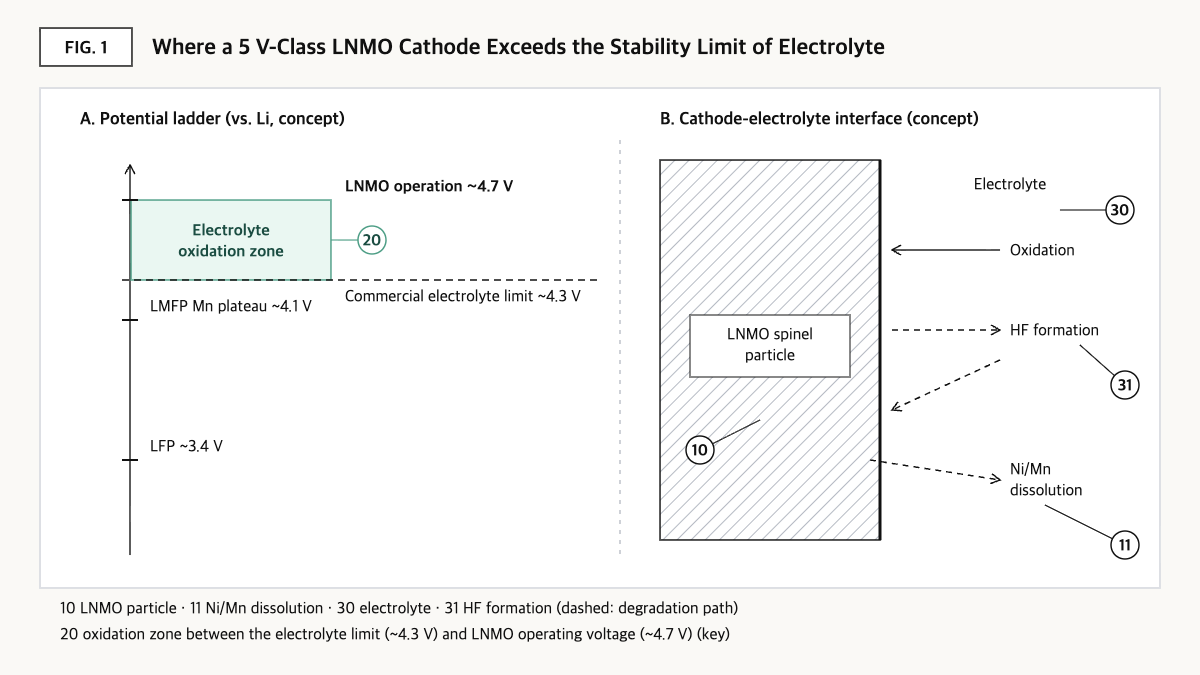
Source: reconstructed by the editorial team from Wei et al. (2025) Scientific Reports, Jung, Oh, and Han (2025) Energy Materials, and the EP3504160B1 specification.
By-products form as it boils down. When the electrolyte oxidizes and decomposes at the cathode surface, hydrofluoric acid is produced, and the acid corrodes the cathode surface and leaches nickel and manganese ions[1]. The cathode that has lost metal ions is left with capacity loss. As this process repeats, capacity drains with each successive cycle.
The key point is that all of these reactions occur at the surface where the cathode meets the electrolyte. Topsoe’s patent specification also explains that oxidative decomposition of the electrolyte and metal dissolution from the cathode material take place at the surface of the cathode material[3]. Responses therefore split broadly into two directions: raising the pot’s boiling point (electrolyte additives and solvent improvements), and changing the stove surface so it reacts less with the pot (cathode surface and composition modification). The patent covered in this article belongs to the latter.
③ Comparison — Where LNMO Stands on the Potential Ladder
| Reference point | Potential (vs. Li) | Relative to commercial electrolyte stability limit (~4.3 V) |
|---|---|---|
| LFP average electrode potential | About 3.4 V [2] | Below the limit |
| LMFP Mn2+/Mn3+ plateau | About 4.1 V [2] | Below the limit (close) |
| Stability level of industrial electrolyte systems | About 4.3 V [1] | Baseline |
| Operating condition premised by the EP3504160B1 claim | Fully or mainly operated above 4.4 V [3] | Above the limit |
| LNMO operating voltage (energy density ~610 Wh/kg) | About 4.7 V [1] | Above the limit (by about 0.4 V) |
Source: reconstructed by the editorial team from Wei et al. (2025) Scientific Reports[1], Jung, Oh, and Han (2025) Energy Materials[2], and EP3504160B1 on Google Patents[3].
What this table shows: LFP and LMFP operate below the commercial electrolyte stability limit (about 4.3 V), but LNMO operates at about 4.7 V, roughly 0.4 V above it[1][2]. LNMO’s challenge lies not inside the material but in this 0.4 V gap.
④ Patent Perspective — Tying the “Operation Above 4.4 V” Use Condition to a Composition Claim
As an example of addressing electrolyte-side degradation through cathode composition, consider EP3504160B1 (title: Cathode active material for high voltage secondary battery). The original applicant is Haldor Topsoe A/S, and Google Patents lists the current assignee as Topsoe Battery Materials AS. Priority date 2016-08-25, filing date 2017-08-21, grant date 2023-06-07, legal status Active, anticipated expiration 2037-08-21, with 12 granted claims[3].
What is interesting is the difference in claim breadth between the application stage and the grant stage. Claim 1 of the international application publication (WO2018036954A1) was a broad form without a composition formula, requiring only that a cathode active material for a high-voltage battery operated above 4.4 V be an oxide containing sulfate as a capacity-fade-reducing compound[4]. By contrast, the European granted claim 1 added a specific spinel composition formula, narrowing the scope[3]. Restating the granted claim 1 element by element gives the following.
| Element of claim 1 (restated) | Meaning for the scope of rights |
|---|---|
| (a) A cathode active material for a high-voltage secondary battery whose cathode is arranged to be fully or mainly operated above 4.4 V vs. Li/Li+ | Use/operating-condition limitation — how much limiting force the “for” wording carries in a product claim is an interpretive issue |
| (b) The cathode active material is an oxide containing sulfate as a capacity-fade-reducing compound | Sulfate-content limitation — the technical core of the invention and the baseline for judging infringement |
| (c) Composition formula LixMyMn2-yO4-v(SO4)z, where M is Ni | Scope specified as nickel-substituted manganese spinel (LNMO family) |
| (d) 0.9≤x≤1.1, 0.4≤y≤0.5 | Nickel content 0.4–0.5 — covers the vicinity of conventional LiNi0.5Mn1.5O4 |
| (e) 0<z≤0.1, 0≤v≤z | The sulfate lower bound is “greater than 0” — even small contents may be literally included |
Source: reconstructed by the editorial team from the claim structure of EP3504160B1 on Google Patents[3] (original claim language and drawings not reproduced verbatim).
The point to watch when reading the scope of rights is (e). Because the lower bound of sulfate content is open at “greater than 0,” it is hard to rule out that an LNMO in which sulfate is analytically detected could fall within the literal scope even if sulfate was not intentionally added. This also means that the manufacturing route and impurity control of the precursor used as raw material could connect directly to the freedom-to-operate (FTO) assessment.
Design-around scenarios (including counterarguments). (a) A composition with nickel content y below 0.4 may fall outside element (d). However, since nickel redox is responsible for LNMO’s high-voltage reaction[1], reducing nickel could mean giving up part of the voltage and capacity gain. (b) Another direction is to control raw materials and washing processes so that no sulfate is detected, demonstrating the z=0 state of element (e). As a counterargument, if the dispute turns on whether trace amounts near the detection limit are “greater than 0,” the choice of analytical method could decide the outcome. (c) Implementing surface protection with an anion compound or coating layer other than sulfate, or solving the problem with electrolyte additives, may not overlap directly with the claim elements, but even then other rights in the field must be checked separately.
Cross-check of similar patents. Within the same family, Japan’s JP7102394B2 is granted (Active), while US20190173084A1 in the US, KR20190042572A and KR20230122178A in Korea, and CN109476504A in China are shown on Google Patents as under examination (Pending)[4]. This means the final breadth of the scope of rights may differ by jurisdiction.
⑤ Limits and Outlook
On the optimistic side, LNMO is a material that can deliver about 4.7 V and about 610 Wh/kg without cobalt[1], and if research on cathode surface modification and electrolyte additives matures together, it may establish itself as an option for reducing cobalt dependence.
There is also a contrary scenario. The gap between the electrolyte limit and the operating voltage cannot be closed by cathode-material improvements alone. Even if side reactions at the cathode surface are reduced, unless the oxidative stability of the electrolyte itself improves, HF formation and metal dissolution may accumulate at high temperature and over long cycling. In that case, LNMO could remain confined to specific niche applications.
The strategic alternative is to design and review the cathode material and electrolyte as a single IP package. If only cathode-composition patents are secured and the electrolyte side is left to suppliers, performance issues and rights issues end up scattered across different contracts. The perspective this article wants to offer is this: rights competition in 5 V-class cathodes is likely moving in a direction where “material claims” and “use conditions (operating voltage)” are combined, which means the risk of infringement could differ for the same material depending on the voltage window in which it is used.
Action to check (planning/IP teams): Request from suppliers the sulfate (SO4) content analysis values and precursor manufacturing route for the LNMO cathode material under review, and document, together with the operating profile, whether the cell design operates the cathode “fully or mainly” above 4.4 V.
Items Requiring Verification
- The optimal sulfate content range and mechanism of action (e.g., whether surface enrichment occurs) in the EP3504160B1 specification were not re-verified at the level of the original text in this article and were therefore not included.
- For the final claim breadth and grant status of the US, Korean, and Chinese counterparts, only the Google Patents status (Pending) was checked; verification against each patent office’s register was not performed.
- Residual sulfate levels in commercial LNMO precursors could not be confirmed from public sources.
Sources
- Aijia Wei et al., “Enhancing the electrochemical performance of high-voltage LiNi0.5Mn1.5O4 batteries with a multifunctional inorganic MgHPO4 electrolyte additive,” Scientific Reports, 2025, DOI 10.1038/s41598-025-90702-z. Link
- Heechul Jung, Chungsun Oh, Dongwook Han, “Lithium manganese iron phosphate (LiMn1-yFeyPO4) rechargeable batteries: bridging material innovation with practical cell design,” Energy Materials, 2025, DOI 10.20517/energymater.2025.29. Link
- Google Patents, EP3504160B1 “Cathode active material for high voltage secondary battery,” bibliographic data and claim 1 (original checked 2026-09-23). Link
- Google Patents, WO2018036954A1, claim 1 and family information (checked 2026-09-23). Link
This article is a technology and patent trend commentary, not legal advice. Specific FTO judgments require professional review.
Related Reading